
Welcome back to the “My Vietnam” series on Lightning Bug. If you’re just joining, this ongoing exploration treats the Vietnam War as more than distant history—it’s a living thread in personal lives, family stories, refugee journeys, and the quiet ways trauma and resilience echo across generations and oceans. Part 1 (”Having a Dad”) reflected on my father’s fortunate avoidance of the draft and the war’s indirect shadow on our family. Part 2 (”Hung Lam”) shifted to a tender, awkward first love in 1988 Philadelphia with a shy Vietnamese refugee classmate—Hung Lam—whose family’s escape from the war’s aftermath brought Vietnam’s human cost directly into my young life. Now in Part 3, I turn to a lifelong friend’s lens: Christopher C, whose early photographic portraits of Vietnam veterans added another intimate layer to the war’s legacy. Your comments, shares on X (@RhusToxidendron), and subscriptions keep this series alive—thank you for engaging deeply.
How Chris Entered My Life
I first met Chris after I moved to the village of Parkerford, Pennsylvania, in 1984 to live with my paternal grandparents. He was a boyhood friend and neighbor of my close friend Larami, and I came to know Chris, his younger brother, and his parents through countless after-school visits, parties at his house, and just hanging out with the same crowd. Chris didn’t attend the public school the rest of us went to—he went to a much smaller, alternative private school instead. We knew a lot of the same people, shared a deep love for what remains of the countryside in southeastern Pennsylvania, and he has strong Ithaca roots from his college days. Over the years, Chris has consistently made a point to leave me a message whenever he’s heading up to our neck of the woods for the Grassroots Music Festival in the summertime, and we’ve managed to reconnect a few times.
After college, Chris invited me to an exhibit of his photography at a hip restaurant in Pine Forge, Pennsylvania. The owner was the mother of one of my high school classmates, Tara, on whom I secretly had a crush. (Tara’s mother, Gracie, that is.) I was living in Center City Philadelphia at the time, and the chance to get back to the country of rural Chester County—maybe even see Gracie—plus check out what Chris was up to, motivated me to catch the R5 train out of 30th Street Station. I wasn’t expecting to be so moved by Chris’s photos, but I was. After all these years, I still have a postcard of one of them.
That’s why I reached out to speak with Chris when I started writing this series. I thought that he, too, might have his own Vietnam. I’ve been processing our conversation ever since. There were some really weighty facts I didn’t know, and looking back in time, they help things make more sense and help me understand the people I grew up around a little more.
The Photographic Project That Bridged Generations
As a senior at Ithaca College’s Park School of Communications (cinema/photo major, still photography focus), Chris was stumped on his capstone. His professor, Janice Levy—a documentary photographer who still teaches there—suggested portraits of Vietnam veterans, fitting his political activism and journalism leanings. “It wasn’t really my idea,” he laughs. “I was mostly trying to get a good grade.” Yet it became something more.
He contacted local veterans’ groups, photographed the men in their environments, and asked them to write personal statements about the war’s lasting effects. These handwritten reflections appeared beneath the portraits, creating a dialogue between image and voice. The exhibit opened around 1993 at Gracie’s 21st Century Cafe and Catering in Pine Forge, PA—about a year after graduation, right before he met his wife. It included the veteran series alongside his work from Grenada (Rastafarian communities in deep poverty) and San Francisco homelessness. (You can still visit Gracie’s today at gracies21stcentury.com—a vegetarian-friendly spot that’s been serving the area since 1988.)
As children of the 70s, we were too young for direct impact, but the war’s tail end lingered. Chris recalls nightly TV death counts and the 1975 fall of Saigon helicopters—images so ingrained they feel like personal memories. “Vietnam was a disaster,” he states firmly, critiquing the domino theory as fearmongering and U.S. intervention as unwarranted meddling. He speculates on JFK’s assassination ties to military-industrial complex opposition to peace talks.
Family Service, Quaker Roots, and Views on “Just” Wars
Chris’s perspective is layered by family military history and Quaker pacifism—respect for service alongside deep skepticism of intervention. His father enlisted in the Army National Guard in 1962 at 22, foreseeing Vietnam’s quagmire, earned a rifle medal for sharpshooting, and discharged just before Bay of Pigs escalation. His mother was on a high school rifle team—perhaps contributing to Chris’s own “natural eye” in occasional target practice.
Neither of us grew up Quaker, but we were both clearly influenced by the little Quaker meeting we attended as teenagers—Schuylkill Friends in Phoenixville, PA. There is something about that which makes me quite hopeful, realizing that the lived actions and role modeling of these mostly quiet and dignified people influenced our young minds and hearts in ways which blossomed and still shape our decisions so many decades later. Children and teenagers watch how we carry ourselves as adults, and our actions really do matter.
True Heroes: Larry Liss, Bob Henry, and the Cost of Valor
The conversation’s emotional core came from veterans Chris knew personally.
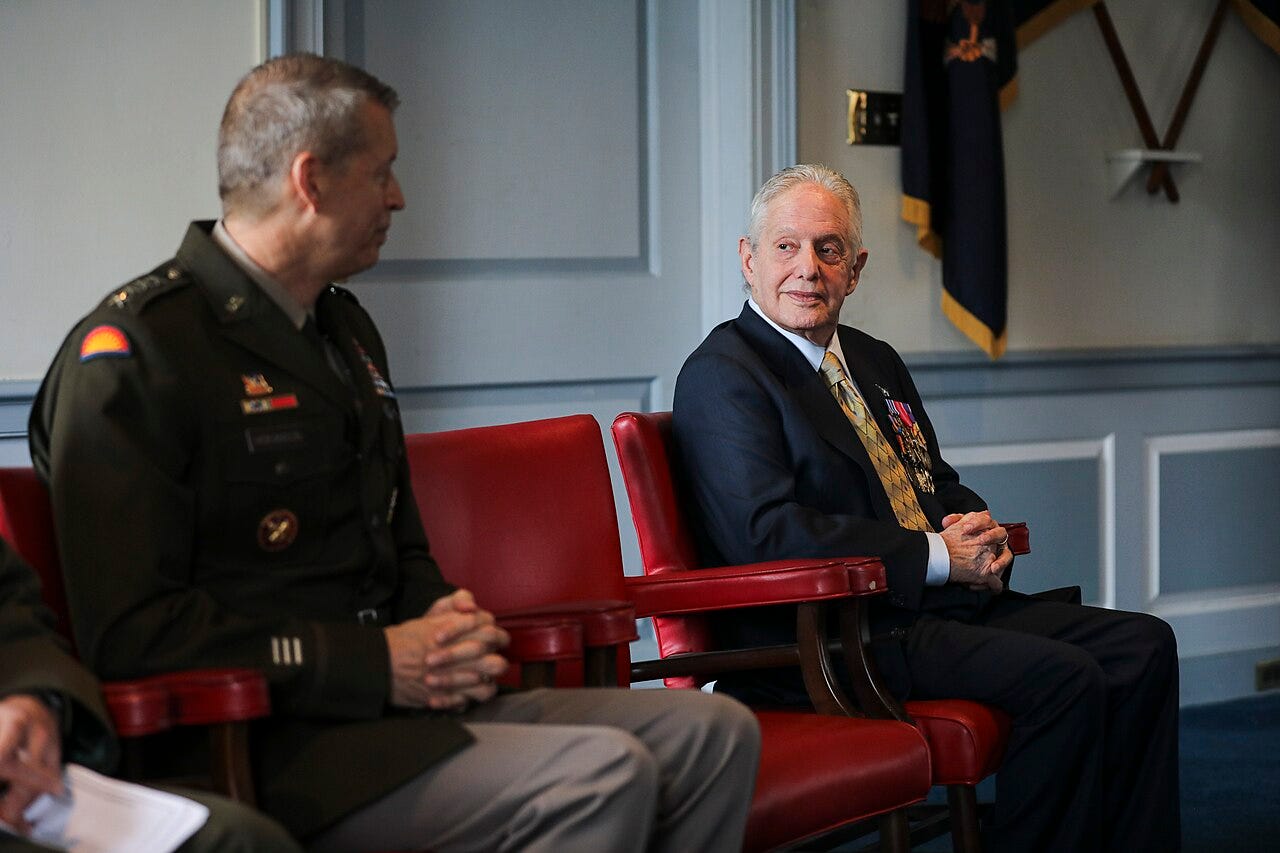
Larry Liss, a Berwyn family friend (early 80s now, still vibrant), enlisted ~1965 as a Huey pilot. His 1967 Cau Song Be rescue—disobeying orders to save ambushed troops by carving a jungle LZ with rotor blades under fire, making multiple runs for 80+ evacuations—nearly led to court-martial. Instead, he earned the Distinguished Flying Cross (upgraded to Silver Star in 2024), with PBS coverage. Chris knew him since infancy, learning details as a boy (ages 6-10), shaping his view of war’s trauma. (You can read more about Larry here, here, here and watch a riveting documentary about him and his fellow soldiers here.)
Bob Henry, a Marine “gentle giant” who moved nearby ~1976, rarely spoke of service but died of leukemia ~15 years ago—possibly Agent Orange-linked. Neighbor Hy Mayerson’s Dow Chemical lawsuits against Agent Orange added activism fuel.
What probably moved me most about my conversation with Chris—which actually moves me to tears—were his references to the men who were possessed of independent thought and brave hearts, who made decisions in the moment that saved lives, both American and Vietnamese, sometimes in direct contradiction to the orders of their commanding officers. While I write about My Vietnam, I mentally toggle back and forth with the crucible of the pandemic, the difficult decisions we have had to make, giving up friends, family, work, to try and forge a new path based upon honesty, integrity, and courage.
Chris spoke at length about the My Lai massacre, one of the darkest stains on the American effort in Vietnam. While Lieutenant Calley was later convicted for ordering the slaughter of civilians, Chris pointed to the true heroes of that day: the soldiers and at least one officer who refused to participate and actively intervened. They turned their machine guns around, positioning themselves between their fellow American troops and the Vietnamese villagers. One officer reportedly warned that if the killing continued, they would fire on the Americans themselves. “Those are the real heroes of Vietnam,” Chris told me, “the guys that stepped in and stopped that from continuing. They would have killed everybody in that entire village and burned it to the ground.” In the moral morass of that conflict, these independent thinkers and men of conscience rescued something essential — a shred of our national morality — through raw courage and clarity in the moment.
God bless him, Chris made one of the most sincere and touching comments I have ever heard from another human, especially one who himself has chosen to get Covid boosters: “I’m not a vaccine injury denier. I understand that you and Kerrie were both injured by the Covid shots. It happened to some, including both of you, and I’m sorry for that.”
Activism, Nuance, and Everyday Choices
Chris’s activism began in the 1970s when, at just seven years old, he joined his parents and the community in protesting the construction of the Limerick nuclear power plant, just seven miles from their home in northern Chester County. That early experience, rooted in the Quaker values of peace and stewardship that shaped both of us as teenagers at Schuylkill Friends Meeting, has flowed directly into his choices today. Last year he and his wife installed solar panels on their house because, as he put it, “something told me that energy prices were going to skyrocket.” On bright, sunny days they now generate more electricity than they use, effectively eliminating their carbon footprint while acknowledging there is no true zero-sum game—“everything you do is going to have a cost to it.” He’s equally deliberate in how he spends his money: after Amazon’s Jeff Bezos “bent the knee to Trump” and the Washington Post’s troubles, Chris switched to Walmart on the advice of a friend, noting that Walmart has kept its DEI programs intact and offers the same prices and selection. He’s also become an advocate for next-generation nuclear technology, praising China’s small thorium-salt reactors that can power 20,000 homes without meltdown risk and run unmanned. “Why aren’t we building these here?” he asks, contrasting them with America’s outdated 70- or 80-year-old plants. For Chris, these are all practical expressions of the same principle: do as little harm as possible to the planet while recognizing that every choice carries trade-offs.
Chris stresses that life and politics are rarely black-and-white. “Most people are pretty center of the road,” he told me, “and they don’t see things in black and white. Life is a real gray area situation.” He points to his next-door neighbor of nearly twenty years as living proof. The man comes from a conservative family—his father was a cop—and initially their political differences were stark, especially after Trump’s first election. Yet over time, through long conversations, the neighbor came to agree that the military-industrial complex “does a lot more damage than it does good.” Chris sees this shift as evidence that when people move beyond labels, they often discover far more common ground than division. “If you go far left or far right, you’re going to end up in the same place,” he warns—zealous extremism leads to the same dead end.
Nowhere is Chris’s blend of rural realism and thoughtful regulation more evident than in his views on guns. Growing up in northern Chester County, where gunshots echoed through the woods every deer season, firearms were simply part of the landscape. Influenced by his parents’ shooting backgrounds, he enjoys target practice but draws firm lines. He and his wife own only a shotgun and a couple of rifles, stored in a biometric safe that opens only to their fingerprints. They have never owned handguns—“they’re far too dangerous; it’s a lot easier to hurt or kill yourself with a handgun than with a shotgun.” When their son was young, Chris made a habit of asking every playdate parent whether they had firearms in the house and how they were stored. “If they told me they’re in a safe and only we have access, I’d say, ‘Okay, fine, see you later.’” He has also been a persistent advocate for age-appropriate firearm safety education in the Owen J. Roberts School District, approaching the police chief, principal, and most recently the school board directly. “You want to reduce harm? Bring back this education, K through 12,” he argued. In a district that has become notably progressive, with an all-Democratic board, the idea is finally gaining traction—proof, for Chris, that responsible gun ownership and education can bridge divides rather than widen them.
Tying the Threads Forward
Chris’s portraits, veteran friends, and activist life add another intimate dimension to Vietnam’s legacy—trauma, heroism, protest—persisting in personal choices and societal debates.
To check out Chris’ photographs and travel articles, please visit www.ChristopherCarroll.com .
Stay tuned for Part 4. What Vietnam echoes resonate for you? Comment, share on X, subscribe—your engagement grows Lightning Bug.
Thanks for reading. Paid subscriptions support independent work like this.
Comments
Nothing yet. Say the first thing.
Sign in to join the conversation.