
Because of social isolation, infirmity and dementia, a significant proportion of elderly people are confined mostly indoors. This includes over 2 million Americans who reside in assisted living facilities and nursing homes, largely lit by conventional LED and fluorescent lighting.
Not only do they lose the lifespan- and healthspan-extending benefits of regular morning daylight exposure, but they are exposed to artificial lighting that gets progressively less healthy as we age.
It is not the lights that are changing. Rather it is the progressive yellowing of the lenses in our eyes, and the unfortunate uneducated choice of 450 nm blue pump LED lighting that makes it increasingly unfit for purpose the older you get.
Readers of this Substack newsletter, and my book THE LIGHT DOCTOR, will know that the timing and the amount of 480 nm sky-blue light that enters your eyes each day is critical for your health and well-being. 480 nm is the peak sensitivity of the blue detecting receptors in the eye1 - the intrinsically photosensitive retinal ganglion cells (ipRGCs), and exposure to this wavelength in the morning robustly synchronizes our circadian clocks and boost our health and well-being.
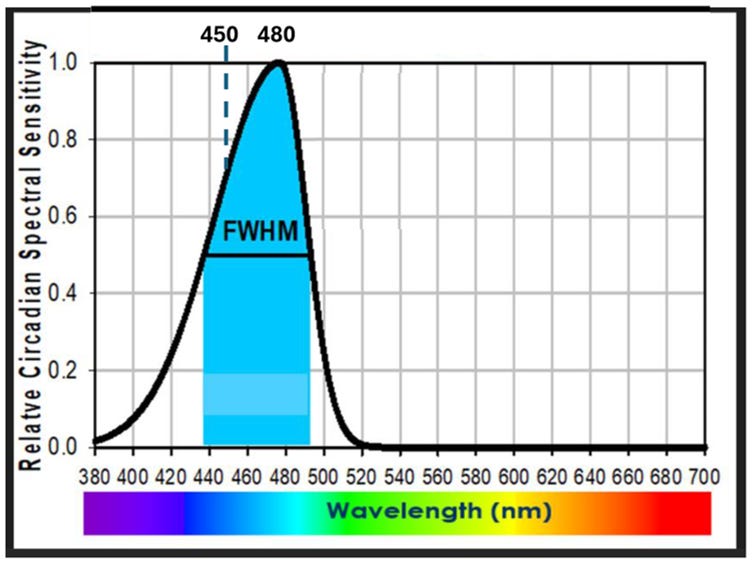
Outdoor daylight provides a rich source of this critical 480 nm blue light. But, as we have discussed, conventional LED lights instead have a royal blue spike at about 450 nm and a big dip in their spectrum at around 480 nm - the so-called cyan gap. The chart above shows that the 450nm blue from conventional LEDs has only 70% of the effectiveness of 480 nm blue tuned to our biological need. The reality is that these LEDs are designed for lumens per watt energy efficiency without any consideration of their negative health impact.
In contrast, healthy circadian lighting uses a 480 nm blue peak during the day that is tuned to the spectral sensitivity of the circadian system.
These failures in the design of conventional LED lights are a problem even when you are young. But as you age this mistuning of blue light gets has even worse effects. As the years pass by the lenses in our eyes progressively grow yellower. As this happens, these lenses within our eyes block more and more of the lower wavelength light in the violet and blue range. This effect is most pronounced the lower the wavelength. Hence the reduction in the transmission of 450 nm wavelengths is much larger than that of 480 nm wavelengths.2
We can read from the chart below that by the age of 70, only 23% of 450 nm blue light reaches the retina of the eye. In contrast, 42% of 480 nm light falls on the retina, because it is less impacted by lens yellowing.
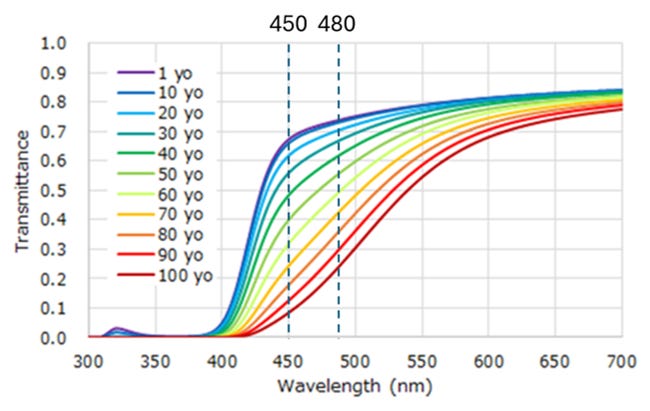
When you multiply the relative circadian clock synchronizing effectiveness of 480 nm versus 450 nm light by the wavelength dependent effect of the ageing lens, you will find that at age 70 only 16% of 450 nm light gets through to the retina, whereas 42% of 480 nm blue light reaches the blue detectors in the 70-year-old person’s eyes.
By using 450 nm blue-rich conventional LED lighting we are placing our elderly in a depressing world of unhealthy biological dimness, thereby hastening their “shuffle off this mortal coil” as Shakespeare would say.3
And as I would say “it is time to change your lights” and the lights of your elderly loved ones.
The quickest way to understand the importance of healthy lighting and outdoor daylight exposure, and the value of nocturnal darkness is to read my book THE LIGHT DOCTOR.
Get Your copy of THE LIGHT DOCTOR

and get The Ultimate Circadian Bedroom Lighting Package as a free gift of healthy light and restful sleep with each new Annual Paid Subscription to THE LIGHT DOCTOR newsletter.
Upgrade to Annual Paid Subscriber
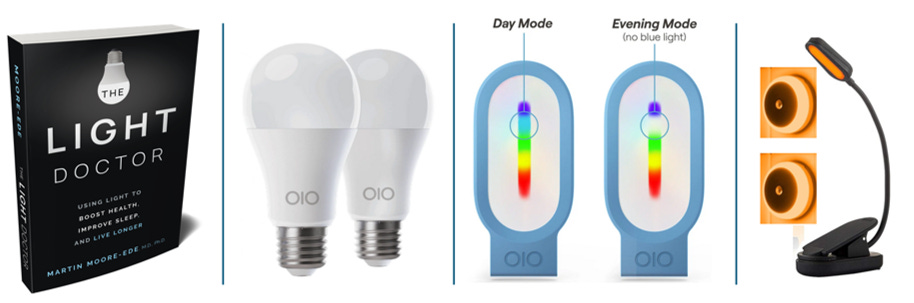
Here are the benefits you unlock with each new Paid Annual Subscription to THE LIGHT DOCTOR newsletter beginning today:
Ultimate Circadian Bedroom Lighting Package mailed to your home (for USA residents only*), including:
Latest edition of THE LIGHT DOCTOR book.
Blue-free book reading light - so you can read the book in the evening without any blue light exposure
Two A-19 automatic OIO circadian light bulbs which automatically cycle between blue-rich days, blue free evening lights and red night lights – so that your lighting is always healthy
OIO loop which enables you check any light fixture or bulb to see if it is providing healthy light appropriate for the time of day or night.
Hallway and bathroom blue-free night lights which automatically switch on when it is dark - so you safely walk to the bathroom without switching on the lights
Unlimited year-long access to all THE LIGHT DOCTOR newsletters, podcasts and premium resource materials.
Catalog of evidence-based healthy lighting products from reliable vendors.
The Ultimate Circadian Bedroom Lighting Package is the ideal gift for family and friends (or yourself) so you can bless them with healthy light and restful sleep,
Give yourself and your loved ones the gift of healthy bedroom lighting with each new Annual Paid Subscription to THE LIGHT DOCTOR newsletter
If you are already a paid monthly subscriber and wish to take advantage of this offer please go to the subscribe page and upgrade your subscription to an Annual Paid Subscriber.
Upgrade to Annual Paid Subscriber
PLEASE NOTE: *The Ultimate Circadian Bedroom Lighting Package can only be shipped to USA residents because of electrical compatibility and current tariff fees. Residents of other countries who sign up for an Annual Paid Subscription to THE LIGHT DOCTOR newsletter will be shipped a signed copy of the latest edition of THE LIGHT DOCTOR.
We regret this offer is not available to monthly paid or complimentary subscribers - but you are welcome to upgrade to a Paid Annual Subscription If you are already an Annual Paid Subscriber we will continue to honor your current lower annual subscription price when you automatically renew, but you will not receive the incentive package for new subscribers.
Moore-Ede M. et al. (2020) Circadian potency spectrum with extended exposure to polychromatic white LED light under workplace conditions. J Biol Rhythms 35: 405-415.
CIE 203:2012 (incl. Erratum) A computerized approach to transmission and absorption characteristics of the human eye. ISBN 978-3-902842-43-5
No posts
Comments
Nothing yet. Say the first thing.
Sign in to join the conversation.