
Hello travelers, tourists, and train riders about to get stuck in the swamp.
I boarded the Amtrak train in Birmingham with more than a backpack, suitcase, and notebook. I was buzzing from the past few days with my granddaughter. At eleven months old, she had shown me the world through touch and sound and small discoveries. Books, porches, birds, light switches, wet leaves. Each moment arrived new to her, and to me too. Those memories stayed with me as the train pulled away from the station.
Another part of me was still feeling the pain and anger about Birmingham’s history. Walking the Freedom Trail had reminded me how much courage it took for people to demand something as basic as dignity. The contrast stayed with me. My granddaughter was discovering the world one touch at a time. Children in Birmingham decades ago were denied the dignity and equality that every child deserves.
I settled into my seat in the coach car and pulled out the latest draft of my next national park mystery thriller, Murder in Vacationland. Reading a mystery while traveling through Mississippi on my way to New Orleans felt right. I had time and space to read, reflect, and edit as the train hummed beneath me, but the storm outside had a different idea. Rain splattered against my window. The storm soaked the green trees and swamp that stretched beyond the tracks.
I looked around the coach car. Two retired women from Alabama sat near me.
“What takes you to New Orleans?” the woman next to me asked.
“I have been there a few times,” I said. “Business trips, family vacations, and for this trip I am writing too. I love the jazz, food, and culture. The cemeteries. And the swamp tours. New Orleans always feels like a place that never runs out of stories.”
Her friend nodded. “It does have that feeling. Like the city keeps its own secrets.”
“What kind of stories do you write?”
“Mystery thrillers,” I said. “In different places I visit from national parks to life journeys, including this tour in the South.”
The woman behind me said, “You ought to write one set in Alabama. Maybe something with a bride who goes missing right before the wedding.”
Her friend laughed. “Now that would be popular. Folks in Alabama love a big wedding and a murder mystery.”
I smiled. “Could be a good one. A Southern mystery with a few twists.”
The woman beside me added, “And once you get closer to New Orleans, you will hear talk about voodoo. Old stories folks pass down. Best to keep your eyes open out here.”
Their voices blended with the rhythm of the train, the soft clatter of wheels on track, and the steady sweep of rain against the windows. The storm outside was threatening, but inside the coach car the conversations felt safe and friendly.
Later, I walked to the dining car for lunch. The space felt like a small roadside diner rolling through the Mississippi countryside.
The woman working the counter looked like someone who had seen every kind of traveler and every kind of weather. The storm pressed against the windows, but she did not seem bothered by it the way the rest of us were.
“Have storms like this ever caused trouble on the line?” I asked.
She handed me my plate with a small laugh. “Baby, this is Mississippi. Storms talk loud, but the train keeps moving. You learn not to jump at every crack of thunder.”
I hesitated, then asked, “Do people still believe in old beliefs around here? The kind tied to New Orleans. Voodoo and all that?”
She did not stop working, but her eyes drifted toward the rain-streaked window. “People talk about all sorts of things in these swamps. Some of those stories have been around longer than this railroad. Folks do not always say them out loud, but they still pay attention when the swamp starts talking.”
On my way back, I saw the train attendant checking tickets. He moved through the coach with the confidence of someone who had been riding this line longer than I had been alive. He did not rush, and his eyes missed nothing.
“Crowded train today,” I said.
He gave a smile. “This ain’t crowded. Mardi Gras is crowded.”
The lights flickered once. He glanced up, then back at me.
“Storms like this ever cause trouble out here?” I asked.
He shifted his weight, bracing as the train rocked. Rain hit the windows in a hard burst. He watched it for a moment, then lowered his voice just enough that I had to lean in.
“Weather changes fast in Mississippi. Train feels it before we do.”
He moved down the aisle checking tickets.
Back in my seat, I opened my manuscript, but the people around me kept pulling my attention away from the page. A teenager with headphones stared out the window, tapping his foot in a rhythm that did not match the train. A family farther down the car tried to manage snacks and restless children. The mother looked worn down in a way that had nothing to do with travel. The father kept checking his watch. The man with a large backpack sat upright and alert, watching the storm like he was waiting for something inside it.
And then there was the man three rows ahead. I had not noticed him before. He sat perfectly still, hands folded, eyes fixed on the aisle. Not reading. Not sleeping. Not watching the storm. Waiting.
Outside, the rain continued to fall as the train carried us deeper into Mississippi.
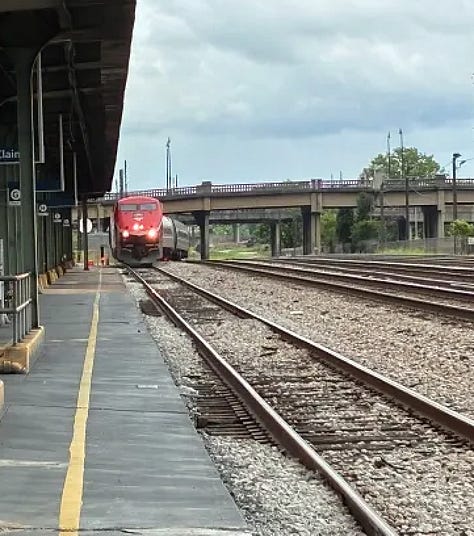
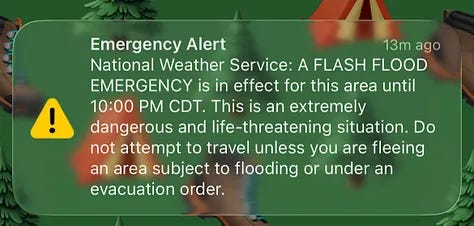
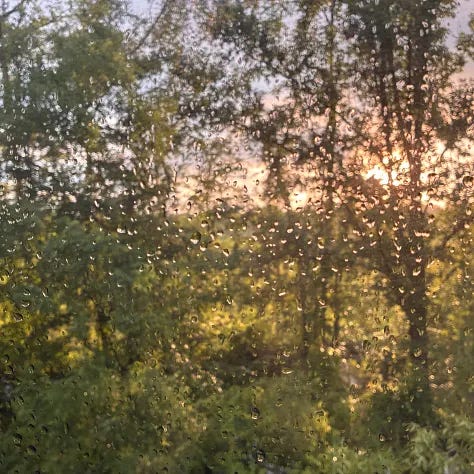
The rain thickened as we crossed deeper into Mississippi. The air inside the coach car was hot and humid. The passengers had settled into the kind of uneasy quiet that comes when people have run out of conversation but are not ready to sleep.
The woman behind me tapped my shoulder. “Tell me something. When you are working on a book, do you read a lot too?”
“All the time,” I said. “Reading helps me understand how other writers build tension and keep readers turning pages.”
Her friend nodded. “Stephen King does that. That man knows how to get inside your head.”
Other voices drifted in the coach as we rolled toward New Orleans. The teenager said he wanted to hear live jazz. The family farther down the car talked about visiting the old cemeteries. Someone mentioned beignets. Someone else mentioned the French Market. A man in the aisle talked about swamp tours. The conversation had the pleasant forward-looking quality of people who still believed they were on schedule.
Then the train slowed.
A long exhale of metal moved through the car. The conductor came over the intercom. His voice was steady.
“Waiting for a freight train to pass. Routine.”
The swamp pressed close on both sides. Rain hammered the windows in uneven bursts, almost like knocking.
We waited. Five minutes. Ten. Twenty. The storm deepened. The lights flickered once, then steadied.
The teenager pulled off one headphone and looked around.
“Did we already stop once before this?” he asked.
The woman beside me shook her head. “No. This is the first stop.”
The teenager frowned. “I could have sworn we stopped back there. Before the freight delay.”
Nobody answered him directly. The conversation moved on. But I had heard the same question twice now and I wrote the time in the margin of my manuscript. I did not know why. It felt like the kind of detail that might matter later.
A few minutes later, the father down the aisle checked his watch and showed it to his wife.
“That is strange,” he said quietly.
“What?”
“I thought we had only been stopped twenty minutes. But look.”
His wife glanced at the watch and laughed. “You have been staring at the rain too long.”
He did not laugh back. He looked at the watch again and set it face-down on his knee.
The man with the large backpack stood and walked toward the back of the coach car with the deliberate step of someone who had somewhere specific to go. I watched him push through the door connecting the cars. I noted the time again in the margin of my manuscript. Ten minutes passed. Then fifteen. The door did not open again.
I looked around the car. The still man three rows ahead had not moved. Hands folded. Eyes forward. I had not seen him speak to anyone or eat or drink or check a phone. I could not have said with certainty when he had boarded or where he had come from.
Finally the train shuddered forward again, slow at first, then steady for a few minutes. A few passengers exhaled. Someone said finally. The rhythm of movement returned and the tension softened just enough to feel like relief.
Lightning flashed so brightly that the entire swamp appeared for an instant. Water. Trees. Rain. Every detail exposed and gone again in a single heartbeat.
The train jolted hard.
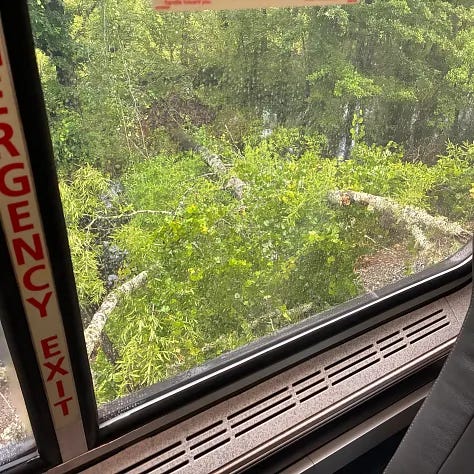
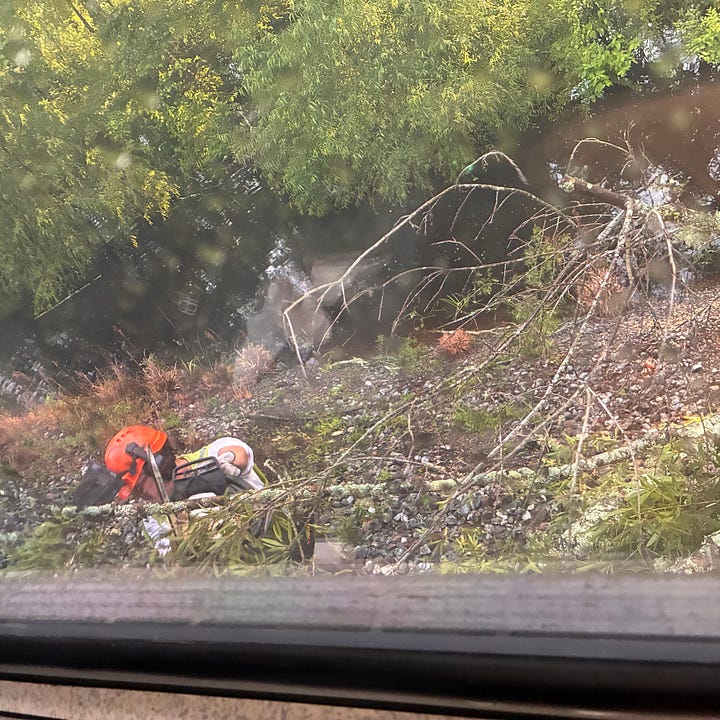
A heavy thud shook the car. The windows rattled. Something scraped along the side of the coach in a long tearing sound. When the light settled, a tree lay across the tracks directly under the train, its branches twisted and dripping. The trunk had come down so close to my window that wet leaves were pressed flat against the glass. I could see the broken wood. I could see water running down the bark. The swamp had reached us.
A few passengers gasped. Someone farther back muttered a prayer.
The conductor came back on the intercom.
“We might be here for a while. The support crew has been dispatched and is en route with chain saws.”
I noticed I had missed a call on my phone. I stepped to the vestibule between cars and called back. The French Market Inn confirming my reservation. We were already four hours behind schedule.
I stood there a moment before returning to my seat. Through the window in the connecting door I could see into the next car. It was darker than ours. I could not see the man with the backpack. I could not see anyone I recognized.
I went back to my seat and wrote one more note in the margin of my manuscript.
Backpack man. Last seen 6:14. Direction rear of train. Not returned.
Outside, the fallen tree remained pinned beneath the train, its leaves still pressed against my window. The storm had calmed but the swamp seemed closer than before, as if it had used the delay to move in around us while we were looking at each other.
The man with the backpack had still not returned. The still man had not moved. No one in the car could agree on how many times we had stopped.
The clouds split open. A warm gold light spilled across the swamp. It hit the water first, turning it into a sheet of color that looked almost unreal after hours of darkness. Then it reached the trees, softening them, making them look gentle again. Almost.
Passengers pressed closer to the windows. The teenager lifted his phone to record the moment. A couple of children climbed onto their seats. The two women stood by the glass, their earlier worries forgotten for a moment.
A truck rolled up along the service road, tires sinking into the mud. Two men stepped out with chainsaws slung over their shoulders. They walked toward the fallen tree with the slow confidence of people who had done this work a hundred times. Hope moved through the car like a warm draft.
One of the men crouched near the base of the trunk. The sunset lit his vest in a soft orange glow. He leaned forward, studying something in the water.
Something moved. At first it looked like a ripple, or a shadow, or light breaking wrong across the surface. The man leaned closer.
A woman in the coach car screamed. “It is an alligator.”
The man jerked back. The swamp erupted in a violent splash that struck the side of the train. Someone stumbled into the aisle. Someone else shouted for the children to sit down. The chainsaw dropped into the mud.
Lightning split the sky. Thunder followed immediately. The gold light vanished as if it had been switched off. Rain returned in a single sheet that hammered the train and turned the swamp dark again. Not night-dark. Something heavier.
A deep metallic groan rolled through the coach. Then a sharp jolt pushed everyone forward. The lights flickered. The teenager grabbed the armrest.
“What was that?” he said.
Another jolt hit harder. The coach car shifted sideways. People braced themselves against seats and overhead racks. The storm outside grew louder, pressing against the train instead of passing over it.
A long metallic snap tore through the car. It sounded like steel giving way under strain. The floor vibrated. The lights dimmed. Someone screamed.
The movement came again, more definite this time. The front of the train pulled forward. Our car did not follow.
We were no longer connected.
People looked out the windows, trying to understand what they were seeing through the rain. The glow of the other cars was already fading into the storm, pulling away in a slow, steady line.
The teenager spoke first. “It is leaving. The rest of the train is leaving.”
Someone answered that it could not be true, that trains did not separate like that, that there must be an explanation we could not yet see. No one offered a better one. The distance kept growing until the last lights disappeared into the rain and black water beyond the glass.
We were alone.
Inside the car, voices scattered into pieces of speculation and disbelief. Someone said the train would return. Another said the crew must have made a mistake. Most said nothing at all and stayed in their seats, watching the storm as if it might explain itself.
Then someone called out from the back.
“Where is the man with the backpack?”
I turned my head to look. His seat was empty. His jacket was still there, folded neatly. No one could agree on when he had last been seen standing. Some said he had walked toward the back of the car. Others said he had never moved at all.
The storm pressed against the roof and windows until the car felt sealed inside it. Then, without warning, the pressure changed. The rain stopped. The wind dropped. The sound of the storm disappeared so completely that the silence felt wrong.
Outside, the darkness began to soften. The shape of the swamp dissolved. The train shifted forward again with a smooth, familiar motion. The wheels found their rhythm. The lights came back up.
I opened my eyes.
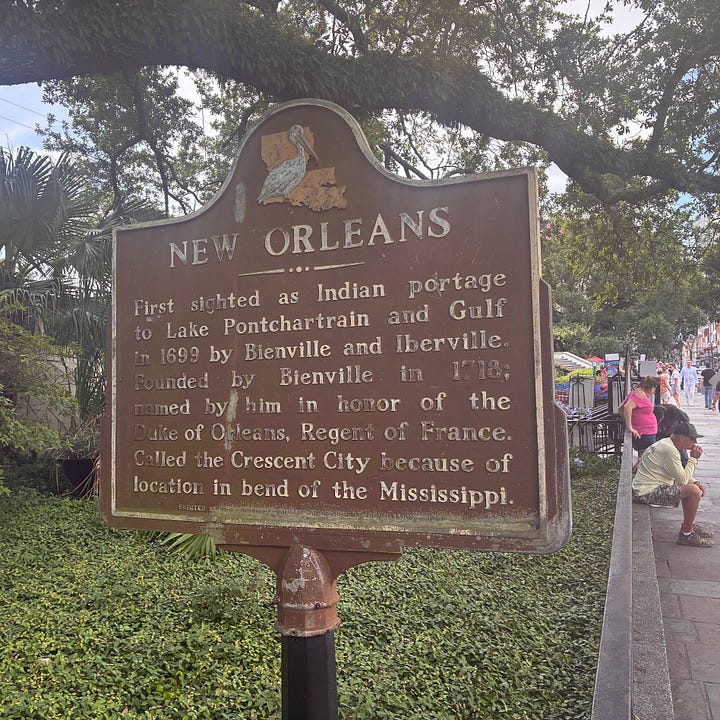
We were pulling into New Orleans.
The station lights slid past the window. Passengers stood, gathered bags, and prepared to disembark. The two women were already talking about beignets. The teenager was texting. The family gathered their children. Arrival settled over the car the way it always does, as if nothing unusual had happened at all.
I stayed seated a moment longer. The man with the backpack was gone. His jacket remained folded on the seat. I told myself there were explanations I had missed. The storm had made everything harder to follow.
None of those explanations made sense.
I walked to the platform just after midnight. The air was warm and heavy, carrying the smell of water, diesel, and a city already awake. I stopped once and looked back through the window.
For a moment I thought I saw him sitting there. Facing forward. Perfectly still.
Then the reflection shifted. Empty glass. The dim interior of the car.
The doors closed. The train moved forward. No one else looked back.
Comments
Nothing yet. Say the first thing.
Sign in to join the conversation.