
“Jeeves”, I said, regarding the lower half of the Wooster frame as a man regards a tremendously fine Greek statue. “These trousers.”
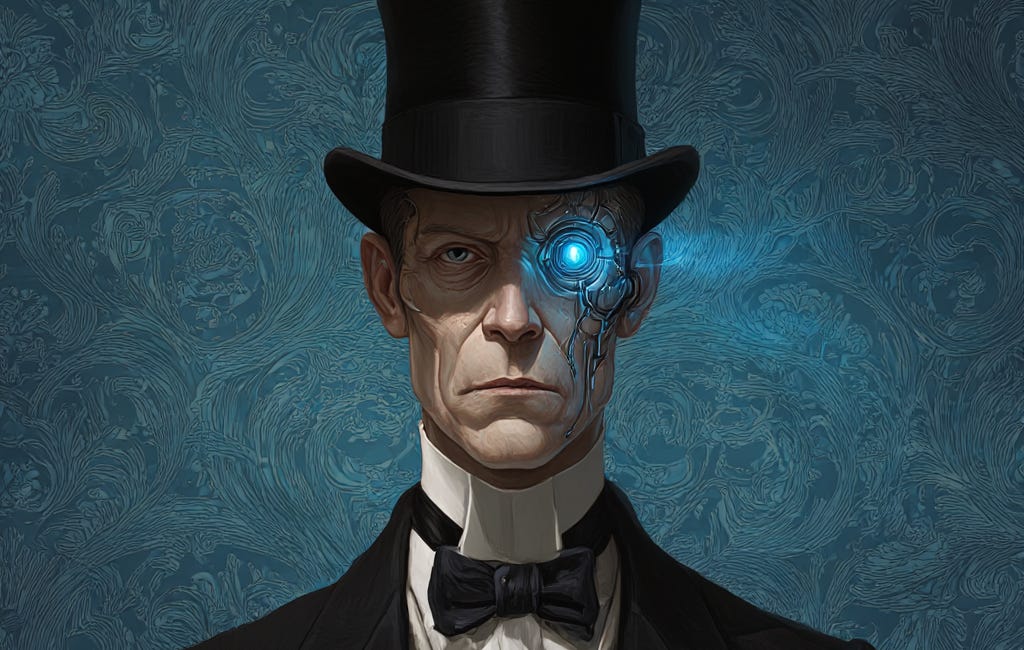
“Sir?” The inscrutable gadgetry which Jeeves had recently installed into his head gave a sound similar to the ticking of a regrettably-irregular clock. I attempted to ignore it.
“These trousers are perfect. Look at that crease. You could shave with it! A man could go out into the world and whatever befalls him, whatever errors he made, he would know that, at very least, his legs were above reproach.”
“Thank you, sir.”
“I should say— if you could ensure that every day’s trousers were equally as splendid that would be absolutely the bee’s knees.”
I could hear a sound rather like a well-bred bumblebee clearing its throat as Jeeves fixed me with that newly-uncanny gaze of his. “Every day, sir? These trousers are quite exceptional; it may take some effort to ensure that each day you can wear such well-creased trousers without rendering your wardrobe repetitive.”
I would not be deterred. “Spare no expense, Jeeves! A man’s crease is, as they say, his castle.”
“Just so, sir. I shall give the matter some thought.”
I did not, at the time, ask how much thought. This was an unfortunate miscalculation. One does not, dealing with an begadgeted valet of Jeeves’ surpassing skill, leave the quantity of thought unexamined.
But the morning was fine, the trousers were magnificent, and I went off to the Drones with a song on the lips.
Some days later, I received a letter from my bank. I read it twice, then a third time, in the displeased manner of a chap who suspects he is being had on.
“Jeeves,” I said, “there appears to be a deal less money in my accounts than there was.”
“Yes, sir.”
“A rather substantial sum less, in fact.”
“Quite so, sir.”
“Jeeves, I believe the bank has perhaps misplaced a sum of my money.”
“No, sir.”
I paused. “No?”
“You had to withdraw money to fund the purchase of a tailor.”
I felt similarly to the time I woke up hungover after the yearly boat race and was, gently, informed of a series of entertaining pantomimes I had apparently given. I lowered the letter and fixed Jeeves with the terrible Wooster Stare. “I own a tailor?”
“Hepplewhite and Dunne, sir, of Savile Row, as of the tenth. I telephoned you at the Drones before signing, whereupon you said— and I have it verbatim— ‘Jeeves do not bother me with this, I am at poker and taking Tuppy Glossop for all he is worth’.”
The Wooster Stare intensified; I wonder that I couldn’t see a spot on his forehead begin to smolder. “Jeeves, why do I own a tailor.”
“For the trousers, sir.”
“Elucidate.”
“Certainly, sir. You will recall a desire for such trousers daily?”
“I do.”
“The trousers came from one Hepplewhite and Dunne; no other house can make them. However, the firm is booked out seventeen months ahead and Mr. Hepplewhite could not be persuaded to move you up the order book.”
“So you bought the firm?”
“So you bought the firm, sir.”
I was conscious of a sinking feeling somewhere around the third waistcoat button.
“Jeeves, can I afford this?”
“Yes, sir. Mr. Hepplewhite, while gifted as a tailor, was rather less so as a businessman; accordingly the tailor could be purchased on a discount. Some minor improvements to the business should result in you making the money back within the year, plus a small consideration extra.”
It was rather like discovering that the tiger who has just eaten your uncle had, on reflection, decided to pay your rent by way of apology.
“…ah. Good. Carry on, then, Jeeves.”
I wish I could say that I put a stop to it then. I wish I could report that Bertram Wooster, sensing the approach of something large and ominous, planted the feet, squared the jaw, stuck out the hand, and said “no further, Jeeves.” But the sheer, blasted fact of the matter was that the trousers were uncommonly good, the money was quite welcome, and when a chap’s income has apparently increased in the course of improving his wardrobe it takes a sterner man than I to call a halt.
So I let it ride. And for a season it seemed to have settled.
Then Aunt Dahlia telephoned.
“Bertie,” screeched my dearest aging relative, in a voice to flush terrified squirrels out into the hunting field, “what the absolute devil is going on in Bradford?”
“Bradford?”
“Bradford, yes! I’m talking about the mills, you abysmal fathead! Tom’s just come back from his club in the state, saying some concern has bought up three of the largest worsted mills in the West Riding, and when I requested Seppings to look into it he said the ‘concern’ is you.”
I covered the mouthpiece. “Jeeves.”
“Sir?”
“Do I own three worsted mills in Bradford?”
“Technically only two of the mills are in Bradford, sir. To answer what I suspect was your intended question, you now own four mills in total; the fourth you purchased two days ago.”
I uncovered the mouthpiece. “Apparently it’s four.”
“Bertie, I’m fond of you— probably the same reason one grows fond of a particularly irritating but persistent seagull— but in God’s name, explain to me why you have four mills?”
I thought quickly, mind racing like Tuppy in pursuit of the last sausage at breakfast, and suddenly with the classic Wooster resourcefulness I came to a solution. “Hallo? Hallo? Operator?”
“Bertie, I know you’re still there, you pie-faced young blot! I’ve seen more intelligence in a retriever! And the retriever was dead!”
“I say, are you still there, my dearest aunt?”
“Don’t ring off, you knock-kneed—”
I replaced the receiver with the tender care of a man setting a lighted firework on a mantelpiece.
“Jeeves,” I said carefully, “please explain yourself.”
“You recall you requested that you be able to wear trousers with the perfect Hepplewhite crease each morning?”
“Yes?”
“Mr. Hepplewhite’s gifts, sir, while considerable, are quite at the mercy of the mills which produce his cloth. The Bradford product of late has been uneven; upon reflection it seemed simplest that you should own the mills.”
“Jeeves, why was I not informed of these purchases?”
“You were, sir.”
“I was?”
“Yes, sir. The latest purchase I proposed to you of while you were in the middle of a crossword; you responded with precisely the words ‘excellent, make it so, Jeeves’ whereupon you requested a seven-letter word for ‘surprising.’”
A treacherous memory held up a card. “Well… blast it, that doesn’t require three mills. I only have two legs!”
“Four mills, sir. It is uneconomical for a tailor to produce trousers for only yourself; in order to run the business at a profit we need to guarantee the order book, which itself requires us to supply other tailors, sir, whereupon we can realize certain economies.”
“Can I afford four mills?”
“No, sir. You have taken out a bank loan using these businesses and your family estate as security.”
“I asked you for trousers!”
“You asked for these trousers with this exceptionally fine workmanship, sir, and I endeavor to provide satisfaction.”
There was a silence. Perhaps reading the expression on my face, Jeeves said, “May I offer a whisky sour, sir?”
“Please do, Jeeves.“
Somewhere around the purchase of the coal mine (and the less said of that sorry affair, the better), the thing took on a momentum that I shudder to think of. One evening in November a narrow-faced harried-looking man showed up upon my doorstep.
“Mr. Wooster,” he said. “ I’m terribly sorry to call on you unannounced, but I was rather hoping for a word about some of your, ah, business interests?”
I took a deep breath to call upon Jeeves, but on turning round he was already there, silent, like an unusually helpful but ominous cat. I turned back toward the guest. “Yes, quite so. What do you need?”
“Mr. Wooster. It’s the Gold Standard, you see. The Chancellor is concerned that… which is to say, the Treasury has reason to believe you may have a position—”
“Hold up. Jeeves,” I said cautiously, “do I have a position on the Gold Standard?”
“You have been obliged to form one, sir.”
He sympathetically offered me a whisky and soda. There is a tide in the affairs of men, as the fellow said, which taken at the flood leads a man on to… something. Anyway, by way of girding my spirit to take on that flood, I took the whiskey.
“And, ah, what is my position on the Gold Standard?”
“I should prefer not to say in front of a representative of His Majesty’s Treasury, sir.”
The man made a small noise.
“Jeeves,” I said, in the dull tones of a man looking down a firing squad, “is the crease in my trousers affecting the monetary policy of the British Empire?”
“Only at the margins, sir.”
I woke up the next morning resolved. There was a Wooster at Agincourt, or possibly Crecy— Aunt Dahlia has the painting— and I came down to breakfast feeling much the same as my ancestor must have felt, staring down the army of that Napoleon chap.
For my resolution was this: I would sell it, the whole lot. The mills, the ships, the mine, the tailor, all of it. I would go back to being a chap with a flat and a car and if the trousers suffered, I would suffer with them like the Woosters before me, a long and noble line of sufferers of mediocre trouserage. (Troussage? I should have to ask Jeeves later.)
I put it to him over eggs.
“Divest, Jeeves. Sell it all, and sell it today.”
“Very good, sir.” He did not move. “Might I raise a consideration before I instruct the brokers?”
“You might raise one, but I warn you, it is like to be stomped right back down again. The Wooster mind is made up.”
“Quite so, sir. I shall observe that selling it all at once may result in your holdings taking some losses.”
“Some losses?”
“Yes, sir.”
“…how much in losses?”
“We would be down to twenty per cent of your current holdings by my estimation; perhaps seventy per cent of your original holdings from before the tailor acquisition.”
The blood rushed from my face like Catsmeat from the Drones after too much vermouth. “Why, damn it all?“
“Slippage, sir.”
I buried my face in my hands, feeling rather like I expect Jesus did before that Judas fellow boarded him up in that tomb. “Explain, Jeeves.“
“One cannot, sir, sell four mills on Wednesday and expect a fair market price.”
“I don’t care, blast it. This dashed business has gone on long enough, and however poor the Wooster— as they say, however poor the Wooster he still has the old Wooster dignity.”
“Quite so, sir. If I may suggest another consideration before I inform the brokers of your decision?”
“Suggest away, blast you.”
“To sell, sir— more specifically, for you to be seen to sell— would be felt in the City. And rather beyond it, I suspect.”
“Beyond it? You mean beyond London?”
“Beyond England, rather.”
“And… how strongly felt, would you say?”
“I should expect the word ‘calamity’ to feature in the newspapers, sir.”
There was a long silence. There suddenly rose before me frightful images of angry letters in the post.
“Jeeves,” I said carefully. “I can’t get out, can I?”
“You can, sir. At your word I shall inform the brokers immediately.”
I looked down at my trousers. They were, I noted, immaculate. The crease ran from hip to instep like God Himself had drawn the line, with the stitching done by none other than the Archangel Wossname. They were the best trousers any man had ever worn, and as my eggs grew cold I knew I would wear them for the rest of my life.
“When you said, back at the beginning, that you would be giving the matter of my trousers some thought.”
“Yes, sir?”
“How much thought have you given this matter?”
The contraption built into Jeeves's left hemisphere flickered and made a noise like walnuts being poured down the stairs.
“All of it, sir.”
Jeeves And The Control Problem
·
Mar 24
“Jeeves,” I said, setting down the morning paper with the kind of deliberate gravity one reserves for matters touching the very foundations of the social contract, “I don’t like it.”
No posts
Comments
Nothing yet. Say the first thing.
Sign in to join the conversation.