
It all started in October 1985. In my first week at university, I resolved to enjoy student life to the full. My parents said goodbye to me on the Sunday, the university football (soccer) trial was on the Tuesday. I was in the school football team, so why not try out for the university teams?
The trial started well – in an unfamiliar position, I made some good tackles in the first 5 minutes. The coach was full of praise.
Reaching out to block a pass, I suddenly crumpled in a heap on the grass. My left knee was consumed by the worst pain of my young life. Trying to stand up, I fell straight over again. Pain, fear and confusion overcame me. What had happened?
Somehow, and I don’t remember how, I ended the afternoon in hospital. The college Master brought me back to my new home and I tried to start my studies, despite barely being able to walk.
2 weeks later I was under the knife, and holed up at my parents’ house for another month. My first term at university, first time away from home, was ruined.
That was only the beginning. Knee injuries became a constant theme throughout my adult life. Another operation at age 23 and 2 more in my forties. Left knee twice and right knee twice - I didn’t have a “good leg”. One ACL torn and not worth operating on – the next step would be at least one replacement, possibly both.
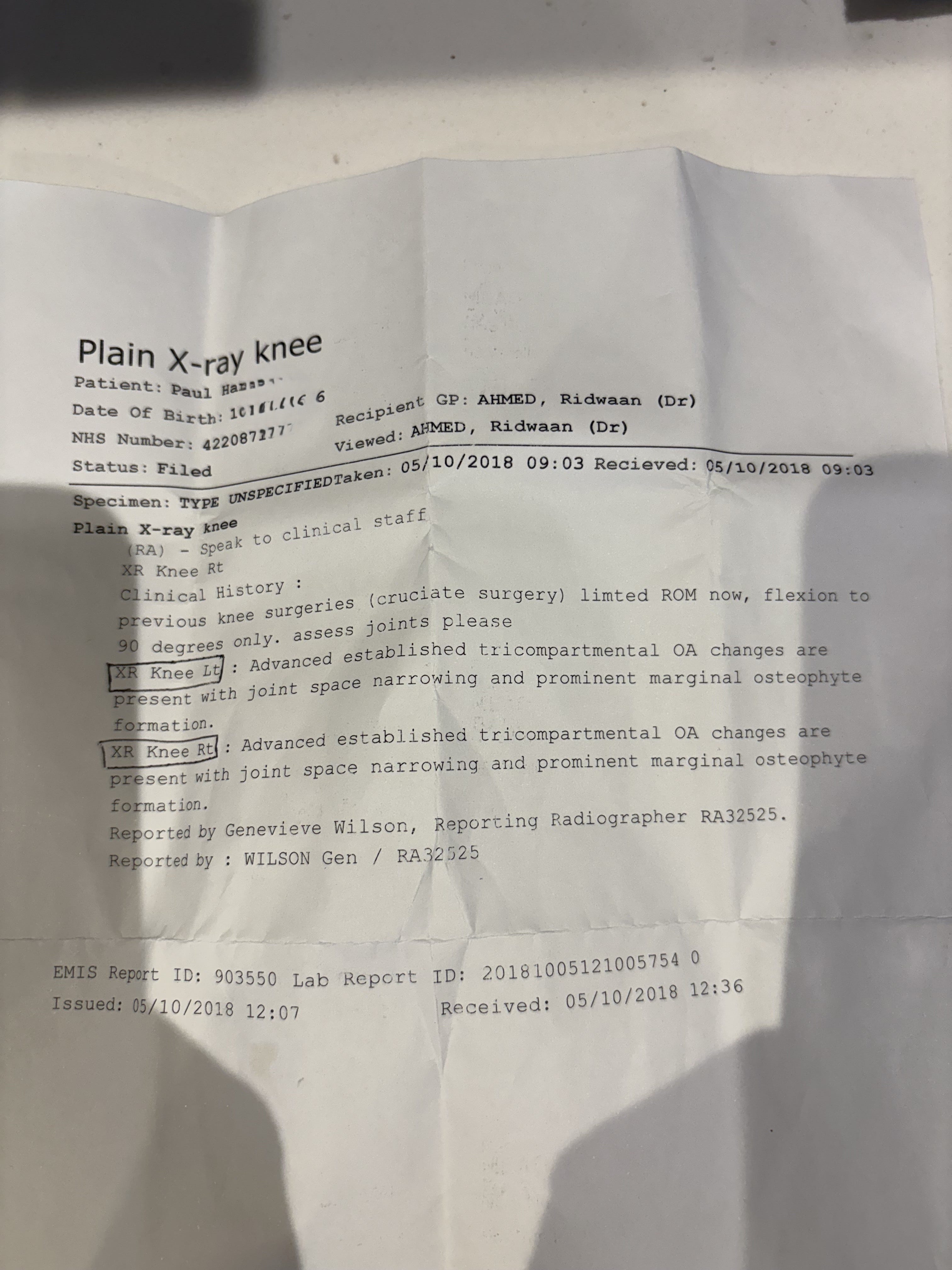
X-rays in 2018 revealed advanced osteo-arthritis, and prominent oestophytes in both knees.
I lived in fear of the big one, the injury which would finally tip the scales. I’d lost some weight, and my fitness was better, but knee replacement(s) could undo that good work.
The big one finally arrived in Summer 2020. Reaching over to a low drawer, I collapsed on the floor. My wife took me to hospital, in a wheelchair. I couldn’t walk at all. This felt like the injury to end it all. There would be no turning back.
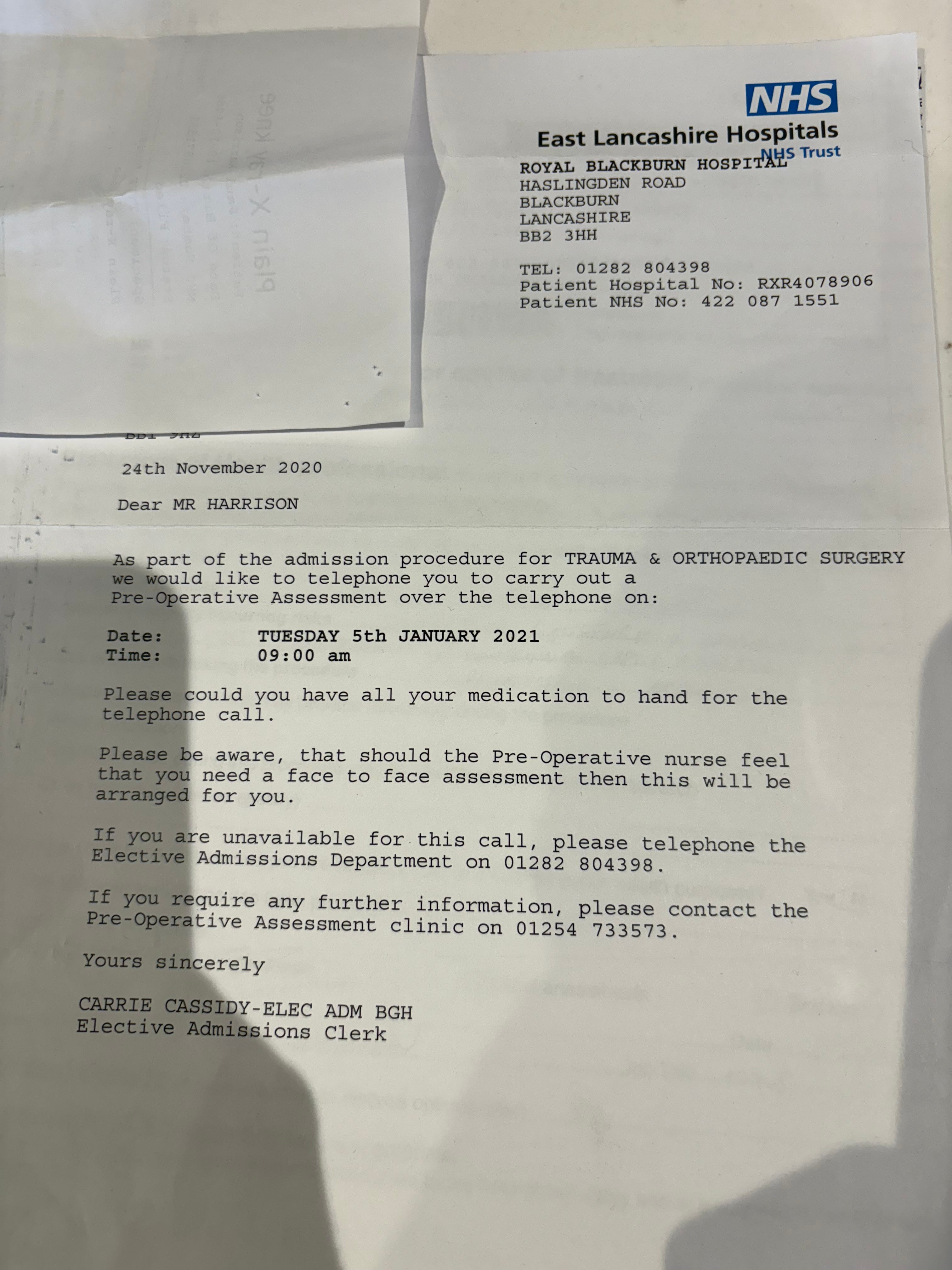
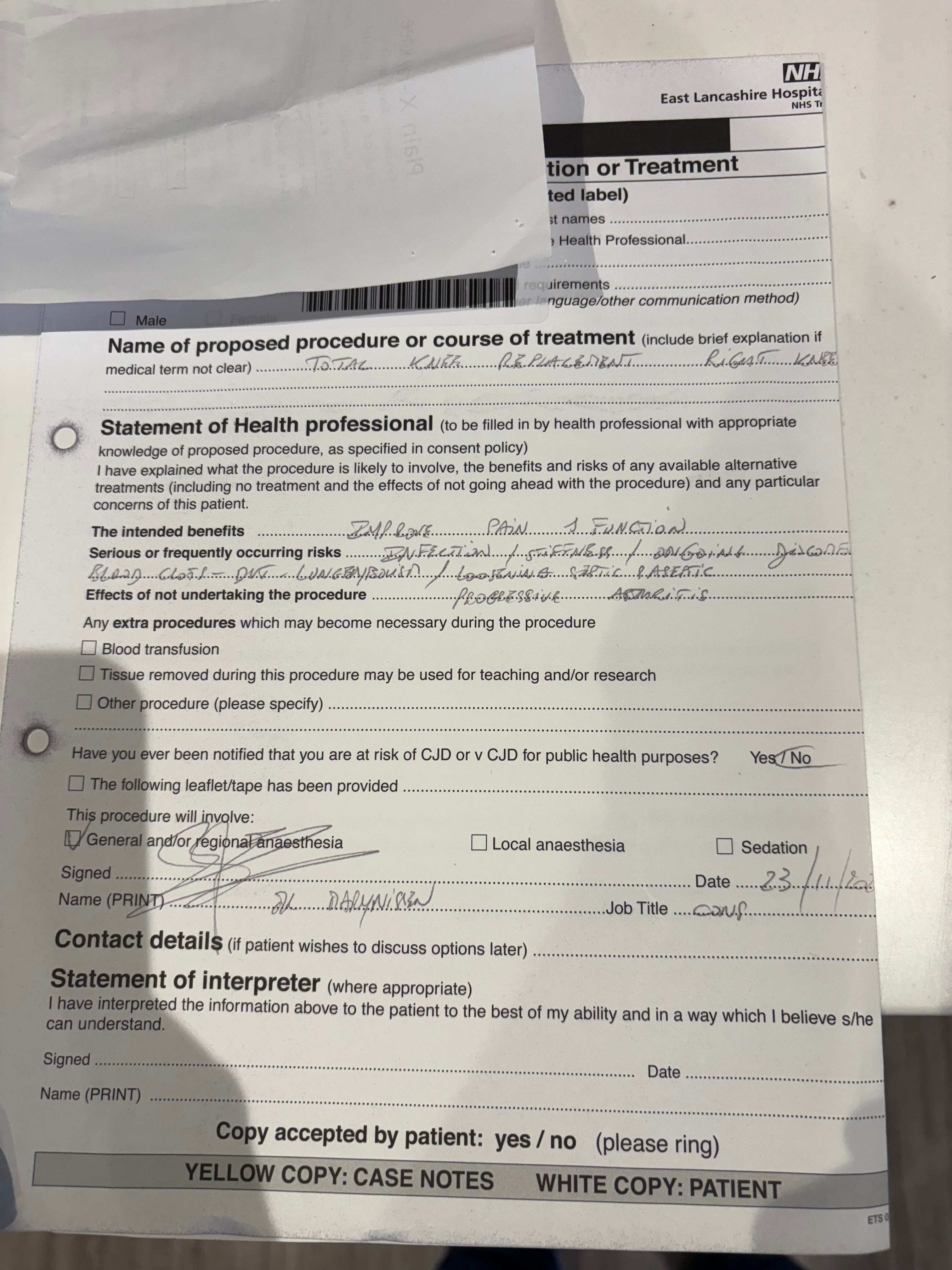
So, this pre-op appointment and Consent Form were dated Autumn 2020, 5 years ago , almost to the day. At the age of 54, I was facing an imminent full knee replacement, an uncertain future of restriction and further potential complications. The alternative was stated as “Progressive arthritis”. The surgical advice was clear.
Luckily, elective surgery paused in Covid. Surgical triage decided that I wasn’t bad enough yet. I was removed from the waiting list.
My entire adult life has been spent recovering from injury, so I knew that I could do it again. But this time, I followed a more structured, more ambitious approach. Steadily, the improvements stacked on top of each other. Today, I’m in no pain whatsoever and my knees are stronger than at any stage since perhaps my early 30s.
How have I done that? No medication, no operations, no injections, no external interventions.
In no particular order, these have been my strategies:-
Almost without fail, this is my daily foundation. A series of stretches, on the ground and against the bed. No fancy equipment, no equipment at all in fact. The stretches loosen the muscles around the knees, and also encourage a greater bend.
Gym sessions, too, always start with essentially the same warm-up and stretch routine:-
· 7-10 minutes on the cross trainer, steadily increasing the resistance but never getting to the intensity of a dedicated cross-trainer workout.
· At least 5 minutes on a mat, fully stretching both legs individually. This also incorporates routines for shoulders and back.
Yes, I know that 10,000 steps is an arbitrary target, and I don’t operate with a specific aim. I don’t walk around the house at 11pm, ticking off the last 200 steps before I reach 5 figures.
But tracking steps is the best proxy for regular movement and activity. There is no shortage of evidence that a daily step count into the several thousands is associated, and probably causational, with good health and longevity outcomes.
Beyond those benefits, for me it’s time on my feet, loosening the muscles in and around the knees.
The benefits for me are unequivocal.
Until the last year, I’d never taken lower body strengthening seriously. I’d rarely used lower body weight stations at the gym. I’d always assumed that it was pointless, that my knees wouldn’t stand for a rigorous routine. Eventually, I’d injure them again.
But, with the help of a personal trainer, we’ve turned that around. We’ve established routines which I can do without pain, without serious restriction, with some adaptations, and which I can develop and improve.
As an example of adaptations, I find the horizontal leg curl, for the hamstrings, very difficult. My knee bend is restricted and this position gives me too much pain for the gain. But the seated leg curl is fine – no pain, no restriction and I’m steadily increasing the weight.
I never thought I would be able to try leg extensions again. My quads are too weak. But the right station, isolating each leg individually, works and I’m able to increase the weight too. Only 7.5 kg on each leg, but for me that huge progress.
This lifestyle change is really pushing the needle for me. Medical science has long established that alcohol increases inflammation throughout the body. Until perhaps 18 months ago, I was a regular weekend drinker, often to excess. Mid-week drinking was more irregular, but not unknown.
The following day, my knees would feel inhibited, often painful and I was unable to exercise. My next gym session would be tentative and restricted, as though I was completely starting again. Steady, unbroken progress was impossible.
I’ve since made a firm commitment to myself. Dramatically reducing alcohol intake is so obviously good for me that the reduction has become part of my identity. I’m no longer a “drinker”, only a “moderate”. Low / no alcohol drinks are a regular part of my life, both inside and outside the home.
Steady improvement in my knee health has only become possible since restricting alcohol.
I’ve been a member of gyms for much of my adult life, with breaks for injury. I’ve tried to keep myself moderately fit, but without any strategy, planning or rigour. Merely because I quite enjoy it, especially the local hotel gym with a pool, sauna and steam room – my Saturday morning “spa day”.
I had no consistency either. I’d skip a week, because I was “too busy”. In reality, I was too lazy and unstructured. It was easy to miss a few days and start again.
But, I now realise that consistency is necessary to make real, sustained and lasting progress.
In the language of James Clear, I think like an athlete - “what would an athlete do”.
In the language of Peter Attia, I become an “elite athlete of aging”.
Perhaps these affirmations sound silly, but they work for me. Instead of unstructured, occasional effort, I’m now consistently implementing strategies to improve my knee health, stability and performance.
They’re working.
Of course, this is obvious, but it bears repeating. Climbing stairs is estimated to put a force of 7 times a person’s body weight through their knees. Even walking on the flat exerts a force several times the body weight.
That’s before we even consider the reduced inflammation throughout the body, as we lose weight.
To improve knee health, form and function, losing weight is imperative. Perhaps the most important strategy of all, without which the other strategies can have only marginal impact.
None of these ideas are remarkable. None are unrealistic. They’re not easy, but neither are they difficult.
They need determination and a long time-frame. Not a week, or even a month. Maybe not even 6 months.
A year. Follow these strategies for a year. My knee health has been transformed within that timescale.
No posts
Comments
Nothing yet. Say the first thing.
Sign in to join the conversation.