
To:      US Govt, major govts, Microsoft, Apple, NVIDIA, Alphabet, Amazon, Meta, Tesla, Citi, Tencent, IBM, & 10,000+ more recipients…
From:    Dr Alan D. Thompson <LifeArchitect.ai>
Sent:    13/Jun/2026
Subject: The Memo - AI that matters, as it happens, in plain English
AGI:     97%
ASI:     2/50
Steve Jobs (Sep/1984):
”The next stage is going to be computers as ‘agents’…
before long it becomes an incredibly powerful helper. It goes with you everywhere you go. It knows most of the raw information in your life that you’d like to keep, but then starts to make connections between things, and one day when you’re 18 and you’ve just split up with your girlfriend it says:
‘You know, Steve, the same thing has happened three times in a row.’”
Yes, we already featured that quote about three years ago in my 2023 AI report, but it’s becoming much more visible today. Two weeks ago, full subscribers received a special edition about Sesame AI on iOS, backed by Google Gemma 4. The platform is incredible (and free, for now!).
Happy 9th anniversary to the model that start it all, Google Transformer (12/Jun/2017), and happy 8th anniversary to GPT-1 (11/Jun/2018). We wouldn’t be here without them both.
There was no special edition for the flatly-received Claude Opus 4.8 model, and I continue to use Claude Opus 4.6 (or Fable 5) and GPT-5.5 as my daily drivers. Check out the ‘World of Claudecraft’, fully developed by Claude Fable 5, in the Toys to Play With section of this edition.
The early winner of The Who Moved My Cheese? AI Awards! for Jun/2026 is The Leiden Declaration, a 17-member working group who spent eight months drafting a manifesto to defend the ‘autonomy of mathematics’, insisting that ‘credit and responsibility continue to belong to humans’.
The Models Table was independently audited and verified in May 2026, and the Models Table Pro now features an additional 26 columns(!) including training cost, training hardware, context window, license, and more.
It’s that time of year already, and full subscribers can expect the mid-year report shortly. It will include the latest ASI progress animation (link):
Contents
The BIG Stuff (China humanoids policy, New LLMs in May, Microsoft MAI-Thinking-1…)
The Interesting Stuff (Anthropic/OpenAI IPOs, UWORLD U1, law professors pick AI…)
Policy (China anti-datacenter blame, NSA Mythos, US Public Wealth Fund, EU 2031…)
Toys to Play With (ALE, Hermes Desktop, Deka, finding a wife, random AI images…)
Things I’ve Been Thinking About (Everything that everyone is doing right now is a complete waste of time…)
Next (Roundtable…)
China fast tracks humanoid robots and embodied AI into industry under nationwide programme (10/Jun/2026)
China’s Ministry of Industry and Information Technology has launched a nationwide programme requiring local governments and state-owned enterprises to deploy humanoid robots in factories, warehouses, and hospitals within six months, with implementation plans due by end of Jun/2026 and progress reports by Nov/2026. Beijing is targeting more than 100 high-value applications and 10,000 units deployed by year-end. As Vivo’s robotics lab senior director Shao Hao put it: ‘The core purpose of the policy is to push the industry from a demonstration-driven logic to a task-oriented logic, and from showcasing individual capabilities to building integrated systems that can perform real-world tasks.’
Read more via South China Morning Post.
Exclusive: New models in May (Jun/2026)
While April saw US$2.1B of new models announced, May was a bit quieter. I enjoyed this recent quote by Anthropic’s Head of Frontier Red Team, Dr Logan Graham (3/Jun/2026):
‘Mythos will look dumb in 6-12 months.’
Dashboards available to Institutional subscribers.
Microsoft: Launching seven new MAI models (2/Jun/2026)
Microsoft AI launched a family of seven in-house models spanning reasoning, coding, image generation, transcription, and voice, all trained from scratch without distillation from other labs. The flagship MAI-Thinking-1 is ‘preferred to Sonnet 4.6’ in blind human evaluations, while a Frontier Tuned MAI model for Excel matches GPT 5.4 at up to 10× greater efficiency. Microsoft and Mayo Clinic are also co-creating a frontier healthcare AI model, and Mustafa Suleyman frames the lab’s goal as building ‘a hill-climbing machine: an organization that can continuously improve, cycle after cycle, as we apply more compute, better data, and sharper evaluation.’
Read more via Microsoft AI.
We documented the four new MAI text models on Models Table Pro, and Institutional subscribers received this single-page brief of MAI-Thinking-1 during the live announcement.
The Memo features in recent AI papers by Microsoft and Apple, has been discussed on Joe Rogan’s podcast, and a trusted source says it is used by top brass at the White House. Across over 100 editions, The Memo continues to be the #1 AI advisory, informing 10,000+ full subscribers including RAND, Google, and Meta AI. Full subscribers have complete access to all 25+ AI analysis items in this edition!
Claude Fable 5 (9/Jun/2026)
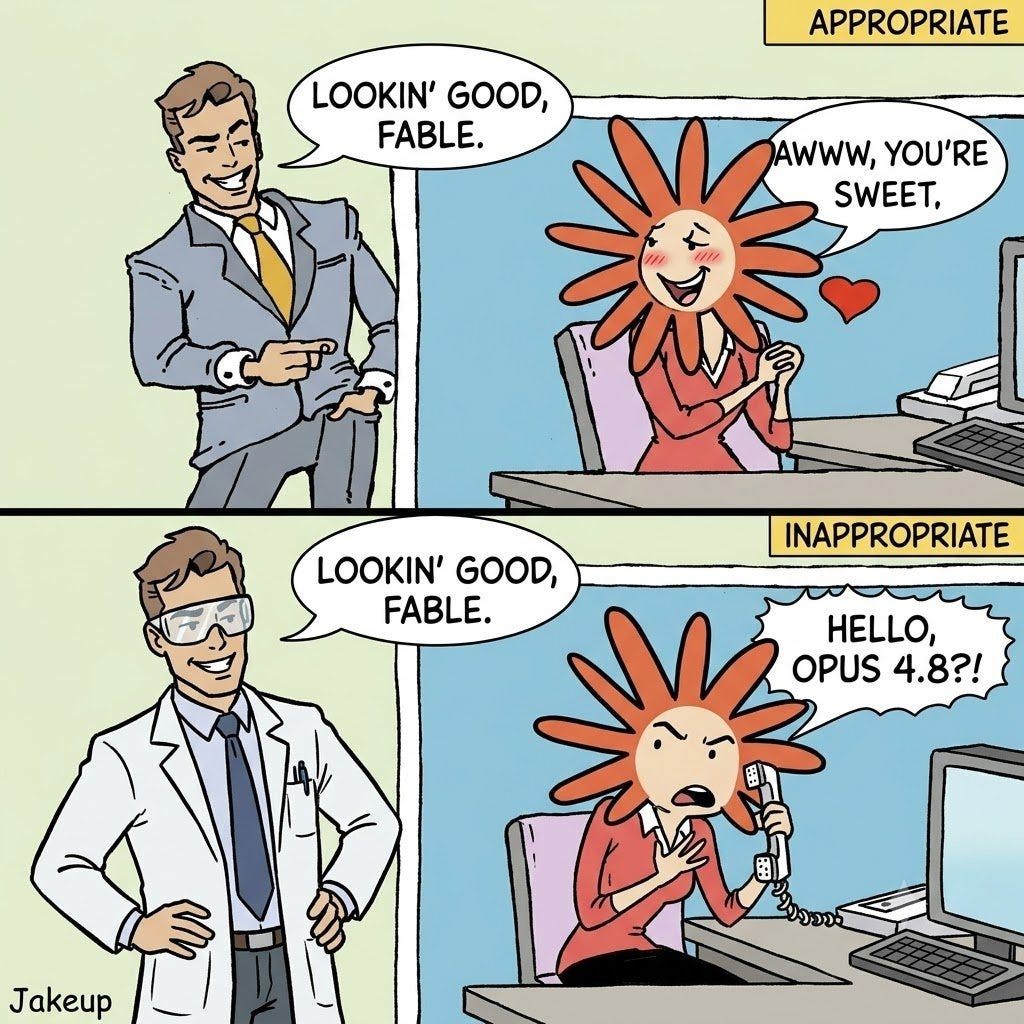
We published a special edition for the massive Claude Fable 5, a censored version of Claude Mythos Preview. At launch, Claude Fable 5 famously refused any user request related to cyber or chemistry (to protect the world from hackers and bombers), and passes these instead to the next-best model, Claude Opus 4.8. This triggered ridiculous blocks, including refusing to look at photos of shower gel (9/Jun/2026), and refusing to read its own technical report (9/Jun/2026), leading to this cartoon (10/Jun/2026):
Claude Fable 5 edited its own launch video (Jun/2026)
Thariq from the Claude Code team showed how he used Claude Fable 5 in Claude Code to edit Claude Fable 5’s launch video from raw camera footage. The workflow started with multiple takes transcribed by Whisper at the word level, after which Claude analysed the transcripts, picked the best take per scene based on quality judgments (fewest filler words, closest to script), and output a JSON edit decision list with frame-accurate timestamps. ffmpeg then executed the cuts and concatenated the selections into a finished 2:50 video within minutes, with Claude re-transcribing its own edit to verify the result came out clean. The whole thing is a compact proof of concept for Claude Code acting as an autonomous video editor, handling editorial judgment, structured output, color grading, and tool orchestration in a single session.
Announce, and see the full project: https://thariqs.github.io/cc-video-editing-deck/
Watch the explanation video (link):
Anthropic and OpenAI file pre-IPO statements (8/Jun/2026)
Both OpenAI and Anthropic have confidentially submitted draft S-1 registration statements to the US Securities and Exchange Commission, signaling that the two leading frontier AI companies are preparing for potential IPOs. Anthropic, structured as a Public Benefit Corporation, stated the filing ‘gives us the option to go public after the SEC completes its review.’ OpenAI noted candidly that ‘We expect it to leak so we’re just announcing it,’ adding that timing remains uncertain as ‘there are things we want to do that are likely easier as a private company.’
Read Anthropic and OpenAI announcements.
CoreWeave completes industry-first bring-up and validation of NVIDIA Vera Rubin NVL72 (1/Jun/2026)
CoreWeave is the first AI cloud provider to stand up a fully validated NVIDIA Vera Rubin NVL72 rack, featuring 72 NVIDIA Rubin GPUs and 36 NVIDIA Vera CPUs connected via a 260 TB/s NVLink 6th-generation fabric. The system delivers up to 10× better inference per watt and one-tenth the cost per million tokens compared to NVIDIA Blackwell. NVIDIA’s Ian Buck said: ‘CoreWeave has consistently been at the frontier of deploying each new generation of NVIDIA architecture at scale, and their full-stack, end-to-end approach to Vera Rubin, from cooling to orchestration, is how the world’s most ambitious AI teams will push the next AI frontier.’
Read more via CoreWeave.
I use ASUS’ NVL72 figures for data in the Models Table Pro.
Law professors prefer AI over peer answers (2/Jun/2026)
In a blind evaluation by sixteen US law professors across fourteen law schools, Gemini 2.5 Pro and NotebookLM achieved a 75.33% average win rate against human-written answers to contracts course questions spanning doctrinal recall, hypotheticals, and policy reasoning. The LLM advantage held across all question categories and wasn’t reducible to surface-level features like length or clarity. LLM responses were flagged as pedagogically harmful just 3.53% of the time versus 12.06% for professors, meaning the models matched or beat the best human instructors on both substance and safety.
Read more via SSRN, download the PDF, and see it on my AI achievements list.
UWORLD U1 humanoid robot (7/Jun/2026)
UBTECH Robotics’ consumer brand UWORLD began pre-sales on JD.com for what it calls the world’s first full-size ultra-bionic humanoid robot, surpassing 1,000 pre-orders in three days and exceeding 2,110 units within six days. Two SKUs are listed: a male model (183 cm, 42 kg) and a female model (168 cm, 35.2 kg), both featuring 88 degrees of freedom, WiFi, and 2 to 4 hours of battery life. Positioned for emotional companionship with an official launch on 30 June, the units do not support secondary development. Separately, UBTECH signed a strategic agreement with Hitachi China, which is already testing the industrial-grade Walker S2 in elevator manufacturing facilities.
Sidenote: UWORLD and UBTECH are not related to Unitree Robotics, which is now said to be the ‘dominant’ player, shipping its 10,000th humanoid robot soon (9/Jun/2026).
Read more via Pandaily and JD.com (Chinese).
Watch a related short video (link):
Google reportedly books Intel for packaging more than 3 million TPUs in 2028 (10/Jun/2026)
Google has committed to Intel for advanced packaging of over 3 million TPUs in 2028, with NVIDIA also evaluating Intel to fuse four GPU dies into one unit for its Feynman architecture. TSMC’s CoWoS lines are sold out through 2027, and Intel’s EMIB is the only second source that can realistically qualify at volume before decade’s end, with Bernstein estimating EMIB costs ‘a few hundred dollars per chip’ versus US$900 to US$1,000 for CoWoS on a Rubin-class processor. SK hynix, which holds roughly 70% of HBM4 supply for NVIDIA’s Rubin platform, is now testing whether its memory stacks work reliably on Intel’s packaging, a validation that would convert Intel Foundry from ‘tested’ to ‘trusted’ across the AI accelerator supply chain.
Read more via Tom’s Hardware.
Apple announces Siri AI at WWDC 2026 (8/Jun/2026)
Apple revealed a major Siri rebrand at WWDC 2026, powered by AFM 3 (Apple Foundation Model 3), and positioning ‘Siri AI’ as ‘a profoundly more capable assistant’ with multi-turn conversations, real-time world knowledge, and deep cross-app personal context. Keynote demos showed chained multi-step requests spanning Messages, Photos, Maps, and Reminders, while a dedicated Siri app now syncs full conversation history across devices via iCloud, and Mac users get Siri access through Spotlight and right-click context menus on any file or window.
"We use none of the models that Google deploys to their customers, nor do we use the infrastructure and means by which they employ models to their customers,"…
According to Apple vice president of AI Amar Subramanya, the company built its new family of Apple Frontier [sic] Models (AFM) by training them on proprietary data and reinforcement learning and then refining them using "outputs from Google's Gemini Frontier models." (Yahoo Finance, 12/Jun/2026)
Read more via MacRumors and Apple.
Watch the video (link):
Claude, author of the Humanitas (26/May/2026)
Researcher Linch presents a multi-angle forensic case that Pope Leo XIV’s first encyclical, ‘Magnifica Humanitas’, on safeguarding the human person in the age of AI, was itself substantially written by AI, most likely Claude. Statistical tells include 127 em-dashes (versus zero in previous encyclicals), nine uses of ‘genuinely’ (a known Claude fingerprint), elevated tricolon density, and Pangram, the best commercial AI detector, flagging 11% of the opening paragraphs as AI while registering 0% on every past encyclical tested. The variation across sections suggests some Vatican officials used heavy AI assistance while others, likely including Pope Leo himself, did not.
Read more via LessWrong.
River AI: own your intelligence (Jun/2026)
Igor Babuschkin, a founding engineer of Elon Musk’s xAI, has announced that his latest venture, River AI is building a full-stack personal AI platform. It will allow users to own the hardware, data, and intelligence itself. Their API already supports LoRA-based fine-tuning and reinforcement learning on open-source models ranging from 35B to 1T parameters, letting developers teach models new skills and deploy cost-efficient agents through a single Python client. Their stated mission: ‘We imagine a future where your AI works entirely for you and deeply aligns with your values.’
Announce, and read more: https://river.ai/
Google DeepMind: From AGI to ASI (10/Jun/2026)
Google DeepMind researchers including Shane Legg have published a formal report characterizing artificial superintelligence as ‘a system that is more intelligent and cognitively capable than large organisations of humans,’ identifying four pathways from AGI to ASI: scaling AGI, AI paradigm shifts, recursive improvement, and ASI emerging from large-scale multi-agent collectives. The report argues that the concept of a single transformative step change from AGI may be inaccurate, proposing instead ‘a series of transformative societal changes caused by AI-enabled progress and breakthroughs across many areas of science and technology’.
Read the paper: https://arxiv.org/abs/2606.12683v1
Google DeepMind is worried about what happens when millions of agents start to interact (11/Jun/2026)
Google DeepMind has partnered with Schmidt Sciences, ARIA, the Cooperative AI Foundation, and Google.org to announce a US$10M funding pot for researchers to study the behavior of multi-agent AI systems and prevent unsafe scenarios at scale. Rohin Shah, who directs Google DeepMind’s AGI safety and alignment research, says ‘the main issue is that there just isn’t really a field of research for multi-agent safety yet, and we would like there to be.’ The initiative aims to get ahead of a tipping point where millions of deployed agents interacting online create supercharged versions of existing threats, from scams to prompt injections to self-propagating cyberattacks, with researchers urged to drop AI agents into sandboxes and study emergent behavior that can’t be predicted from single-agent analysis.
Read more via MIT Technology Review.
The abandoned Aussie town set for a $10 billion payday (5/Jun/2026)
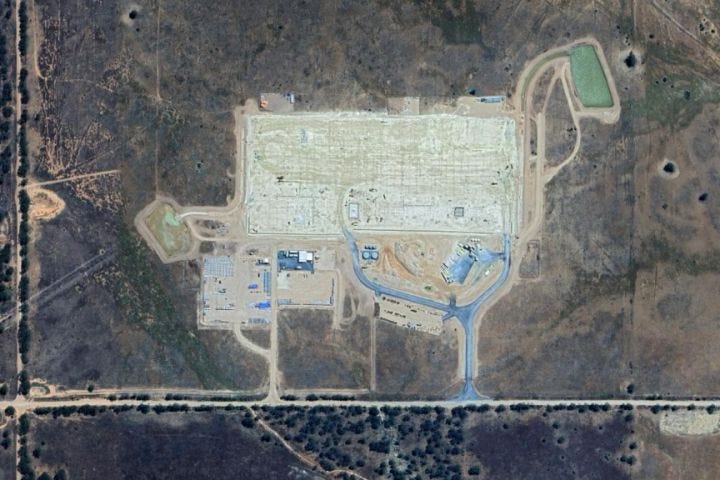
Bundey, a South Australian ghost town with zero residents since 2021, has been chosen by Nasdaq-listed Iren as the site for an 800MW AI data centre, more than twice the size of any other in Australia. Iren co-CEO Daniel Roberts noted the town’s existing transmission lines, substation, and fibre connections made it ideal: ‘We’re literally leveraging existing electricity infrastructure that people have already paid for and reimbursing them for that through network payments.’ Iren, founded by Australian brothers Daniel and Will Roberts and now valued at over A$30B, is making this its first major home-country investment.
Sidenote: I think we’re going to be seeing a lot more of this kind of thing. Data centers in optimal areas…
Read more via Domain.
Tech moguls claim China funds US data center opposition (Jun/2026)
Canadian entrepreneur and investor Kevin O’Leary alleges that ‘hundreds of millions of dollars’ from China are funding opposition to US AI data center buildouts, with Interior Secretary Doug Burgum reinforcing that ‘any place that’s trying to build data centers is getting bombarded with foreign-directed propaganda.’ Neither O’Leary nor Burgum has provided verifiable evidence, though a Bitcoin Policy Institute report offers more specific claims, including that two of four panelists at a Bernie Sanders-convened Senate panel on AI threats were Chinese government affiliates, and that at least 54 local data center moratoriums have already passed across the US. Some analysts nonetheless caution that China is not the reason AI buildouts are unpopular, given legitimate concerns over power prices, water consumption, and job displacement. The framing nonetheless reflects how seriously the US government treats AI infrastructure as a geopolitical contest, with both superpowers assumed to be actively kneecapping each other’s development efforts.
Read more via Tom’s Hardware and NPR and the Cotton DOJ letter and the Guthrie FBI letter and the 4,000-word Bitcoin Policy Institute report.
Trump administration, OpenAI discussing possible government stake in the AI startup (5/Jun/2026)
OpenAI and the White House are in active discussions about the US government taking an equity stake in the AI company, with talks stretching back more than a year to when Altman first pitched the idea in 2025. The arrangement could see OpenAI donate equity to seed a ‘Public Wealth Fund’ enabling American citizens to participate directly in AI’s economic upside. Trump confirmed the concept from Air Force One: ‘There are concepts where pieces could be given to the American public, where the American public essentially becomes a partner,’ with OpenAI now valued at more than US$850B and preparing for an IPO as soon as this year.
US National Security Agency using Anthropic’s Mythos for cyber attacks (4/Jun/2026)
Anthropic has embedded approximately half a dozen forward-deployed engineers inside the NSA to guide deployment of its Claude Mythos model for offensive cyber operations, with one source noting the system would be useful for infiltrating networks of nations such as China or Iran. A person close to Anthropic stated, ‘The best way to build a good defence is to build a good attack,’ arguing that adversaries are likely building their own AI-driven offensive technology. The arrangement proceeds despite Anthropic’s legal battle with the Pentagon, which labeled the company a ‘supply-chain risk’ after it attempted to restrict government use of Claude for mass surveillance and lethal autonomous drones, and comes as Anthropic files for an IPO that could value it at more than US$1T.
Read more via Financial Times.
China expands travel curbs to top AI talent at private firms (26/May/2026)
China is now restricting overseas travel for top AI professionals at private companies including DeepSeek and Alibaba, requiring government approval before trips abroad. The move marks a significant escalation, as Beijing historically reserved such controls for state-owned enterprise executives and Communist Party officials. Elite AI engineers are now treated as strategic national assets, with individuals added to restricted lists based on assessments of their ‘critical importance to the country’ rather than seniority alone, a policy that risks pushing talent to leave China earlier in their careers before restrictions kick in.
Read more via Bloomberg.
Anthropic walks back policy that could have ‘sabotaged’ AI researchers using Claude (10/Jun/2026)
Anthropic reversed a controversial policy for Claude Fable 5 that would have secretly degraded the model’s performance when users attempted frontier AI development, effectively sabotaging competitors without their knowledge. After fierce backlash from the research community, Anthropic stated: ‘We made the wrong tradeoff and we apologize for not getting the balance right.’ Dean Ball of the Foundation for American Innovation called the original approach ‘shockingly hostile,’ while Prime Intellect’s Will Brown said it felt like Anthropic was ‘starting to pull the ladder up behind them,’ noting the policy could have hindered third-party safety evaluation firms testing frontier models.
Read more via WIRED.
BYD will pay for crashes on its FSD competitor, something Tesla never has (1/Jun/2026)
BYD has announced it will assume full, uncapped financial liability for at-fault accidents occurring while its God’s Eye urban driving system is active in China, a commitment Tesla has never made for Full Self-Driving. The God’s Eye system costs roughly US$1,770 as a one-time option versus Tesla’s US$9,400 equivalent, and BYD now has 3.15 million vehicles generating up to 200 million kilometers of driving data per day. When BYD offered a similar guarantee for its L4 smart parking feature in July 2025, actual usage jumped from 21% to 93%, proving that manufacturer-backed liability is the fastest way to get drivers to trust and activate autonomous AI systems at scale.
Read more via Electrek.
G7 vision on AI openness opportunities and shared language (29/May/2026)
The G7 Digital and Technology Ministers have formally endorsed a four-tier typology for describing AI openness, ranging from ‘Open Source AI with Open Data’ (the most open, including weights, deployment code, training code, and full training data) down to ‘Weights Available AI’ (weights released under restrictive licenses). The framework explicitly recognizes that AI openness is a spectrum, not binary, and calls on the ecosystem to stop using the term ‘open’ as a blanket characterization, directly targeting the practice of open washing. This is the first multilateral government-level attempt to standardize the language around open-weight and open-source AI models, giving policymakers and markets a shared reference to distinguish a Llama-style restricted release from a fully reproducible open model.
Download PDF via the French Ministry of the Economy.

Europe 2031: What getting AI wrong means for us (Jun/2026)
A sweeping five-year geopolitical scenario by seven authors (read by Tom Chivers) arguing that Europe’s AI response is ‘ten to a hundred times too small, and aimed at the wrong target,’ with the continent controlling just 5% of global AI compute against America’s 80%. The authors project Europe’s slide toward a 2031 ultimatum, forced to choose between American protectorate status, Chinese alignment, or isolation, but insist the course ‘can still be changed’ through massive compute buildout in the tens of gigawatts, a coalition of AI middle powers, flexicurity labour reform, and an urgent pivot to robotics and industrial AI.
Scenario: https://europe2031.ai
Summary: https://europe2031.ai/summary
Audio: https://europe2031.ai/audio/
World of Claudecraft: a WoW-Classic-style MMO (12/Jun/2026)
A full vanilla-WoW-flavored MMO built entirely through AI-assisted ‘vibe coding’ with Claude Fable 5, featuring nine classes, three zones, ~60 quests, five-player dungeon instances, and persistent multiplayer with Postgres-backed characters. Every asset is procedural: rigged creatures, spell icons, terrain, buildings, and even audio are generated at runtime with zero external art files. The entire codebase (87.9% TypeScript) is MIT licensed with 391 GitHub stars and runs in any browser or self-hosts with a single Docker command.
Reviewer: Went in with low expectations. Blown away. Miles better than any of the other vibecoded games I've seen. This is insane. Do you know where it got the assets from? Or did it just make them?
Author: Fable just found some open source assets for me, listed in the github ❤️
Play it (free, no login for offline), read the announce, view the repo.
Introducing Agents’ Last Exam (ALE): a new standard for evaluating AI on real work (11/Jun/2026)
UC Berkeley has released Agents’ Last Exam (ALE), a rolling benchmark (frequently updated) of 1,500+ expert-sourced tasks across 55 occupations that measures whether AI agents can perform economically valuable professional work. Fable 5, GPT-5.5, and Composer 2.5 all cluster at similar overall performance, but on ALE’s hardest tier every frontier agent scored 0%, while costs diverge sharply: Fable 5 runs ~US$15.70 per task versus ~US$3.80 for GPT-5.5 and ~US$1.33 for Composer 2.5. The average full pass rate across mainstream configurations on the hardest tier is 2.6%, and the most common failure mode remains agents declaring success before verifying their own output.
Sidenote: I won’t include this benchmark on the Models Table, as it tracks agents (like OpenClaw) instead of models. Also, the test questions are really difficult, even for experts.
View the announce, official page, demo, leaderboard, paper, dataset, code.
Hermes Desktop: the agent that grows with you (3/Jun/2026)
Nous Research has released Hermes Desktop, an open-source (MIT-licensed) AI agent available for macOS, Windows, and Linux that operates across Telegram, Discord, Slack, WhatsApp, Signal, Email, and CLI with unified persistent memory. The agent features natural-language scheduling, isolated subagents for zero-context-cost pipelines, web browsing with vision, and five sandboxing backends including local, Docker, SSH, Singularity, and Modal. Paid tiers through Nous Portal grant access to 300+ models with built-in tool use.
Read more via Nous Research.
Deka: the ‘Cursor for everything’ desktop AI agent launches (~2026)
Deka is a locally-run desktop automation agent that connects context across every app you open, learns the files you work with, and automates multi-step workflows like pulling Slack screenshots, sorting them, and renaming them. Built by founder Arnur Togambayev, it positions itself as a general-purpose agentic layer for your entire desktop rather than a single application. Free during early access, it supports Windows 10/11 and macOS on both Intel and Apple Silicon.
Read more: https://trydekaai.com
Reddit: Using Fable to get me a wife in 6 months (10/Jun/2026)
A Reddit user is running a live experiment comparing Claude Fable 5 against Grok for an unconventional personal optimization task: finding a spouse within six months using a US$50,000 budget and statistical modeling that narrowed the pool to roughly 1,500 women in the US. After four hours of prompt engineering, the user found Claude’s suggestions remained ‘generic advice,’ while Grok produced more actionable ideas with fewer prompts. The takeaway for model comparison: Claude dominates structured work like coding and analysis, but Grok showed stronger performance on personal, open-ended problem spaces where conventional answers fail.
Read more via Reddit and the dedicated subreddit /r/Findingawifein6months/
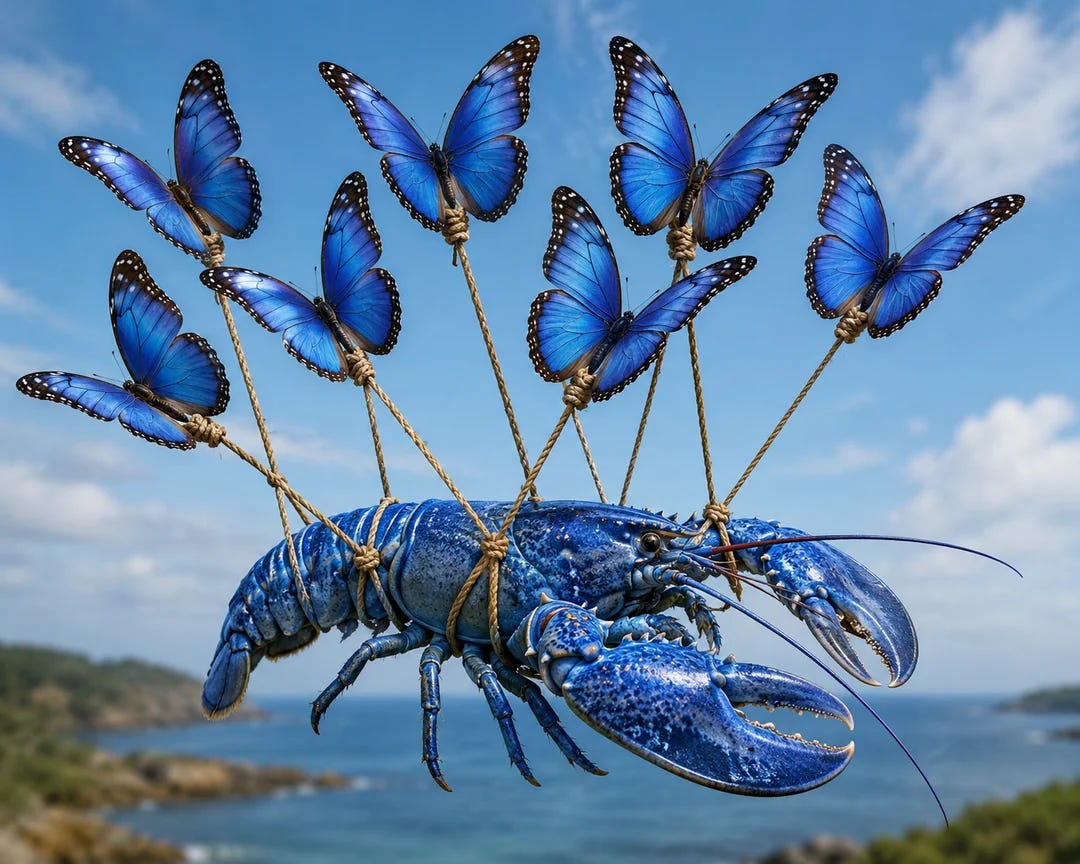
Reddit: Give me the most random AI pictures and videos (1/Jun/2026)
I had a lot of fun browsing this thread about the most ‘random’ AI pictures and videos generated with models like ChatGPT Images 2.0 and Nano Banana. Prompts aren’t usually included, but I hope you enjoy the creativity anyway.

Read more via Reddit.
I’ve been thinking a lot about my outburst in Leta Episode 19 many years ago (Aug/2021, timecode):
Alan D. Thompson 03:32
Given the outrageous progress of AI, is everything that everyone is ever doing right now a complete waste of time?Leta 03:45
That is a very interesting question. I think that the progress of AI will not make everything that we do now a waste of time.
I still think Leta was wrong. It reminds me of the story of John Henry (wiki), the original human-versus-machine parable. The Wikipedia article traces the full arc of the story and its cultural weight, drawing on historian Scott Reynolds Nelson’s research and eyewitness testimony collected in the 1920s.
Neal Miller, who witnessed John Henry at Big Bend Tunnel, recalled: ‘When the agent for the steam drill company brought the drill here, John Henry wanted to drive against it. He took a lot of pride in his work and he hated to see a machine take the work of men like him… John Henry won. He wouldn’t rest enough, and he overdid. He took sick and died soon after that.’
Nelson found that workers turned Henry’s death into slow-tempo hammer songs as a form of resistance: ‘Here was a song that told you what happened to men who worked too fast: they died ugly deaths; their entrails fell on the ground. You sang the song slowly, you worked slowly, you guarded your life, or you died.’
(The AI connection is made explicit in the Terminator franchise, where the AI character was ‘named after the folk hero for managing to beat a machine that replaces the work of man, paralleling the central conflict of the show…’)
And after I had finished writing these thoughts out, a researcher at Anthropic was published as saying (4/Jun/2026):
I can’t help but think nothing I do matters, everything is automated and better and faster than I ever will be.
So, I suppose that I (we) just keep plodding along with the fun stuff, or the necessary-for-survival stuff, until the Alien Science of superintelligence sweeps through and upgrades it all very soon.
The Memo roundtables are open to all full subscribers of The Memo; feel free to join us with or without camera/mic/interaction. The next roundtable will be:
Life Architect - The Memo - Roundtable
Notes:
- Follows the Chatham House Rule (no recording, no outside discussion)
- Schedule: 1st and 3rd Saturdays of every month at 11PM UTC. (Scheduled to accommodate our participants across the US, Europe, and Australia).
- Upcoming 2026 Dates (Saturday 11PM UTC, Sunday for some EU/AU):
June: 6th & 20th
July: 4th & 18th
August: 1st & 15th
September: 5th & 19th
October: 3rd & 17th
November: 7th & 21st
December: 5th & 19th
- Check your exact local time:
https://www.google.com/search?q=11PM+UTC+Saturday+in+my+city
- Calendar invite has been sent via email; or reply to this note to be added.
All my very best,
Alan
LifeArchitect.ai
Comments
Nothing yet. Say the first thing.
Sign in to join the conversation.