
“Why this is hell, nor am I out of it,” Christopher Marlowe’s Mephistopheles declares.
“Kristian. Haven’t you understood? Hell is here,” Hans, the latest of our fictional Mephistopheles, echoes.
Faust is back. A legal contract signed with the heart’s blood; the commodification of human souls; phantasms pretending to be beautiful women; the promise of absolute power over a realm of images: you don’t have to be Heinrich Kramer to perceive a Faustian pact in the modern age. For all the talk of a Gutenberg Parenthesis—the notion that literate modernity has now reached its conclusion—this myth forged at the beginning of print resonates in the present.1 We seem, if anything, to have become trapped within its prism.
Yet although each retelling of the Faustian pact follows the same pattern, beneath the continuities, successive versions have transformed its meaning. Are we, today, on the verge of another major reinterpretation of the fable—and of the modernity it represents and rejects?
Unlike many of our great myths, we can trace the Faust story to its moment of origin. Early in the sixteenth century, a scholar and alchemist named Jörg Faust or (in Latin) Georgius Faustus made his way across Germany, giving lectures, drawing horoscopes, and occasionally conjuring the dead—for a fee. Although he claimed to be the heir to the great occult traditions of Simon Magus and Faustus the Manichean, contemporaries didn’t take these pretensions very seriously. They saw him as a braggart and a charlatan: someone who should be moved along swiftly to the next town, not a plenipotentiary of Satan. When Faust died around 1540, no one could have guessed that the life of this petty con man would come to represent modernity’s nightmare. But Reformation-era Germany was an unusual place. In the Black Forest at the beginning of the witch craze, the devil seemed to be lurking behind every tree. After Faust’s death the legend of his pact with the devil gradually took hold, until, nearly half a century later, it was given printed form in the Faustbuch (1587), a lurid account that swiftly became an international bestseller.
The story of the Faustian pact might have been lost in an endless series of monstrous births, gruesome murders, and terrible portents, had it not been plucked from the swift churn of cheap print and placed into the more placid waters of literature. When the English Faust Book appeared in London in 1592, Christopher Marlowe, then the leading playwright in England, was twenty-eight years old. Five years earlier, Marlowe had written the most successful play of the new Elizabethan commercial theater, Tamburlaine, the story of a Scythian shepherd (Timur) whose ruthless will to power led him to “the sweet fruition of an earthly crown.” Marlowe, a scholarship boy who understood ambition, had a taste for heroes who wanted everything and would stop at nothing. The Jew of Malta, written around 1590, brought Machiavelli onstage to declare “I count religion but a childish toy / And hold there is no sin but ignorance.” With its cosmic ambitions, the story of Faust was exactly calculated to appeal to this young playwright, who was about to enter the final year of his brief, dazzling life.
Marlowe’s version simplified the original and cast it into exquisite verse. Faustus, a scholar and a fool, seeks to go beyond the limits of human endeavor, represented by the Aristotelian-Christian paradigm, and turns to black magic. Mephistopheles appears, and Faustus signs a contract in blood for twenty-four years of power on earth in exchange for eternal damnation. It’s one long day, with the clock ticking toward an inevitable midnight. But first, there are revels: a pageant of illusions that ends only when it is too late.
Pared to its essentials, the Faust myth was much more than an account of one man’s terrible mistake. It became a dark parable of capitalist modernity, as men and women first sensed their godlike capacity to transform the world. In Holborn, just a few miles north of the Thames from The Rose theater, Francis Bacon was formulating the idea that knowledge is power, that is, that understanding causes and producing effects are one and the same. The dawning era promised staggering wealth, fantastic inventions, and endless discovery.
Of course there was a price. Promethean gifts are not as easily harnessed as they appear. Even as we create novel instruments, we ourselves become instrumental. To sell one’s soul is to make it, to make us, into a commodity. With the help of Mephistopheles, Faust can create every object, but he is cut off from human creation. That is why Mephistopheles cannot give Faust a wife. He can only show the doomed scholar a succubus disguised as Helen of Troy, the “face that launched a thousand ships.”
So far, Marlowe’s Faust myth looks very much like the ones that followed. The sterility of illusion, the objectification and commodification of the human soul, is at the center of every later version. But Marlowe’s Faustus has something that later variants lack: a real moral universe. After plunging us in a world of conjuring tricks, the play’s tragic conclusion comes as an astringent dose of reality. Faustus begins the play by doubting hell. “I think hell’s a fable,” he tells Mephistopheles. By the end he and the audience know better. “Ugly hell, gape not! come not, Lucifer! / I’ll burn my books!—Ah, Mephistopheles!” Faustus cries, dragged down by devils. An inexorable moral law still holds, independent of any human action. There is consolation here as well as tragedy. Hell exists, but so does heaven, far outside the frame of the play.
The Elizabethans were not us. They still stood on the threshold of modernity. Marlowe himself may have been a freethinker and a restless, Faustian spirit (indeed, like Stephen Greenblatt, I think he was). But intellectually and aesthetically, one foot remained in the medieval tradition of the mystery plays, even as the other stepped into the brave new world of commercial theater. In one of the best interpretations of the play, Richard Halpern argued that the Faustian bargain represents Marlowe’s own experience of writing for the market, making his contract with the devil one of the first fictional examples of that fatal document, much-discussed on Substack, the book deal. But the world of the mystery plays was also still real, still morally and aesthetically urgent. Doctor Faustus must be understood as an allegory of the intense, prolonged conflict between those two modes.
Over time commercial forces would erode the medieval elements of the Faust story. It’s already possible to see scenes of spectacle and farce expanding, beginning to overwhelm the moral frame, in the transition from the A text to the B text, published after Marlowe’s death about a decade apart. By the end of the seventeenth century, the transformation was complete: Doctor Faustus had become a work of burlesque. In Germany, strolling players staged versions of Marlowe’s play in the seventeenth century, but by the eighteenth century, it had become a theme for puppet shows, a kind of cosmic Punch-and-Judy.
It was through the puppet theater that the young Goethe was introduced to the Faust theme. He began to write his own version of the myth in 1772, when he was twenty-three, and continued to work on it until shortly before he died in 1832, at the age of eighty-three. Faust was contemplated, written, and revised over the six eventful decades that spanned the end of the Enlightenment and the birth of Romanticism, the American, French, and Industrial Revolutions, the Napoleonic wars and the rise of Prussian nationalism. For better or worse, this long and varied history shows. Goethe’s epic drama is a strange and sprawling work, endlessly allusive, a compendium of styles, characters and philosophies.
In part I, Faust (his first name has metamorphosed from Jörg to Johann to John to Heinrich) seeks out Mephistopheles, who has been elevated from a mere emissary of Lucifer to the prince of darkness himself: unlike in Faustus, the devil no longer exists outside the horizon of the play. Faust pledges himself to a life of unceasing action, and seduces a young girl, Gretchen, leading to the death of her family and her own execution for infanticide. Part 2 of this funhouse mirror of a drama recapitulates the themes of part 1, but the subject is now, overtly, modernity’s pact with the devil. It is touched off when Faust and Mephistopheles invent paper money at the court of the emperor. In a passage Marx admired and quoted, Mephistopheles explains how the strength of a team of horses becomes that of their owner: “Six stallions, say, I can afford, / Is not their strength my property? I tear along, a sporting lord, / As if their legs belonged to me.”
Paper money completes the process. Freed even from its commodity form, money can enable every metamorphosis.2 The phantasmagoria that follows, plumbing the depths of the classical underworld and imagining a new global empire of trade, is a consequence.
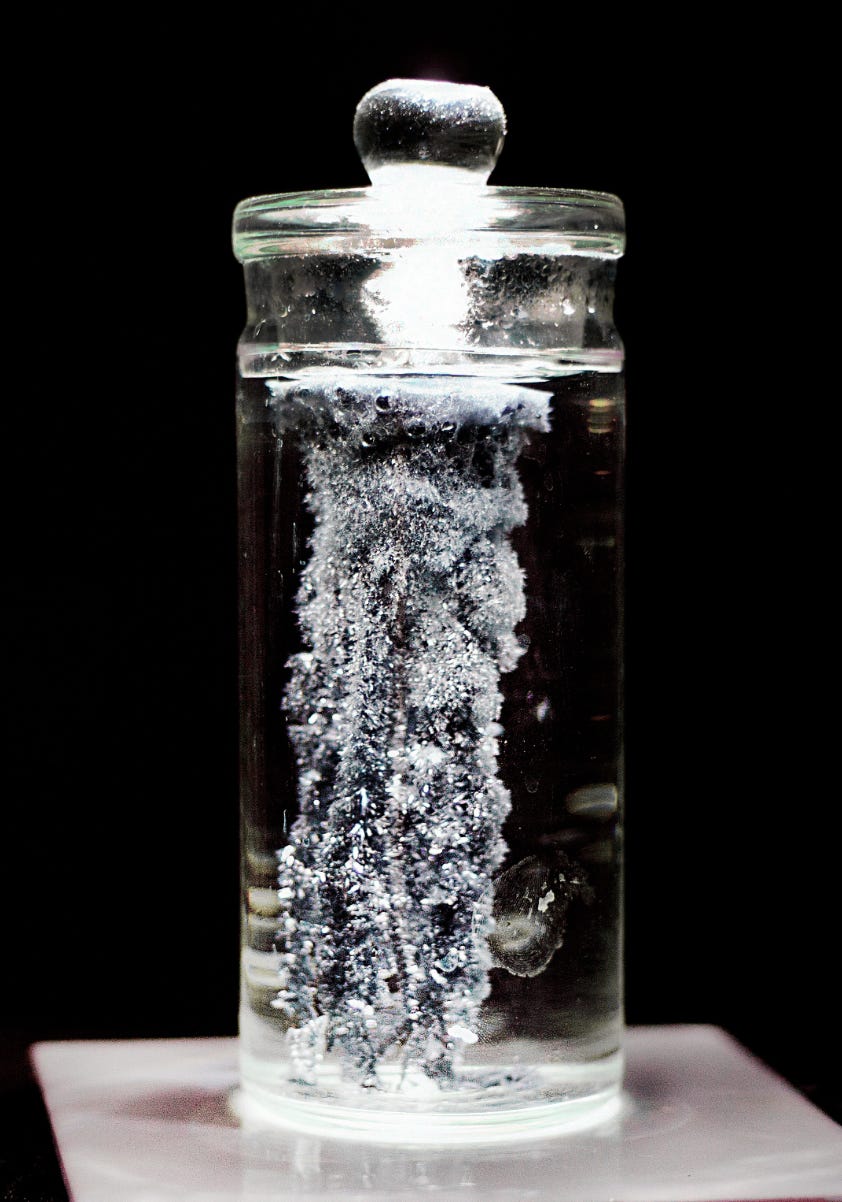
Yet one thing is not granted to Faust. Although Goethe’s Faust, unlike Marlowe’s, manages to procreate, his two sons (Gretchen’s child and Euphorion, his short-lived son with Helen) swiftly die. Faust’s assistant Wagner seeks to do away with procreation, making an artificial man, Homunculus, in a test tube. “What [nature] has organized / We will crystallize.” The name derives from the sixteenth-century German alchemist Paracelsus, but the idea of artificial life was clearly in the air in the early nineteenth century. As in Frankenstein, the experiment goes badly wrong. Homunculus is not a human being and cannot survive outside his glass vial; when it breaks, he’s absorbed into the sea.
In this realm of endless energy and action, death, the inorganic, has come to rule. In Faust’s final speech, the play’s hero, now blind, imagines the new society he is ordering to be built with land reclaimed from the sea, and stolen from his neighbors in a violent act of primitive accumulation. He can hear the sound of shovels beginning the task. But the shovels, wielded by the restless ghosts of the dead, are not building a new society. They are digging Faust’s grave, as Mephistopheles waits to collect his soul.
He will not get it, for Faust, somehow, is saved. His restless energy, in partnership with the devil, has unleashed every form of chaos. Yet his soul, in the end, is claimed by angels, with the help of the “eternal feminine,” women’s salvific love. Is this an affirmation of the triumphant spirit of capitalist modernity, with its principle of creative destruction, making the earth anew in its wake? Or is it an ironic conclusion, representing the last illusion of a world unable to recognize itself as hell?
For many contemporary scholars, it’s both. Goethe’s modernity is both a hell on earth and our ultimate salvation. But I have to admit that I don’t find this at all satisfying. The play has shown the old, solid moral universe melting into air. It stands to reason that the bonds of hell are dissolved, that Mephistopheles cannot claim Faust’s soul. But what, precisely, is the heaven to which Faust ascends, apart from its gesture toward the feminine mystique? Appearing at the last minute, it feels to me less like a radical affirmation of modernity, with all its splendors and miseries, than an act of indecision. Yet the fault was not really Goethe’s. Two and a half centuries had changed the very nature of the Faustian pact.
A little over a hundred years later, following the rise of the Third Reich, the conclusion of Goethe’s Faust appeared far more sinister. By elevating his antihero to heaven, had Goethe urged Germany past the horizon of good and evil, licensing every act of violence, every crime? It was Klaus Mann who first reimagined the Faust story as a parable of Nazism in Mephisto, a story of Germany’s peculiar pact with the devil refracted through the career of the actor Gustaf Gründgens. (Not incidentally, Mann’s brother-in-law and sometime lover.)3 But it was Mann’s father, Thomas Mann, who gave the myth its most brilliant twentieth-century form.
Written in Los Angeles between 1943 and 1947, Mann’s Doktor Faustus tells the intersecting story of the rise of Nazism and musical modernism in bourgeois pre-war Germany. Adrian Leverkühn, Mann’s Faust, combines elements of Nietzsche’s biography, especially his syphilitic madness, and Arnold Schoenberg’s invention of the twelve-tone technique. (The Jewish Schoenberg, a refugee from the Nazis who lived only a few miles away from Mann and Adorno in LA, was justifiably annoyed.)
Adrian, like all Fausts, is restless, ambitious, and cold. He is cut off from all human intimacies and, by extension, from the flux of life. As a child, Adrian’s father, an amateur naturalist, shows him crystalized chemicals in test tubes, in a scene that reimagines Wagner’s creation of Homunculus. Crystalline patterns swirl in the water, resembling plants or tiny animals. But they are only mere matter. “And even so they are dead,” said Jonathan, and tears came in his eyes, while Adrian, as of course I saw, was shaken with suppressed laughter.” Adrian’s sympathy is with the artificial, the inorganic. His one instance of quasi-paternal love, for his nephew Nepomuk, proves fatal.
The renunciation of love is, of course, a form of damnation in its own right. But Mann also sought the myth’s invocation of a real hell. In linking Adrian’s madness to the horrors of Nazism, attempted to return Faustus to its original form—it is Doktor Faustus, as in Marlowe’s masterpiece, not Faust, as in Goethe’s. Up to a point, he succeeded. For much of the postwar era, the hell of the Holocaust was the center of our public morality tales. Even today we can still understand the force of a moral order grounded on the exemplary rejection of Nazism, the foundation of the postwar liberal code of human rights. But we can also, I think, see the limitations of this negative regulatory ideal in the absence of an equally powerful positive vision. Surely it is becoming a little threadbare, a little less real with the passing of each generation? Surely it is becoming harder to see Germany’s sins as the unrivaled focal point of the modern morality play?
There is a countervailing moral ideal in Doktor Faustus, though it is sketched far more lightly. It lies in Christendom, an Erasmian, humanist Catholic Europe before it was shattered by the violent, individualist energies of the Reformation. Zeitblom, the novel’s narrator, is Catholic, and affirms the “unbroken harmony” between his humanism and his religion, reaching back into “pre-schismatic times, back into a world of unity in Christ.” And of course that is one possibility. We can, like Alasdair MacIntyre, reject modernity and seek to return to Aquinas, to the Aristotelian Christianity that Faust rejected. I know people who strive precisely for this. For them, perhaps for you, the divine law that damns modernity can be read everywhere. It is inscribed in the book of nature in burning letters.
The rest of us, however, need a different foundation—and, today, a different Faust.
Has Karl Ove Knausgaard’s 2025 novel, The School of Night, given us our own Faust?
The fourth novel in his Morning Star series, The School of Night claims to be the extended suicide note of the Norwegian photographer Kristian Hadeland, recounting his time at art school in 1980s London before moving to the near-present. Kristian is a pathological narcissist, indifferent to others and utterly consumed by ambition; it is easy to feel claustrophobic as we inhabit his mind. But as his name indicates, in his own, perverse way, he is an everyman; he is Christian, which is to say he is us, trapped perpetually in Vanity Fair.4
In returning the myth to London, Knausgaard has wrested it free from the allegory of German history in which it was enmeshed for over a century. Inevitably, he still takes many of his cues from Goethe and Mann, but they are recontextualized for the Internet Age. As with Adrian Leverkühn, artistic ambition is at the heart of Kristian’s Faustian bargain. But while Leverkuhn’s art, music, linked him to the national fate of Germany, Kristian’s art, photography, points to the transformation of artistic expression through technology. The School of Night’s Faustian modernity is that of lives embedded in vast technological systems, selves dispersed across the internet and social media, and minds refracted in the universal funhouse mirror of AI. We are all photographers now; conversely, we are all also alienated images, circulating endlessly as objects within systems we cannot control.
Knausgaard makes this very explicit. The novel’s Mephistopheles, a Dutchman called Hans who tinkers with early cybernetic mice, tells Kristian, “We live in a world of mirrors now. Like Narcissus and Echo… The repeated image of ourselves. We’re living in a loop. Yes. Roll your eyes if you must.”
When Kristian is assigned a self-portrait, it is no surprise that he photographs his reflection, emphasizing the division between image and subject. His artistic turning point, reached shortly after he has become enmeshed with a mysterious clique staging Doctor Faustus, comes with a luminous photograph of the mangled corpse of a cat. Later, he photographs human corpses, men and women who have become objects. It is an idea derived from the photographer whose work most informs Knausgaard’s descriptions of Hadeland’s images, Sally Mann. (Knausgaard admires and has written about Mann’s work, but one wonders whether nominative determinism also played a role in making it the model for Hadeland’s photographs.)
Like all Fausts, Kristian’s bargain removes him from the human community and the shared biological life that forms its basis. Although he marries Yelena—Helen, one of two women by that name in the novel—and has a child, Euphorion and Nepomuk in one, Kristian remains fatally isolated. Hans, as Mephistopheles, can give Kristian almost everything, but he cannot create life. When Hans is asked to design the set for Doctor Faustus, he proposes projecting an image of the inorganic crystals taken from Mann’s Doktor Faustus, itself alluding to Goethe. As mere images, the crystals are doubly removed from the life they mimic. The crystals seem to strive toward the light, but “they’re dead, they’re just dead matter.”
But there is also something else that Hans cannot, or is not willing, to give: death. When Kristian’s young son learns about death, he asks, “Is the wall going to die?” “Is the carpet going to die?” “Is the lamp going to die?” Kristian answers, “No, only what’s living can die.”
Death makes our bodies into objects but, in doing so, reveals that we ourselves are not objects, cannot be transformed into mere matter without loss. The ambivalent vitality of death, its centrality to all human meaning, is the subject of the Morning Star series, in which The School of Night forms a kind of katabasis. Death, the other side of the coin of reproduction, marks us as part of a continual flux, a biological community that can only find meaning outside the merely individual. We cannot see the full picture in The School of Night. But in its form as a suicide note, Kristian’s narrative arcs toward it.
I do not know if Knausgaard has found the system of values that can exert the equal and opposite pressure, the force of inexorable moral law, that any true retelling of the Faustian pact needs, and that most, since the birth of modernity, have not been able to summon fully. But I do feel that, in reckoning with death, he is looking in the right place. In our technology-driven age, the distinction between living and dying things and mere matter has become more difficult and more urgent. We may be on the cusp of redrawing its lines entirely. After all, babies can now be made in test tubes (or on petri dishes) without sharing the fate of Homunculus. Genes can be edited, organs can be grown, bodies can be cryogenically frozen.
I don’t think we’re on the verge of achieving personal immortality, although its pursuit through technology seems like the essential quest of our age. But as our ability to remake the world and ourselves changes once again, we may find ourselves on the precipice of another revaluation of values as fundamental as the transition to modernity in Marlowe’s age. We may well find new and very real hells opening before us—and perhaps also new heavens, new earths.
Faustus the magician was often confused with the Johann Fust who provided the capital for Gutenberg’s press and eventually, when Gutenberg was unable to pay him, appropriated his invention. For later writers, the idea of a Faustian printer-capitalist was hard to resist; hence his name became John.
Marlowe anticipated this in Barabas’s desire for “infinite riches in a little room,” that is, the desire to compress infinite value into infinitesimal space—or, ideally, none at all.
Klaus Mann’s version lacks the brilliance of his father’s novel (almost inevitably) but, as a work written during the rise of the Nazis and before their defeat became inevitable, it has an incredible sense of urgency and foreboding. It probably deserves a greater place in literary history than it has.
Would any Scandinavians like to comment on the possibility of the Hadeland Glassverk as an association for his surname? The oldest industrial company in Norway, it was founded with the help of German artisans in the eighteenth century to make flasks and medicinal equipment: not irrelevant to the Faust story. But it is easy to be led astray in source hunting.
Comments
Nothing yet. Say the first thing.
Sign in to join the conversation.