
In 2015, Duke University’s library acquired Virginia Woolf’s writing desk. The oak desk had been a gift to the teenaged Woolf, who used it through her twenties, composing her early works of fiction and journalism on its slanted surface. By the time it arrived at Duke, it looked very different from the object Woolf had used: her nephew Quentin Bell had painted a recumbent, laurel-garlanded muse on its surface and lowered its height, transforming it from a standing to a sitting desk. Even in its altered form, it preserved enough of its mystique to make it an important acquisition for the library. It now sits near the entrance to the Rubenstein, Duke’s Special Collections, letting visitors glimpse it through the glass and, perhaps, allowing those who work in the library to imagine that they’re writing beside Woolf, fellow laborers in a common literary endeavor.
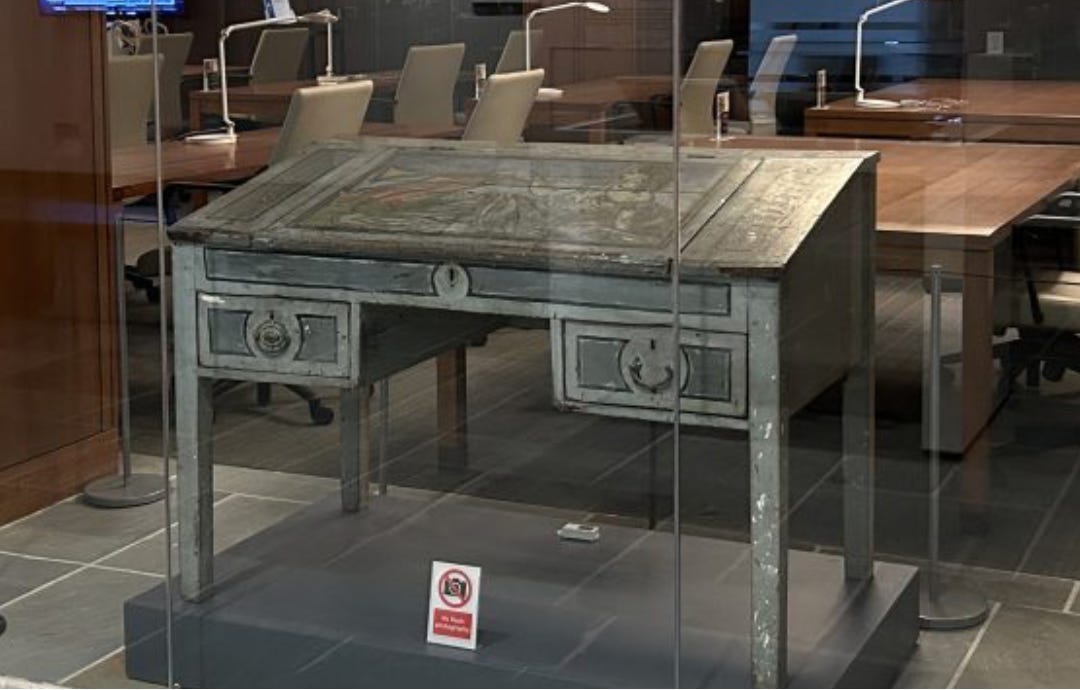
Writers’ desks are often fascinating to readers, as if adjacency to the act of creation allowed a special insight into it, like clothes revealing the curve of a body. But Woolf’s desk is obviously a special case. Woolf’s argument that the woman author needed a room of her own drew a powerful connection between authorship and its site of composition. Long before it became a collector’s item, Woolf made her desk into a metonym for herself and her work.
Of course, it isn’t just women who need privacy to write. For modern authors, men as well as women, public reputations have long been predicated on private withdrawals. Writers move “from under ashes into sudden flame,” as Milton wrote of Samson. The solitude of the individual room, where we are potentially at our most isolated, opens directly onto the public sphere. Today, as we angle our Zoom cameras to capture our bookshelves, or post on Substack from our bedrooms, the relationship between the private room and the public sphere is more evident than ever.
But the private room for holding a personal library, reading, and writing—the study—is a relatively new phenomenon: like much of our modern intellectual world, it first became widespread in the Renaissance. It was only as books became more common, first through the surging late-medieval manuscript trade, then on a new scale with print, that men—and sometimes, very occasionally, women—were able to build private collections of books and set aside rooms to house them.
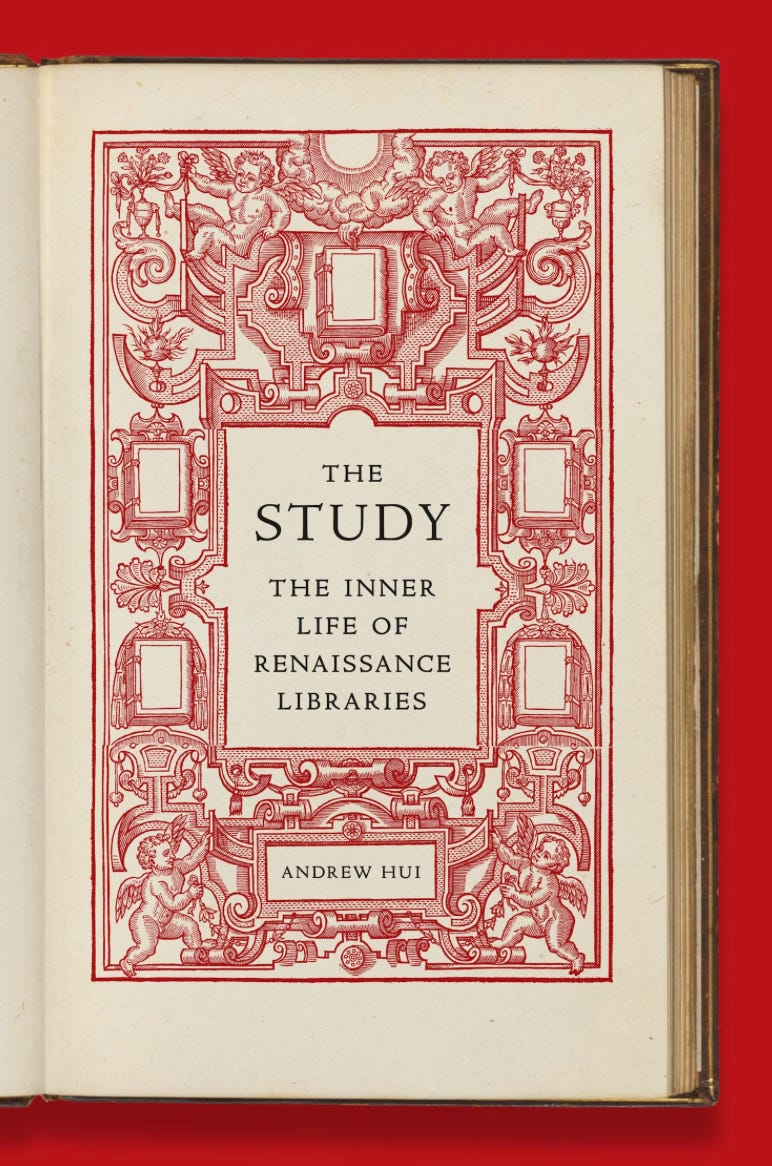
The story of those rooms, and the personal libraries contained within them, is told in Andrew Hui’s new book, The Study: The Inner Life of Renaissance Libraries (Princeton, 2024). Moving from late medieval Florence to sixteenth century France and Spain to early seventeenth-century England on the cusp of colonial empire, The Study shows how intellectuals used, loved, and were driven insane by books, as the written word worked its way ever deeper into the home and mind. Comparisons with classical Chinese and Arabic writers, as well as contemporary intellectuals, help to tell the story; copious illustrations, both imaginary and actual, make it a delight to read. Sparkling and capacious, it’s exactly what I expect from Andrew Hui, an old friend whose work I’ve been reading for many years.
For Hui, more is at stake than a new approach to domestic space, or even to reading and authorship. In personal libraries, we see the birth of that elusive animal, the modern self. In the Renaissance, the study emerged as a space for personal cultivation—at least the equal of that other site of domestic self-definition, the bedroom. In separating the intellectual life of its owner from that of the family, it “manifested the desire for an inner life” (6). And in its location in the household, it differed from the collective culture of the universities or monasteries. “In the studiolo the individual curates and produces culture, whereas in the bibliotheca it is the institution that does so” (10). Studies create individuals, university or monastic libraries reproduce institutions.1
At first, the private study was as much aspiration as reality. For the earliest Renaissance intellectuals, such as the poet Petrarch, born at the beginning of the fourteenth century, building a personal library was no easy task. Manuscript books were shockingly expensive, out of reach of all but the wealthy or the connected. Rare works, alluded to in sources, were difficult or impossible to track down: no one knew what exactly had survived the fall of Rome. "I am unable to satisfy my thirst for books,” Petrarch wrote.
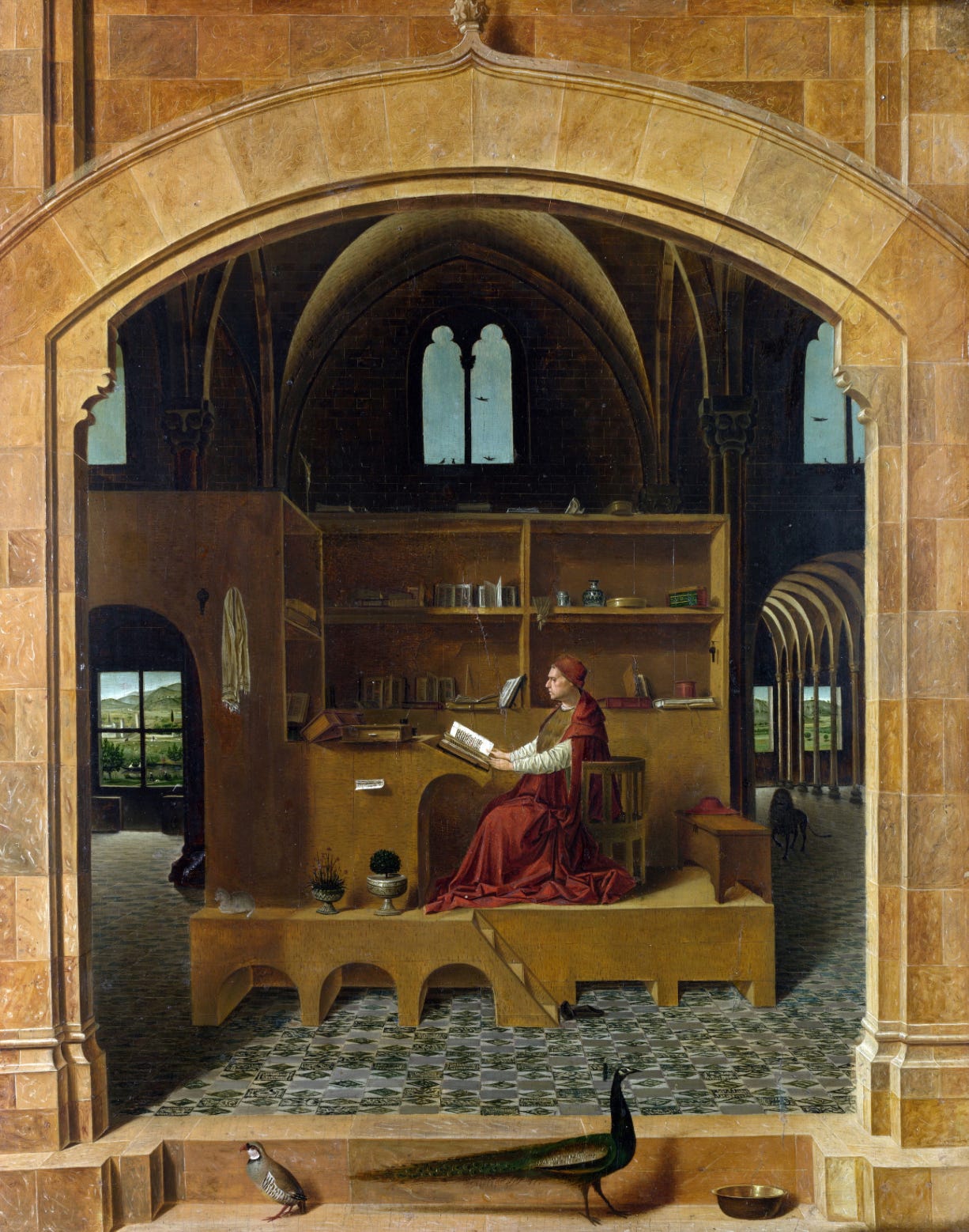
Still, he and his friends did manage to piece together libraries. In Petrarch’s case, he began with a copy of Augustine’s City of God, purchased at age 21 for 12 florins, about two months’ wages for an unskilled construction worker: a relatively cheap book.2 “I perhaps own more [books] than I ought,” he admitted (36). Alone among the volumes he had painstakingly gathered, Petrarch felt himself to be in intimate conversation with the dead, their voices echoing across the centuries. In Petrarch’s study, “the obsolescent grandeur of antiquity dissolves,” Hui writes, “and is replaced with a utopia of the mind” (31). By the time Petrarch died in 1374, such dialogues with the dead were more necessary than ever; by then, nearly all of his living friends were also gone, swept away in the Black Death.
Petrarch didn’t know it, but the conditions that would change the history of writing were already present in his life and library. There were the rising rates of literacy, reshaping government, trade, and the educational system, leading to a heightened demand for books. And there was the Black Death, which by some accounts was responsible for print. Following the plague years, labor shortages made wages surge. In a commercializing Europe, experiments were made in every sphere with labor-saving technologies. Literate labor seems to have been hit particularly hard by the plague: everywhere schoolmasters and clerks were in high demand; so were copyists, driving the price of books up.3 The printing press, that transformative example of a capital-intensive, labor-saving device, was one consequence.
As print began to flood Europe, the rich and educated were able to build impressive libraries, on a scale of which Petrarch and his friends could only dream. Montaigne exemplified the new modes of introspection that developed as individuals sought to chart a course through their private libraries. As Hui writes, “his lesson to us is that in every studiolo lies an autobiography of the soul” (150).
But with bibliophilia came bibliomania: in the second half the book, Hui shows the dangers intrinsic to a world where everyone lived in his own, slightly different, media landscape. If one side of the coin was individual self-actualization, the other was solipsism. As Hui points out, the story of the famous fictional madmen and magicians of the Renaissance, Don Quixote, Prospero, and Faustus, begins in the study. It is with Faustus, and “the total library as hell” (229) that he concludes. As he puts it,
In the turbulent cosmos of modernity, the studiolo forges an uneasy microcosm of the world. The soul and the system can dance or they can battle. With Faustus, after such knowledge, Marlowe bestows no forgiveness. It is not until Goethe that he is redeemed (236).
A reprieve, however, that proves to be temporary: in the twentieth century, he’s again dragged down to hell.
In a moment where our little rooms are at once self-enclosed realms and infinite libraries, the relevance of Andrew’s work could hardly be sharper. As he explains, the book began as a pandemic project: unable to visit libraries and museums, he sought to map his own study; in the process, he found a new angle from which to consider one of the fundamental transformations in the history of the world.
It’s this capaciousness of perspective, the idea that understanding anything has the potential to illuminate everything, that draws me to Andrew’s work. We first met nearly two decades ago in graduate school, before we, like our classmates, scattered across the world. While my phase of global peregrination was relatively short-lived, Andrew moved permanently to Yale-NUS, in Singapore. In some respects our interests, like our time zones, diverged: while I became increasingly preoccupied with the social and economic history of early modern Britain, Andrew continued to range through vast swathes of the intellectual and aesthetic life of the world. His previous book, A Theory of the Aphorism, followed that oldest and newest of forms from Confucius through Francis Bacon through Nietzsche to Twitter (among many more—unfortunately, he wrote too early to encounter Substack’s brilliant aphorist Philip Traylen ).
In other respects, though we share an orientation: we’re both interested in tracing very long arcs of literary history; we both think you need to understand the past to understand the present and the present to understand the past; and we both see the Renaissance as a vital moment of transformation, which continues to shape our contemporary world even as it recedes ever further.
In the next couple of weeks, I’m going to post a written conversation between us on the topic of the Renaissance, past and future, local and global, which will hopefully be only the opening of a much wider conversation with the readers and writers of Substack.
I derived the comparison from the figures in Richard Goldthwaite’s magisterial The Economy of Renaissance Florence (Baltimore: JHU, 2009). Attempts to convert earlier monetary amounts into modern money are too misleading to use, since the ratio between different prices changes radically over time. Grain prices and unskilled labor in the building trades are the most common baselines, since they’re the rare figures that can generally be found across time and space, and they are illuminating.
This is a slight tangent from Andrew’s marvelous book, but I couldn’t resist! On this point, see “The Cost of Doing Scribal Business: Prices of Manuscript Books in England, 1300-1483,” by Joanne Filippone Overty, which helpfully calculates the proportion of labor as a cost of book production.
Comments
Nothing yet. Say the first thing.
Sign in to join the conversation.