
This book is an absolute treasure, one I’m happy to lose myself in again and again — but it’s not a book you exactly “read,” at least, not in the ordinary sense of reading a book from start to finish (although theoretically you could). No, this is a book to open at random, wandering through it with no clear plan but relishing the sights as you go.
Tolkien’s Library: An Annotated Checklist, compiled and edited by Oronzo Cilli, is exactly what its title indicates: a catalog of all the books Tolkien is known to have owned and/or read, plus notes on each entry provided by Cilli. It’s not, to be clear, an analysis of how Tolkien read, or a scholarly treatise on what he read; it is, simply, a list — a detailed catalog — of his reading.
If all this sounds painfully dull, think again! Admittedly, if you tried to read the book in the ordinary, cover-to-cover fashion, then yes, it would probably become tedious; but that’s not what you do with a book like this. You can drop into any part of Tolkien’s Library, peruse it, flip through it, following whatever rabbit-holes it takes you down and enjoying the surprises and insights that you find along the way.
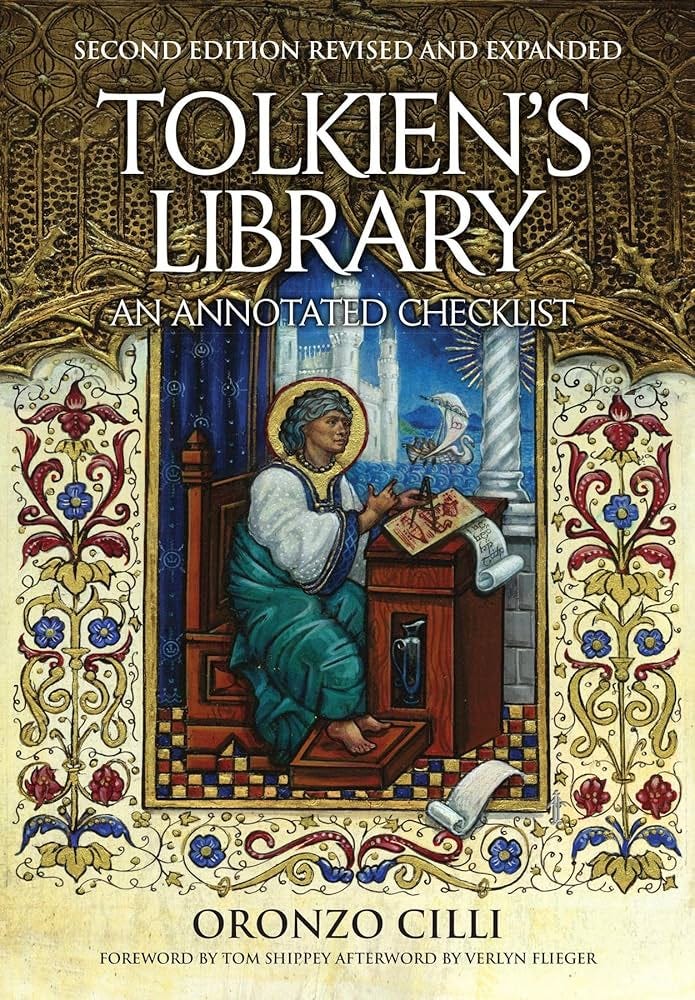
And what terrific insights they are! Cilli’s annotations are succinct and to-the-point, but they often conjure up whole biographical windows into Tolkien as a reader. One of my favorite such windows is that of Tolkien adding contemptuous marginal notes such as “most unlikely!” and “nonsense!” to a chapter on the Germanic Consonant Shift written by fellow philologist Hermann Hirt. (Clearly Tolkien disagreed rather strongly with some of Hirt’s claims!) This is a terrific glimpse of Tolkien the philologist, both erudite and passionate about his subject.
Another favorite entry of mine is that for Tolkien’s copy of the New Testament: according to Cilli, Tolkien took “numerous notes” on the text and added corrections to the footnotes; moreover, the book contains “numerous instances of burned spots from tobacco ash falling on the pages.” We have to picture Tolkien reading his Bible, annotating it (as well as deigning to disagree with some of the footnotes!), all while intently smoking his pipe: it’s a delightful mental image.
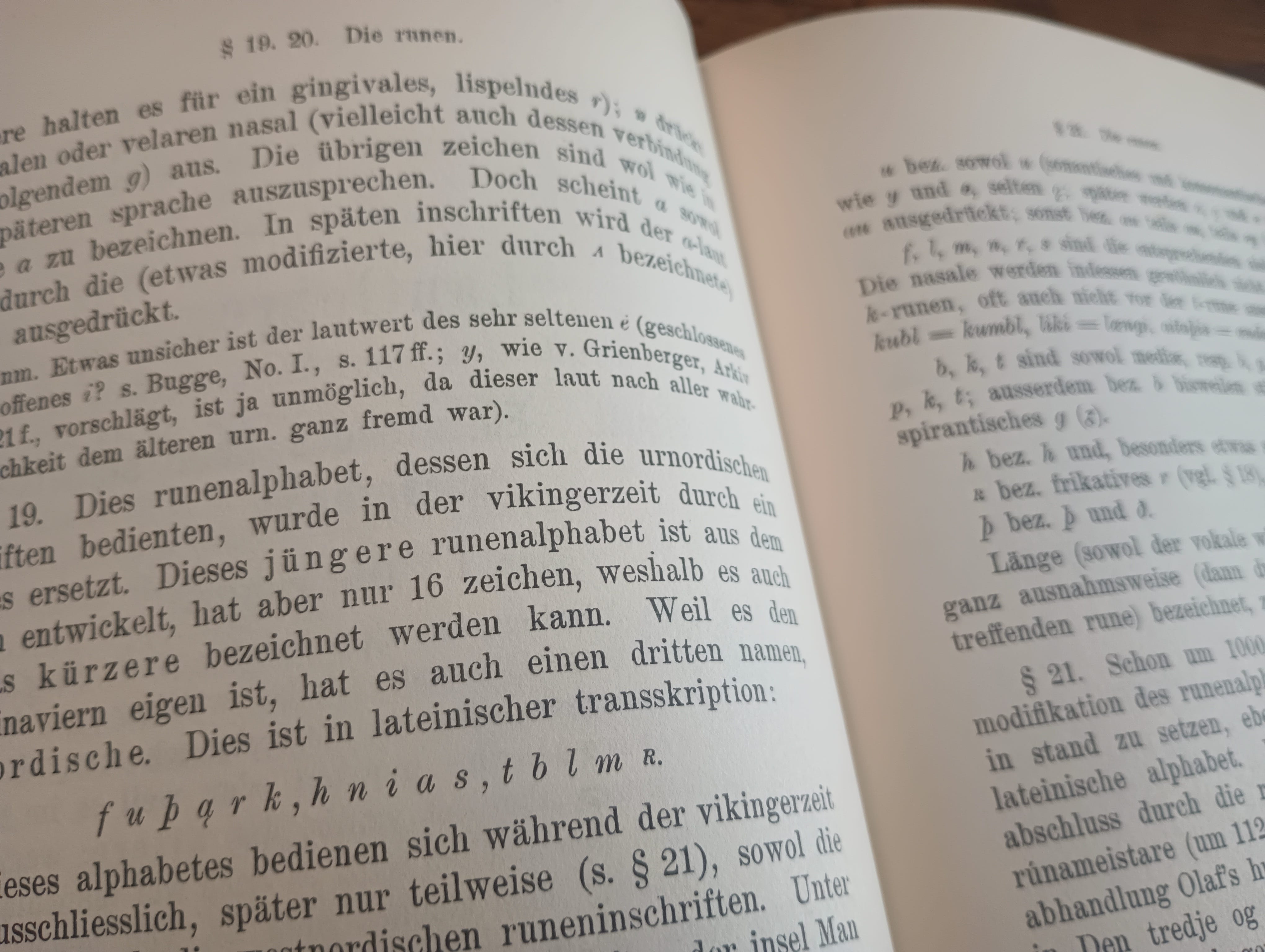
It should be stressed that not all of Cilli’s annotations contain equally illuminating or interesting biographical windows; but many of them do. Some of these biographical windows are merely intriguing: for example, in his copy of Adolf Noreen’s Altnordische Grammatik (i.e., Old Norse Grammar), a classic philological text, Tolkien bookmarked pages 14-15, which cover runes: one wonders why, but can’t help but think also of Tolkien’s own use of runic writing in his fiction.
Other biographical windows are more poignant: Tolkien’s copy of Sir Thomas Malory’s Le Morte d’Arthur (or one of them, anyway: Tolkien had several) bears the inscription “Geoffrey B. Smith January 1910”; and underneath, in Tolkien’s own handwriting, “left by will to JRRT.” G.B. Smith, of course, was one of Tolkien’s dearest school-friends, killed in the trenches of WWI: this copy of Malory was one of several books bequeathed by Smith to Tolkien, a fact which Tolkien carefully recorded.
Other of Cilli’s annotated entries are suggestive of the sheer fertility and creativity of Tolkien’s mind. We learn that Tolkien, in his copy of the Old Norse legendary poem Atlakvitha, rendered some of the poem’s lines into Old English verse in the margins: perhaps an experiment in the differing poetic registers and dictions of Old Norse and Old English verse, a topic Tolkien was interested in. But it’s an experiment only someone like Tolkien would think to carry out in the margins of a scholarly text.
Perhaps even more strikingly, in a text of the Old High German poem Evangelienbuch by Otfrid of Weissenburg, Tolkien translated some of the lines of this early medieval German poem into Quenya! This is again a fact that Cilli records straightforwardly, without further reflection or analysis; but it’s a rich biographical detail all the same.
Finally, one of the things that Cilli’s catalog most impresses upon me is the sheer depths of Tolkien’s erudition. Tolkien’s library included, of course, a whole range of books pertaining to his professional field of philology, that wonderful blending of linguistic study, literature, folklore and fairy tales: just to name a few, he owned a two-volume set (written in German) on Old Celtic vocabulary; a book (again written in German) on place-names and field-names in Northern Frisia; a book (this one in French) on the Indo-European “nasal infix” in Celtic languages; Grimms’ fairy-tales (again in German); a book of Welsh folksong and stories; the Middle English Pearl, Old Norse Prose Edda, Medieval French Lais of Marie de France (all annotated by Tolkien); and much more.
As dry as some of these might sound, books like these — books on things like field-names in Northern Frisia — reflect a crucial part of Tolkien’s imagination: the historical and linguistic precision, the detail of cultures and languages, that make his invented world of Middle-earth so distinctively tangible and vivid.
But Cilli’s catalog provides glimpses into other, perhaps less-expected aspects of Tolkien’s brilliant mind, areas beyond the realms of Germanic and Celtic philology. We learn, for example, that Tolkien evidently read Thomas Aquinas’ monumental Summa Theologica with great engagement and reflection (his seven-volume set was copiously annotated by him); we also learn that, as an undergraduate, he made a list titled “Books in Exeter Library useful,” the contents of which include some no-brainers — for example, books on Swedish, Danish, and Irish — but which also reveals the range of the young Tolkien’s philological curiosity: other items on the list includes books on Basque, Hungarian, Polish, Turkish, and Japanese.
If you’re a fan of Tolkien, then this book is a delight to browse through — especially if you’re interested in the literary, philological, and bibliographic contexts that he himself was immersed in. I think the book is valuable not only for the biographical glimpses I mentioned above, but also for the fascinating record of nearly- or totally-forgotten books it records. Who knows what treasures you might stumble upon to add to your own reading list?
No posts
Comments
Nothing yet. Say the first thing.
Sign in to join the conversation.