
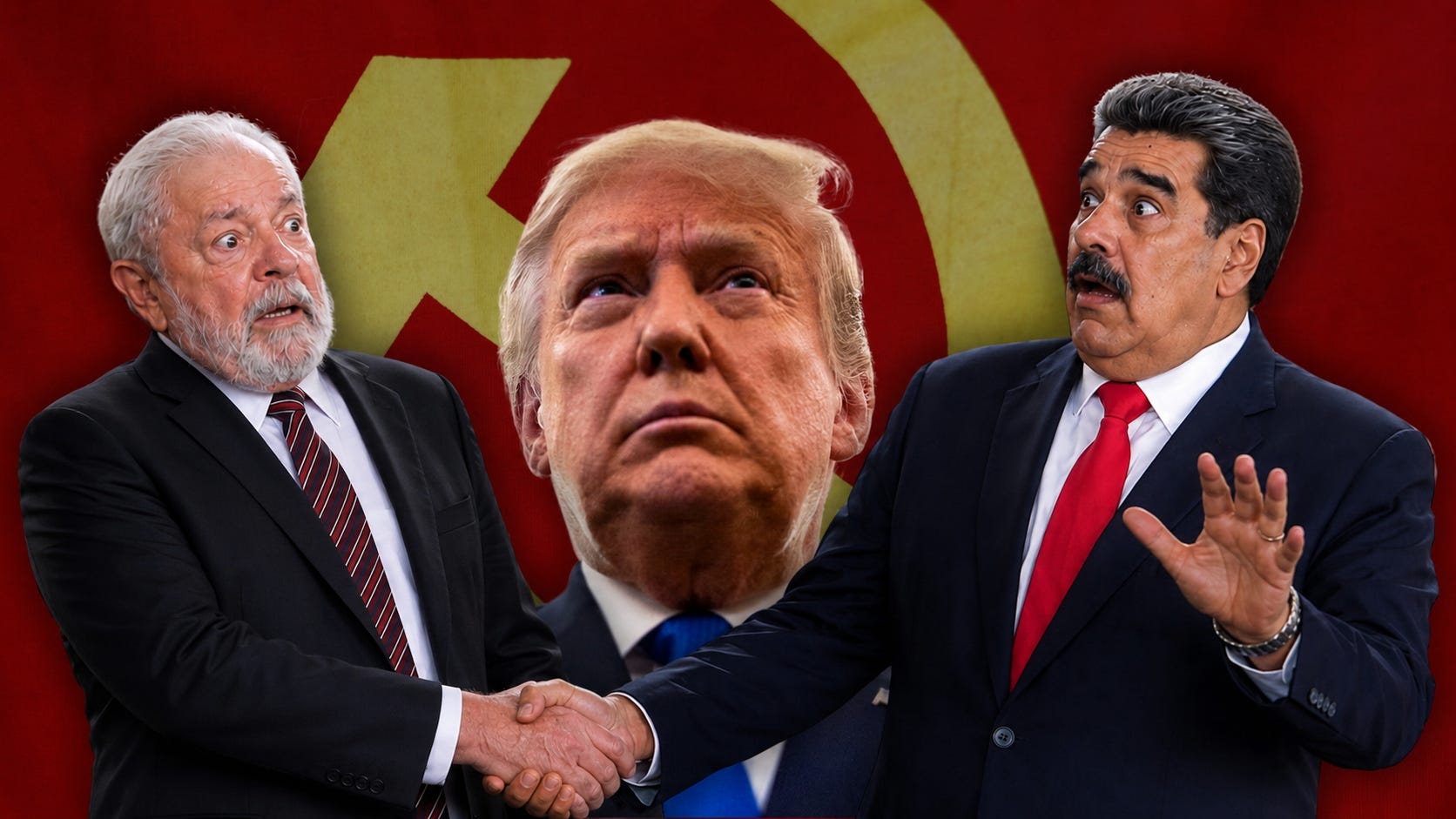
As the October 2026 presidential elections loom in Brazil, the international communist movement is fighting desperately to preserve its most important operational base in the Western Hemisphere.
Under the third presidency of Luiz Inácio “Lula” da Silva, the South American giant has become the strategic headquarters for the coordinated advance of socialism across Latin America—a project whose architects have never hidden their ultimate goal of rebuilding what was lost when the Soviet empire collapsed.
That project is now under severe pressure from a resilient Brazilian resistance led by the Bolsonaro family and its allies, even as the regime in Brasília escalates its campaign of judicial tyranny, censorship, and political persecution. But the battle ahead will be long and hard.
The stakes could hardly be higher for the United States. A consolidated communist beachhead in Brazil — home to more than 200 million people, vast natural resources, and a strategic position controlling much of the South Atlantic — would threaten American national security for generations.
The same networks that even recently dreamed of a “Union of Latin American Socialist Republics” continue to operate openly through the São Paulo Forum, the organization Lula co-founded with Fidel Castro, the Sandinistas, and the mass-murdering Marxist narco-terror group FARC. Their success or failure in the coming months will reverberate far beyond Brazil’s borders.
Few institutions better illustrate the continuity of the communist project than the São Paulo Forum. Founded in 1990 in the Brazilian city that gave it its name, the Forum was the explicit response of Latin America’s Marxist parties and guerrilla movements to the fall of the Berlin Wall.
As Lula himself later explained, the Left had previously believed “the only possible way to achieve power was violent struggle.” The Forum offered a new strategy: electoral conquest combined with the cultivation of criminal and terrorist networks that would provide both funding and muscle.
The late Brazilian philosopher Olavo de Carvalho, who went on to become President Jair Bolsonaro’s right-hand man during his term in office, offered warnings about the Forum for years. Unfortunately, they went largely unheeded by Western elites even as subversives within the U.S. government and the Deep State aided and abetted its takeover of the region.
“The São Paulo Forum,” he explained in a 2010 interview with this writer for The New American, “is the strategic command of the communist and pro-communist movement in the continent.”
Bringing together more than 100 legal parties and social movements alongside terrorist groups such as the Revolutionary Armed Forces of Colombia (FARC) and Chile’s MIR, the Kremlin-backed organization at one time controlled almost two thirds of Latin America’s governments. Legal organizations provided political cover; criminal networks supplied the money from drug trafficking, kidnapping, and extortion.
The goal was straightforward: to recover in Latin America what had been lost in Eastern Europe, as the Forum itself recorded in its 1997 minutes.
Lula chaired the Forum for more than a decade. Under his first two presidencies (2003–2010), Brazil became the financial and diplomatic engine of the “Pink Tide” — what this magazine has long called the Red Tsunami. Venezuelan oil money, Cuban intelligence expertise, and Brazilian diplomatic cover combined to install allied regimes across the region.
Even after Lula’s 2018 imprisonment on corruption charges (he helped steal money from the state-owned oil giant for himself and communist allies across Latin America) and Jair Bolsonaro’s 2018 victory, the Forum never disbanded.
With Lula’s return to power in 2023 after an election marred by massive fraud, Brasília resumed its role as the movement’s principal base of operations.
Lula has made no secret of his ideological affinity. At a 2023 São Paulo Forum meeting he declared that being called a communist or socialist “does not offend us.” “On the contrary,” he continued, “it makes us proud.”
The statement was not rhetorical flourish. It accurately reflected the continuity of a project that has always subordinated short-term economic pragmatism to long-term revolutionary consolidation.
Lula’s foreign policy has been a study in alignment with the principal enemies of the free world. His repeated visits to Moscow — including attendance at Vladimir Putin’s Victory Day parade — have drawn sharp criticism even from Brazil’s mainstream media. He has repeatedly echoed Russian and Chinese talking points on the war in Ukraine, suggesting that Kyiv should cede territory and that the United States is primarily responsible for the conflict. Brazil under Lula has remained a major buyer of Russian energy products and a vocal opponent of Western sanctions.
Relations with the Cuban dictatorship remain intimate. Lula’s personal friendship with Fidel Castro dated back decades; the Cuban Communist Party was a co-founder of the São Paulo Forum. The same pattern holds with the Chinese Communist Party. Lula has deepened economic dependence on Beijing while praising the “multipolar” world order that both Moscow and Beijing (and many Western globalists) promote as an alternative to American leadership. According to a U.S. congressional report released in February, the regime is even hosting a secret CCP military space base in Bahia.
These relationships are not mere diplomatic diversification. They form part of a coherent strategy to weaken U.S. influence in its own hemisphere while shielding the Forum’s member regimes from accountability for human-rights abuses, drug trafficking, and electoral fraud.
As de Carvalho observed years ago, the revolutionary movement long ago perfected the art of using internal dissidence and tactical moderation as camouflage. Lula’s occasional “market-friendly” gestures serve the same purpose that Lenin’s New Economic Policy once did: temporary concessions to buy time for the consolidation of power.
The rise and restoration of Lula and the São Paulo Forum did not occur in a vacuum. Powerful forces within the U.S. establishment and the broader Western globalist apparatus have systematically aided, abetted, and shielded the communist network for decades — often while American taxpayers footed the bill and official Washington pretended the threat did not exist.
At the center of this enabling network stands the Council on Foreign Relations (CFR), the premier brain trust of the American Deep State. For years the CFR’s Latin America portfolio was directed by Julia Sweig, a figure U.S. counterintelligence officials identified as an “agent of influence” for the Castro dictatorship.
Sweig enjoyed unprecedented access to Cuban archives, praised convicted Cuban terrorists in her writings, and secured exclusive interviews for Western journalists with Fidel Castro himself.
The same organization that once helped install Castro — through New York Times propaganda by CFR member Herbert Matthews and State Department betrayal of anti-communist forces — continued to whitewash the Forum’s “Pink Tide” as a harmless social-democratic experiment.
As countless Brazilian critics repeatedly warned, American elites deliberately camouflaged Lula as a “moderate” man “of the people” while the Forum consolidated power across the continent. During a 2009 G20 summit in London, Obama called Lula “the most popular politician on Earth.”
A former U.S. ambassador, writing anonymously because the truth carried “huge” professional risks, finally stated the obvious in a piece for the Miami Herald: Brazil under Lula’s Workers’ Party forms part of “a powerful network of socialist and communist forces” bent on imposing tyranny.
“All you have to do is read the records of the São Paulo Forum,” the ambassador declared, noting that Lula’s allies — Hugo Chávez and Nicolás Maduro in Venezuela, the Castros in Cuba, Evo Morales in Bolivia, and others — are “the enemies of the United States.” Cuban influence inside Brazil, he added, is “covert but very intense.” Yet successive administrations ignored or actively rewarded this reality.
The Obama years provided the clearest illustration. In 2010, the administration transferred $2 billion in American tax dollars and advanced technology to Petrobras, Brazil’s state oil giant, even as U.S. domestic offshore drilling was throttled. Obama proclaimed that America wanted to be “one of Brazil’s best customers” once the oil began flowing — effectively subsidizing the economic base of a Forum-aligned government.
The same White House engineered the delisting of Castro’s terror regime from the U.S. State Sponsors of Terrorism list, legitimizing the very dictatorship that co-founded the São Paulo Forum with Lula. Obama’s State Department and Secretary of State John Kerry then midwifed the “peace” deal with Colombia’s FARC narco-terrorists — founding members of the Forum — granting amnesty, political power, and continued control of drug routes to mass murderers. U.S. taxpayers poured nearly half a billion dollars into Colombia in a single year to underwrite the surrender.
That was nothing new. President Bill Clinton’s “Plan Colombia” offered economic and military aid to the Colombian government on the explicit condition that criminal organizations “of a political nature” be spared. “The result was that the old cartels were destroyed and the FARC became the absolute rulers of drug trafficking in the continent,” explained Carvalho. “In reality this kind of ‘war on drugs’ is a war that favors the Left against Latin America.”
Globalist foundations and United Nations organs reinforced the U.S. Deep State’s efforts. Chilean leader Michelle Bachelet, later UN High Commissioner for Human Rights, faced credible allegations of receiving campaign funds directed by Lula from a connected Brazilian construction giant — money ultimately traced to the same corruption and narcotics networks that bankrolled Forum campaigns across the region.
When Jair Bolsonaro finally shattered the Forum’s momentum in 2018, the reaction from these circles was hysterical. Establishment media and CFR outlets branded the newly elected president a “far-right” extremist while recycling discredited smears; the same voices that had excused Lula’s alliances with terrorists and dictators now warned of impending “fascism” in Brasília.
This pattern of selective blindness and active subsidization continued into the Biden era. High-level American officials pressured Brazilian military leaders to accept the disputed 2022 results and transfer power to Lula, framing resistance as a threat to “democracy.”
The Deep State’s preferred outcome — a restored Forum beachhead under Lula — was secured. The result is the very judicial dictatorship and regional radicalization now unfolding. Americans who wonder how a convicted corruption figure and lifelong communist operative regained the presidency of Latin America’s largest nation need look no further than the long record of America’s own globalist establishment.

“Your retirement savings may not be legally yours.” The Retirement Reset documentary exposes The Great Taking, the next Great Depression, and the retirement risks most advisors will never tell you. Featuring yours truly Alex Newman. Watch free — promo code LIBERTY at checkout.
Go to retirementrenegade.com/liberty. Use promo code LIBERTY at checkout. Do it today. retirementrenegade.com/liberty
Comments
Nothing yet. Say the first thing.
Sign in to join the conversation.