
The UK’s small and medium-sized enterprises (SMEs) employ two-thirds of our workforce and generate around half our entire national income. The SME sector is a hotbeds of innovation and enterprise – vital not just to today’s economy but for our broader economic future.
“SME’s are effectively the engine room, the lifeblood of the UK economy”, says James Sheehan, Director of Capital Markets at Bowsprit Partners and a staunch advocate of “small-cap” UK-based businesses.
“But, as a nation, we aren’t putting enough capital to work to funds those SMEs,” says Sheehan. “Our pension funds, our savings as a nation, aren’t going towards the development of the firms we need to drive our economy forward, creating jobs and prosperity for our children and grandchildren”.
SMEs are indeed the UK’s growth engine room – and have traditionally relied on high-street banks for the finance they need to expand and develop. But, over many years now, increasing evidence from business groups and parliamentary reports suggests Britain’s SMEs face a cumulative funding gap exceeding £22 billion, which restricts investments in productivity, digital tools and more general expansion.
Traditional bank loan approvals have tightened – as local branch networks have been cut back along with the restrictive impact of Basel III regulations, which have insisted on asset-backed lending. Application rejection and drop-off rates have consequently climbed, forcing SMEs to rely on alternative or specialist lenders.
More recently, as inflation has remained persistent, as overheads have risen sharply – not least energy costs, national insurance payments and minimum wage adjustments – squeezing operational margins even more, further limiting investment from internal cash flow.
Regional SMEs have been particularly badly hit, despite some localised government grants. But across the country, the uptake of alternative financing (such as peer-to-peer lending or commercial credit data sharing schemes) remains modest, with SME owners sometimes lacking awareness but more often finding application processes overly complex and viewing lending terms as exploitative.
Over thirty years ago, the London Stock Exchange launched the Alternative Investment Market (AIM) – specifically to help SMEs access finance from the City of London.



Since 1995, AIM has helped SMEs raise tens of billions of pounds, generating countless jobs and driving the UK economy forward. But as other sources of finance have diminishing, AIM is also increasingly now missing the target – so to speak.
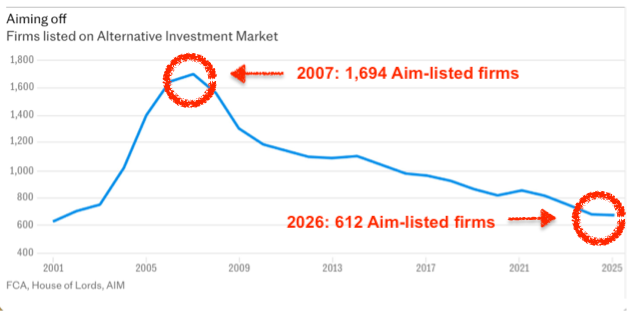
Back in 2007 almost 1,700 companies were listed on AIM. As regulation and listing costs have increased, though, with some tax advantages curtailed, that number has plummeted to little more than 600 AIM-listed firms today – a huge 64pc reduction.
James Sheehan remains an outspoken champion of AIM, having helped to launch many of the generally restricted number of listings on the junior tier of the London Stock Exchange over recent years.
In this full-length interview on When The Facts Change, he discusses with Liam Halligan how and why AIM should be revitalised. A five minute preview of that interview can be viewed below.
Sheehan feel that the UK’s broader financial services sector, while the source of a healthy share of tax revenues, is failing the country in a more general sense – with just a small share of pension assets and other domestic savings now being channelled into domestic firms – not least British-based SMEs that will generate wealth and prosperity for Britain in the years and decades to come.
In this extended interview, with a genuine finance insider, Sheehan outlines recent listings he has worked on, while putting forward the policy and regulatory changes he believes are needed to get the City of London working again for Britain’s SMEs – particularly the revamping and regeneration of AIM.
If you want to watch the full forty-minute conversation between Liam Halligan and James Sheehan, please support my efforts to develop When The Facts Change by becoming a paid subscriber. For less than the price of a pint each month, you’ll be helping me to both report on and analyse on the state of the UK economy, and the the broader global context.
At what is a critical time for our country, a critical juncture in history, a critical few years ahead, please back my independent writing and broadcasting if you can – allowing you to access not only this conversation between myself and James Sheehan, but everything I write and broadcast on When The Facts Change – along with my full Substack archive.
Thank you, Liam Halligan
Comments
Nothing yet. Say the first thing.
Sign in to join the conversation.