
Most hosts expect podcast booking to get easier as their show grows.
It often doesn’t.
A show with 50 episodes has a larger back catalog, a stronger reputation, and a more defined audience than a show with 5.
But the host is still spending the same hours on outreach, the same time on scheduling, and the same energy on conversations that don’t convert to recordings.
The show got better. The booking system didn’t.
The shows whose booking systems get easier over time aren’t the ones that grew the fastest or accumulated the most downloads.
They’re the ones whose hosts built deliberate compounding mechanisms into the booking process from early on, so that every month of consistent activity made the next month’s booking task smaller rather than equivalent.
That compounding is what this post is about.
Compounding in a financial context means that returns generate their own returns. The same principle applies to a guest acquisition system, but the currency is reputation, relationships, and platform signals rather than money.
3 types of compounding run in a well-built Talks booking system.
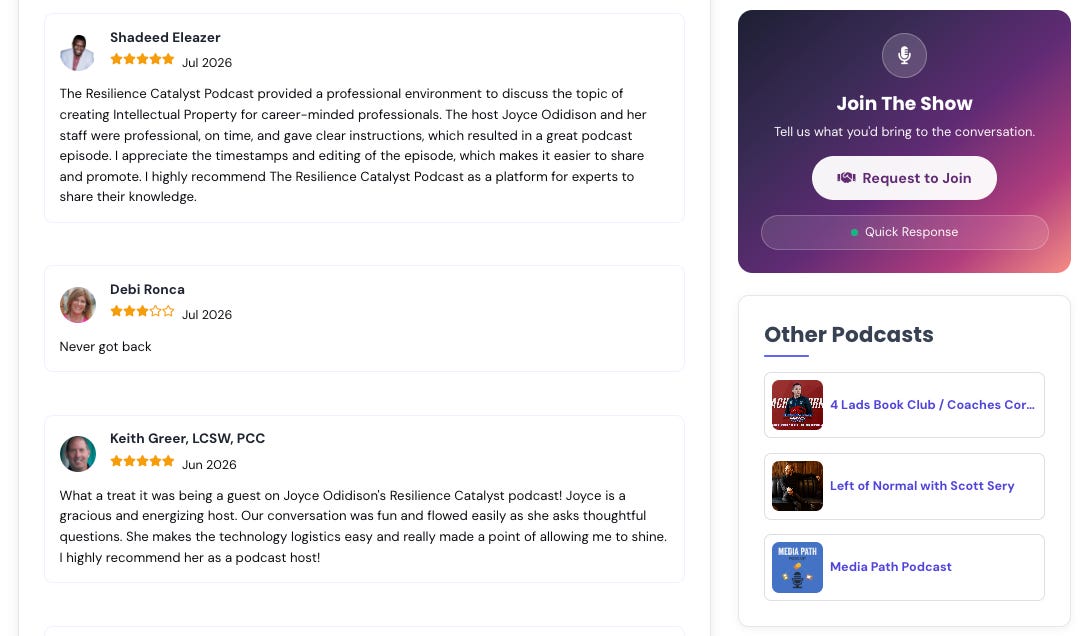
Every completed interview, every review received, every quick response to a message adds to the public authority signals on your Talks show profile.
What accumulating authority signals does: Makes your show progressively more attractive to higher-caliber guests without requiring any additional active work; a show profile with 30 completed interviews and 15 strong reviews is a fundamentally different proposition to a potential guest than the same show at 5 completed interviews.
How it compounds: A stronger profile attracts better guests. Better guests produce stronger episodes; stronger episodes attract more listeners and more listeners make the show more attractive to better guests. The cycle accelerates rather than plateaus when the inputs are consistent.
What maintenance looks like: Completing every recording and moving it through the Talks workflow immediately, leaving reviews within 24 hours of every recording, and keeping the profile updated with new episodes as they publish.
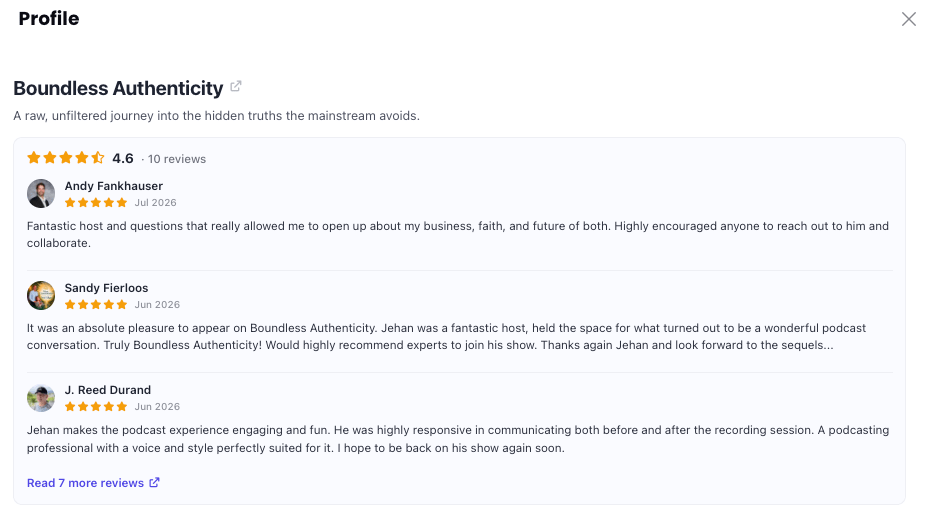
Every podcast guest you record with is a node in a network of potential future guests, hosts, and collaborators.
What relationship compounding produces: A referral network that generates inbound guest applications without requiring active outreach. A show with 50 recorded guests who each make one introduction over time has 50 warm referrals feeding the pipeline without a single additional connection request sent.
How it compounds: Referred guests tend to refer other guests. A network effect builds around shows that treat their guests well, follow through consistently, and produce episodes worth sharing. The shows that develop this reputation find that podcast guest acquisition shifts from outbound to increasingly inbound over time.
What builds the relationship capital that produces referrals: Showing up prepared for every recording, following through on every commitment made to the guest, leaving thoughtful reviews promptly, and making introductions proactively before being asked.
Every backlink from an episode show notes page, every social profile that links to your Talks show profile, and every platform mention of your show adds to the search authority that makes your show discoverable to guests who are actively looking for shows to appear on.
What visibility compounding produces: Passive inbound guest discovery from guests who find your show through Google, through AI search results, and through the Talks platform’s own matching algorithm without you having to initiate contact.
How it compounds: More appearances produce more show notes pages that link to your profile, more links strengthen your Google ranking. A stronger Google ranking produces more passive discovery, more passive discovery produces more inbound connection requests, and more inbound connection requests reduce the outbound effort required to keep the pipeline full.
What the visibility looks like at different stages: At 20 episodes the compounding is beginning. At 50 it’s noticeable. At 100 the inbound flow from visibility compounding is substantial enough to meaningfully reduce the outbound effort required to maintain a full calendar.
Create Your Free Talks Show Profile
Compounding doesn’t happen automatically. It happens when specific habits are applied consistently enough that the outputs of each month’s activity become the inputs of the next.
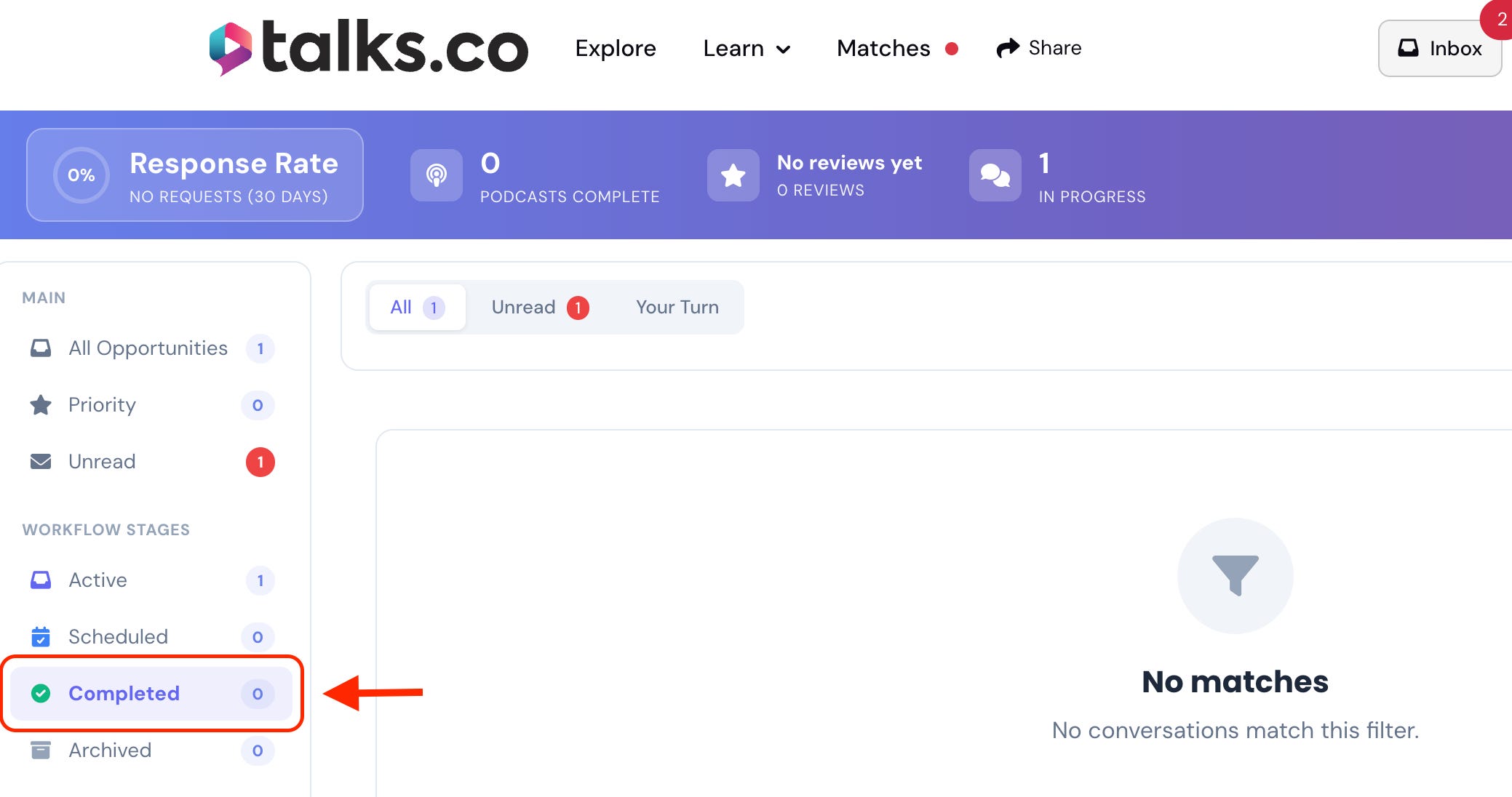
A recording that moves all the way through the Talks workflow, from active to scheduled to completed to reviewed to archived, contributes to every compounding mechanism simultaneously.
What completing the workflow produces: An accurate completed count, a triggered review prompt, a clean inbox, and a platform signal of consistent follow-through that strengthens your profile’s algorithm weighting.
What skipping steps costs: Incomplete authority signals, missed review opportunities, and a cluttered inbox that makes the pipeline harder to manage. The cost compounds in the wrong direction just as the benefit compounds in the right one.
The habit worth building: As soon as a recording is complete, open the Talks inbox and move the conversation to completed before doing anything else. The 2-minute action keeps every compounding mechanism running accurately
Reviews compound faster than any other authority signal on the platform because they’re visible to potential guests, searchable within the platform, and reciprocal in a way that produces more reviews than any other action.
What a growing review profile does to inbound guest quality: a show with twenty strong written reviews from guests who recorded with you is a show that higher-caliber guests feel safer connecting with. The review profile does qualification work for you before a conversation opens.
What the reciprocal effect produces: Podcast hosts who leave reviews consistently receive reviews at a higher rate than hosts who don’t. A podcast show profile with strong reviews from podcast hosts attracts guests who know that appearing will be acknowledged and documented.
The timing that produces the best reviews: Immediately after the recording while the specific details of the conversation are still fresh. A review written 6 weeks after a recording is less specific and less useful than one written the same day.
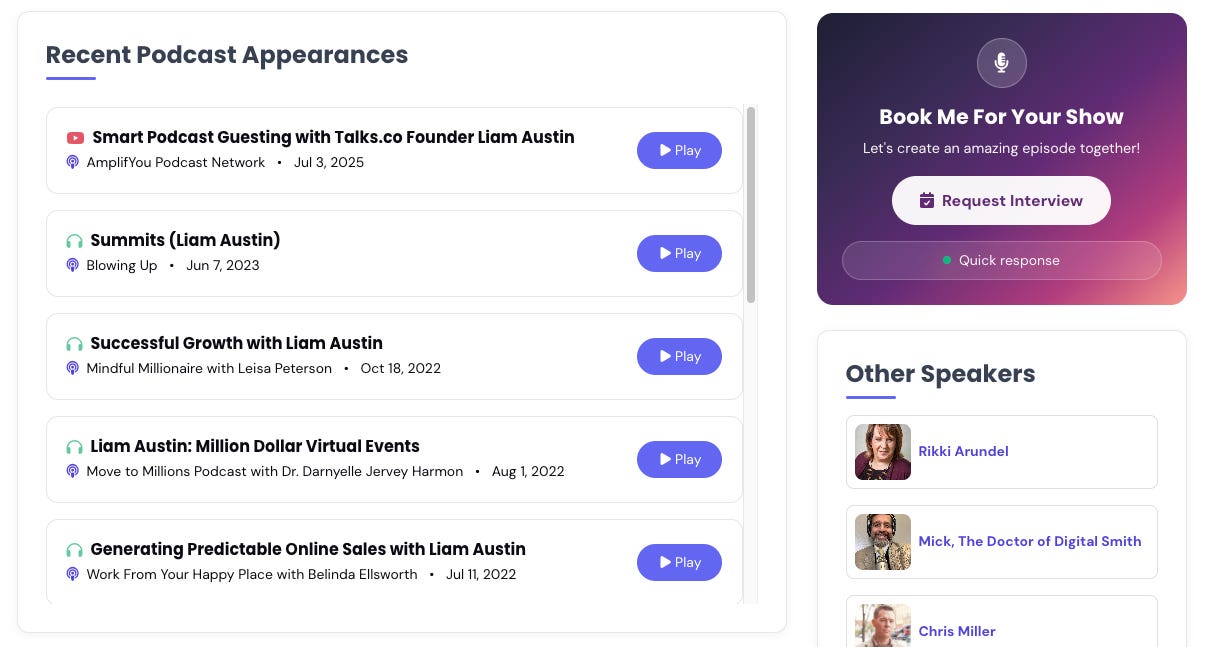
Every podcast episode added to your profile is a piece of social proof, a backlink source, and a demonstration of publishing consistency.
What an up-to-date episode list produces for inbound guests: A clear picture of the show’s consistency, quality, and audience focus that a potential guest can assess before they send a connection request. A show that hasn’t added episodes to its profile in 3 months looks inactive regardless of how many episodes it has actually published.
What a consistently updated episode list produces for the algorithm: A signal of active platform engagement that strengthens your show’s placement in match suggestions and search results.
The habit worth building: Add each new episode to your Talks profile on the same day it publishes. It takes 3 minutes and keeps every compounding mechanism fed with current information.
A single ask after every recording is the most leverage-efficient action available in a podcast guest acquisition system.
What one introduction per guest produces at scale: A show that records 2 guests per week and asks each one for an introduction generates 8 to 10 warm referral opportunities per month without any additional outreach effort. Not all of them convert, but even a 20% conversion rate produces 2 additional recordings per month from referrals alone.
The ask that works: Specific, brief, and easy to act on. “If you know anyone in your network who would be a strong fit for the show I’d genuinely appreciate an introduction” said at the end of the recording or in the follow-up message after.
What happens to the ask over time: Early in the show’s life the referral network is small and the conversion rate is modest. At 50 recorded podcast guests, the network is substantial and a meaningful portion of new bookings come from introductions rather than outbound connections.
A pipeline that isn’t measured isn’t managed. 4 numbers checked weekly tell you whether the compounding system is running correctly or whether a specific component needs attention.
Active conversations: The lead indicator. If this number is low today the calendar will be thin in 4 to 6 weeks.
Scheduled recordings: The current inventory. A healthy pipeline keeps a minimum of four to six recordings confirmed at any given time.
Reviews written this week: The relationship compounding indicator. A week with zero reviews written is a week where relationship compounding stalled.
New connections sent this week: The pipeline inflow indicator. Consistent weekly connections rather than monthly bursts is what produces consistent calendar fullness rather than feast and famine cycles.

A podcast host who builds this system properly and applies the 5 habits consistently arrives at month 12 with something that looks nothing like what they had at month 1.
Profile authority: 30 to 50 completed interviews, a review profile with enough entries to remove booking hesitation from any caliber of guest, and a platform placement that surfaces the show prominently in search results and match suggestions for its topic area.
Relationship network: A referral network of recorded guests who know the show, trust the host, and make introductions when asked. Inbound guest applications arriving through referrals that require no outbound effort to generate.
Visibility: A Talks show profile ranking in Google results for the show name and core topics, receiving passive discovery traffic from podcast guests who find it through search and AI results without the host initiating contact.
Calendar health: A pipeline with consistent weekly inflow of new conversations, a 4- to 6-week scheduling buffer that makes selection rather than urgency the basis of booking decisions, and a recording calendar that fills more easily each month because the compounding mechanisms have had time to build.
None of this required more hours at month 12 than at month 1. It required the same consistent habits applied to every recording across the entire period.
💡 The annual Talks Pro plan is the practical commitment that gives the compounding system the time it needs.
A monthly subscription is enough to test whether the platform produces results.
An annual commitment is what allows the profile authority, the relationship network, and the visibility compounding to build long enough to become self-sustaining.
The podcast hosts whose booking systems get easier every month are almost universally the ones who made the annual commitment at the start and applied the 5 habits consistently rather than deciding each month whether to continue.
5 habits. Applied consistently. For 12 months.
Complete the full workflow for every recording.
Leave a review within 24 hours.
Add every episode to your profile on publish day.
Ask every recorded guest for one introduction.
Check your pipeline metrics weekly.
None of these habits take more than 5 minutes individually. Together they run every compounding mechanism in the booking system simultaneously.
The host who applies all 5 consistently for 12 months arrives at a recording calendar that fills with less effort, better guests, and stronger episodes than the one they started with.
The host who applies them sporadically arrives at month 12 doing roughly the same work for roughly the same results they had at month 1.
Consistency is the input.
Compounding is the output.The system works when you give it both.
This is Part 5 of a 5-part series on filling your recording calendar in 30 days using Talks.
The full series:
✅ Part 1: Creating a show profile that attracts more guest applications and matches
✅ Part 2: Using audience size and publishing frequency filters to find better-fit guests faster
✅ Part 3: Managing multiple guest conversations without losing momentum
✅ Part 4: Building a guest pipeline that keeps your recording calendar consistently full
✅ Part 5 (you’re here): Creating a long-term booking system that compounds month after month
🔖 Save this post and share it with any host who is still treating guest booking as a periodic search rather than a continuous system. The compounding starts the moment the 5 habits do. The only question is when to start.
Build Your Booking System on Talks
P.S. The review habit is the one that compounds fastest because it’s reciprocal and visible simultaneously.
A podcast host who leaves a thoughtful written review within 24 hours of every recording builds a review profile that attracts better podcast guests, receives more reviews in return, and creates a public record of a host who shows up professionally and acknowledges the podcast guests who trusted them with their time.
5 minutes after every recording. That’s the whole ask. 👇
Keep Talking, Liam
~
Visibility systems to grow your personal brand, audience + authority with guest appearances. First online sale in 2001. Built multiple 6–7 figure online businesses. 400+ interviews. Malta, Stockholm, Sydney. Love soccer, surf & burritos.
No posts
Comments
Nothing yet. Say the first thing.
Sign in to join the conversation.