
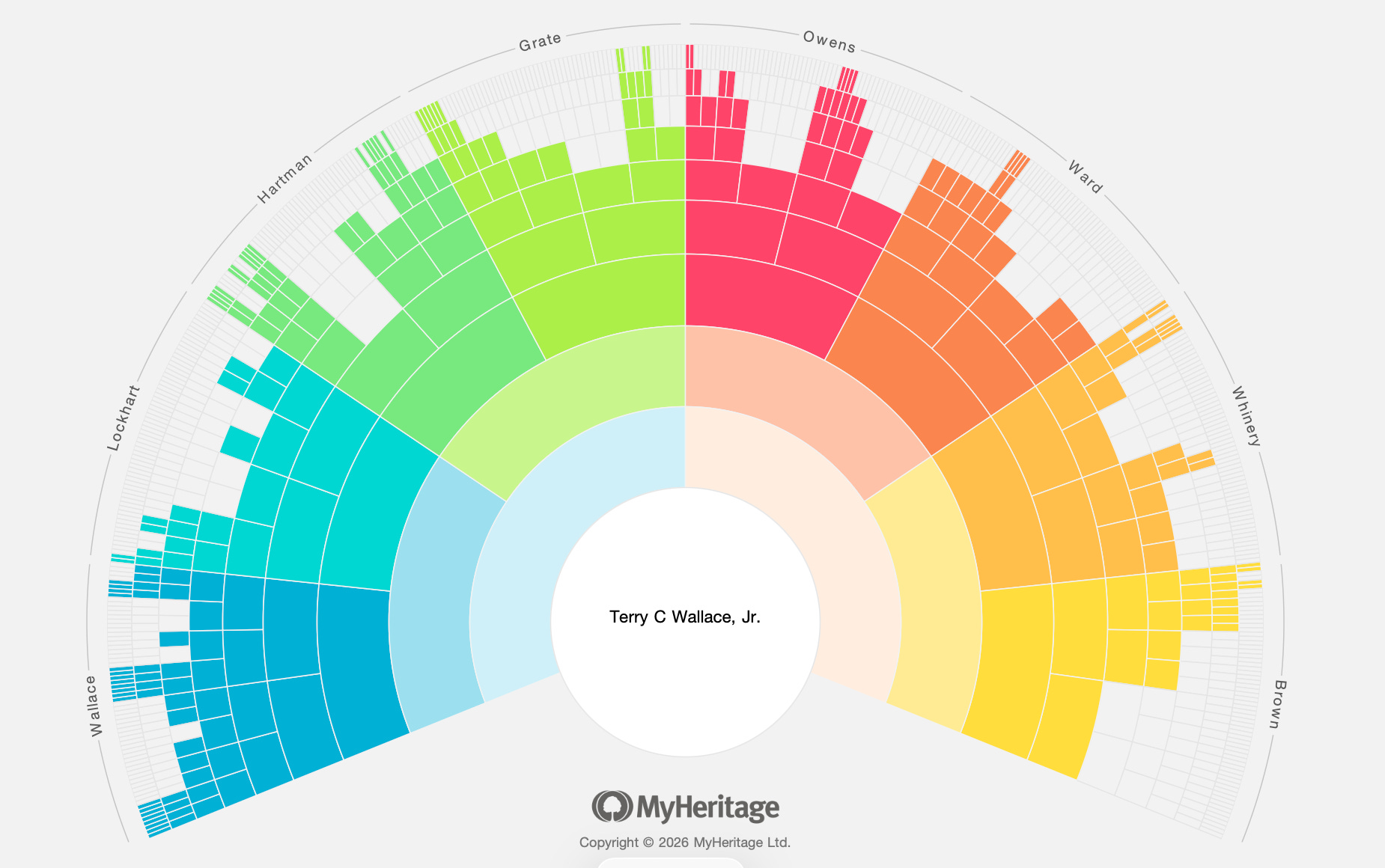
My family tree to 10 generations. the four slices on the left are the ancestors of my father, and the four slices to the right are my mothers ancestors.
On September 26, 1905, Annalen der Physik published Albert Einstein’s paper “On the Electrodynamics of Moving Bodies.” Einstein had submitted it less than three months earlier, on June 30. The paper established what we now call the special theory of relativity, helped launch modern physics, and fundamentally changed our understanding of the universe.
Einstein began with two deceptively simple principles. The first was the principle of relativity: the laws of physics must take the same form in every inertial—that is, nonaccelerating—frame of reference. The second was the constancy of the speed of light: light traveling through a vacuum has the same measured speed for every inertial observer, regardless of the motion of its source.
Einstein treated these two principles as inviolable. The surprising consequence was that space and time could no longer be fixed and independent. Observers moving relative to one another could measure different distances and different intervals of time. They could even disagree about whether two spatially separated events occurred simultaneously. Space and time were not absolute; their values depended upon the observer’s motion.
The paper did not immediately make Einstein famous. Its reception beyond a small circle of physicists was initially subdued, although Max Planck quickly recognized its importance and helped bring it to the attention of the German physics community. Acceptance spread gradually among theoretical physicists, while many experimental physicists remained skeptical. Einstein would not become a worldwide public figure until 1919, when eclipse observations were announced as confirmation of a prediction of his general theory of relativity.
Three years after Einstein’s paper, the German mathematician Hermann Minkowski came up with an extraordinary new way of understanding its meaning. In a lecture delivered in Cologne on September 21, 1908, Minkowski argued that space and time should no longer be regarded as separate entities. They formed a single four-dimensional structure: spacetime. Einstein had developed the physics and Minkowski revealed its geometry.
Minkowski’s great explanatory device was the spacetime diagram. An event—a birth, a meeting, a departure, a death—could be represented as a point with both spatial and temporal coordinates. The complete history of an object moving through spacetime formed a curve called its worldline. In a simple diagram, an object remaining in a single place traces a vertical worldline. An object moving at constant speed traces a tilted straight line. If the object accelerates, turns, or changes direction, its worldline bends.
This was more than an elegant redrawing of Einstein’s equations. Minkowski made visible something that mathematics alone had left difficult to imagine: nothing exists only in a place. Everything exists in a place at a particular time. Every object—and every human being—follows a path through both.
But this essay is not about physics. It is about ancestry—and about how an idea from modern physics helped me understand what a family tree could not.
I have been pondering why people—and Americans in particular, including me—are so fascinated by their heritage and devote so much effort to constructing elaborate family trees. We often speak of ancestry as a search for place: the country, village, farm, or landscape from which our families came. But ancestry is equally a search through time. Minkowski’s worldlines offer a different and unusually rich way to imagine that relationship.
We ordinarily draw a family history as a tree, with names branching backward into earlier generations (my family tree is the opening figure in this essay). But our ancestors, which are represented on family trees as “living” in little boxes with lines drawn to connect to little boxes for their parents and off spring, lived dynamic lives. Each followed a worldline. They moved through villages, cities, farms, battlefields, oceans, and continents. Their paths twisted and turned through childhood, work, migration, illness, love, loss, accident, and choice.
Our heritage is not described simply by the fact that our great-grandfathers and great-grandmothers met, married, and had children. Each arrived at that meeting along a unique worldline, carrying the history accumulated along the way. When two of those lives intersected, they created the possibility of a new event in spacetime: the birth of a child and the beginning of another worldline—one that would become our grandfather or grandmother.
That new life carried something forward from both lines, but never everything. DNA was recombined in birth. Names were retained or lost. Stories of lives were repeated, altered, or forgotten. Places were abandoned. Values, injuries, habits, and silences passed from one generation to the next. The intersection produced not a copy of the past, but a new human path shaped by it.
Perhaps a family tree is better understood as a spacetime diagram: a map of human worldlines twisting, intersecting, and continuing across generations until their accumulated crossings made our own existence possible.
I believe that most of us carry a profound desire to belong. We want to know where we came from and what parts of our unique selves were handed to us by people who lived before us. Are we the twentieth-generation descendant of a great king, or perhaps the fifth-generation descendant of a great scientist like Einstein? Did we inherit a family’s courage, stubbornness, curiosity, melancholy, or capacity to survive? Which qualities arrived through biology, and which were carried forward through stories, expectations, habits, and example?
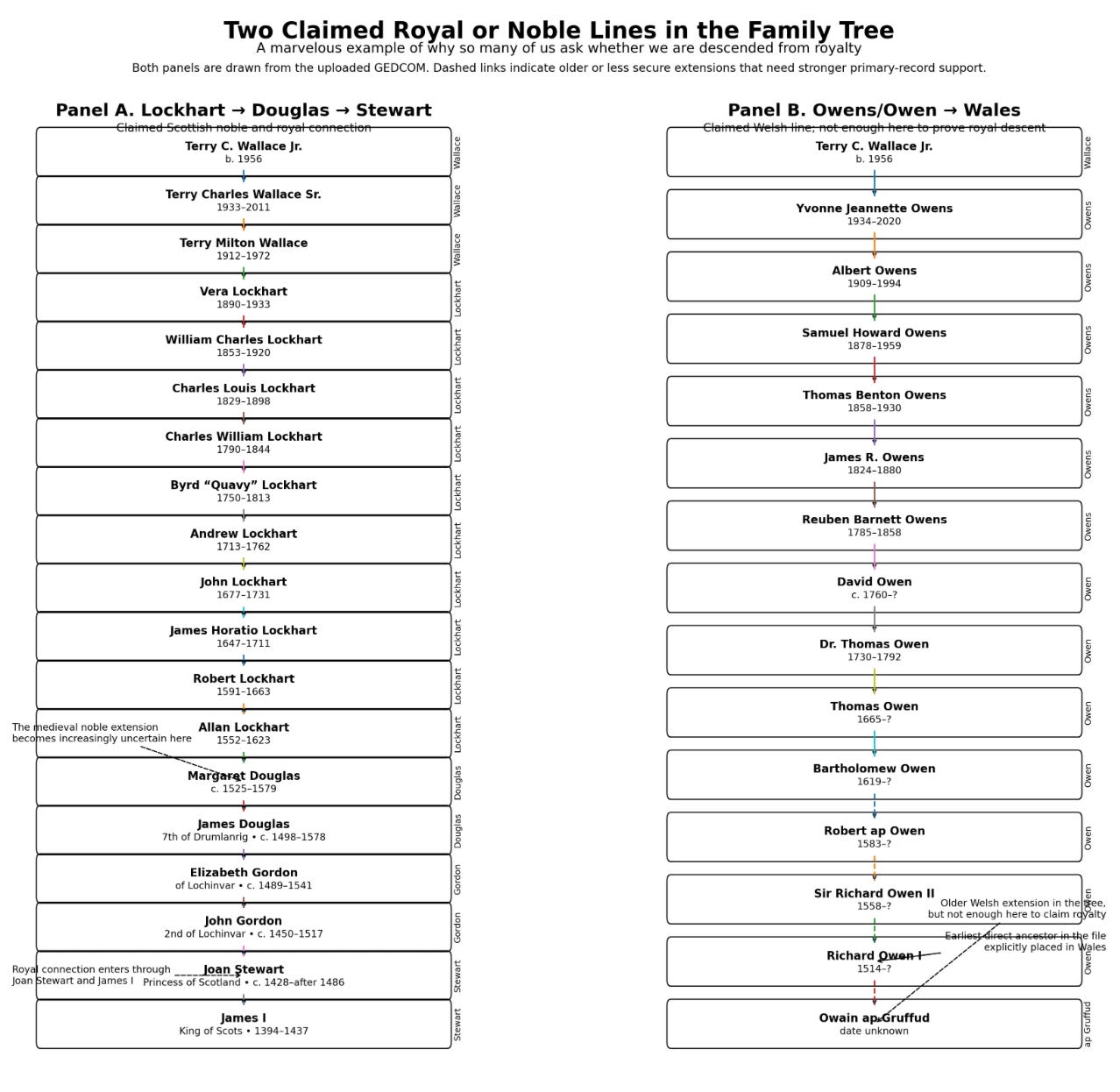
My family tree presents plausible descent from two royal lines: the founding of modern Scotland (from my father’s side) and the ancient royalty of Wales (from my mother’s side). The lines are compelling until you start calculating the DNA contributions after 10 or more generations — statistically the contribution to my DNA is about 0.098% — that is round off error!
Genealogy offers answers—or at least the promise of answers—to some of the most elemental human questions: Who am I? To whom do I belong? What has been given to me? What am I responsible for carrying forward?
Psychologists describe identity as a self generated narrative. We make sense of ourselves by placing the events of our lives into a story that connects the past, present, and future. A family tree enlarges that story beyond the boundaries of our own birth and death. It allows us to imagine ourselves as part of an intergenerational self: not an isolated individual, but one brief worldline within a much longer human passage.
That may be especially powerful in America, a nation shaped by immigration, forced migration, geographic movement, and repeated uprooting. Many of us no longer live near the villages, farms, churches, or burial grounds of our ancestors. The inherited landscape has disappeared, but the longing for connection remains. Genealogy gives us a way to recover a sense of place—and, just as importantly, a sense of time.
We search backward because the story of the self feels incomplete when it begins with our own birth. A family tree tells us that others traveled before us. They crossed oceans, endured wars and epidemics, lost children and spouses, moved west, began again, and made decisions whose consequences eventually reached us. Their lives did not point knowingly toward our existence, but their worldlines formed the causal path that made it possible.
There is also an awareness, growing stronger with age, that we are not only descendants. We are becoming ancestors. We look backward to recover what might otherwise be forgotten, even as we begin to ask what stories, values, and memories we will leave behind. Constructing a family tree is therefore both an act of inheritance and an act of preservation.
That is why I began constructing my own. I wanted to know where my family’s worldlines began, where they traveled, and how they intersected. I wanted to know how much of the story recorded in names, census forms, marriages, and family legends could be trusted—and what those records could actually tell me about the person I became.
When my sisters and I began constructing our family tree, we followed the usual path. We collected names and dates: births, marriages, and deaths. Each discovery provided a starting point for the next search backward in time. A birth certificate named the parents; a marriage record linked two families; a census placed them in a particular household. Along the way, we gathered other fragments—occupations, places of birth and death, military service, migrations—but the central goal seemed straightforward: to establish an unbroken connection from me to my father, from my father to his father, and from him to the generations before.
On paper, we succeeded remarkably well. We assembled an elaborate family tree containing more than a 1000 ancestors, with some branches extending back to the fifteenth century. The more names we found, the more substantial the tree appeared. Each new generation seemed to deepen my roots and strengthen the connection between my life and a distant past.
The records also revealed how deeply my family is rooted in the United States. Every one of my known ancestors through my sixteen great-great-grandparents was born in this country. Nearly all the identifiable family lines had arrived in North America before 1800, many during the colonial period, and then moved gradually through the Carolinas, Georgia, Tennessee, Texas, Arizona, and the American West. My family was descended from immigrants, but the immigration itself had occurred so long ago that it had largely disappeared from family memory. We had been American for generations before anyone alive in my childhood was born.
At first, this seemed to be what ancestry meant: a chain of names extending backward through time and a sequence of places marking the family’s movement across the continent. If every parent could be connected to another pair of parents, and every generation attached securely to the one before it, then the tree appeared complete.
But the names and dates left larger questions unanswered. Why did so many members of the Wallace line seem to follow the same broad path—from Scotland to the southern American colonies, through the southern states to Texas, and finally to Arizona? What circumstances pushed them from one place to the next? What did they encounter along the way? Weren’t those experiences—their migrations, hardships, choices, losses, and adaptations—just as important as their DNA in shaping who I am?
According to the family tree my sisters and I assembled, the first person in my direct Wallace line to reach America was George Sugg Wallace. The tree records that he was born in Melrose, Scotland, in 1761. Family tradition holds that George and two of his brothers crossed the Atlantic in 1777, when George would have been only sixteen years old. They supposedly came not merely in search of land or opportunity, but with a youthful desire to join the American rebellion against the British Crown.
It is an irresistible story: three Scottish teenagers leaving home, crossing an ocean during wartime, and arriving in the colonies to fight the government under which they had been born. It gives George’s worldline drama, intention, and even a touch of heroism. He does not merely appear as a name in North Carolina. He becomes a young man making an extraordinary choice at an extraordinary moment.
The records suggest that a George Wallace was living in Pitt County, North Carolina, by the time of the 1790 census. But the documentary evidence I possess does not establish when exactly he crossed the Atlantic, whether two brothers accompanied him, or why they came. Nor does it conclusively prove that every record bearing the name George Wallace refers to the same man. The story may be true, partly true, or a later family tradition constructed around a few surviving facts.
That uncertainty marked the beginning of a different understanding of genealogy. A family tree creates an impression of precision because every person is enclosed within a box and every box is connected by a solid line. But the solidity of the line is graphic, not evidentiary. A connection repeated in enough online trees can begin to look like an established fact even when all those trees ultimately rely upon the same unverified family account.
The farther back I traveled, the more I encountered this mixture of record and tradition. Dates varied. Names changed spelling. People with the same name were merged into a single person, while one person sometimes appeared under several identities. A story copied from one genealogy to another gradually acquired the appearance of independent confirmation. The tree continued to grow, but some of its most impressive branches rested upon increasingly fragile evidence.
The most revealing uncertainty, however, was not in fifteenth-century Scotland. It was much closer to me.
I am the fourth consecutive generation to bear the name Terry Wallace. My father was Terry Wallace. His father was Terry Wallace. His father was also Terry Wallace. On paper, this appears to be an unusually straight and stable line—a name passed deliberately from father to son for more than a century.
But the first Terry Wallace in that sequence, Terry William Wallace, enters the documentary record under unusual circumstances. He was born in Texas in 1887. The family tree identifies his mother as Ora Frances Terry and his father as Libb Wallace. Yet the surviving information attached to his death record identifies his mother only by the surname Terry and does not clearly name his father.
Ora Frances Terry died in 1891, when Terry William was only four years old, and there is no record of any type for Libb Wallace after 1887. Family stories say that the boy was then raised in an orphanage, although I have not found the institutional or guardianship records that would prove it. His name may preserve the essential facts of his uncertain beginning: Terry, the surname of his mother, joined with Wallace, the surname of the man believed to have been his father—or perhaps simply the family name under which the child was known.
Thus, the most apparently secure line in my family tree—the four Terry Wallaces leading directly to me—may begin with one of its greatest uncertainties. The name that looks like evidence of perfect paternal continuity may instead be the product of a mother’s early death, a child’s separation from his family, an orphanage, and an effort to preserve two names whose exact relationship can no longer be proved.
That does not make Terry William Wallace any less my great-grandfather. It makes his worldline more human. His significance lies not only in whether every biological connection can be demonstrated, but in what he carried forward: a name, a family identity, and a story powerful enough to pass through four generations.
The family tree had begun as a search for certainty. It was becoming an encounter with uncertainty—and with the realization that heritage consists of far more than an unbroken chain of DNA.
But DNA seemed to offer another way forward.
Documents can be lost, names misspelled, family stories embellished, and parentage incorrectly recorded. DNA appeared different. It was physical evidence carried within me, a biological record that had survived every migration, marriage, death, and forgotten story. Perhaps it could confirm the branches of the tree that paper records left uncertain.
I submitted a sample to FamilyTreeDNA for an analysis of my autosomal DNA. Autosomal DNA is inherited from both parents and recombined in every generation. By comparing segments of my DNA with those of other customers, the test could identify people with whom I likely shared a relatively recent ancestor. Those matches offered a potentially powerful way to test the family tree. If I shared substantial segments of DNA with descendants of a particular ancestral couple, that would strengthen the argument that the documentary connection was real.
The company also provided what it called a family-origins estimate. According to that analysis, approximately 98 percent of my autosomal DNA most closely resembled its reference populations from England, Wales, Scotland, and Northern Ireland. Everything else appeared only in fractions of a percent.
At first, the result seemed remarkably precise. Ninety-eight percent sounded almost like a census of my ancestors. It was tempting to imagine that my genome had preserved a detailed geographical account of where each branch of the family originated. But that is not what the number means.
Commercial ancestry companies do not identify DNA that is intrinsically English, Scottish, Welsh, or Irish. They divide a person’s genome into segments and compare those segments with reference groups composed of living people whose recent ancestors are associated with particular regions. The reported percentages describe statistical resemblance, not nationality. They depend upon the people included in the reference panels, the boundaries the company draws between populations, and the algorithm used to assign each segment.
Those limitations are especially important within the British Isles. The populations of Scotland, England, Wales, and Ireland are not genetically sealed from one another. People have moved, intermarried, invaded, traded, and shared ancestors for thousands of years. The genetic differences among those populations are real, but subtle. A commercial test can often place a person confidently within the broad genetic landscape of Britain and Ireland while being far less certain about which side of a modern border produced a particular segment.
The small fractions were even more uncertain. A trace result might represent a distant ancestor, but it might also reflect genetic overlap between neighboring populations, an incomplete reference panel, or the statistical misclassification of a short segment. A fraction of one percent cannot simply be translated into one particular ancestor eight or nine generations ago.
The DNA test could paint only with broad brushes.
In my case, the broad brush was consistent with the family tree. Nearly all my identifiable ancestral lines had been in North America by about 1800, and every known ancestor through my sixteen great-great-grandparents was born in the United States. But two centuries in America had not fundamentally altered the geographic ancestry carried in my DNA. My family had become thoroughly American while continuing, generation after generation, to marry largely within communities descended from the British Isles.
The test therefore affirmed the general outline of the documentary record. My ancestry was overwhelmingly rooted in Britain and Ireland. It did not, however, tell me how much was specifically Scottish. It could not identify which segments came through the Wallace family and which came through the Lockharts. Most importantly, it could not tell me whether Libb Wallace was truly the biological father of Terry William Wallace.
DNA had given me evidence, but not certainty. It could confirm broad patterns and help test relationships with living cousins. It could not reconstruct every worldline, restore every missing record, or resolve every family silence.
The genome preserved part of my heritage, and the family tree preserved part of the history handed down through documents and oral tradition. Yet this great compendium of names, dates, marriages, migrations, and genetic probabilities—fascinating as it was—still seemed strangely distant from me. It described the people who made my existence possible, but it did not fully explain who I am.
My own life is not a simple plain box on a family tree. It is a succession of events occurring in particular places and at particular moments. It is a worldline.
That insight came from an unexpected place. While preparing a public lecture on relativity, I began to see that DNA and family trees provide only part of the physical scaffolding of identity. They describe what arrived at the moment of our birth: chromosomes, names, geographic origins, and a history we did not choose. But a worldline describes what happens afterward. It records where we go, whom we encounter, what we choose, whom we love, and how our lives alter the paths of others.
On reflection, my own family may be the best illustration.
I married Michelle Hall in 1988. I gained far more than a partner. I gained a son, David, Michelle’s child from an earlier marriage. In 1989, he became David Wallace.
There is no biological Wallace connection between David and me. No commercial DNA test would identify him as my son. A strictly genetic family tree would draw no line between us. Yet in the life we have lived together, that missing line means almost nothing. David is my son. He is proud of the Wallace name and the heritage it represents, not because the name arrived through chromosomes, but because it arrived through family.
David is now in his forties, and through him I have been blessed with three grandchildren: David Jr., Avery, and Aria—all Wallaces.
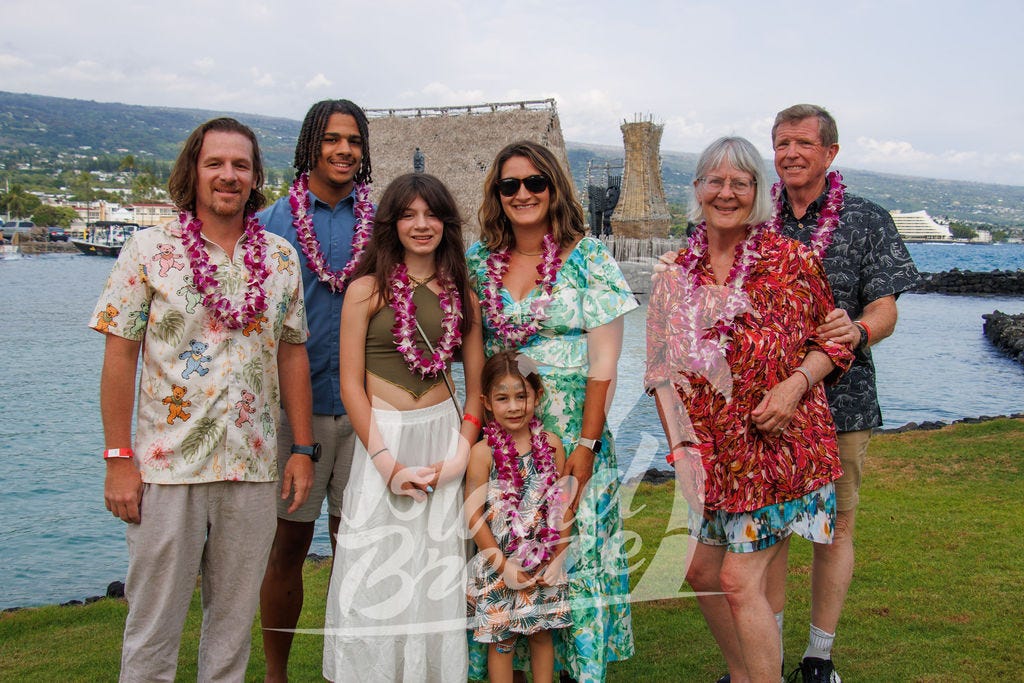
My family — Wallaces all. David Sr., David Jr., Avery, Aria, Hillary, Michelle, and me
This is also my heritage.
My worldline intersected with Michelle’s. Her worldline already included David, and when our lives joined, his became inseparable from mine. Over the years, those lives formed a braid of shared experience: marriage, parenthood, responsibility, affection, conflict, forgiveness, celebration, illness, endurance, and love. Later, David’s worldline joined with another, and three new worldlines began.
None of this is visible in my DNA.
The genome can describe biological inheritance. A family tree can record descent. But neither can fully describe a family. They cannot measure the nights spent caring for a sick child, the lessons taught and ignored, the traditions repeated, the disappointments forgiven, or the pride felt as a son becomes a father. They cannot quantify the influence that moves from one life into another through attention, sacrifice, example, and love.
Children and grandchildren do not merely inherit from us. They change us. Their worldlines exert a kind of human gravity, bending the direction of our own. We make choices because they exist. We travel to different places, accept different obligations, and imagine the future differently. Their births do not simply extend the family tree; they reshape the lives already in progress.
Perhaps this is the true meaning of heritage. It is not only what we receive from those who came before us. It is what passes through us—what we preserve, transform, and give to those whose lives follow.
Einstein and Minkowski did not set out to explain family. Relativity says nothing about love, parenthood, belonging, or obligation. The connection is only an analogy. Yet the idea of spacetime gave me a language for something that DNA and genealogy alone could not express.
A person does not exist merely at the end of an ancestral chain. A person follows a worldline. That line carries the accumulated past, but it is also changed by every meaningful intersection along the way. Some intersections produce children. Others create families without any exchange of DNA. All can redirect the future.
I began my search believing that heritage lay behind me—in Scotland, England, old census records, uncertain fathers, and names passed from one generation to another. Much of it does. But heritage also lies ahead of me, in David, David Jr., Avery, and Aria, and in whatever part of my life continues along their worldlines.
A family tree tells me how I arrived. The worldlines tell me where I belong.
No posts
Comments
Nothing yet. Say the first thing.
Sign in to join the conversation.