

Today’s post is going to be a tad different from the reviews I usually post since there’s a bigger issue that has been plaguing Steam for a long time, and as a Steam curator myself, it pisses me off to no end. That’s it, “curators” who buy bots to increase their follower count artificially, and then contact devs to ask them for copies of their games (or wait until the devs themselves send their games to them) to later trade them for games that they can sell in the gray market.
And still are. What those curators do to abuse the system is invite the trader to their curator so they can grab the game they traded their key for, and later remove them from the group. At a glance, it looks like it could go wrong at any moment, but they take advantage of the fact that trust is so important in Steam key trading that a single negative rep from a trade that went wrong would irreparably damage the reputation of the trader.
For traders, it’s easy to spot them since they always make offers that are too good to be true, such as offering a rare unbundled game for a bundled game that everyone and their mother has. For developers, this gets a lot trickier, so I’m going to post a few tips based on anecdotal evidence I gathered from the few times that I had to deal with them, in hopes they can help devs avoid these people. While they aren’t 100% failproof, they are very likely to help you determine if a curator is legit or not in most cases.
It sounds pretty obvious on the surface, but the way Steam sets the system discourages devs from doing it. Whenever you spot a curator you want to send a game to, take a few minutes to check their reviews. Any legit reviewer will put some effort into evaluating the game’s aspects, while any fake one will straight-out copy-paste the short description in the game’s page (or worse, other people’s reviews). Also, there are those “reviewers” who post memes and the like. They are very hit or miss, so you’re better off looking for someone who actually reviews the games, regardless of how many followers they have.
On average, an active curator gets 3~4 new followers each day, so a good way to determine if they are legit is to check their founding date on their about page and calculate how many followers they should have. A small difference of about 50~100 followers is no biggie, of course, but if you spot a 1-year-old curator page with 10k followers, then yeah. Chances are that they used bots to pump up their followers count. Keep in mind that this doesn’t apply to any curator group managed by a prominent content creator or internet personality, such as Sex Positive Gaming.
There are two reasons why you should do it. The first and obvious one is to check who is at the helm, just in case it’s someone that you know has been abusing the system. The second is to look if the group “has” an admin or moderator.
If you’re wondering how an “adminless” group could operate normally, you’re not alone, as I have spent an inordinate amount of time trying to figure this out. What’s happening is that new or limited accounts don’t appear in the list of members, mods, and admins of any group for some odd reason, which only Steam knows. Needless to say, you should avoid those groups since only someone up to no good would be that interested in covering their tracks.

While we are at it, check the difference between the number of followers on their curator and the number of members in their group. A big disparity is normal, as some curators barely pay attention to their groups. However, any curator with a massive number of followers and next to no group members raises a few red flags, unless it’s an invite-only group.
It probably is the best way to tell whether they are legit, and sadly, it’s the kind of info you can realistically get if they contact you first, as Steam doesn’t provide this information to developers, and asking reviewers for their traffic stats out of the blue would make them suspect your intentions.
The thing is, you can tell whether a curator used bots or not just by looking at their traffic page’s chart. The things that you should keep an eye on are the following:
A big spike right at the beginning. What makes it suspicious is not the spike itself, since they can happen at random times, but getting one a few days after the group’s creation.
An average number of visits that’s too low for the number of followers that they have.
A small or total lack of traffic growth.
An increase of no more than 5 new followers per week (or worse, a decrease in the number of new followers).
To give you a good idea of what I mean, let’s compare my stats with those of a fake curator I’m going to use as an example.
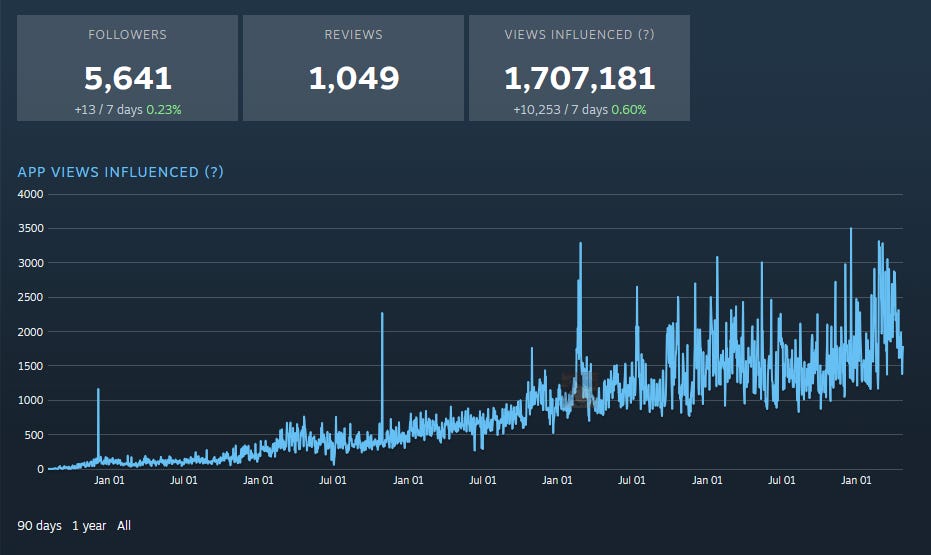
These are my stats. I have 5641 followers as of now, and my traffic is in the range of 1500-3000 daily visitors.
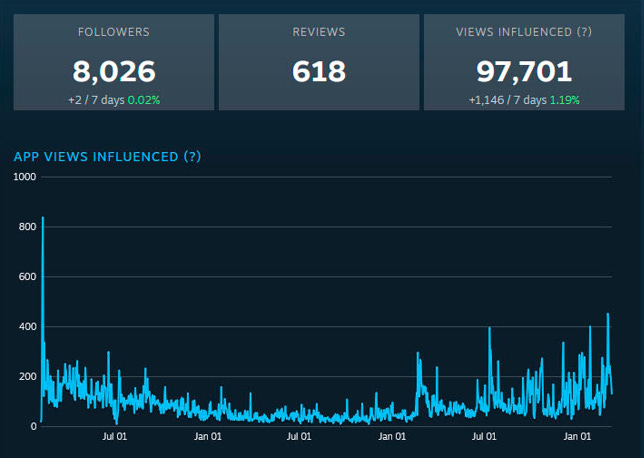
By contrast, this one has 8042 followers, and after the 800-visit spike it got in the first few days, it barely manages to break past 400 visits a day. Heck, it’s even more glaring when you compare it to the joke curator group I made a while ago to have a place where I could post the cringy jokes that pop into my mind from time to time. This group has a whopping 164 followers, and I don’t promote it at all.
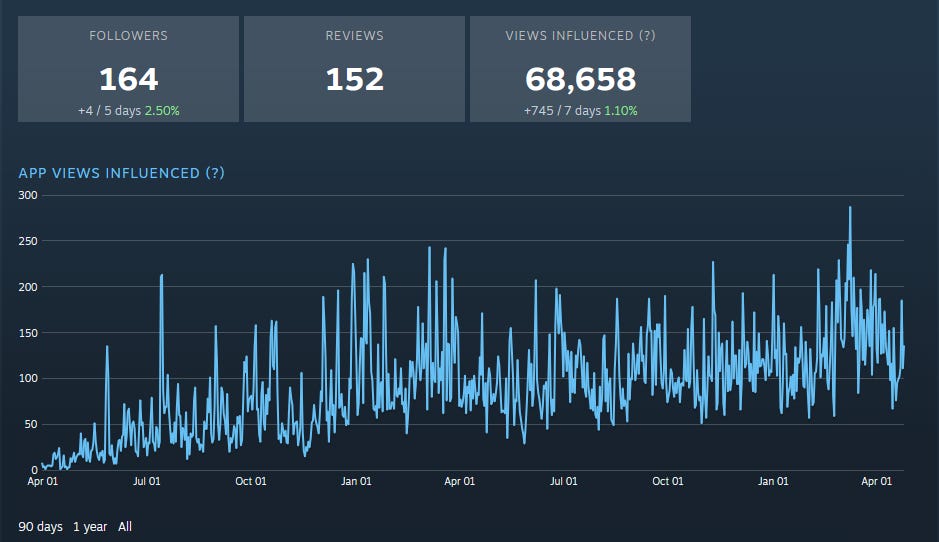
Now, keep in mind that Steam introduced an update that lets you choose between three different ranges: 90 days, 1 year, and all time, so make sure to ask them to set it to “all time” before they show you their traffic stats, since it’s set to “1 year” by default.
I hope you guys find these tips helpful. I could have name-called the groups that abuse the Curator Connect system, but knowing how easy it is for them to set up a new group with tons of followers, I opted to give you a few pointers on how to detect them instead. That way, you can tell who’s legit and who’s not, especially when more than one of the tips I gave applies to them.
No posts
Comments
Nothing yet. Say the first thing.
Sign in to join the conversation.