
In her article “When We Fed Ourselves: The Beginnings of The East and The Uhuru Food Co-op,” Rae Gomes opens with a moment: Baba Malik Yakini standing before a room at Black-Led Day, reminding us that we claimed the space.
This video conversation, filmed at the 5th Annual Black-Led Day at the Up & Coming Food Co-op Conference, brings that moment full circle as Rae sits down with Malik to reflect on the history of The East and Brooklyn as a center for Black organizing and institution building.
Black-Led Day itself emerged through the leadership of food justice organizers, including Baba Malik Yakini, as a space within a white-dominated food conference to center the needs and realities of Black-led co-ops, many operating in food apartheid communities where access to healthy food remains limited. It also addresses a persistent gap in the co-op history, where narratives often trace cooperative origins to 19th-century England and the Rochdale Pioneers while overlooking the long traditions of Black cooperation and mutual aid that preceded them.
For Black communities, cooperation has long been both cultural practice and political strategy serving as a way of caring for one another and building the foundations for self-determination, even as imperialism has repeatedly attempted to break the continuity of these efforts.
In their conversation, Malik reflects on the cyclical nature of movements particularly as Black liberation struggles have faced state repression, fragmentation, and cultural appropriation. But the work never disappears. It resurfaces in new generations searching for answers to the same conditions.
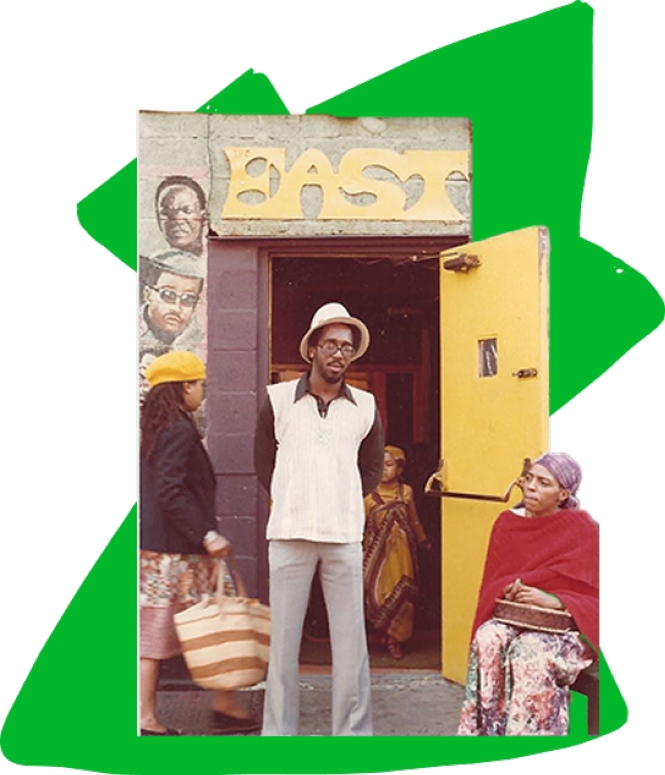
In many ways, today’s renewed interest in Black land stewardship, food co-ops, cooperative economics, and community-controlled food systems echoes the institution-building era that produced organizations like The East in Brooklyn in the late 1960s and 70s. Those organizers weren’t just starting food projects. They were building a world: schools, cultural institutions, newspapers, political education spaces, and food co-ops like Kununuana and later the Uhuru Food Co-op.
But Malik also names an important difference between then and now. That earlier generation moved with political clarity rooted in the Black Radical Movement, shaped by global philosophies that gave direction to their organizing:
Pan-Africanism, advanced by leaders like Kwame Nkrumah and Marcus Garvey, calling for unity and collective power among people of African descent worldwide.
The Black Consciousness Movement, led by Steve Biko, emphasizing psychological liberation and reclaiming Black identity as the foundation for freedom.
These philosophies shaped the cultural insistence behind The East’s institutions.

The path toward liberation has never been linear. Movements surge forward, are met with repression, fragment, and reorganize only to rise again carrying the lessons, strategies, and wisdom of those who came before. And in another turn of that cycle, the conversation closes with Malik reflecting on his role now as an elder: to pass forward the stories and hard-earned wisdom of earlier movements, so the work can continue.
So the question becomes:
What lessons from earlier movements are waiting to be reclaimed? How are we not just repeating efforts towards Black liberation, but how are we advancing them?
And in this cycle, what will it mean for us to build the institutions our communities still need?
Resources
A View from the East: Black Cultural Nationalism and Education in New York City by Kwasi Konadu
The Sun Rises in the East (Documentary)
No posts
Comments
Nothing yet. Say the first thing.
Sign in to join the conversation.