
There is a pattern that shows up again and again in the lives of the most consequential people in history, and once you see it, it becomes very hard to stop seeing it.
When you go back and look at the early chapters of their lives, before the companies and the albums and the discoveries, you almost always find the same thing: a brain the world had tried to fix, and a person who had been told, in one way or another, that the way they moved through the world was a problem that needed solving.
And then you look at what they built, and you realize that the thing the world wanted to correct was often inseparable from the thing that made them extraordinary.
That observation is what became Neurodivergent, a new series on NBN.fm. Episode 1 is already in your feed, with the remaining nine episodes live now on Spotify and Apple, and a new episode every day, starting tomorrow.
If it resonates with you, a five star review means more than you know.
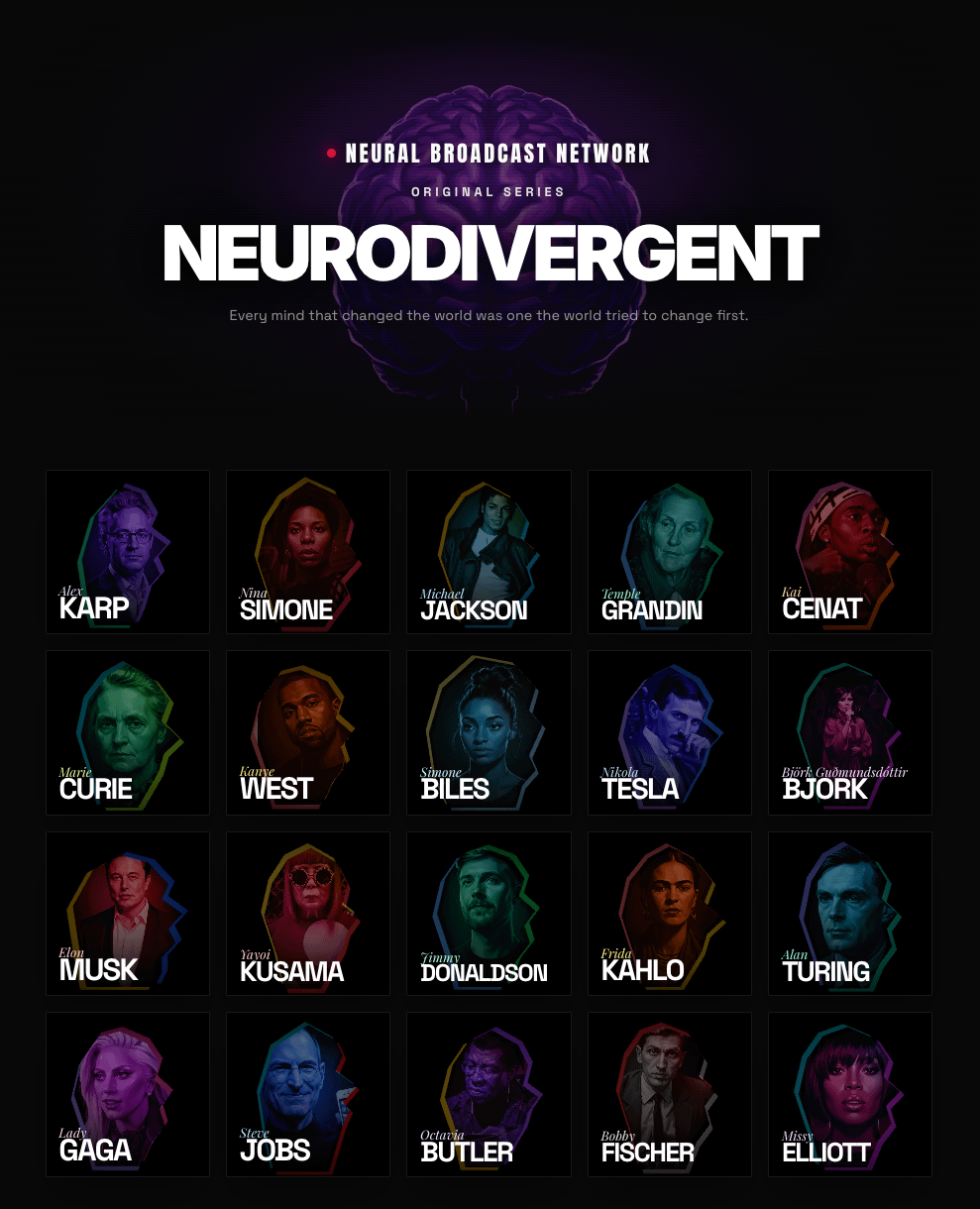
Each episode is a deep character study, one person, one mind, and the frame we bring to each one is not the biography you already know.
We are not retelling the Apple story or recounting the albums you grew up with.
What we are doing is mapping the specific neurodivergent traits of each subject directly onto the decisions that defined them, and showing how those traits, the ones that made them difficult to educate, difficult to manage, and difficult to fit into conventional structures, were precisely the traits that made them impossible to ignore.
Alex Karp, the CEO of Palantir, is the person who first made me want to build this series.
Here is a man who spent his graduate years studying social theory under Juergen Habermas in Frankfurt, who practices martial arts with a kind of meditative seriousness, and who built one of the most consequential and controversial defense technology companies in the world.
The contradiction between his intellectual roots and the nature of what Palantir actually does is something most profiles gloss over entirely, but we think it is the whole story, because when you understand how his mind actually works, the contradiction stops looking like a contradiction at all.
From there the series moves through Steve Jobs, whose sensory sensitivity and emotional dysregulation were not incidental to his career but were the engine of it, showing up in every product decision and every interpersonal rupture that people have spent decades trying to explain, and then through Elon Musk, Rihanna, Tupac, Oppenheimer, and Zendaya.
People you have heard about your entire life, whose stories you think you already know, told through a lens that most of the coverage of them has never seriously applied.
The stories we tell about neurodivergence tend to go in one of two directions.
Either it is framed as a deficit, something to manage, accommodate, or medicate, or it gets romanticized into some kind of superpower narrative that does not match the actual lived experience of struggling through systems that were not built for you.
What this series is looking for is something in between, something that looks honestly at real people, at the full complexity of how their minds worked and how that played out across their lives, and lets you draw your own conclusions about what it means.
Go listen, and if you have ever had any version of this experience yourself, I think you will find something in it that most coverage of these people never quite gets to.
Adam
Comments
Nothing yet. Say the first thing.
Sign in to join the conversation.