
So over the first week of February I started a weekend project that kind of spiraled. I wanted to see if I could take the Epstein files, all the court documents and DOJ filings that have been dumped online over the years, and turn them into a podcast series coming every angle, every case, and every connection.
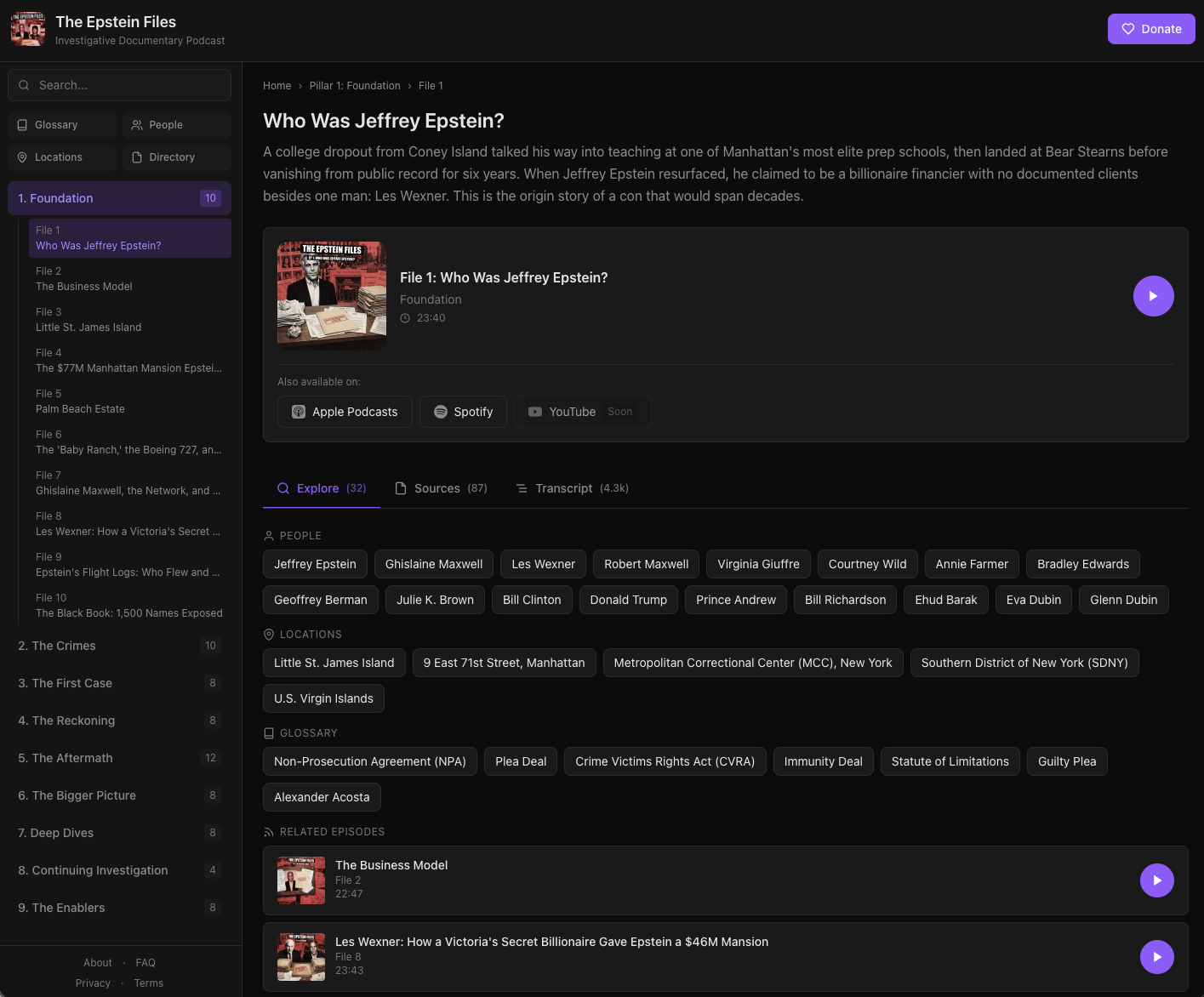
By February 12th I had 73 episodes live on Spotify and Apple Podcasts, a companion website at epsteinfiles.fm with full transcripts and source links for every episode.
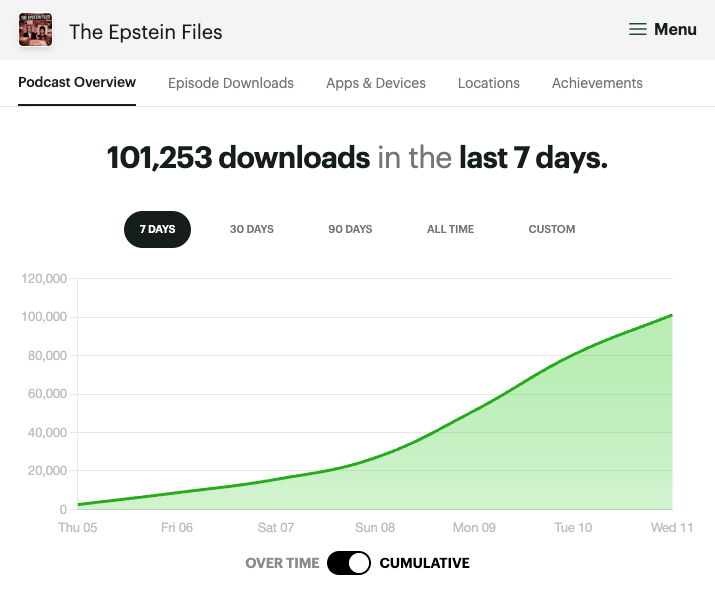
It crossed 100,000 downloads in its first week. To put that in perspective, the top 1% of all podcasts globally get around 5,000 downloads in their first 7 days. This did 100k. That’s 20x the top 1% threshold. The average podcast gets 141 downloads in its first 30 days and most spend 18+ months trying to crack 1,000 per episode. There are 4.5 million podcasts out there right now.
No fancy studio. No production team. Just Claude, a mac mini, and a weekend of focused work curating the right approach to this series. Still processing this one honestly.
The reason I thought this could work is pretty simple. There is an insane amount of Epstein-related documentation sitting on the internet right now, from court filings, bank records, depositions, flight logs, witness testimony, and financial disclosures.
But there’s so much of it that no single person could realistically read through everything and connect the dots. You’d need to cross-reference shell companies with flight manifests, match financial records to testimony, and do that across dozens of overlapping cases. A journalist could spend years on this and still miss stuff.
AI doesn’t have that problem. It can hold all of it in context at the same time.
That’s the part that got me excited. Not AI replacing journalists. AI doing the thing that was physically impossible for a human to do, which is process thousands of pages of documents simultaneously and find the connections between them. The information was always there, but no one could use all of it at once until now.
So I built a pipeline that handles the full production. I set the editorial direction, what topics to cover, what sources to trust, what tone to strike. Every episode runs on one rule: “remove the emotion, keep the tension.” The pipeline takes an episode from research to published podcast automatically, with quality checks that catch hallucinations and anything that can’t be sourced back to an actual document.
The site has 79 searchable transcripts and every claim links back to an original DOJ filing or other supporting documents.
Since the holiday break when this whole AI boom really exploded, I’ve been getting my hands on every tool, every product, and every workflow I can find.
Before Claude I didn’t even know what an .env file was until mid-December. I just kept copying and pasting and hitting 404s until it clicked.
And the thing I keep coming back to is that software is now anyone’s game. What I raised money for three years ago now lives inside a chat interface and a lot of founders feel this tension as the barrier to building is basically gone.
But you can’t prompt your way into distribution (or at least not yet). That’s the part that still requires a human who understands what people actually want to consume and how to get it in front of them.
There’s no shortage of public information that deserves to be heard and there’s no shortage of people who want to hear it.
One person can now do what a newsroom did and I don’t think people fully understand what that means yet.
Epstein was the proof of concept. The next series is already in the works. Similar workflow, completely different topic. Stay tuned.
Ps. Just dubbed the series in Spanish. Rate Los Archivos de Epstein 5 stars on Spotify and Apple Podcasts.
No posts
Comments
Nothing yet. Say the first thing.
Sign in to join the conversation.