
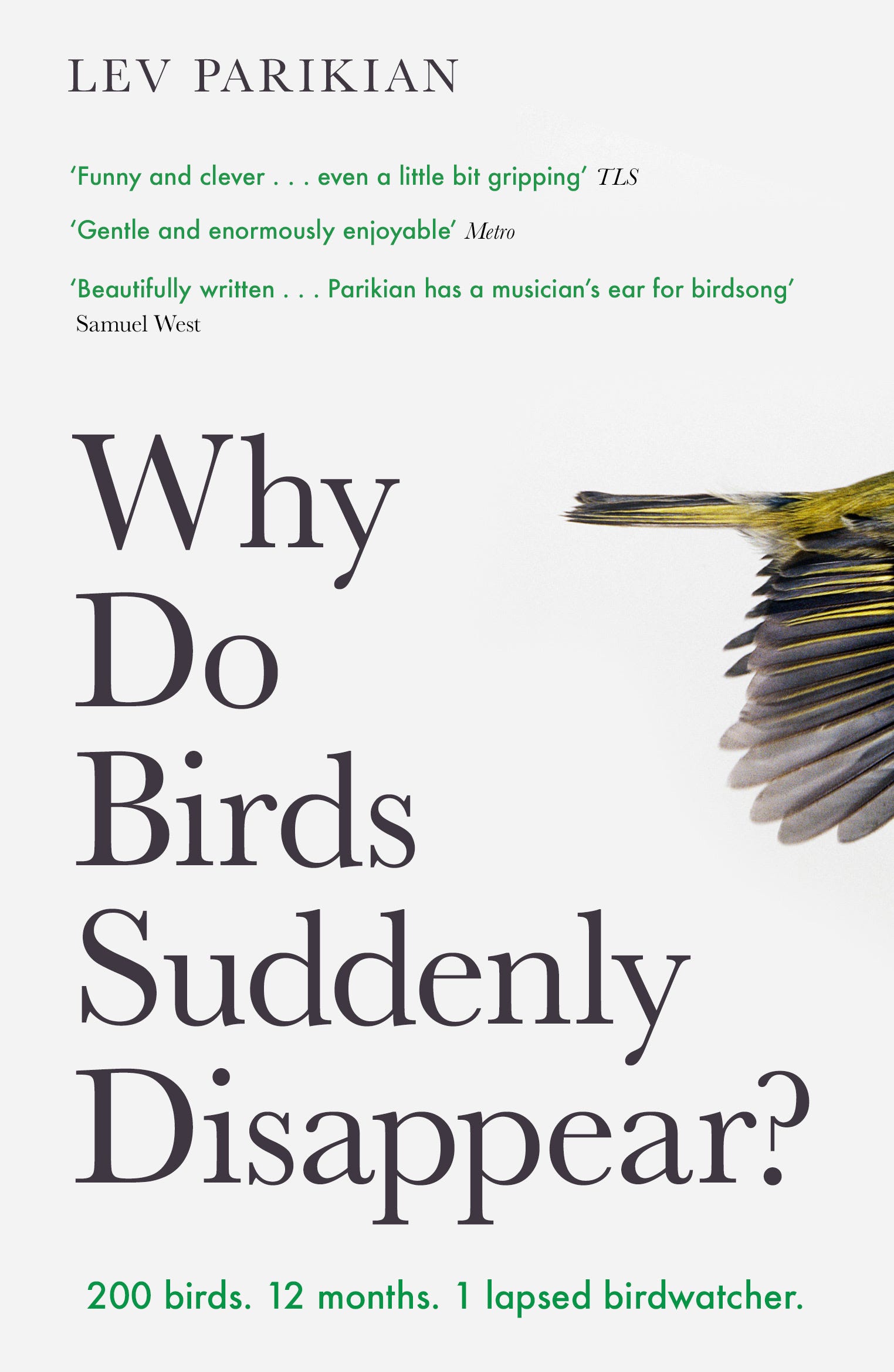
In 2016, prompted by the resurgence of my childhood enthusiasm for birds, I set out to see 200 British species. The above book was the result. Ten years on, I thought it would be fun to revisit it. Throughout 2026 I’ll be going out, looking for birds, revisiting old haunts, seeing what’s changed and what hasn’t.
Free subscribers will get a monthly post – a little vignette from that month’s birding activity. There might be occasional references to Why Do Birds Suddenly Disappear? – enough, I hope, to pique your interest, but not so much as to irritate you if you either haven’t read the book or have no desire to. For the benefits of becoming a paying subscriber, see below this month’s piece, which concerns terns, music and how to pause time.
There’s a piece of music by Rameau. It goes like this.
I’m not going to insist you listen to it before reading any further – you’re responsible adults, able to decide for yourselves how best to spend four minutes and forty-five seconds of your time, but I put it to you that listening to that Rameau is a worthwhile way to spend four minutes and forty-five seconds of your time1.
It’s music of exceptional simplicity, exquisite in its stillness. It’s a reminder that complexity isn’t everything, that sometimes all the universe requires of us is to stop and notice, to place ourselves into a receptive state, open to wonder, and that if we do that, then sometimes, just sometimes – and without wishing to get excessively mindful on you – we can pause time.
Listening to it just now, sitting with my wife at our kitchen table amidst the remnants of lunch (beans on toast, since you ask – another, albeit quite different, offering of exquisite simplicity), it made me think of common terns.
Let me explain.
We were at a nature reserve. Hello birds, hello sky, hello 30-degree heat at 10.45 in the morning.
Hello dog owner either unable to read or comply with signs asking them to keep their dog on a lead, the better to protect the nesting plovers, which – entirely understandably, given that this was after all a nature reserve – had established themselves on the beach.
You don’t need to know the full details of the exchange. Let’s just say that words were had. Words from which it became abundantly clear that said dog owner cared little for the plight of plovers. (For the record, I love dogs, and yes of course not all dog owners. Definitely this one, though.)
I simmered. I seethed. Trying to find a positive angle on the encounter, I thought about differing worldviews, and how best to bridge the divide between them.
In this mood I entered the hide. Here, I thought, I could sit in peace and seek the elusive state known as birdfulness.
I don’t know if you’ve ever been to a tern colony. They’re dainty birds. Even the largest of the British species, the Sandwich tern – named after the place, not the foodstuff, it made no. 95 in Robert Francis’s excellent “100 Greatest Bird Names of All Time” list – lacks the stoutness common to their gull cousins. Where a gull has bulk, a tern is all angles – sharp bill, pointed wings. In flight, they have an enviable buoyancy, gliding overhead with delicate wing flicks. And to see a common tern hover and dive for a fish is to witness murderous grace in avian form. No wonder they’re known as ‘sea swallows’2.
But for all their angular elegance, they’re not quiet. The calls vary between species, but common to them is a harsh, rasping quality. The call of the common tern is sharp and choked in a way that reminds me of the Wilhelm scream, while the Collins Bird Guide has this to say on the flight call of the Sandwich tern: “a loud, grating ‘kerrick’ (like pressing amalgam into a tooth)”. I can’t argue with that description, although I suspect it was written by someone with a recent and traumatic memory of a dentist’s chair.
0:00
-0:22
I was greeted by a seething mass of terns, cheek by jowl on the four islands in the lagoon, and competing for space with black-headed gulls. Many seabirds have a raucous quality to their vocalisations, and if there’s one that can give terns a run for their money, it’s the black-headed gull.
This is my long-winded way of saying that it was all very loud, an unrelenting screeching babble, each bird laying claim to its own little space by shouting at all the others to fuck off.
And in among it all, on the nearest shore of the nearest island, unusually silent and matter-of-fact, two common terns, one standing on the other’s back. Now, why on earth would they be oh yes of course, I see.
Oblivious to the surrounding din, they wait, a still point in a hectic world.
When it came, it didn’t last long. A few seconds. Just long enough for the cloacas to meet and for sperm to be transferred. An upwards arch from the female, a brief flurry of wings from the male, and then off he jumps.
Such a tiny moment. Blink and you’d miss it. And it would be wrong to present it as something tender. Matter-of-fact, more like3. But for me, the lone observer, it suspended time. The racket went on all around it, and those two existed, for just those few seconds, in a time bubble, unconscious to anything but their genetic imperative.
I find myself wishing I could follow their story – laying, incubation, hatching, chick care, fledging. So much has to go right for them to bring their offspring into the world, and each stage is fraught with danger. An egg is a tasty and nutritious snack for a crow – disaster for the terns. You’d shout, too, if you thought it was the only way to keep your children safe.
Within a few seconds, as if determined to perpetuate stereotypes, the male abandoned the female and whizzed off to get a fish. The female lingered for half a minute, and then she was gone too, flying towards and over the hide. And all around the cacophony continued, as if they were never there at all.
So this is where we say goodbye to the free cohort.
For paying subscribers, there are extra goodies below the line. If you’d like to join them, this is what you’ll get:
– PDF and audio versions of that month’s chapter from Why Do Birds Suddenly Disappear?
– an extra piece with more detail about the writing of the book, behind the scenes stuff, trivia, whatever crosses my mind
– occasional chat threads where you can ask questions about any aspect of the book: birds, music, places, the writing process, anything that occurs to you
– a whopping 50% discount on the signed and dedicated copy of the paperback edition
PS While I do earnestly invite you to sign up for the assorted goodies listed above, do please get in touch if you really want to take out a paid subscription but can’t afford it. No questions asked. There will also remain the option to chuck something into my tip jar via Ko-Fi.
This month’s extra content concerns close encounters of the ornithological and musical kind.
Comments
Nothing yet. Say the first thing.
Sign in to join the conversation.