
One of the greatest moments of my reading life happened on page 40 of Mrs. Dalloway, by Virginia Woolf. It’s not one of the famous marquee bits, it’s not the match-in-the-crocus or anything like that, it’s just a bit with sad old Peter Walsh, the passionate but socially marginal fellow who Clarissa passed up to marry rich dependable Mr. Dalloway.
(And let’s be honest she probably dodged a bullet there. Honestly I find Peter a bit narcissistic, with his pocket-knife and his Bartlett pears. Though he does bear a passing resemblance to Leonard Woolf, who Woolf herself of course did actually marry in real life … maybe she’s playing a bit of a sliding doors game.)
On page 40 or thereabouts, Peter sits down on a park bench in the sun, closes his eyes and falls asleep. Woolf describes it thus:
A great brush swept smooth across his mind, sweeping across it moving branches, children's voices, the shuffle of feet, and people passing, and humming traffic, rising and falling traffic. Down, down he sank into the plumes and feathers of sleep, sank, and was muffled over.
So far, so amazing. But then an even more amazing thing happens, which is that Woolf doesn’t stop. Usually in novels the border between sleeping and waking is strictly policed. When your character falls asleep you’re supposed to pause, add a line break, and then pick up again when the character wake ups. Or you start a dream sequence. Or you move the story somewhere else.
But Woolf does none of those things. She flits over to a nearby nurse for a moment, and then with supernatural nimbleness—you have to read the sentence twice just to see how she does it—she flits right back to Peter and keeps narrating, accompanying him across the border into dream, barely even acknowledging that his mind is now a sleeping mind:
The solitary traveler, haunter of lanes, disturber of ferns, and devastator of great hemlock plants, looking up, suddenly sees the giant figure at the end of the ride…
Probably Woolf isn’t the first person ever to do this, to hop the fence in exactly this way, though she’s surely the first to do it with such agility. The only comparable moment I’m coming up with, in terms of general boundary-breaking, is the one where Joyce follows Bloom into the bathroom in Ulysses:
Asquat on the cuckstool he folded out his paper, turning its pages over on his bared knees. Something new and easy. No great hurry. Keep it a bit. …
I’m sure Woolf could’ve followed Peter Walsh into the bathroom if she’d wanted to, but she was too well-mannered. (She once described Ulysses as “a queasy undergraduate scratching his pimples.” Which is totally unfair, because I’m sure Joyce influenced her, but I know what she means.) (And of course I’m remembering now that Bloom falls asleep too, at the end of “Ithaca,” in one of my other absolute favorite moments ever.)1
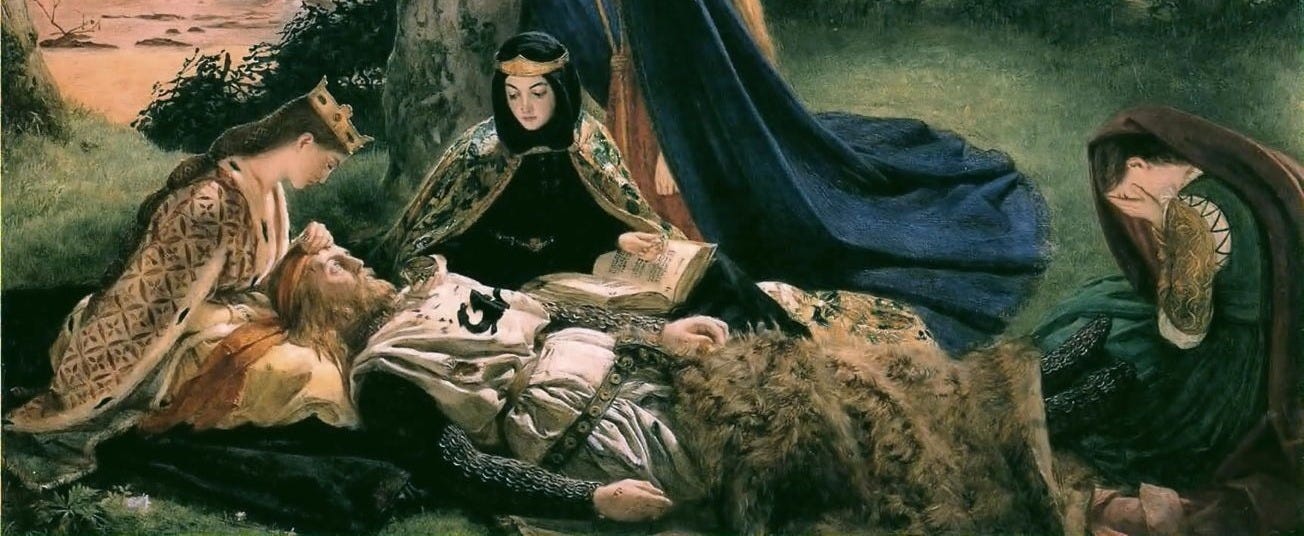
Loving these scenes as I do, I obviously wanted to try my own version in The Bright Sword. What better way, I thought, what better way could there be to bring Arthur’s mighty arc to a close than by having him fall asleep? And not on a damn park bench like a hobo but in his own very expensive royal bed?
But as it turns out, there are lots of better ways, because in actual fact nobody wants to read about King Arthur nodding off. They want to see high drama! Action! They want—just for example—a rousing royal speech, an unexpected betrayal, and a great and terrible miracle that draws together several important thematic threads!
At any rate that’s what they get in The Bright Sword. But I did write the falling-asleep version first. Then I killed it.

But before I lay it to rest in the crowded cemetery along with all the other darlings, I’m going to let it lie in state here. Not so everyone can politely applaud and say, it’s great, you should’ve kept it, because obviously the passage just doesn’t work, and had to go. But sometimes failures are instructive:
In great peace Arthur closed his eyes, and it was as if a soft sac burst in his brain, bathing it in the cool balm of weariness, and in the company of good men and women everywhere, from all over Britain, from kings down to the poorest peasant, with no fanfare or ceremony, he set out on the great journey of night and dreams.
In dreams they would travel through silent forests, over snow-swept mountains, across black frozen lakes and through humid jungles. They would fight battles shoulder to shoulder, brothers and sisters in arms. They would be swept out to sea, drowned in green oceans, washed up on distant shores. They would be raised up and thrown down, worshipped and sacrificed, exposed as impostors and consigned to the underworld and then, at long last, redeemed and restored to life.
And after all that, after all that, they would never find the Grail.
At dawn a golden goddess would touch their lips with a burning fingertip, and say speak no word of this. And all their adventures would be forgotten.
Maybe one day I’ll find a place to recycle it.
In closing, I wish to acknowledge that this passage includes a straight steal from one of my other very favorite things in all of literature, a truly stunning paragraph from Thomas de Quincey’s Confessions of an English Opium-Eater where he’s describing what happened when, well, he ate some opium and got super high:
I ran into pagodas, and was fixed for centuries at the summit or in secret rooms: I was the idol; I was the priest; I was worshipped; I was sacrificed. I fled from the wrath of Brama through all the forests of Asia: Vishnu hated me: Seeva laid wait for me. I came suddenly upon Isis and Osiris: I had done a deed, they said, which the ibis and the crocodile trembled at. I was buried for a thousand years in stone coffins, with mummies and sphinxes, in narrow chambers at the heart of eternal pyramids. I was kissed, with cancerous kisses, by crocodiles; and laid, confounded with all unutterable slimy things, amongst reeds and Nilotic mud.
NILOTIC MUD. We’ve all been there.
I’m going to quote the bit from Ulysses too because it’s so incredible:
In what posture?
Listener: reclined semilaterally, left, left hand under head, right leg extended in a straight line and resting on left leg, flexed, in the attitude of Gea-Tellus, fulfilled, recumbent, big with seed. Narrator: reclined laterally, left, with right and left legs flexed, the index finger and thumb of the right hand resting on the bridge of the nose, in the attitude depicted in a snapshot photograph made by Percy Apjohn, the childman weary, the manchild in the womb.
Womb? Weary?
He rests. He has travelled.
With?
Sinbad the Sailor and Tinbad the Tailor and Jinbad the Jailer and Whinbad the Whaler and Ninbad the Nailer and Finbad the Failer and Binbad the Bailer and Pinbad the Pailer and Minbad the Mailer and Hinbad the Hailer and Rinbad the Railer and Dinbad the Kailer and Vinbad the Quailer and Linbad the Yailer and Xinbad the Phthailer.
When?
Going to dark bed there was a square round Sinbad the Sailor roc’s auk’s egg in the night of the bed of all the auks of the rocs of Darkinbad the Brightdayler.
Where?
•
I’ve always loved that dot.
Comments
Nothing yet. Say the first thing.
Sign in to join the conversation.