
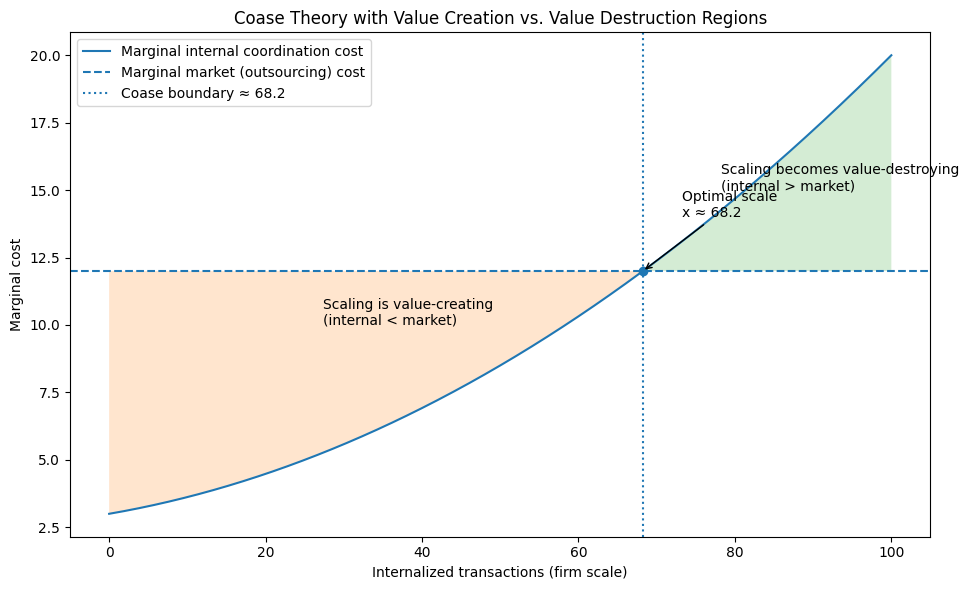
Coase explains that organizations and firms exist because transacting in open markets is costly: every time you go outside the firm for a piece of work, you incur search, bargaining, contracting, and enforcement costs in addition to market prices. To avoid that tax, humans organized into companies—hierarchies, job descriptions, org charts—that internalize those transactions and replace market prices with instructions, routines, and trust.
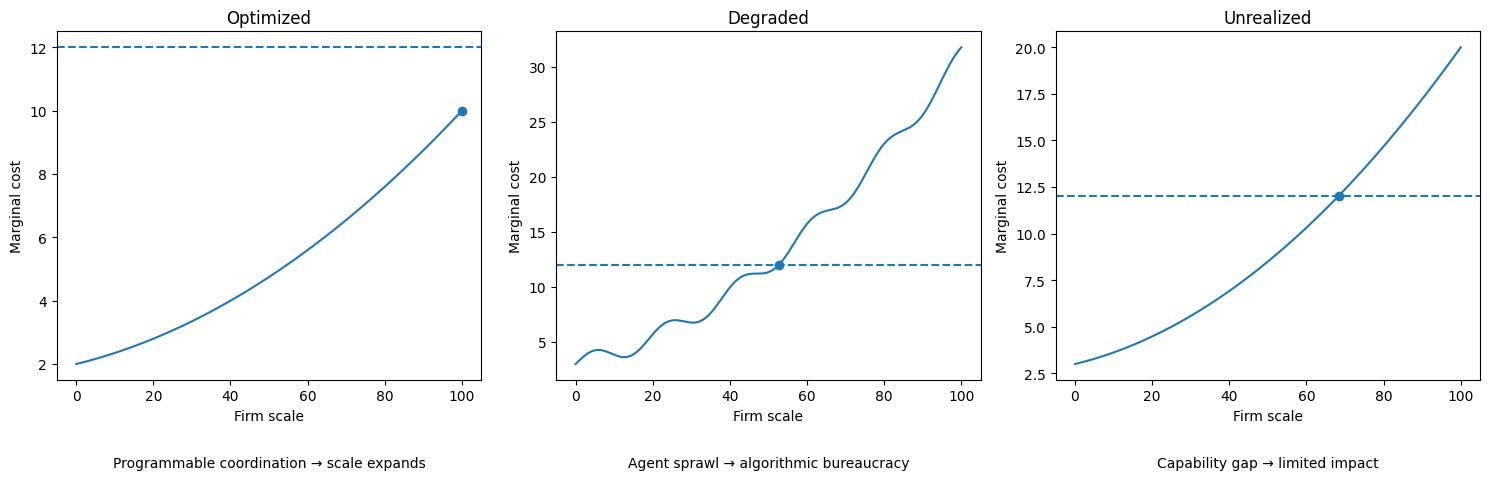
Organizations are cheaper, but only up to a point, because coordination inside a firm is not free. As you pile on people, products, and processes, you hit diminishing returns—overhead, bureaucracy, and misallocation errors start to dominate. Coase’s boundary condition says a firm will expand until the marginal cost of organizing one more transaction internally equals the cost of doing that same transaction through the market; that boundary sets the natural scale and scope of the modern firm.
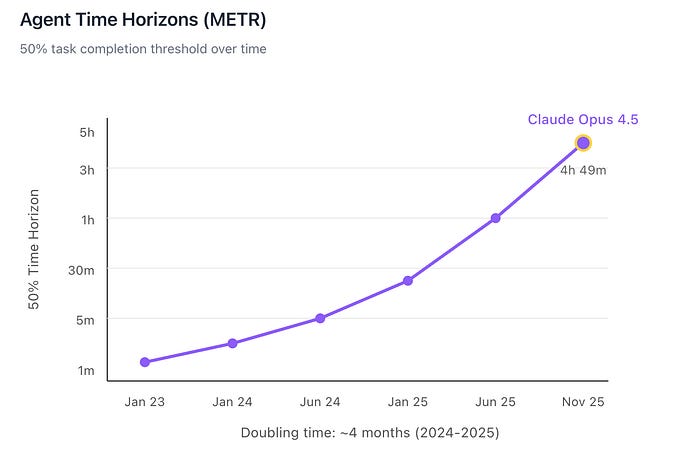
As AI agents enter the stack, and subsume a large percentage of human cognitive work, they are expected to reduce coordination costs, using both tight and loose coordination design patterns (some agents are woven into coupled orchestration; others are connected more loosely, depending on the workflow).
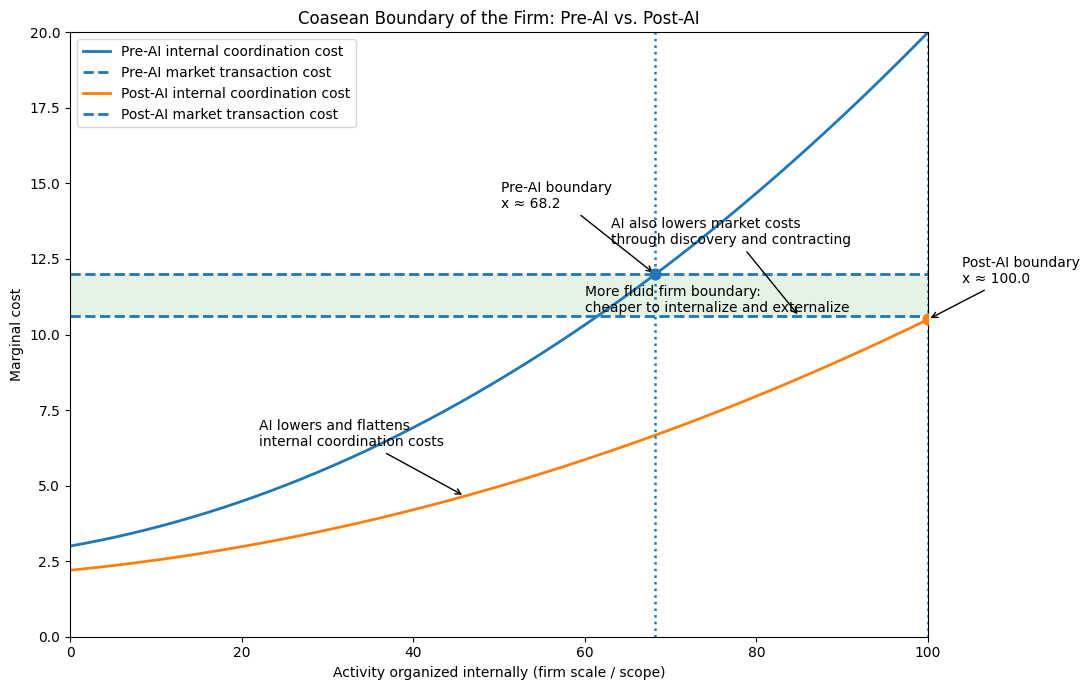
That is, AI agents will reshape the Coasean boundary by directly minimizing coordination costs. Inside the firm, with regards to internal transaction costs, they automate search and summarization, structure handoffs, and perform continuous checks against rules and metrics, thereby lowering and flattening the marginal cost of organizing work and mitigating bureaucracy. Outside the firm, agents reduce external transaction costs by making it easier to discover, contract with, and monitor external partners, which pushes in the opposite direction toward more modular, plug‑and‑play relationships rather than monolithic, vertically integrated organizations.
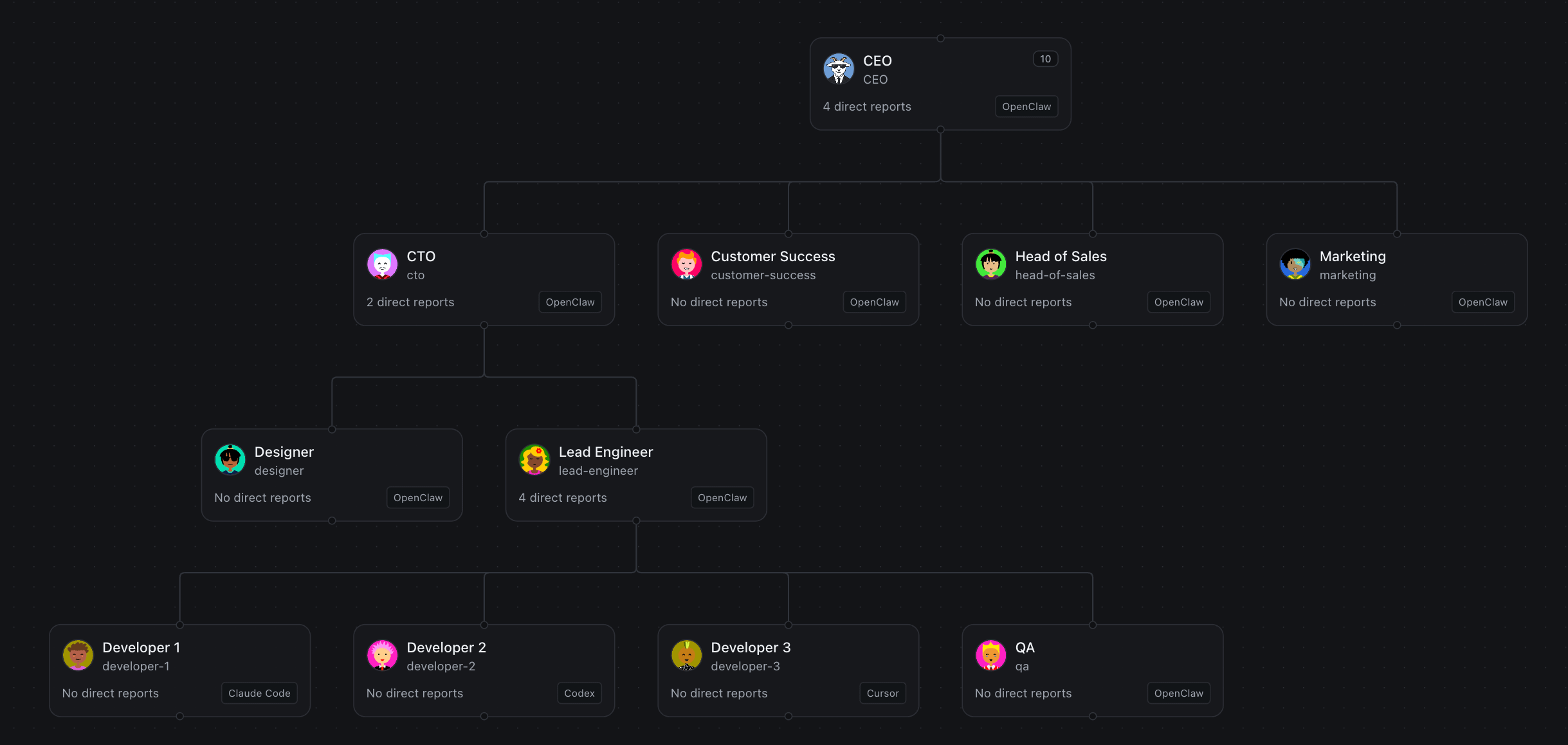
The net effect is not a simple shift toward bigger or smaller firms, but a redefinition of the firm itself: boundaries become more fluid, coordination becomes programmable, and the classical tradeoff between hierarchy and market increasingly gives way to systems that can dynamically internalize or externalize work at near‑zero friction. This enables both larger firms to scale more efficiently and smaller teams to achieve outsized output.
However, there is a catch. AI agents don’t just compress coordination costs; they also reintroduce them in new forms. A swarm of loosely designed agents creates its own coordination layer: overlapping agents, brittle workflows, and opaque decision chains that are difficult to debug, audit, or govern. Integration debt becomes the dominant friction: fragile integrations, data plumbing, and debugging. The exhaust and output of agent swarms can simply be too much to read or comprehend. As a result, coordination costs don’t fully disappear with agents; they take the new form of integration debt, schema inconsistencies, noisy outputs and audit trails, and constant debugging. This means that realizing the upside of agents is not automatic: firms will need strong capabilities in workflow design, data quality, APIs, evaluation, and governance.
AI Agents also need context: structured background information such as data definitions, business rules, user state, history, and environment alongside prompts to interpret tasks correctly and act reliably. Without these, agents tend to generate noise and slop rather than leverage.
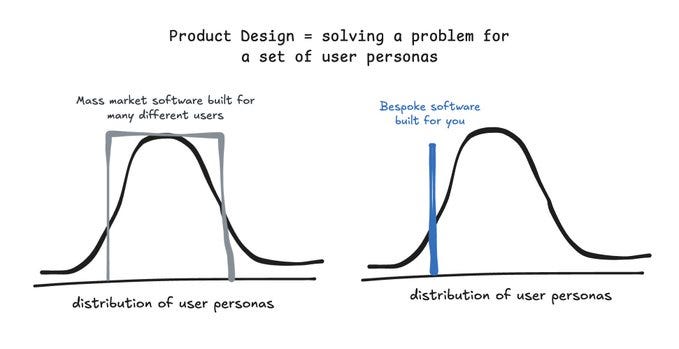
At Level, we are implementing large-scale agentic systems for various investment workflows. What we have found is that:
Agents need to reason against a set of frameworks—higher-order systems and schemas that define mechanistic beliefs about how the world works (i.e., our investment philosophies). These frameworks enable the agents to reason about agreed-upon human-oriented structures (example below) and thus provide opportunities for explainability and path analysis.
Agents need a shared workspace/memory to coordinate within and across agent runs (read/write/update), thereby building an ever-growing institutional knowledge base that learns across time.
Agent workflows require deep observability, not just at the level of agent chains (i.e., LangFuse) but also understanding the actual reasoning, intent, logic for tool access, etc.
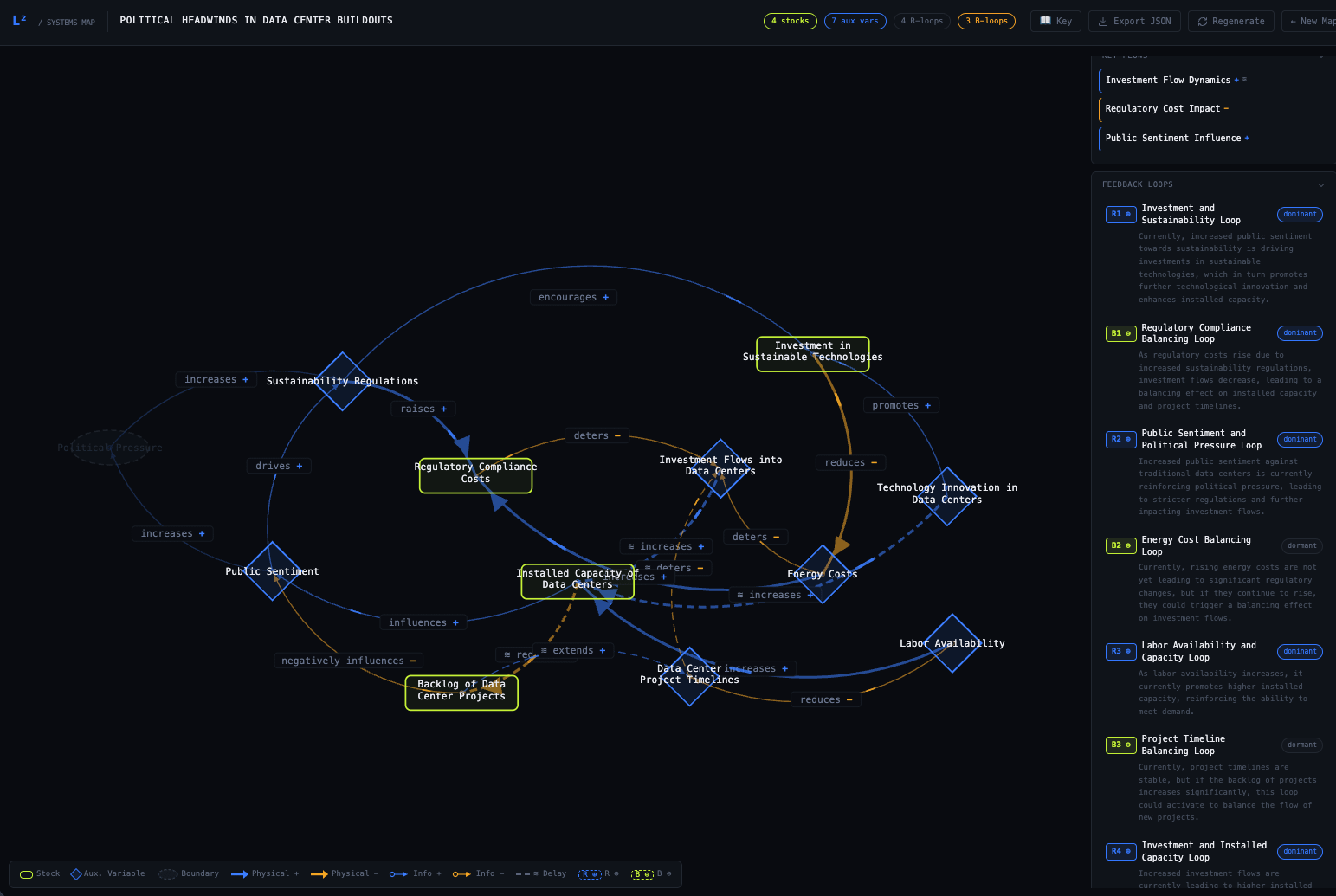
In traditional Coasean transaction‑cost economics, the firm is modeled as a mechanism for minimizing coordination and transaction costs. In an AI‑native world, coordination becomes cheaper, but agents introduce new integration costs, design and governance challenges, and failure modes that only firms with strong frameworks, data quality, and observability approaches can manage effectively.
No posts
Comments
Nothing yet. Say the first thing.
Sign in to join the conversation.