
A gradual reawakening of interest in traditional Japanese literature (specifically haiku, haibun and tanka) combined with my failed attempts to finally learn to read with confidence in the Irish language have led me to detect similarities in old Irish poetry and Japanese forms. I am, of course, not the first to arrive at this lightbulb moment. In his afterword to Our Shared Japan (Dedalus Press, 2007), an anthology of Irish poems inspired by Japan or Japanese poetic forms, themes etc., Seamus Heaney noted that ‘we in Ireland have learnt to recognize something Japanese in the earliest lyrics of the native tradition. The hermit poets who wrote in Old Irish in the little monasteries were also masters of the precise and suggestive:
Text within this block will maintain its original spacing when published
Int én bec
ro léic feit
do rind guip
glanbuidi
fo-ceird faíd
os Loch Laíg
lon do craíb
charnbuidi
Text within this block will maintain its original spacing when published
Text within this block will maintain its original spacing when published
Text within this block will maintain its original spacing when published
The small bird
Text within this block will maintain its original spacing when published
let a chirp
Text within this block will maintain its original spacing when published
from its beak:
Text within this block will maintain its original spacing when published
I heard
Text within this block will maintain its original spacing when published
woodnotes, whin-
Text within this block will maintain its original spacing when published
gold, sudden:
Text within this block will maintain its original spacing when published
the Lagan
Text within this block will maintain its original spacing when published
Blackbird!’
This, in turn, brought me down a rabbit hole of different versions of the famous little 9th century blackbird poem. I was sure I’d read a different rendering by Heaney elsewhere. Sure enough, in the notes section of The Translations of Seamus Heaney (Faber, 2022) we can find this alternative:
The Blackbird of Belfast Lough
Text within this block will maintain its original spacing when published
The small bird
Text within this block will maintain its original spacing when published
chirp-chirruped:
Text within this block will maintain its original spacing when published
yellow neb,
Text within this block will maintain its original spacing when published
a note-spurt.
Text within this block will maintain its original spacing when published
Blackbird over
Text within this block will maintain its original spacing when published
Lagan water.
Text within this block will maintain its original spacing when published
Clumps of yellow
Text within this block will maintain its original spacing when published
whin-burst!
This, in fact, is the version that the late Ciaran Carson referenced in his brief article on the blackbird poem on the Queen’s University Seamus Heaney Centre website:
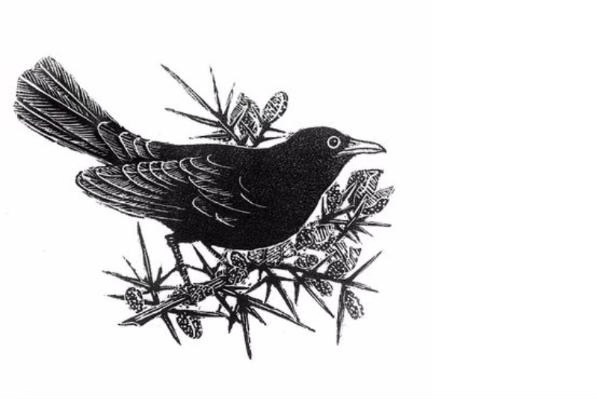
"In October 2003, on my first day as director of the Seamus Heaney Centre, I was walking up the little path to the School of English at 2 University Square when I spied a blackbird scuffling around in the shrubbery. I thought of the Early Irish poem known in English as ‘The Blackbird of Belfast Lough’. It looks like a typical piece of marginalia in its brevity and clarity, an example of how Irish scribes would sometimes so divert themselves from the copying of ecclesiastical texts. For all its apparent spontaneity, it is cunningly worked, written in the complex metre know as snám súad, literally ‘the swimming of the sages’, or ‘poetic floating’. I was familiar with Seamus Heaney’s translation, and I thought I might float my own attempt at it. And the poem suggested a fitting emblem for the Centre. Hence our logo, the elegantly spiky wood engraving of a blackbird singing from a ‘whin’, or gorse bush, by the artist Jeffrey Morgan.
‘The Blackbird of Belfast Lough’ has been much translated into English. The versions in the margin of this text are but two possibilities. There are, to paraphrase Wallace Stevens, at least thirteen ways of looking at a blackbird; and the blackbird can be heard in many ways. Poetry resides in that ambiguity, and that is why the blackbird has been chosen as the emblem of the Seamus Heaney Centre, and its beak, neb or nib, as the title of the Centre’s journal, The Yellow Nib."
Here is the Carson version:
Text within this block will maintain its original spacing when published
the little bird
Text within this block will maintain its original spacing when published
that whistled shrill
Text within this block will maintain its original spacing when published
from the nib of
Text within this block will maintain its original spacing when published
its yellow bill
Text within this block will maintain its original spacing when published
a note let go
Text within this block will maintain its original spacing when published
o’er Belfast Lough—
Text within this block will maintain its original spacing when published
a blackbird from
Text within this block will maintain its original spacing when published
a yellow whin
Here’s a version by Derek Mahon:
The Bangor Blackbird
Text within this block will maintain its original spacing when published
Just audible over the waves
Text within this block will maintain its original spacing when published
a blackbird among leaves
Text within this block will maintain its original spacing when published
whistling to the bleak
Text within this block will maintain its original spacing when published
lough from its whin beak.
The Finest Music, An Anthology of Early Irish Lyrics (Faber, 2014).
But what is it about this short poem? Why are we still reading it, discussing it and coming up with our own versions? The simplicity perhaps, the clarity of the image, the beak and the gorse flowers (a.k.a. furze or whin) and their visual rhyming of colour? Sure, but also something else. So much has changed since the 9th century, so much ecological destruction but, nevertheless, we still have blackbirds, for now, at least. We still have the Lagan and the Belfast Lough, we still have yellow gorse blossoms. Our forests are mostly gone but we still have scraps of hedgerow and spiky branches where the yellow-nibbed bird can shelter.
Since Let the Dead came out, I’ve mostly been writing, thanks to a couple of Arts Council bursaries, the manuscript for my third collection, poems that focus on our relationship with the natural world, with a particular focus on Ireland. So, yes, even though I find translation almost impossible, the urge to overthink almost unavoidable, I forced myself to come up with my own version of the blackbird poem. Before that, have a look at this, by John Hewitt, excuse the spacing issues:
Gloss, on the Difficulties of Translation
Across Loch Laig
the yellow-billed blackbird
whistles from the blossomed whin.
*
Not, as you might expect,
a Japanese poem, although
it has the seventeen
syllables of the haiku.
Ninth-century Irish, in fact,
from a handbook on metrics,
the first written reference
to my native place.
*
In forty years of verse
I have not inched much further.
I may have matched the images;
but the intricate wordplay
of the original - - assonance,
rime, alliteration - -
is beyond my grasp.
*
To begin with, I should
have to substitute
golden for yellow
and gorse for whin
the last is the word we use
on both sides of Belfast Lough.
John Hewitt, Collected Poems (Blackstaff Press 1991).
I like how he creates a poem on the difficulties associated with translation in which his translation of the original is embedded. The last line might also point towards a sense of the whin as a sort of unifier, the yellow petals uninterested in tribal concerns, opening the poem up to other issues and connections. My version is simple. I had a look at the original Irish. The 4th and 8th lines contain the yellow colour, the bright yellow of the beak and the yellow cairns/mounds/clumps of the branch in blossom. I have not mentioned the name of the flower (gorse/whin/furze) as it is not mentioned specifically (I think) in the original. I have also committed the sin of not naming the Lough but, I figure that, at this point, anyone with an interest in these things already knows what we’re dealing with here:
THE BLACKBIRD
little thing
whistling from
a yellow-bright beak
*
crying out
across the lough
*
from the
yellow-clumped
branch
There are plenty more English-language versions of this poem to be found, if you look hard enough you might encounter one you like. My favourite version of the blackbird is by Carson but it’s not the one mentioned above. It’s a short poem named ‘Belfast’, the opening poem from his collection Breaking News, a book I have loved since I heard him read from it in 2004 in Dun Laoghaire:
Belfast
east
*
beyond the yellow
shipyard cranes
*
a blackbird whistles
in a whin bush
*
west
*
beside the motorway
a black taxi
*
rusts in a field
of blue thistles
Carson calls back to the 9th century, and the waterside song of the blackbird answers him in the 21st.
Finally here is a poem/riddle by Michael Longley, from Angel Hill (Cape Poetry, 2017). If you’ve been paying attention you already know the answer to this riddle, feel free to respond below:
RIDDLE
I flourish between pleasure and pain.
Lovers make love during my season.
One of my names says breezy branches,
Another a young man’s downy chin.
The third remains a thorny problem.
Farmers stamp on my feet for fodder.
Now I’m a chimney sweep, now a broom.
Thanks for reading. As always, the best way to support me is by buying Let the Dead here.
No posts
Comments
Nothing yet. Say the first thing.
Sign in to join the conversation.