
The reason I write about and study matriarchal theory is simple. Patriarchy cannot withstand it.
No, literally.
The entire way patriarchy keeps going is through the idea that it is natural and that any other social structure is a fantasy.
If matriarchy simply exists as a possibility, patriarchy weakens.
If matriarchy is studied, well-defined, and accurately understood, patriarchy crumbles.
That’s why it’s really important to get clear on what matriarchy truly means. When I created this graphic, it was with the intention to illustrate how matriarchy is different from patriarchy, and why it does not mean “women rule”, or patriarchy with women in charge.
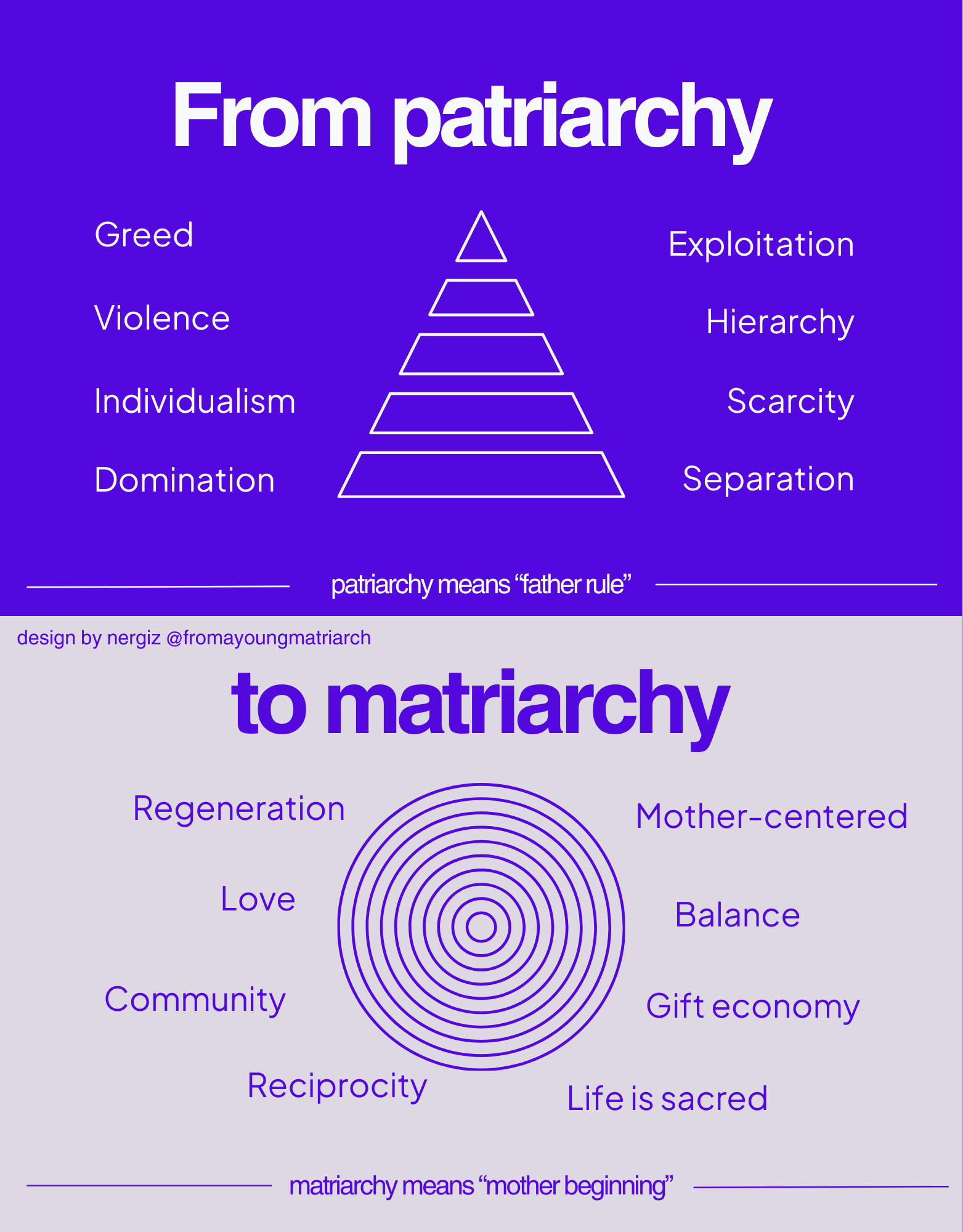
One of the most controversial parts of the graphic was the phrase “mother-centered”. Many people said they preferred the term “child-centered”. But this does not capture what matriarchy actually means.
These definitions are not mutually exclusive, but mother-centered is both a more complete and subversive definition. We need that in our toolkit for dismantling patriarchy.
It’s telling, first of all, that there is a discomfort in our culture with centering mothers. I don’t judge the instinct to center children: it comes from a well-intentioned place. However, we have to understand that the system we are up against runs on the erasure of mothers. This has a deeply negative effect on society and children.
When you become a mother in a patriarchal society, you experience firsthand our culture’s projections about motherhood. It was always my instinct to nourish myself so I could show up better for my child. It simply made logical sense to me that my daughter and I were a unit, and if I were depleted, I would not be able to nourish her properly.
Rather than being supported in this, I have been called selfish more times than I can count. I have been told that I’m “making it all about me” and that my daughter should come first. The idea that my daughter and I are competing for scarce resources, which therefore means I must sacrifice myself so that she is nourished, is pure patriarchal conditioning.
But this is what truly happens in our society. We give mothers (and anyone in a caregiving role) so few resources that they are forced to self-sacrifice.
In the US, around 1 in 7 children experience childhood neglect in some form. While that number is unacceptable, it also shows that martyrdom is the norm. Most mothers are invisibly absorbing the sacrifice. Both mothers and children are getting shortchanged, because there’s only so much one person (or two people, in the case of the nuclear family) can give. Even if you give all of yourself, it’s not enough.
I have tried to do things differently by rejecting martyrdom. But because I want the best for my child, I have been forced to deplete myself anyway. This has felt incredibly dehumanizing, and it continually shocks me how normalized it is.
I am a mother, and I am also a person. In early childhood, especially, the idea that a mother’s basic needs won’t be met and we simply have to accept this is appalling.
In the 2.5 years of being a mother, I cannot remember the last time I was well-rested. I just searched “exhausted” in the digital journal I keep, and fifty-three entries came up. Fifty-three! During one particularly hard day last summer, I wrote: “I feel like I’m not being the best version of a mother I can be, my emotional regulation is not there”.
Through the deep love I feel for my daughter, I conjure up the strength to get through every day, but I am pushed to my limits almost constantly. It has taken a lot of reflection not to let the guilt overwhelm me, to place it where it rightfully belongs: on the society that fails mothers and children.
When scarcity is manufactured, and then mothers are blamed for the outcome, guilt becomes a tool of control. It keeps mothers focused on their own inadequacy rather than the system's failure.
We do not need to keep accepting this as normal. This is exactly the problem that matriarchies, aka mother-centered societies, solve.
Mothers are the source. When we center mothers as people, we resource them so fully and so abundantly that they cannot create anything but the most nourished children. This creates a stronger society overall. We also allow room for mothers to be their own people. To simply rest, create art, laugh joyously, or contribute to their community. This is a noble goal on its own.
But mother-centered means much more than centering human mothers. Matriarchies being mother-centered means the entire society is organized around maternal values.
Matriarchy, or mother beginning, means honoring that every person comes from another person. That every human child must be intensely mothered for a long period of time to make it to adulthood. That every person becomes dependent on others at some point, through illness, disability, or ageing. That every single living being is mothered by the Earth.
We know these things as facts. Matriarchy organizes politics, economies, social and cultural norms around them.
Rather than privatizing care and dumping all the work on a couple of people (usually the mother), a matriarchal family structure means there are multiple mother figures for children, and caregiving is a shared load among many.
When mothers are pregnant or postpartum, they are honored and abundantly cared for, given ample time to heal and regenerate.
In ancient goddess cultures, archaeological records show an abundance of vulva imagery and temples shaped like pregnant bodies, with entry through the vulva.1 Bringing life into the world is considered to be of the highest value, in sharp contrast to our society, which treats it as worthless, especially against capital-producing work.
The act of mothering is itself sacred, and not limited to biological mothers. For the matriarchal Minangkabau in Indonesia, a man is considered a strong leader when he is “like a good mother”.2
What does a good mother do? A good mother cares, nourishes, and protects. A good mother provides emotional attunement, sets boundaries, and nurtures connection with the child. A good mother provides everything the child needs to be balanced and whole.
Our planet does this for us every day. She provides care through the air we breathe, the water we drink, and the food we eat. She gives us protection through her medicinal plants, the design of our immune systems, and our incredible brains, which we use to move through the world. She provides nourishment through her beauty, and the awe and wonder we feel when we witness and commune with her fully. Earth is us, we are her.
Patriarchal society treats the Earth the same way it treats mothers. It extracts without nourishing her in return.
The concept of mother-centeredness in matriarchy corrects this imbalance. When we honor and resource the mother - as a person, as an archetype, as the planet - everyone benefits. It is not about prioritizing mothers over children. It's about understanding that nourishment has a source.
To resource the mother is to reject the patriarchal logic that normalizes mothers of all types existing solely to be consumed by others. That is a radical act in our society.
It is a daily practice for me to commit to matriarchal mothering in a culture that sees maternal depletion as normal. I want my daughter to know that mothers and women are full human beings. That we deserve joy. That caring for others should not require self-erasure.
That is what mother-centered means. Honor the source, and abundance flows.
If you are new to goddess cultures, I would recommend starting with The Living Goddesses by Marija Gimbutas. I am currently reading The Goddess of Malta, the Lady of the Waters and the Earth. Malta is rich with intact temples and archaeology that shows evidence of matriarchal and goddess-worshipping cultures from ~5,000 years ago.
No posts
Comments
Nothing yet. Say the first thing.
Sign in to join the conversation.