
“To love someone is to agree to be rearranged — cell by cell, memory by memory — until you no longer recognize the borders of your own skin.”
We talk about love as if it were something we fall into—a soft, calming state of pure happiness. Something gentle. Something safe. But sometimes, rather than a landing, loving can feel like a demolition. There is a psychological theory called the self-expansion model. It suggests that when we fall in love, we do not simply grow closer to another person; we expand our sense of self to include them. Their preferences, their fears, their language, their way of looking at and approaching the world—all of it begins to live inside us. Love, then, is not just connection. It is incorporation. And if that is true, then love is not just beautiful. It is existential.
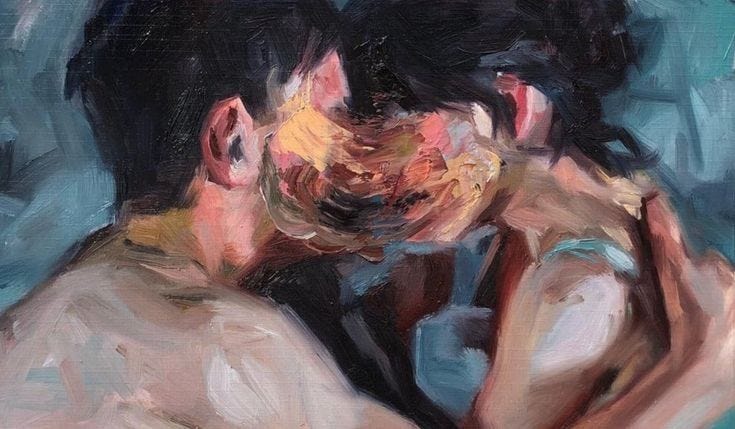
When you begin loving someone—when you both accept that you are irretrievably, undeniably in love—something subtle shifts. You start saying “we” without noticing. You adopt their favorite songs as if they had always been yours. You care about cities you have never been to because they once walked their streets. Their childhood stories become part of your emotional landscape. Their grief aches in your chest as if it were your own. To some, this may seem poetic—romantic even—as if two souls are merging into one because they care so deeply. But this is not poetry. It is psychology.
We like to believe identity is fixed—that we are solid, separate, self-contained beings. But identity is porous. It absorbs. It stretches. It merges. And romantic love accelerates this process. The boundaries between “me” and “you” blur—not because we lose ourselves, but because the definition of self quietly expands to include another. You are no longer just a singular being navigating the world. You are carrying another consciousness inside your emotional architecture. And that changes everything.
When we miss someone we love, the most rudimentary way of expressing it is to say, “I miss them.” But that is not the whole truth. What we are really grieving is the version of ourselves that existed with them. So, when someone leaves, it can feel like amputation—not metaphorically, but neurologically. If they had become integrated into your identity, their absence creates a rupture. Your nervous system does not understand why the person who once felt like home is suddenly gone. The brain still fires in patterns shaped by their presence. It is not just that you lost someone. It is that you lost part of who you were becoming.
To let someone become part of you requires a form of surrender most of us are never taught how to handle. We are raised to value independence. Self-sufficiency. Emotional control. We are praised for not needing anyone. Ever. Yet love asks us to do the opposite. It asks us to open the door. To allow change. And to us creatures—who equate independence with strength—change feels terrifying. Because if another person becomes part of your identity, you are no longer fully in control of who you are. You are co-creating yourself with someone else. We often think the scariest part of love is rejection. But perhaps the scarier truth is this: love means consenting to change in ways you cannot predict.
When someone knows you intimately, they do not just see your strengths. They see the places where you are insecure. The patterns you repeat. The wounds you carry. And in loving you, they hold a mirror you cannot easily look away from. Sometimes we fall in love not because someone completes us, but because they expand us into versions of ourselves we had not yet met. The writer. The nurturer. The risk-taker. The helper. Or, painfully, the jealous one. The avoidant one. The fragile one. Love expands, it rearranges. And that rearrangement is not always comfortable. But it is real.
There is a tension at the center of this idea. If love expands the self, then what happens to individuality? Are we dissolving? Are we losing autonomy The truth is more nuanced. Healthy expansion is not erasure. It is enrichment—the addition of perspective, not the deletion of identity. The danger arises when expansion turns into absorption, when one person disappears entirely into the other. But at its best, love does something extraordinary: it allows two separate selves to remain distinct while also overlapping. In that shared space, we discover capacities within ourselves we would never have unlocked alone. This is why love can feel like becoming more yourself, not less.
To love someone is not simply to choose them. It is to allow them inside the borders of your identity. To let their voice echo in your decisions. To let their presence alter your future. Love is not just an emotion. It is a psychological expansion of the self. And that is why it feels so consuming. So intoxicating.
So dangerous. So worth it. Because in loving, we do not just experience another person. We experience new versions of ourselves. And every time we love, we are not only saying, “I choose you.” We are also saying, quietly, without fully realizing it: “I am willing to become someone new. I am willing to grow. I am willing to change.”
- L.
No posts
Comments
Nothing yet. Say the first thing.
Sign in to join the conversation.