
Forecasts aren’t my favorite thing.
They’re more often than not glorified guesses people tend to overdo.
But it IS possible to keep forecasts practical & simple to do, allowing for more time to be spent on the real work needed to hit those forecasts.

Creating a revenue forecast has 2 main parts:
Predicting revenue from returning customers (Retention): This is what this article is about.
Creating new customer targets to meet revenue goals (Acquisition): This will be covered in Part 2.
Assumptions:
You’ve got at least a year worth of sales history.
You have a retention curve (people come back to buy more than once).
Elephant In The Room:
Macro-Economics: The method I’ll cover below works well in stable market conditions, but things are anything but stable as of writing.
The longer you’ve been in business, the more accurate this method will be.
The Method: Use retention curves from customers acquired in previous years, to predict revenue from those same customers in the current year.
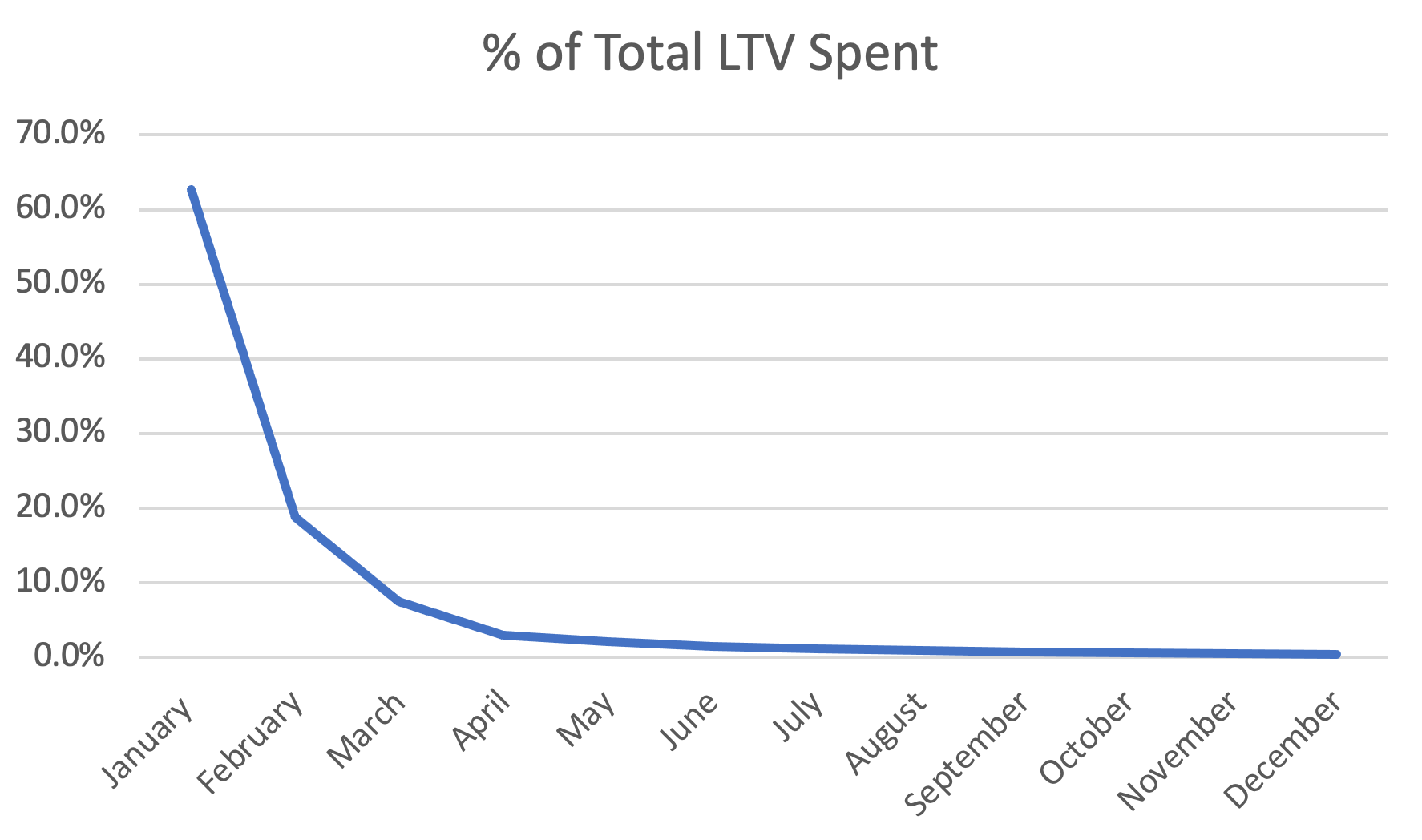
Example: In the example below, new customers from January 2020 spent $500,000 collectively in January, then $150,000 collectively in February, and so forth.
Here are 2 ways to get this data:
Manually with Shopify Analytics Exports + Excel Lookups
With a Shopify App like “REVEAL” from Omniconvert (I’m not affiliated, I just used their free trial a few months ago and it was helpful).
Every month’s cohort will have a decay of revenue, where in Month 12 for example, there might be 1% of the revenue captured compared to Month 1.
As time goes by, the exponential decay becomes fairly linear.
The Math: Once you have historical data lined up, you’ll have things like “For customers that start in Month 1, on Month X, Y% of revenue compared to Month 1 is captured.”
The Result: You can come up with a prediction of how much each cohort of customers will spend for the year being projected.
Below is an example showing a hypothetical scenario from 2021 acquired customers.
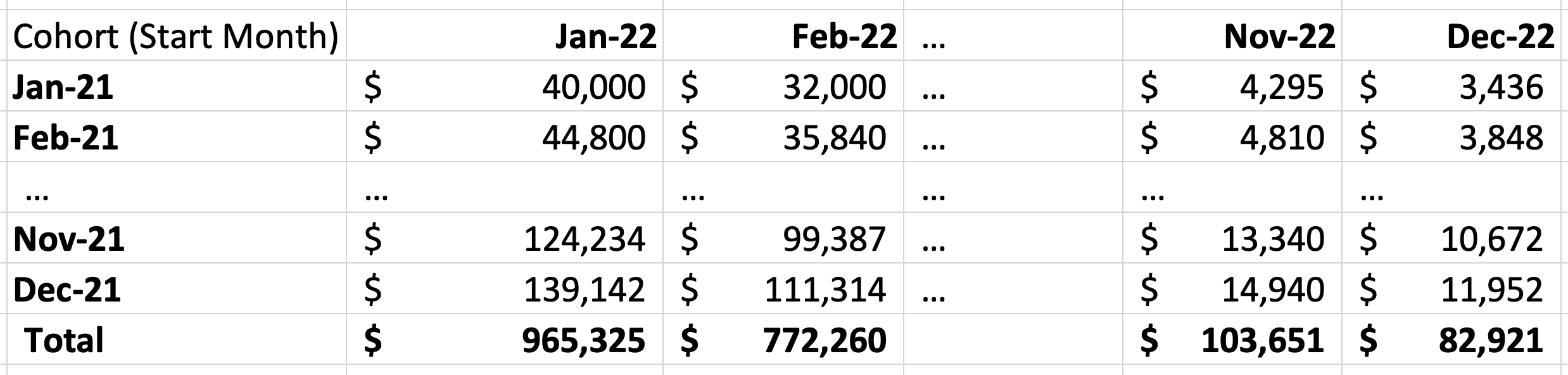
In the table above, assuming every month in 2021 the same amount of customers were acquired, spending the same amount, we see a retention stack starting to form.
If we look at December 2022 projections, most of the revenue will come from latter half of 2021’s customers, and it decays as we go back in time.
Like I mentioned, this is the first part of building a revenue forecast.
The above exercise is a prediction of how much revenue you will generate if you didn’t acquire ANY new customers from now on.
It’s revenue you can count on, with varying degrees of certainty.
Some things that will effect certainty of prediction:
Macro-economic changes
Inventory shortages
Retention rates
Customer Lifetime Value (closely tied to retention rate)
What we’ll do in part 2: Combine our retention stack revenue with a revenue goal, with the objective of creating acquisition targets to meet that overall revenue goal.
No posts
Comments
Nothing yet. Say the first thing.
Sign in to join the conversation.