
This is my second consecutive year publicly sharing a Books-I-Read-This-Year list. I have mixed feelings about doing so, and explained why last year. For the details, and for an explanation of why I’m writing this anyway, you can go to last year’s post or read the footnote at the end of this sentence.1
Before getting into this year’s list, there’s one thing I want to say about it:
This is really long, and I know it’s really long, and I know that even people who are interested in it are unlikely to read the whole thing, and I am okay with that. Readers are invited to skim the list and dive in wherever their interest is piqued.
Thank you. I feel better having said that.
Here are some things you may want to know about my list:
These are books I finished in 2025. I began to read a few of them in 2024.
These books are listed chronologically, in the order I completed them.
I included audiobooks in this list. I know this is a sore subject with some readers, so don’t worry: I have used asterisks to indicate which titles I merely listened to. I won’t be offended if you refuse to give me credit for these.
Books I read twice are indicated by ‘x2’ and I counted them as two books for purposes of this list. Again: you don’t have to give me credit for the second readings. But this is my list, and these are my rules.
Children’s books only made it onto this list if they take at least a few hours to read out loud (and if I did, in fact, read them out loud). I recently read The Grinch Who Stole Christmas—which is magnificent in every respect—to my eight-year-old, but it didn’t make the cut because it’s just too short. The Best Christmas Pageant Ever did make the list, because two or three evenings of family time were occupied by it.
I’ve used pairs of three daggers (†††) and included an image to indicate my “winners” in a variety of categories. If you’re looking for some recommended reading in 2026, well, here you go. The images of these books contain hyperlinks to sites where you can buy them.
Now, on to the list. In addition to a bajillion texts messages and emails, lots of Substack essays, a shameful number of Facebook posts, and quite possibly everything The Cleveland Plain Dealer published about the Cleveland Browns, here’s what I read in 2025:
1. Charles Dickens, A Christmas Carol – Marley was dead. Like, super dead. As for Tiny Tim… well, no spoilers.
2. †††Annie Jacobsen, Nuclear War: A Scenario*†††
WINNER: BOOK OF INTEREST TO LITERALLY EVERYBODY AND THAT EVERY SINGLE POLITICAL LEADER OF ANY KIND ON PLANET EARTH SHOULD READ

Very compelling read (or, my case, listen): I got through the whole thing in about three days. Nearly the entire book is simply a description of what would happen in the first 72 minutes [yes, minutes] after the launch of a nuclear weapon, at least under one plausible set of assumptions. [Spoiler Alert: What would happen is that the world would end, that’s what would happen.] Jacobsen paints a compelling picture of how easily this could happen and how utterly horrific it would be. My only real critique of the book is that she gets a little preachy: it’s clear throughout that she thinks nuclear deterrence is a completely ridiculous idea, but she never acknowledges that once the nuclear genie was let out of the bottle, everything changed. No one could read this book and not wish we’d never developed the Bomb, but we did, and now we have to live with that fact. Jacobsen doesn’t say in so many words that we should seek nuclear disarmament, but it’s clearly her view, and in principle I agree. Until someone articulates a plan to get Russia and North Korea to go along with it, however, it’s a pipe dream. Would that it were otherwise. My only other comment is that it seems nearly impossible for anyone familiar with the Christian scriptures not to be reminded of biblical images of the apocalypse when listening to Jacobsen describe a nuclear holocaust. Let him who has ears, hear, I suppose.
3. †††St. Thérèse of Lisieux, Story of a Soul†††
WINNER: BEST SPIRITUAL WRITING

An extraordinary book by an extraordinary saint. For much of my life, I don’t think I would have been able to appreciate this at all, but I encountered it at the right time. The real payoff is in Manuscripts B & C, but the whole thing is worthwhile. St. Thérèse’s willingness to suffer—nay, her desire to suffer—is a remarkable thing. And of course her “little way” is such an important idea and a beautiful legacy… her refusal to defend herself against misperceptions, her commitment to dealing with little annoyances with good cheer, etc., etc., etc. Certainly a powerful witness to those of us who aren’t called to violent martyrdom and live mostly comfortable lives…
4. Andrew Kim, An Introduction to Catholic Ethics Since Vatican II — The title of this book gives a lot of information about its content. With the exception of a bizarre error on page 159 (“bizarre” in that Kim certainly knows better than to make such an error, and somehow his editor at Cambridge University Press missed it too: an obviously invalid argument is presented as valid), it’s really excellent. I doubt you’ll find a better book for giving a solid introduction to the topic.
5. C. S. Lewis, The Voyage of the Dawn Treader — It’s Narnia. It’s great. Read it out loud to some of my kids.
6. C. S. Lewis, Perelandra — Of his own novels, this was one of Lewis’s favorites. I’d be hard-pressed to say that any of his writings are better. It’s the second book in his “Ransom trilogy,” a series of (sort of) sci-fi novels promoted by a friendly challenge with his friend J. R. R. Tolkien. It’s a beautiful picture of an unfallen world, and a powerful illustration of how it could be possible for a sinless creature to fall into sin. There’s also some great stuff about providence and human freedom, hearing God’s voice, and time and eternity. Just a magnificent book. Your mileage may vary. I read it with a group of people at my parish and some of them couldn’t get into it at all.
7. C. S. Lewis, The Great Divorce — Among my favorite books and one of the most important for my own life. When I was in college, I nearly abandoned Christianity due to an inability to reconcile belief in a loving God with Jesus’ talk of hell. Reading this book—a story in which the narrator takes a bus from hell or purgatory to heaven, a rather remarkable premise!—helped me to see how these can coexist. “There are only two kinds of people in the end: those who say to God, ‘Thy will be done,’ and those to whom God says, in the end, ‘Thy will be done’” (75).
8. C. S. Lewis, The Silver Chair — More Narnia. More reading out loud. So good.
9. †††Rod Dreher, Living in Wonder†††
WINNER: BOOK I MOST WANT TO HAVE CONVERSATIONS WITH SMART PEOPLE ABOUT
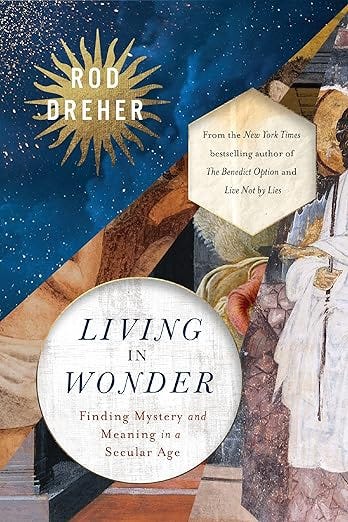
This is a very interesting and, I daresay, important book. I don’t endorse everything Dreher says, but Living in Wonder is fascinating and largely spot-on. I suspect that many nonreligious people will find it intriguing, and I hope that many religious leaders will read it and wrestle with the many issues it raises. I wrote more about it here.
10. William C. Mattison III, Introducing Moral Theology: True Happiness and the Virtues — A textbook, and, aside from a few typos and some occasionally dull writing (the latter being tough to avoid in this genre), a really excellent one. Better than the Kim book mentioned above for a moral theology course; probably inferior to it for an individual interested in becoming more acquainted with the topic. Mattison structures his book around the cardinal and theological virtues and has a few helpful digressions into theology proper. It’s good stuff.
11. Malcolm Guite, The Word in the Wilderness: A Poem a Day for Lent and Easter — I’m not sure how many times I’ve read through this book over the Lenten season and Easter octave (or, as was the case this year, extending a few weeks beyond). It’s a real gem, though. The poems themselves are a diverse collection, and Guite offers commentary that is both scholarly and pastoral, helping to reveal the brillIance of the poetry as well as to edify the reader. Highly recommended.
12. †††Ross Douthat, Believe: Why Everyone Should Be Religious†††
WINNER: MOST IMPORTANT NEW BOOK ABOUT RELIGION WRITTEN FOR NORMAL PEOPLE
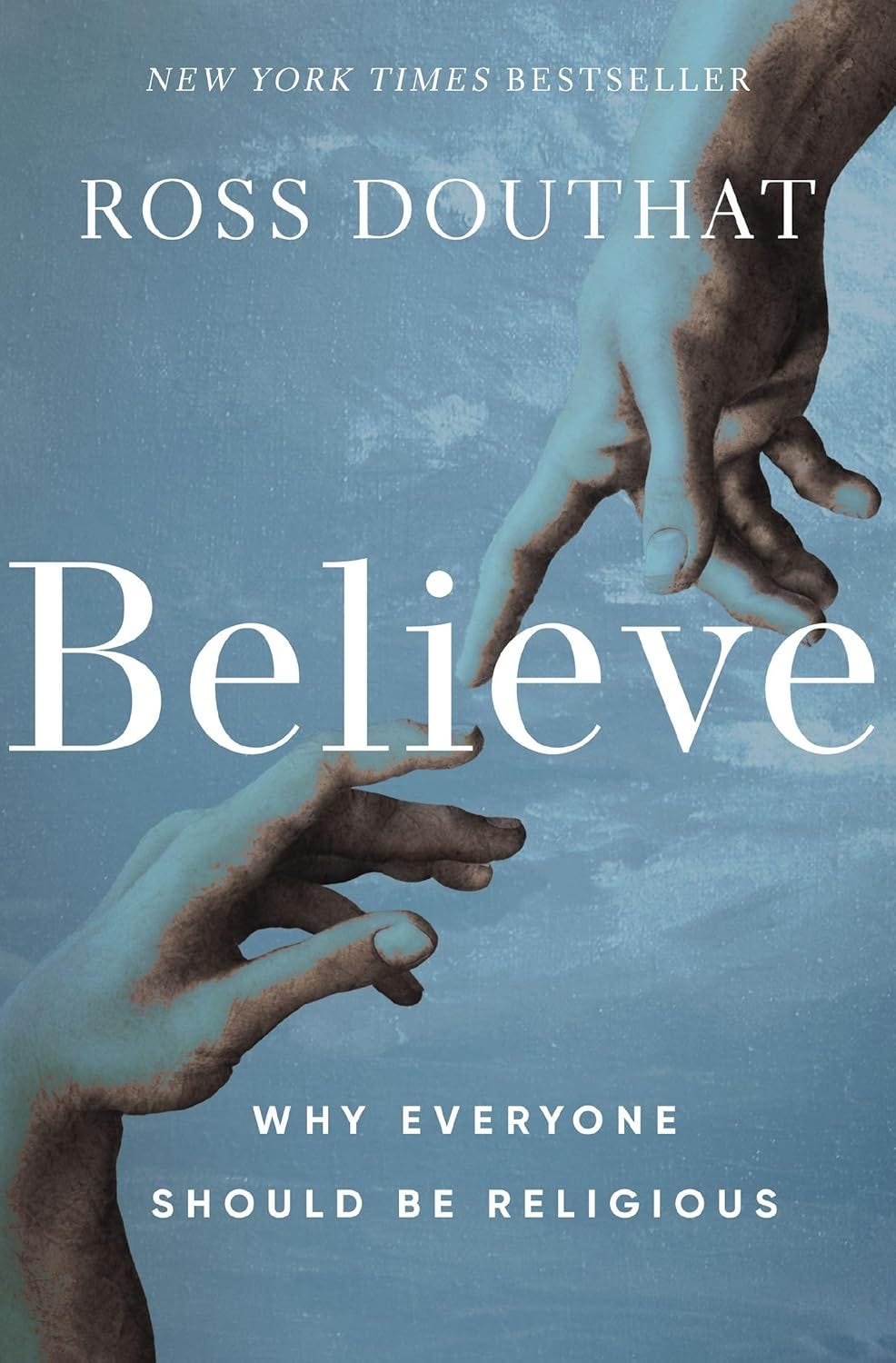
We finally have the twenty-first century’s Mere Christianity. This book is tremendous, providing an accessible overview of principal reasons for adopting a generally religious stance toward the world. Douthat himself is a faithful Catholic, but only in the final chapter does he attempt to make a case for Christianity as uniquely true. Throughout most of the book, he is content to advocate for a pluralistic “perennialism,” suggesting—with good reason—that our default setting toward religious questions ought to be one that assumes that the world’s great religious traditions are unlikely to have been simply in fundamental error for all these generations, but rather that they contain genuine wisdom and insight into what is really real and how human beings live well. Going forward, when I learn that someone is interested in, but skeptical of, religion, this will be the first book I encourage them to read.
13. G. K. Chesterton, The Everlasting Man — I expected and wanted to love this book. I did not.
Chesterton is wonderful, and my intellectual hero C. S. Lewis thought that The Everlasting Man was the best defense of Christianity he’d ever read, but… this was a slog. I don’t know how far I would have made it had I not been reading it with a group and felt obliged to stick with it (especially as I was the person who proposed it!). Having completed it, I’m inclined to say that it is both
a work of genius
and
a work for a different time.
Its audience is literate and patient and deeply acquainted with Christianity in a way that our age is not. Chesterton brilliantly strives throughout the work to make the familiar unfamiliar and thereby demonstrate what a unique thing the Christian faith really is. But boy is it tough sledding in parts. To say that Chesterton can be verbose—and I know I live in a glass house here and shouldn’t be throwing any stones—would be an understatement. As a colleague of mine said in one of our discussions of the book, “I think Chesterton got paid by the word.” I learned in the commentary on the conclusion [I read the version published by Word on Fire, with helpful notes and excellent commentary by Dale Ahlquist] that Chesterton actually dictated this work, and this fact may explain the style.
A representative passage (II.4.377):
What really happened was this. When the Faith first emerged into the world, the very first thing that happened to it was that it was caught in a sort of swarm of mystical and metaphysical sects, mostly out of the East; like one lonely golden bee caught in a swarm of wasps. To the ordinary onlooker, there did not seem to be much difference, or anything beyond a general buzz; indeed in a sense there was not much difference, so far as stinging and being stung were concerned. The difference was that only one golden dot in all that whirring gold-dust had the power of going forth to make hives for all humanity; to give the world honey and wax or (as was so finely said in a context too easily forgotten) ‘the two noblest things, which are sweetness and light.’ The wasps all died that winter; and half the difficulty is that hardly anyone knows anything about them and most people do not know that they ever existed; so that the whole story of that first phase of our religion is lost.
And another (II.5.414):
What the denouncer of dogma really means is not that dogma is bad; but rather that dogma is too good to be true. That is, he means that dogma is too liberal to be likely. Dogma gives man too much freedom when it permits him to fall. Dogma gives even God too much freedom when it permits him to die. That is what the intelligent sceptics ought to say, and it is not in the least my intention to deny that there is something to be said for it. They mean that the universe is itself a universal prison; that existence itself is a limitation and a control; and it is not for nothing that they call causation a chain. In a word, they mean quite simply that they cannot believe these things; not in the least that they are unworthy of belief. We say, not lightly but very literally, that the truth has made us free. They say that it makes us so free that it cannot be the truth. To them it is like believing in fairyland to believe in such freedom as we enjoy. It is like believing in men with wings to entertain the fancy of men with wills. It is like accepting a fable about a squirrel in conversation with a mountain to believe in a man who is free to ask or a God who is free to answer. This is a manly and a rational negation for which I for one shall always show respect. But I decline to show any respect for those who first of all clip the wings and cage the squirrel, rivet the chains and refuse the freedom, close all the doors of the cosmic prison on us with a clang of eternal iron, tell us that our emancipation is a dream and our dungeon a necessity; and then calmly turn round and tell us they have a freer thought and a more liberal theology.
And so it goes, on and on, for over 470 pages in my edition. Some of the writing is absolutely beautiful, and as the above passages reveal, Chesterton has a gift for analogy and a love of paradox. Read him as a poet and you’ll be on the right track. As for me, I can imagine going back to this book as a source of quotations and memorable images (the strangeness of a horse as described in the introduction is one for the ages), but I don’t know when I’m likely to try to read it again, and I don’t foresee recommending it to a skeptic who is looking for reasons to believe.
14. Simon Horobin, C. S. Lewis’s Oxford — A very nice biography of Lewis, focusing primarily on specific locations in Oxford as a way of telling his story. Not much was new to me, personally, but I would certainly recommend the book to someone who wants to learn more about Lewis and expects to have an opportunity to visit Oxford in person. The photographs are excellent.
I had the chance to meet Horobin in Oxford in June 2025, and he is a delightful person.
15. C. S. Lewis, The Magician’s Nephew — Book six of The Chronicles of Narnia. Don’t read it first, even if the spine says “1” on it.
16. †††Mark Hansard, Star Trek and Faith†††
WINNER: BEST BOOK WRITTEN BY A FRIEND OF MINE
WINNER: MOST ORIGINAL APPROACH TO WRITING ABOUT FAITH
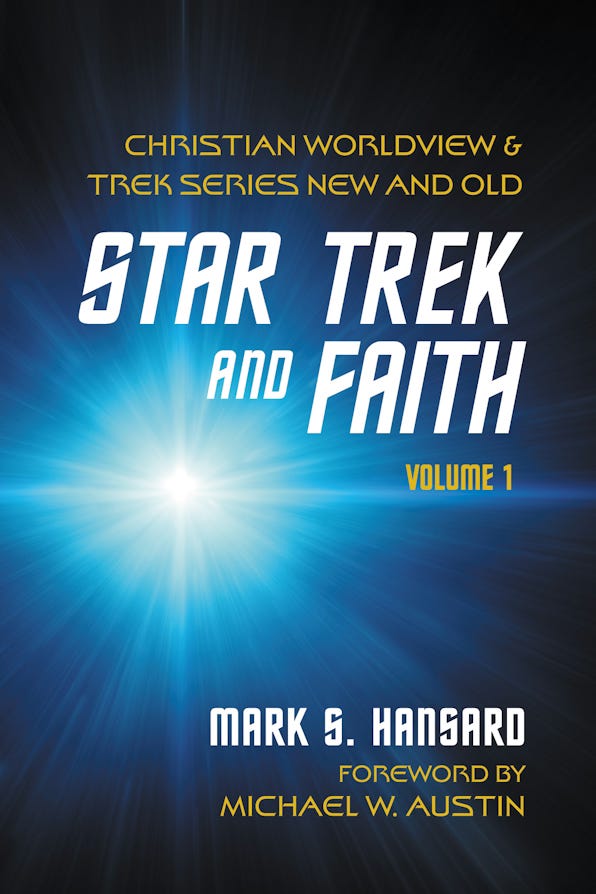
I read this in manuscript form; the author is an old friend and classmate of mine, and I was asked to blurb it. Here’s what I wrote: “Star Trek and Faith is a model of winsome engagement, identifying important theological questions raised across the Trek canon and showing how the Christian faith offers reasonable and even compelling answers to those questions. Whether you’re a Trekkie Christian trying to reconcile your fandom with your faith, or a skeptical Trekker who embraces Trek’s secular humanism, this highly accessible book is worthy of your attention – definitely recommended!” For serious — Mark did a great job with this.
17. C. S. Lewis, Till We Have Faces — Lewis’s best novel. A retelling of the myth of Cupid and Psyche. He saw it as an image of how loves can go awry and what religious conversion looks like to the covert’s loved ones; I’ve always seen it as a marvelous picture of the problem of the hiddenness of God. Perhaps those are two sides of the same coin?
18. C. S. Lewis, The Four Loves — I hadn’t read this book in many years. On the whole, it’s very good, though not Lewis’s best. Apparently Pope Saint John Paul II once told Walter Hooper that it is on the same level as St. Augustine’s writings on love, so that’s pretty high praise. The chapter on friendship stands out as particularly good and particularly important, in my humble opinion, though one of my favorite lines also makes it awkward to recommend to readers with twenty-first century sensibilities. In a delightful takedown of the modern tendency to interpret every literary expression of friendship as homoerotic, Lewis writes on page 80:
Kisses, tears, and embraces are not in themselves evidence of homosexuality. The implications would be, if nothing else, too comic. Hrothgar embracing Beowulf, Johnson embracing Boswell (a pretty flagrantly heterosexual couple), and all those hairy old toughs of centurions in Tacitus, clinging to one another and begging for last kisses when the legion was broken up … all pansies? If you can believe that you can believe anything.
“All pansies?” – I wouldn’t use, or recommend using, this language in the mid 2020s, but this makes me smile every time I read it. Don’t judge me.
19. Jane Austen, Pride and Prejudice* — Somehow I made it nearly half a century without ever reading this book. It’s every bit as good as its reputation. Arguably the real heroine of the story is the English language. Just glorious! And I am not ashamed to admit that I was really keen to find out whether Elizabeth and Mr. Darcy would, in fact, get together. No spoilers from me, though.
20. †††Tom Farley et al., The Chris Farley Show†††
WINNER: MOST SURPRISINGLY COMPELLING AND TOUCHING BOOK
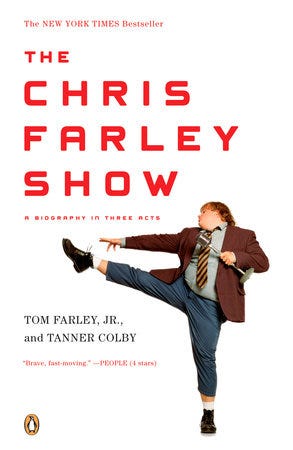
I did not expect to be so captivated by this book. It’s written in an interesting style: eighty percent or more is just snippets of interviews with people who knew Chris Farley. It feels sort of like you’re sitting around with these people listening in on their conversation, which means you sometimes get pretty different perspectives on the events they describe. It surprised and fascinated me to learn how seriously Farley took his Catholic faith, a theme that runs throughout the book, and there are moments that are laugh-out-loud funny even in the midst of genuine tragedy. The last part of the book is gripping and sad — I had tears in my eyes as I read the last few pages. Anyone who came of age in the 90s and laughed at SNL and the movies featuring its cast members during those years will enjoy this book immensely.
21. Graham Greene, The Power and the Glory — This is definitely a great book in the sense of being an artistic achievement, but it is not my cup of tea. It’s about a priest—he’s nameless, which is interesting, and a drunk, and the father of a child—in revolutionary Mexico, where Catholicism had been outlawed. It’s pretty dark. And I took a break in the middle of it for several months, which made it difficult to keep track of some of the characters. These factors did not enhance my enjoyment of it. I didn’t understand the ending at all. Yet it feels like something I might read again someday. Was the whiskey priest (that’s what he’s called) a good man, or a bad man? A sinner or a saint? How often are we mistaken about which people belong in which camp, or where we ourselves belong? These are the questions it leaves me asking. It’s also astounding to think about the fact that Catholicism was illegal in Mexico—Mexico!—a hundred years ago.
22. Thomas Cahill, How the Irish Saved Civilization* — I was surprised to learn that this book was published way back in 1995. I read it in the early 2000s and remembered enjoying it; I’m not sure what inspired me to download the audiobook. It’s… okay. Definitely entertaining. Occasionally a bit salacious. Sometimes warm toward Catholicism, and sometimes smarmily condescending, in the manner one can unfortunately expect from contemporary secular historians. There were also a few claims that seemed to me to be overstated in light of the evidence, or even flat-out wrong, which made me question how reliable the narrative is overall. Of course, I can’t give any examples because I was driving while listening and didn’t make any notes. Oh, well. It’s a good listen, though. I particularly enjoyed the story of St. Patrick. And it struck me how similar in some respects our own time feels to the collapsing Roman Empire. It also struck me how brutal life was (is!) for so many people. I think I might have enjoyed being an early medieval Irish monk, all things considered, but I would be terrified of the Vikings. Also, I didn’t realize that the Irish engaged in so much missionary activity. Had they not done so, they might still have saved western civilization in the sense of preserving it, but the history of Europe would have been much different.
23.William C. Mattison III, Introducing Moral Theology: True Happiness and the Virtues (x2) — I taught the first-ever course in what will hopefully be the long and illustrious history of the Mary, Mother of the Good Shepherd Institute, and this was the textbook. It really is excellent. Going through it carefully a second time, I am struck afresh by the deeply integrated character of Catholic ethics, and by the oh-so-important idea that Catholic morality is simply and fundamentally about being human. (Mattison doesn’t say much, if anything, about that theme—at least not directly—but it’s something I think about a lot and it shines through in this book.)
24. †††The Word on Fire Vatican II Collection: Constitutions†††
WINNER: BOOK EVERY CATHOLIC NEEDS TO READ AND IT WOULDN’T HURT YOU NON-CATHOLICS TO READ EITHER
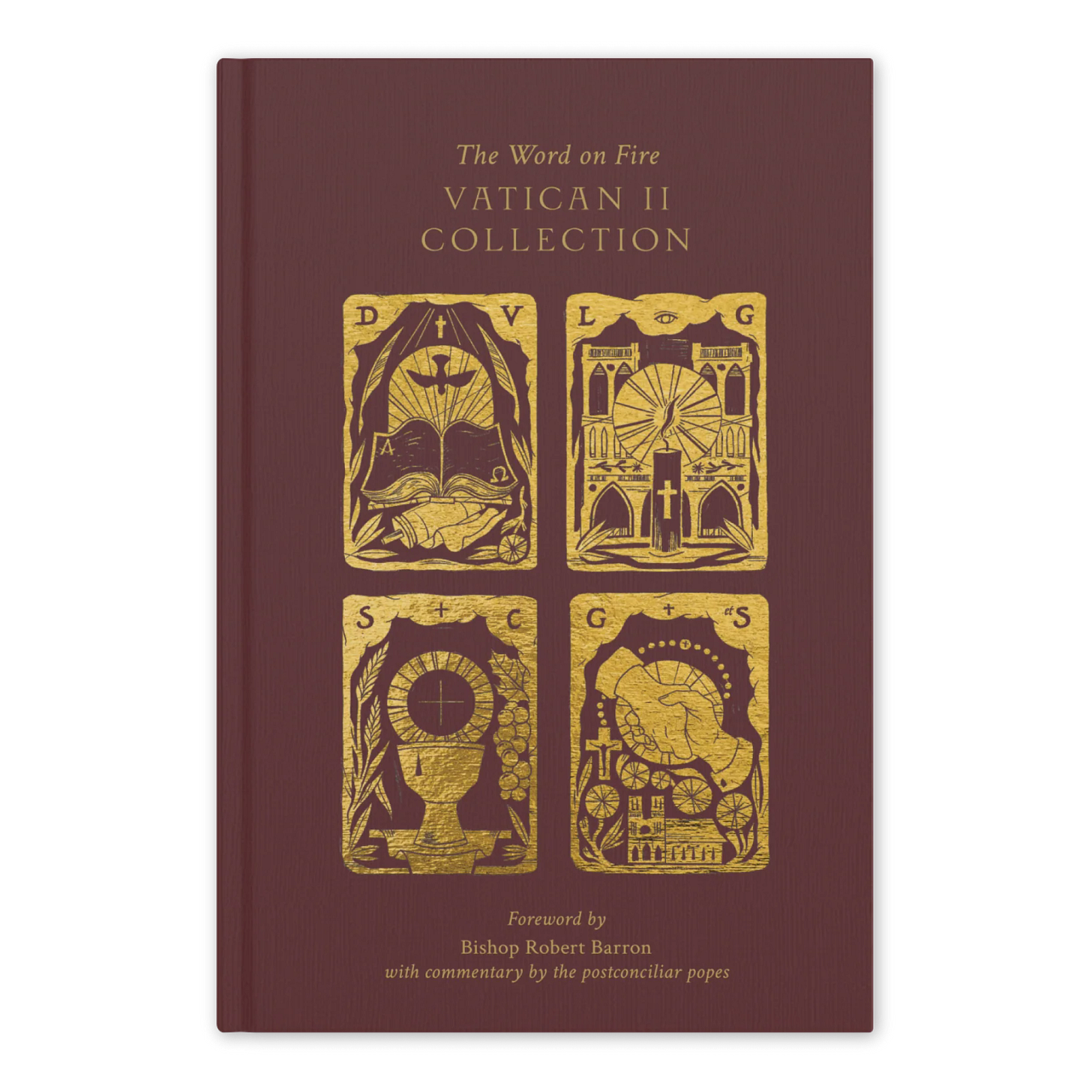
I finally read this volume after letting it languish on my shelf for a couple of years. It includes the four main documents of Vatican II: Dei Verbum, Lumen Gentium, Sacrosanctum Concilium, and Gaudium et Spes, along with commentary from Bishop Robert Barron and the postconciliar popes. Really, really great stuff. I’d heard much about Vatican II through the years but never worked through the primary sources for myself. My main takeaway is that an awful lot of the “implementation” of the Council in the 1970s and beyond was shockingly unfaithful to the actual documents. “The spirit of Vatican II” crowd was anything but. (I’d been pretty confident of this, but am now totally convinced.) Bishop Barron’s foreword and Matthew Levering’s afterword are not to be missed.
My quick summaries/highlights:
Dei Verbum (The Word of God: Dogmatic Constitution on Divine Revelation) — Affirms a high view of the inspiration of Sacred Scripture while emphasizing the Scriptures are inerrant with respect to “that truth which God wanted to put into sacred writings for the sake of salvation” (p. 28; 11)… a phrase that leaves rather a lot of freedom for interpretation and room for disagreement. Encourages lay reading of the Bible and exhorts priests to preach from, and with a deep understanding of, the Scriptures, for (quoting St. Jerome), “ignorance of the Scriptures is ignorance of Christ” (p. 39; 25)
Lumen Gentium (Light of Nations: Dogmatic Constitution on the Church) — Reminds the lay faithful of the priesthood of all believers and exhorts us to be missionary disciples, reminding us of the importance of “faithful and respectful obedience” to the Church’s magisterium (p. 61; 12; see also p. 80; 25 and p. 99; 37). Non-Catholic Christians are recognized as “separated brethren,” and the possibility of salvation for those who are outside the faith entirely is raised (p. 66; 16).
Sacrosanctum Concilium (Sacred Council: Constitution on the Sacred Liturgy) – This document was the most surprising of the four. It renders many of the liturgical changes of the late twentieth century simply incomprehensible. Sacrosanctum Concilium endorses the use of (some) Latin and Gregorian chant, singles out the pipe organ as being worthy “of high esteem” because it “adds a wonderful splendor to the Church’s ceremonies and powerfully lifts up man’s mind to God and to higher things” (120), and emphasizes the importance of Scripture and beautiful art. How the heck we got from this document to some of what transpires in American Catholic Masses is a mystery. It also strongly encourages laypeople to pray the liturgy of the hours.
Gaudium et Spes (Joy and Hope: Pastoral Constitution on the Church in the Modern World) – Part I emphasizes the Church’s stance toward the world: a posture of dialogue rather than condemnation. Echoing what I said above about William Mattison’s Introducing Moral Theology, I was struck throughout the document by the frequent appearance of phrases like “fully human”: the Church sees herself as offering to the world an authentic–and deeply Christocentric–humanism. Part II focuses on “some problems of special urgency”: “fostering the nobility of marriage and the family,” “the proper development of culture” (this is where the humanistic stuff becomes more explicit), and “economic and social life.” It’s impossible to force this document to fit into our standard “conservative” and “liberal” categories. It challenged me to think better (and more) about nuclear proliferation and disarmament as well as duties to the poor.
25. Zena Hitz, Lost in Thought — I read this with a group of students and faculty at our diocesan seminary. It’s a really wonderful book about the life of the mind and the intrinsic value of learning. This is the second time I’ve read it. On my first encounter, a few years ago, one of the main things that stuck out was Hitz’s case against politicizing the humanities — I was working at Cuyahoga Community College at the time, and that portion really resonated. Now, more than a year into my seminary career, the book challenges me to get beyond my tendency toward factionalism, figuring out who’s on which team, etc., and sorting the world into ideological “usses” and “thems.” Wouldn’t it be nice just to sometimes wrestle with a question without trying to win an argument or score a point for my team?
26. The Word on Fire Bible: Acts, Letters, and Revelation — Another beautiful volume from Word on Fire. The images of fine art (and the explanations thereof) are the best addition to the text. The reflections and commentaries from Bishop Barron are nearly always outstanding; many of the other included writings are less impressive — to me, anyway. They do serve as a vivid reminder of how long and how deeply Christians have wrestled with these texts. As usual, reading the New Testament leaves me, as a convert, struck by just how Catholic it all is. It remains strange to me how so many can see it so differently, and how I myself once did so. Lord, have mercy.
27. †††David McCullough, The Pioneers*†††
WINNER: MOST INSPIRATIONAL

This book tells the story of the earliest European settlers in the Northwest Territory. It’s terrific. Among other virtues, it neither hides the fact that the American Indians suffered cruelly as a result of white Americans’ westward expansion, nor pretends that the native population was without its own capacity for cruelty and atrocities. The main focus of the story, however, is not so much on broader historical dynamics but on the individuals who traveled west to settle along the Ohio River: above all, the Cutler family and others in and around the town of Marietta. It’s a terrific story, full of genuinely inspiring heroes, and a few villains. (Aaron Burr, for the record, was the worst!) So much discussion of American history—at least that to which I’ve been exposed for the last decade—insists on narratives that foreground the sins of the past: slavery and the poor treatment of American Indians above all else. These things must not be hidden or overlooked, and McCullough certainly can’t be accused of doing so. At the same time, the book’s subtitle captures well its tone and spirit: The Pioneers is “the heroic story of the settlers who brought the American ideal west.” It’s refreshing to hear our history told in a manner that isn’t afraid to celebrate the greatness of many of those who came before us, and it reminded me of the general optimism and patriotism that seemed to be much more common and much less controversial when I was a kid in the 80s and 90s. There’s a lot to celebrate about the American experiment, and I was glad to be reminded of it. As an Ohioan (and an alumnus of Ohio University, to boot), this book felt like it was telling my culture’s history, and it made me proud of our heritage and desirous of living up to the example of those who endured so many hardships to make our way of life possible. I guess what I’m saying is: I liked it.
28. C. S. Lewis, The Horse and His Boy — Spoiler alert: there was only one Lion.
29. Erik Varden, Chastity – I really wanted to love this book. I’ve heard or read a few interviews with the author, and he’s a fascinating person: a convert to Catholicism, a Trappist monk, and a Norwegian bishop. He’s also super erudite. The book is beautifully written and genuinely profound, yet I didn’t enjoy it as much as I felt like I should. The basic thesis is that the virtue of chastity involves not the suppression of human nature, but its restoration and fulfillment. In this respect, it’s standard fare Catholic natural law stuff and very much my cup of tea. But I kept wondering whom the book is for. Like, who’s the person who isn’t already familiar with this content but would read a book crammed so full of allusions to poetry and literature and artsy films? Thus I have decided that I will give this book to the next secular humanities professor who inquires of me about a Catholic perspective on human sexuality. That’s the best audience for this book, I think. [Update: I learned from my colleague Fr. Joe Koopman that the inimitable Sr. Miriam James Heidland is the person who recommended the book to him, and she raves about it. So Division-I-college-athletes-turned-nuns are also apparently a good audience for it.] Seriously, it’s really beautiful in places and worth reading. I was in a hurry to complete it… maybe I just read it too quickly?
30. Gerald O’Collins, Rethinking Fundamental Theology — This is one of several books I read in the autumn of 2025 in hopes of beginning to fill in the gaps in my own theological education. It’s very good, on the whole, though probably not a book I would recommend to someone brand-new to the study of theology. Even after reading it, I’m not entirely sure how best to characterize what “fundamental theology” actually is. Perhaps the best thing to say is that fundamental theology involves setting the stage for the rest of theology: it identifies the basis, boundaries, and appropriate mindset for engaging in the work of systematic, biblical, historical, liturgical, and other forms of theology.
O’Collins does a really nice job presenting a more or less “centrist” (my word, not his) Catholic theology that leaves plenty of room for disagreement, dialogue, and debate, while remaining firmly within the bounds of fidelity to the Magisterium. It’s a heavily Christocentric approach that makes clear the uniqueness of Jesus Christ as the pinnacle of God’s self-revealing activity and the historicity of the accounts of his life as recorded in the synoptic Gospels. My only real quibble with the book is that there are many places where O’Collins overstates his conclusions or frames contentious opinions as obvious truths, and he consistently does so in a manner that pushes the conversation in a leftward direction. As someone who is disposed to push rightward, I would have liked to see greater acknowledgement of the merits of more “conservative” (again, my word, not O’Collins’s, and one I use with enormous reluctance) positions. For example, after distinguishing between propositional/rational and more experiential approaches to theology and noting the twentieth-century shift in favor of the latter, he becomes somewhat dismissive of the former. Chapter 3 offers “an account of the human person as homo experiens (the human being who experiences),” and this becomes the dominant framework for the whole book (42). Strangely, in his initial overview of such accounts, he includes symbol-making, suffering, and questioning as plausible alternative accounts of the essence of the human person, but he doesn’t even mention—initially—the possibilities of homo credens/cogitandi or homo amat (the human being who believes/thinks or the human being who loves2) as options. Readers of a more Dominican sensibility may feel a bit left out. Similarly, O’Collins takes it to be both obvious and uncontroversial that the Bible contains sundry errors. While he does an admirable job of demonstrating how one can be convinced of this position without running afoul of orthodoxy or engaging in implausible intellectual contortions, it would have been nice to see some acknowledgement of the problems that attend to this view.
Again, however, it really is a very good book. In the epilogue, O’Collins summarizes its principal themes as “faith in a personal God and its justification; the essential features of the nature and destiny of human beings…; some of the essential features of revelation… [and] God’s self-communication in the history of Israel and Jesus Christ; the fullness of revelation that came with the life and ministry of Jesus; the self-disclosure of the Trinity that reached its highpoint in the crucifixion, resurrection, and coming of the Holy Spirit; the response of faith to God’s self-manifestation; the transmission through tradition and Sacred Scripture of that divine self-revelation; the nature of biblical inspiration and truth; the formation of the biblical canon and some principles for interpreting the Scriptures; the founding of the Church; the situation of world religions…; [and] theological styles and guidelines for practising any theology” (342). Anyone interested in exploring those themes will find real value in this book.
31. The Word on Fire Bible: Exile and Return — As I write these words, this is the most recent volume in the Word on Fire series: it’s the fifth of what I believe will be a seven-volume edition of the Bible. It contains 1 & 2 Chronicles, Ezra, Nehemiah, Tobit, Judith, Esther, and 1 & 2 Maccabees: the story of Israel (and, we might say, stories of Israel) from the reign of King David through the exile and into the post-exilic and Hellenistic periods. One thing that leaps out—and which the selections from Bishop Barron and great saints and theologians included in this text often highlight—is how central “right praise,” i.e., orthodoxy is to the Hebrew tradition. It is kind of a shocking contrast to so many contemporary attitudes suggesting that how we worship doesn’t particularly matter, so long as our hearts are in the right place. Surely there’s something true in that attitude—the posture of our hearts toward God is more fundamental and more important than the manner of our worship, no doubt—but no one can possibly read the story of Solomon constructing the temple, for example, and conclude that God is indifferent to the details of the liturgy. Also, with the exception of 1 Maccabees, the stories in the deuterocanonical books (what Protestants call the Apocrypha) are perhaps the most compelling stories in the whole Bible. Mel Gibson and Denzel Washington should make movies out of them. I am compelled to highlight the writing in 2 Maccabees, which has a style unlike anything else in Scripture and whose narrator is just delightful. It’s interesting to notice the influence of Greek culture on the book — not that I’m an expert, but it’s easy to hear the same general sensibility that one finds in Plato’s dialogues behind the words of 2 Maccabees. There were numerous places where I smiled at the choice of words (I know, I know: these words are the choice of a translator, but you get what I mean), though I didn’t make notes on them as I was reading. But the penultimate verse of the book is one of the very best examples: “So here I will end my story. If it is well told and to the point, that is what I myself desired; if it is poorly done and mediocre, that was the best I could do.” Great stuff.
As for 1 Maccabees, I found myself wondering what to do with it. I don’t think it’s impious of me to admit that I found it to be a slog to get through — names and places I couldn’t keep track of, and records of battle after battle and various political alliances and betrayals and machinations. It’s an ancient narrative, of course, so while that description might sound fairly promising, the style isn’t compelling to a modern reader: “This happened, and then this, and then this person did this, and this other person did that,” and so on. So what do I take from it? On the one hand, it’s easy to see how it must have been a source of pride and inspiration for Jewish people living under Roman rule. For me, living in a completely different context many centuries later, I couldn’t help but wonder whether, perhaps, it’s legitimate to take the tedium (from my perspective) of the narrative as its point, or as one of its points. Like, is this it? Can fighting wars and defeating one’s enemies really be what it’s all about? Chapter 14 has a beautiful passage describing a time of peace and rest, maybe hinting that this is what we are made for, and giving a taste of the renewed creation for which we long. I dunno. Just a thought.
32. C. S. Lewis, The Last Battle — I’ve been reading the Narnia books out loud to my family for 24 years, since my firstborn was in utero… and my streak continues: I am 0-for-forever in my attempts to read the last few chapters of The Last Battle without crying. 😭
33. Richard R. Gaillardetz, By What Authority? – Another entry in the filling-in-gaps-in-my-own-theological-education category. Not my favorite book I’ve read and not one I would recommend. I may write a longer review of it sometime. (I mean, I know that I almost certainly won’t actually do that, but I like to tell myself that I might. My idea is to read Jimmy Akin’s Teaching with Authority and see how the two compare. I think the odds of me reading Akin’s book sometime in 2026 are at least 50/50. The odds of me actually writing an essay in which I compare and critique the two are more like 10/90 against.) For now, I’ll just say that there’s a lot of value in Gaillardetz’s book, but one gets the impression throughout that he’s setting the stage for a distinctively progressive brand of Catholicism that minimizes the importance of doctrine and right belief. Even more than O’Collins in the book discussed above, Gaillardetz seems to see “propositionalist” approaches to theology as the boogeyman of faith. He comes across as saying, more or less, “it actually doesn’t really matter what you believe, as long as you’re sincere about it.” That’s a caricature, but I don’t think it’s terribly wide of the mark.
To be fair, he’s not completely off the rails. And it’s quite possible that I’ve read him less charitably than I ought. It just seems to me—and I don’t think Gaillardetz has left himself in much of a position to critique another’s subjective experience—that his statements about fidelity to the tradition and submission to the Magisterium are attempts to avoid censure. They feel empty. Again: that’s just my take. As I’ve said elsewhere: your mileage may vary. It’s just hard to shake the sense that he’s sort of winking at the reader: “Yeah, I know… the Church says all kinds of crazy stuff! But if at the end of the day you don’t buy it—especially the controversial stuff about marriage and sexuality—well, that’s between you and God and it’s not really the Church’s business.” I am reminded of a story told by a Catholic couple I know who asked their priest, during one of their preparatory premarital meetings with him, about the Church’s prohibition on contraception. “Well,” this priest said to them, “that’s the Church’s opinion.” [Insert eye roll here.]
Again, I want to give credit where credit is due. Gaillardetz says very clearly that pastoral ministers have a “responsibility to present the official teaching of the Catholic Church comprehensively and sympathetically” (212; my emphasis). And maybe he really means it, in which case I am being unfair. It’s just really easy, upon finishing this book, to see how its logic—especially the argument of the last few chapters, which focus on disagreement within the Church, the sensus fidei, and the special charism of trained theologians—could lead someone to think and speak just like that priest. That’s the Church’s opinion… wink, wink.
There’s a section late in the book, titled “Vatican II’s New Framework for Considering the Magisterium-Theologian-Sense of the Faithful Relationship” (pp. 222-28) that nicely illustrates my qualms. Gaillardetz selects quotations from Church documents that support his stance while minimizing, dismissing, or just ignoring passages that don’t. One gets the sense that he sees the special charism of academic theologians as manifested in a particular way in their ability to tell the Magisterium what it is wrong about, and he is confident that the Holy Spirit is at work in “the theological community” that has its own “effective way” of “assess[ing] its own productions” (229).
Combine this with his stance that “Every adult Catholic” has a “responsibility to wrestle with the teaching of the church” (213; and no, if you’re wondering, Gaillardetz does not tell us whence lies the source of this responsibility, other than to italicize the phrase “as adults”), his reluctance to affirm that the sensus fidei is legitimately exercised only by those who are actively practicing the Catholic faith (see the “disputed questions” on pp. 197-98), and his—to me, shocking—choice not even to discuss the idea of the development of doctrine, and I am once again left with the sense of dealing with a wolf in sheep’s clothing. This book is written with sufficient awareness of controversy that it could probably earn an imprimatur from a duly licensed authority. And, I do want to emphasize, there’s quite a lot that’s very good in it. I found it helpful in many ways. If I ever write that longer review I mentioned above, I’ll say more about those. (Probably.) But By What Authority? certainly needs to be read with a critical eye, and it’s absolutely not a book I would recommend to a lay Catholic simply seeking a deeper understanding of the nature of authority within the Church.
[One more thing: I just have to elaborate on the development of doctrine thing… This phrase doesn’t appear anywhere in the book, even in chapters 5 and 6, which are titled, respectively, “What Is the Authority of Tradition?” and “How Did the Magisterium Develop Historically?” Instead, we get a breezy acknowledgement that it is “controversial” to assert that Catholic tradition involves “a reversal or repudiation of past beliefs and practices,” as “some” Catholics and “some theologians” prefer “to view these so-called reversals within a framework of development and growth.” Such fundamentalist-adjacent rubes hold the view that “any legitimate ‘new’ developments in tradition must emerge organically out of the old and not as the result of assimilating genuine novelty.” (All of the quotes here are from p. 88.) It’s just bizarre that Saint John Henry Newman’s understanding of the development of doctrine doesn’t even merit a footnote. Newman’s Essay appears in the “For Further Reading” list at the end of chapter 5, and that’s it – though Gaillardetz is quick to cite Newman as an authority in later chapters when doing so suits his argumentative strategy.
/end rant]
34. †††T. H. White, The Once and Future King*†††
WINNER: BEST FANTASY WRITING
WINNER: BEST BOOK I STARTED TO READ IN SIXTH GRADE AND FINALLY FINISHED AT AGE FORTY-EIGHT
I have been meaning to read this book for approximately 36 years. In 1989, I was a pageboy in Aurora Community Theater’s production of Camelot, and my dad bought me a copy of The Once and Future King in honor of the occasion. It wasn’t fancy or anything: just a cheap paperback edition. I started it a couple of times and could never really get into it, my lifelong Anglophilia and enthusiasm for people wearing armor and fighting with swords notwithstanding. At some point, I lost or discarded it, but I eventually picked up a new-to-me copy at a used bookstore: the same mass market edition I remembered from my middle school bookshelf, but with a hard cover. (According to ChatGPT, this is called a “turtleback” edition, which explains why the copy I now own has a picture of a turtle on it even though the copyright page tells me that it’s an Ace Book “published by arrangement with G. P. Putnam’s Sons” and has “THE BERKELEY PUBLISHING GROUP” in all capital letters followed by “Published by the Penguin Group”— none of which seems very turtley.) I never read that one, either, though I still have it.
For no particular reason, this past May I decided to borrow the audio version of The Once and Future King from my local library. The Libby app tells me that I have “picked up this audiobook 49 times, reading for 1 day, 3 hours, 3 minutes” – and that was at 1.5x speed. It’s pretty long, in other words, and it took me quite a while to get through. On the day I finished it, I learned that the audiobook includes a relatively recently-discovered fifth section which added about five hours (at normal speed) to the duration. The physical copy I own does not contain this fifth section, but it’s still 639 pages of small print. Again: a long book… but a brilliant one.
This is not to say that I loved the whole thing. I found the first part, “The Sword in the Stone,” to be a bit too cute in places, and the fifth (“The Book of Merlyn”)—along with pretty much any section of the book where Merlin gets talking—to be pretty tedious. And while the reader of the audio version did a mostly outstanding job, I found a couple of the voices to be a bit grating. The character of the snake in part one was so annoying to me that I almost gave up on the book entirely.
The real meat of the story, however, which presents the familiar tale of King Arthur, his knights of the round table, and the love affair between his best friend, Sir Lancelot, and his beloved wife, Guenevere, is just magnificent. There’s a blurb from the Los Angeles Times included with the front matter that simply reads, “Touching, profound, funny, and tragic,” and I’m not sure I can improve on that as a description of the book, except to add that the tragedy is both deep and heartbreaking, and that much of the writing is simply magnificent.
Particular aspects of The Once and Future King that stood out to me include White’s ability to portray eros powerfully while avoiding both salaciousness and puritanicalism; his picture of life in the middle ages as equal parts glorious, beautiful, difficult, and brutal; and his depiction of religious faith and the competition between love for God and other human loves. There’s also a surprising amount of political philosophy, with Merlin serving (one presumes) as a mouthpiece for White. The vision he endorses is a sort of conservative universalism, emphasizing the family, traditional virtue, and a basically libertarian ethos along with a total repudiation of nationalism. The book was written over the course of many years, encompassing all of World War II, and it’s easy to see how the war is likely to have influenced White’s thinking.
I feel both reluctant and compelled to share an excerpt from the book: reluctant because, taken out of context, I don’t know if any passage can possibly have the impact it has in its proper place; compelled because so much of the writing is so good, and frequently expresses deep insights into the human psyche. There’s also the fact that I was mostly listening to this book while driving or working in the yard, so I couldn’t pause to underline or otherwise note my favorite parts. I did, however, make a note to myself that chapter 13 of Book III was one of many passages that struck me as really excellent, so here’s a bit of it for you. This is White reflecting on how the idealism of youth typically fades as we age:
The slow discovery of the seventh sense [i.e., “knowledge of the world”], by which both men and women contrive to ride the waves of a world in which there is war, adultery, compromise, fear, stultification and hypocrisy—this discovery is not a matter for triumph. The baby, perhaps, cries out triumphantly: I have balance! But the seventh sense is recognized without a cry. We only carry on with our famous knowledge of the world, riding the queer waves in a habitual, petrifying way, because we have reached a state of deadlock in which we can think of nothing else to do.
And at this stage we begin to forget that there ever was a time when we lacked the seventh sense. We begin to forget, as we go stolidly balancing along, that there could have been a time when we were young bodies flaming with the impetus of life. It is hardly consoling to remember such a feeling, and so it deadens in our minds.
But there was a time when each of us stood naked before the world, confronting life as a serious problem with which we were intimately and passionately concerned. There was a time when it was of vital interest to us to find out whether there was a God or not. Obviously the existence or otherwise of a future life must be of the very first importance to somebody who is going to live her present one, because her manner of living it must hinge on the problem. There was a time when Free Love versus Catholic Morality was a question of as much importance to our hot bodies as if a pistol had been clapped to our heads” (378).
And then—and this is the passage I really wanted to share, but it needs the preceding to be properly set up—White gives us this depiction of Queen Guenevere, during a season when Lancelot has left to be with Elaine, the mother of his child:
Guenever was twenty-two as she sat at her petit point and thought of Lancelot. She was not half-way to her coffin, not ill even, and she had only six senses. It is difficult to imagine her.
A chaos of the mind and body—a time for weeping at sunsets and at the glamour of moonlight—a confusion and profusion of beliefs and hopes, in God, in Truth, in Love, and in Eternity—an ability to be transported by the beauty of physical objects—a heart to ache or swell—a joy so joyful and a sorrow so sorrowful that oceans could lie between them: then, as a counterpoise to these attractive features, outcrops of selfishness indecently exposed—restlessness or inability to settle down and stop bothering the middle-aged—pert arguments on abstract subjects like Beauty, as if they were of any interest to the middle-aged—lack of experience as to when truth should be suppressed in deference to the middle-aged—general effervescence and nuisance and unfittingness to the set patterns of the seventh sense—these must have been some of Guenevere’s characteristics at twenty-two, because they are everybody’s. But on top of them there were the broad and yet uncertain lines of her personal character—lines which made her different from the innocent Elaine, lines of less pathos perhaps but more reality, lines of power which made her into the individual Jenny that Lancelot loved.
“Oh, Lancelot,” she sang as she stitched at the shield-crown. “Oh, Lance, come back soon. Come back with your crooked smile, or with your own way of walking which shows whether you are angry or puzzled–some back to tell me that it does not matter whether love is a sin or not. Come back to say that it is enough that I should be Jenny and you should be Lance, whatever may happen to anybody.”
The startling thing was that he came. Straight from Elaine, straight from her robbery, Lancelot came like an arrow to the heart of love. He had slept with Guenevere already in deceit, already had been cheated of his tenfold might. He was a lie now, in God’s eyes as he saw them, so he felt he might as well be a lie in earnest. No more to be the best knight in the world, no more to work miracles against magic, no more to have compensation for ugliness and emptiness in his soul, the young man sped to his sweetheart for consolation. There was the clatter of his iron-shod horse on the cobbles, which made the Queen drop her needlework to see if it was Arthur back from his hunting—the ring of his chain-mail feet upon the stairs, going chink-chink like spurs against the stone—and then, before she was quite certain of what had happened, Guenevere was laughing or weeping, unfaithful to her husband, as she has always known she would be” (379-80).
Again: it may be impossible for these words to mean much to a reader who encounters them out of context. But if you like ‘em, you’ll like this book. A lot.
35. Avery Dulles, The Assurance of Things Hoped For – Another theology textbook, and a good one. Definitely not a light read, but a really solid overview of Christian thinking about the nature of faith from the New Testament onward. I found it to be a helpful general overview of what the main issues are and the strengths and weaknesses of various perspectives. Near the middle of the book (page 180), in a discussion of “models” of faith, Dulles proposes a harmony between seven principal approaches:
In the propositional model God appears as teacher, whose statements are to be accepted on his authority. In the transcendental model he is an enlightener; he illumines the minds of those who are struggling in darkness. In the fiducial model God is a merciful benefactor, who can be trusted to keep his promises. In the affective, or experiential, model he is a lover who touches the hearts of those who seek him. In the obediential model God is a revered ruler, whose word is a command. In the praxis model, he is the great emancipator, who lends strength to those who struggle against injustice and oppression. In the personalist model, finally, God is the ever-blessed source of life, who draws others into his own glory by enabling them to participate in it.
All of these approaches can and should be integrated into a coherent whole, as Dulles writes on the following page:
Ideally, faith should take root at the deepest level of the human personality. It should transform believers from within, orienting them in a new way toward God as their creator, savior, and last end. Faith should make a person doctrinally orthodox, trustful, obedient, and socially committed. It should go out to God as one who is to be believed, trusted, obeyed, and loved.
I endorse this message.
36. †††Joseph Cardinal Ratzinger, Introduction to Christianity†††
WINNER: MOST LIKELY TO MAKE ME A BETTER PERSON
A magisterial work from the theologian who would (much later) become Pope Benedict XVI. It’s far more sophisticated than one might infer from the title, though I had the advantage of knowing that before I started reading it. I suspect there must be more than a few people out there with a passing interest in religion who have seen this book written by a pope and thought it would be, well, an introduction to Christianity. And it is that, for sure, but it’s not for the casual reader. Really profound stuff: at its core, an extended reflection on the Nicene Creed. Like so much good Catholic writing, it manages to stake out a path between secular skepticism and theological progressivism, on the one side, and religious fundamentalism, on the other. Against the former, Ratzinger insists on the objectivity and knowability of religious truth; against the latter, he insists on the inherent limits of our knowledge of God and the irreducibly mysterious nature of then divine. The principal theme of the book—and certainly what I took from it, above all else—is the idea of love as essentially “being for others.” Because God is triune and because we are called to participate in the divine life, this point is both metaphysical and ethical: reality itself—Being itself—is essentially “for others,” is essentially love. And what it is for us to be human, to truly live, and to participate in the divine life both now and in eternity, is also essentially to love, to be for others. In between the metaphysical point about the nature of reality and the ethical point about how we are to live, there is the historical fact of the Incarnation, the paradigmatic exemplification of “being for others” and the central event not merely of the Christian religion but of all human history.
It’s a really good book.
37. †††Gene Wolfe, Shadow & Claw†††
WINNER: BIGGEST GAP BETWEEN HOW MUCH I ENJOYED IT AND HOW MUCH I UNDERSTOOD IT
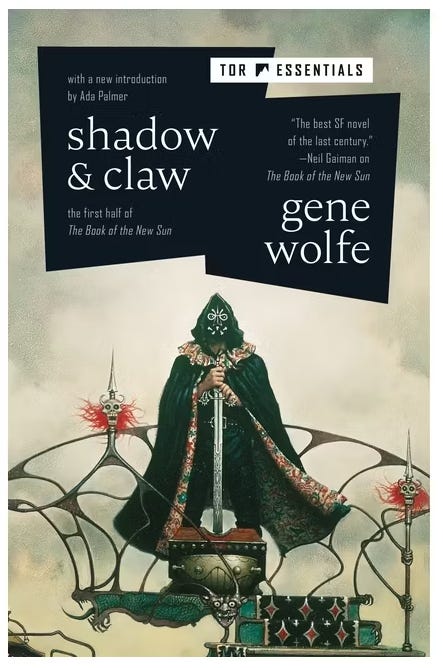
Well this is a strange and remarkable book. I absolutely loved big chunks of it and found other portions incredibly hard to understand… which may, I suspect, have been the author’s intention. Set in the distant future, it’s not exactly dystopian, but it’s definitely not not dystopian. There are hints of remarkable technological advancements but most of the characters’ day-to-day lives seem pretty much like those of medieval Europeans. And eventually it becomes pretty clear that there is (was?) space travel and extraterrestrial life, but none of it is spelled out.
I want to give myself credit for two books for reading this, as it’s over 500 pages long and includes both The Shadow of the Torturer and The Claw of the Conciliator. But it’s also merely the first half of The Book of the New Sun, so I guess I’ll just stick with my rule and call it one book because it’s between two covers.
Neil Gaiman described it as “the best SF novel of the last century,” which is pretty high praise.
38. Barbara Robinson, The Best Christmas Pageant Ever — Pretty dang short, I admit, but I did read it out loud, and the preceding four books on this list are all long, so give me a break. I’m taking credit for it and you can’t stop me because this is my list.
This is such a terrific book. I almost made it to the end without crying, but man. When Imogene Herdman is suddenly struck by the wonder of Christmas… well, if it’s wrong to be moved by that, I, for one, don’t want to be right. And what Gen Xer can read this and not feel nostalgia for the America of the 1970s and 80s? Not that there’s much in the book that uniquely identifies the time period (it was published in 1972), but it just fits. It’s so easy to picture the little Protestant church I attended as a kid as the place where the story is set.
Anyway, it really is a brilliant angle on the story of the Nativity, even if, as a Catholic, I’d like to see greater reverence for the Blessed Virgin. A wonderful book and an underappreciated Christmas classic.
39.United States Conference of Catholic Bishops, Program of Priestly Formation in the United States of America , Sixth Edition — If you want to know what the USCCB requires of seminaries, I literally cannot think of a better book for you to read. I feel obliged to note, in case my boss happens to see this, that I have routinely referred to this book over the last year and a half. (Really, Fr. Andy! I have!) But this year I made a point of reading it cover-to-cover and managed to get it in under the wire.
40.Charles Dickens, A Christmas Carol (x2) — Spoiler alert: It turns out that Tiny Tim did NOT die.
Here’s what I wrote a year ago about my reservations via-a-vis post like the present one…
For one thing, they can seem, well, obnoxious. We live in a culture that values reading, but in which relatively few people actually read. Thus anyone who reads relatively a lot and talks about it runs the risk of sounding like a braggart. [This problem may be compounded by throwing around words like ‘braggart’.]
There’s also the fact that books vary so widely in so many respects. The Mouse and the Motorcycle, Pride and Prejudice, and The Critique of Pure Reason are all books, for sure. If you read them all, you will have definitely read three books. I am certain of it. You have not, however, had the same experience, nor even the same kind of experience, three times. Yet you get to say that you read three books. Go figure.
Finally, tracking one’s own reading knowing one plans to talk about it in public can encourage intellectually unhealthy habits. One reads too quickly, hoping add another title to the list, rather than enjoying books at an appropriate pace and permitting oneself time to reflect on books that merit it. Reading becomes a chore rather than something one does for its own sake. December becomes a season for plowing through whichever texts one is closest to completing. This is especially problematic when one seeks to make “spiritual” reading a priority… do I really want to approach the Scriptures or the writings of St. Thérèse of Lisieux with one eye on how quickly I can get through them? [No, I don’t. The answer is “no.”]
So why do it?
Well, on the whole, tracking my reading has done me more good than harm. This is the third consecutive year in which I’ve maintained a list of what I’ve read, and tracking my reading has given me a little additional motivation when I might otherwise be tempted to waste time on social media or elsewhere online. I definitely read more when I do this.
As for posting about it, I have two thoughts. First, there are at least a handful of people out there who share my interests but lack the time to read a lot. For those people, lists like this can provide some helpful suggestions for titles they themselves might like to explore. Second, for my own sake, it puts some pressure on me to be able to say something about each of these books. And that’s a healthy counterbalance to some of the pernicious effects noted above. I feel like I can’t really count the book as “read” unless I paid enough attention to it to say something about it. So that’s good.
Let the record show I had to use Google translate to coin these terms.
No posts
Comments
Nothing yet. Say the first thing.
Sign in to join the conversation.