
Welcome to the third installment of this series. In Part I, I explained how I went from being convinced that Catholicism was not really a form of Christianity at all to accepting it as one of many legitimate expressions of the faith. In Part II, I talked about the problems I started to see as inherent in my Protestant approach to the faith, arguing that the central Protestant doctrine of sola scriptura [i.e., the idea that the Bible alone is our only legitimate authority in matters of faith and morals1] leads inevitably to disagreement and disunity. In this essay, I want to say a few more things about sola scriptura, and then turn to questions about human sexuality and the influence those questions had on my journey to Rome.
As I wrestled with trying to figure out what I should or must believe as a Christian, I became more and more convinced that disagreement about very important theological topics—including the question of which theological topics count as “very important!”—could not be avoided if sola scriptura was affirmed. For closely related reasons, real Christian unity could not be achieved if sola scriptura was affirmed. These convictions led me to wonder about the doctrine itself. Though I was interested in theological questions and had by then been seriously practicing the Christian faith for some fifteen years, I don’t think I had ever asked the question, why is sola scriptura true? It had just seemed obvious to me that, if you believe in the Bible as divine revelation, then the Bible must ipso facto be what we turn to in order to figure out what we’re supposed to believe and how we’re supposed to live. The more I thought about it, however, the less obvious this seemed.
For one thing, the Bible itself does not teach the doctrine of sola scriptura. This generates a real puzzle for the whole Protestant framework. (I’m going to shift into a more academic mode for a minute here, but don’t worry: I’ll try to make it relatively painless.) Consider the following principle, which I’ll label ‘P’ for Protestant:
(P) Faithful Christians are required to believe only what the Bible teaches and whatever the Bible teaches.
Fair enough. This is simply one way of stating the doctrine of sola scriptura. No Protestant should object to it. But… what’s the status of principle P itself? Where does it come from? You will search the scriptures in vain for an affirmation of P or anything like it. The best candidates you’ll find are St. Paul’s statement in 2 Timothy that “All scripture is inspired by God and is useful for teaching, for reproof, for correction, and for training in righteousness,” and St. Luke’s praise for the Jews in Berea, who “received the word [i.e., St. Paul’s preaching] with all eagerness, examining the scriptures daily to see if these things were so.” As a simple matter of logic, you cannot infer P from these two passages, nor from anything else in Scripture. P is an extrabiblical rule of faith that, paradoxically, mandates rejecting any extrabiblical rule of faith. In other words, if you believe that Christians are required to believe P, then in order to be consistent, you should immediately stop believing that Christians are required to believe P!
Reflecting further on the situation of those Jewish Bereans, one notices an additional difficulty for the doctrine of sola scriptura. “The scriptures” against which the Bereans were testing Paul’s preaching were the Hebrew scriptures, what Christians call the Old Testament. The New Testament hadn’t been written yet — indeed, the story of the Bereans is found in the New Testament. So… on what basis do we affirm that the story of the Bereans is itself part of Sacred Scripture?

Or rather, on what authoritative basis do we affirm that the story of the Bereans is part of Sacred Scripture? Protestantism maintains that we are obliged, as faithful Christians, to submit our intellects to that which is taught in the Bible, and to do so because the biblical writings are uniquely inspired by God. On Protestantism, however, there is no acknowledged authority which confirms that the twenty-seven books of the New Testament are, in fact, uniquely inspired by God. We just have to trust that those who came before us got it right. The Bible itself does not tell us which writings belong in the Bible.
The consequences of this view are pretty significant. Suppose that a theologian comes to the conclusion that there is a book in the Bible that is not, in fact, inspired by God. Perhaps this theologian has carefully studied the letter of St. James, for example, and becomes persuaded that James’s teaching on the relationship between faith and words is erroneous. This teaching contradicts the rest of Scripture, our theologian concludes, and therefore the book that contains it should be rejected. It never should have been accepted by Christians as part of the biblical canon. Well, if the only authority we acknowledge is Sacred Scripture itself, what is wrong with the theologian’s decision to jettison James? We may disagree with her about whether or not there really is a contradiction, but that’s a different question. Nowhere in the Bible are we told that the letter of St. James is among the sacred writings that have been uniquely inspired by God. So what’s the error in rejecting James entirely if you decide that it doesn’t fit with the writings that are uniquely inspired by God?
Lest anyone think that this is just a silly hypothetical, consider the following remarkable words from none other than Martin Luther himself:
I do not regard [James] as the writing of an apostle; and my reasons follow. In the first place it is flatly against Paul and all the rest of Scripture in ascribing justification to works….This fault, therefore, proves that this epistle is not the work of any apostle….But this James does nothing more than drive to the law and to its works….He mangles the Scriptures and thereby opposes Paul and all Scripture….Therefore, I will not have him in my Bible to be numbered among the true chief books.2
Now, in fairness to Luther, it should be noted that he eventually pulled back from this view and did not remove James from the Bible. But that fact is irrelevant to the point I am making here. What if hadn’t? What if he had stuck to his guns and insisted that James does not belong in the canon? What if he had gone into the printing business and published an official Lutheran Bible containing merely twenty-six New Testament books? What if he issued a proclamation that faithful Christians ought to disavow James entirely? On Protestant grounds, what would he have done wrong? The answer, it seems, is nothing. For Protestants, the biblical canon is, in the infamous words of one Reformed theologian, “a fallible collection of infallible books.” If, in fidelity to our convictions, we reach the conclusion that a mistake indeed was made in assembling the Bible—if writings were included that should not have been—then removing those writings is the correct thing to do! On the Protestant understanding, we are bound to submit to whichever writings have been inspired by God, but we are not told authoritatively which writings those are. If, therefore, we conclude that our predecessors made a mistake when they labeled something “inspired,” what can we possibly do in good conscience other than fix their mistake? Rejecting the books they erroneously embraced is to continue the good work of the Reformation.
I don’t want to get too far into the weeds with this [he said, after getting way too far into the weeds with this], but I don’t believe there is a principled basis for holding any doctrine at all to be secure, or to affirm confidently that any text or part of a text is inspired by God, once one asserts that the canon itself is fallible. To take an obvious contemporary example, there are self-professed Christians who reject most or all of Paul’s writings on the grounds that his views on sexuality and relations between the sexes are contrary to their understanding of Jesus’ teachings in the Gospels. Those teachings are the authoritative ones, in their view, and the institutional church made a mistake when it included Romans and Ephesians and other Pauline epistles in the Bible. This is where honest Protestantism leads: fidelity to the core Protestant principle of sola scriptura undermines the very idea of authoritative scripture itself.
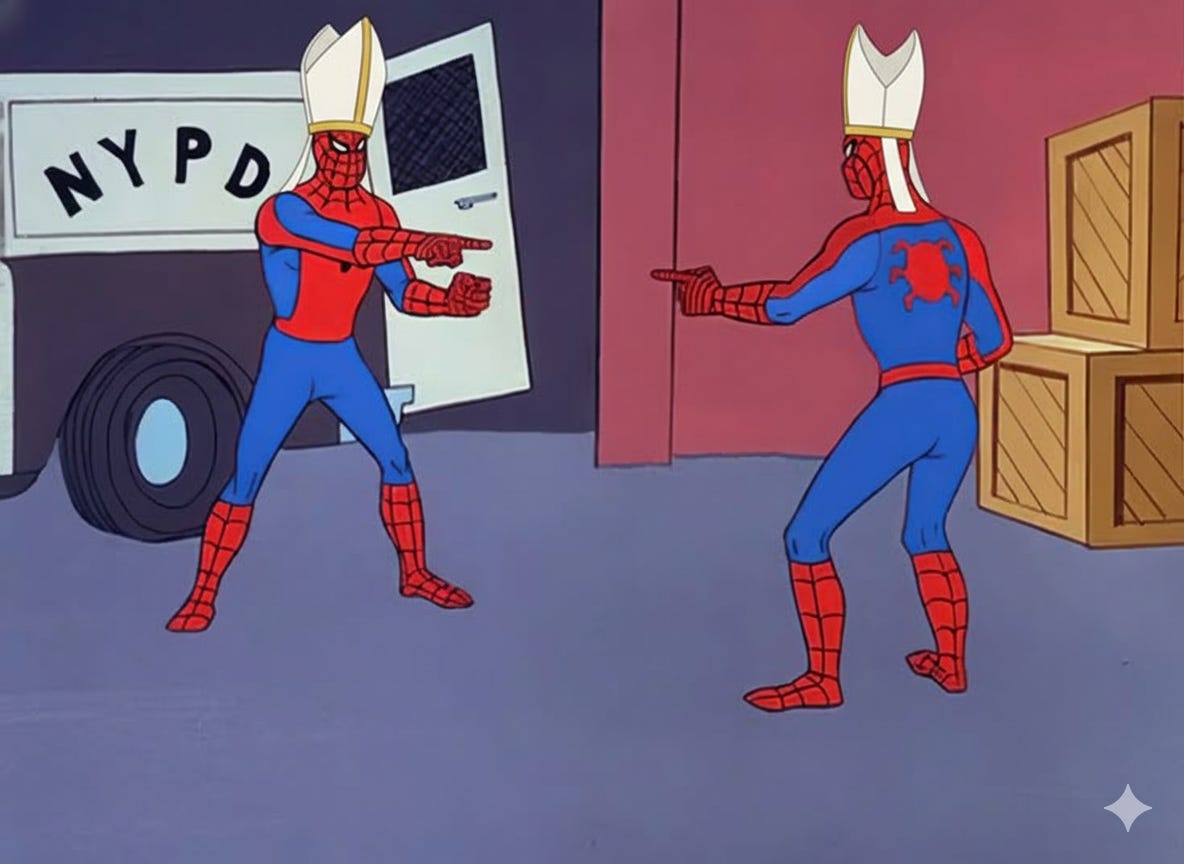
There’s a deep irony here, related to the fact that many Protestants see the papacy as one of Roman Catholicism’s most egregious errors. A good friend of mine, when I first told him I was investigating the Catholic faith and was thinking about converting, was shocked. “I can’t believe you would accept the idea of a pope,” he said. “I just can’t imagine giving that kind of authority to a mere man.” Setting aside several other problems with this statement, it occurred to me later that my friend certainly could imagine giving that kind of authority to a mere man: he had already given it to himself! On his own understanding of the Christian faith, it was ultimately his responsibility to determine—with respect to every theological question and every moral issue—what he ought to believe and how he ought to live. To put it succinctly: Protestants object to the existence of a pope, but on Protestantism, everybody is the pope!
The only plausible strategy for the Protestant who wants to avoid the most extreme implications of sola scriptura is to lean hard into the view I proposed above: we can be confident that the canon of Sacred Scripture does contain writings that were uniquely inspired by God because this is what Christians have more or less always believed. Furthermore, where consensus emerged around doctrinal statements like the Nicene Creed, we should have confidence that the Holy Spirit was at work and those creedal statements, if not absolutely infallible, are nonetheless a trustworthy guide. In the words I used above: we just have to trust that those who came before us got it right. Now, this is not a satisfactory solution to all of the problems generated by the doctrine of sola scriptura, but it’s not a crazy view either. After all, at some point, each of us has to make a decision about whether to submit to the judgment of another in matters of faith and practice, and if so, to whom. The Catholic makes a decision to submit to the Magisterium of the Church; the Protestant we are imagining here makes a decision to submit to the (perceived) consensus of Christians in ages past.
This strategy, however, has disastrous implications for Protestantism. It doesn’t take much investigation into the history of Christianity to discover that such distinctively Catholic doctrines as the ordained priesthood, an ecclesial hierarchy of bishops, and the Real Presence of Christ in the Eucharist were taken for granted and understood by Christians to be normative from the earliest post-apostolic age. If our confidence in the canon of Scripture is grounded in the testimony of the first generations of Christians, then that same testimony ought to give us equal confidence about their understanding of the organization of the Church and the nature of the sacraments. Why would we think they were right about the former but fundamentally—profoundly—wrong about the latter?
To get to the point where one is asking such questions is to get very close to becoming Catholic. I wasn’t quite there yet, myself. I had questions and concerns about a number of Catholic doctrines and needed them to be resolved before I could in good conscience enter the Church, my qualms about Protestantism notwithstanding. I’ll say a few words about those questions and concerns in my next post. For now, I’d like to move on from the sola scriptura stuff and turn to another topic that occupied a lot of my attention: sex.
In December 2009, everything in my life seemed to be coming together. After nine long and difficult years of graduate school, I’d completed my PhD and had just accepted a tenure-track job as a philosophy professor at Auburn University at Montgomery. My wife and I had four young children, and our family, so far as I was concerned, was complete. It was time to move on to the next season of our lives.
We were visiting my in-laws for Christmas, along with some other members of the extended family. My wife’s cousin Joel and his wife Jamie were there with their first baby, and watching them deal with bottles and infant car seats and all the other things that go along with caring for a brand-new human being confirmed my conviction that I absolutely did not want to have any more children. I said as much to my wife. “Yeah… About that…” she replied. It was early in the day when we had this exchange, and I more or less immediately drove to the store and purchased a pregnancy test. Jen took it, and sure enough: it was positive.
To say that I received this news poorly would be an understatement.
I became utterly despondent. I laid down on the bed in the guest room with the lights off and the door closed. All day. I didn’t talk to anybody. I didn’t eat. I suppose I must have had some water or used the restroom at some point, but for all intents and purposes I did nothing other than lie on the bed and feel sorry for myself. It was not my finest hour.
All these years later, I’m still a bit embarrassed by this story. My behavior that day was appalling. I make no excuses for it. But I’m also grateful, in a weird way, that I reacted so badly to learning that my wife was pregnant with our fifth child. Had I simply accepted the news like a mature adult and continued on, had I chosen to grin and bear it, I don’t think I would have had any reason to reflect on my own attitudes. That’s not what happened. In the weeks and months that followed, I had no choice but to engage in some serious introspection. What was going on with me? What was in my heart? What did I really believe about children, about marriage, about parenting, about the meaning of human life itself, such that I would react like that upon learning that another baby was on the way?
Concurrent with this season of self-reflection, I was doing a lot of thinking about marriage and sexuality in connection with my job. I was teaching courses in applied ethics, and the most prominent controversy in American public life at that time was the debate over same-sex marriage. I started reading essays by thinkers from across the ideological spectrum in order to be able to give my students a clear picture of the main arguments on both sides, and to figure out what I ought to believe about the issue, myself.
As I read and reflected, I became increasingly persuaded of the merits of a philosophical tradition known as natural law theory. As with any philosophical tradition, it includes various camps and intramural disagreements, but one standard—and in my view, helpful—way to articulate natural law theory is as follows. Every living thing has a nature, an essence, a distinctive set of capacities that make it what is. Living things flourish when they exercise those capacities, when they fulfill their natures. That may sound very abstract, but it’s actually a pretty simple idea. Consider the difference between a good, healthy tree and one that is diseased. The healthy tree is living in accordance with its nature; its natural capacities for taking in nutrients and growing and so on are being fulfilled in a manner proper to it as a tree. A diseased tree has had its nature thwarted in some way; it is not healthy, it is not flourishing, because its ability to fulfill its own nature has been impeded.

Human beings, and human nature, are far more complex than trees, but natural law theory maintains that the same basic principle applies to us. We flourish as human beings when we fulfill our nature. We have natural capacities that point toward various goods: biological life, knowledge, and friendship are examples. To attain such goods is to live well. And to intentionally thwart these goods is to live badly and act wrongly. Murder is wrong (at least in part) because it intentionally thwarts the good of biological life. Lying is wrong because it intentionally thwarts the good of knowledge. Betrayal is wrong because it intentionally thwarts the good of friendship. And so on.
What does this have to do with marriage? Well, generally, natural law thinkers support the traditional view that marriage is an essentially heterosexual institution. This view is not grounded in animosity toward gay people. Rather, it is grounded in the idea that procreation is among the many goods that are proper to us as human beings. We are oriented toward the creation and rearing of children in the same way that we are oriented toward biological life, knowledge, and friendship. A central purpose of marriage is to safeguard and support the good of procreation. And because only a union between a man and a woman can result in procreation, it is only heterosexual couples who can be married.
I’m oversimplifying here, of course, but this gives a sense for the basic intellectual trajectory I was on as a young philosophy professor.3 One thing I’d already known, but was now encountering in my own studies, was the fact that there is a strong historical link between natural law theory and the moral teachings of the Catholic Church. I couldn’t help noticing that many of the authors whose writings I was finding so helpful as I thought through the marriage debate were themselves Catholic. Frequently, these Catholic writers spoke of the meaning of sex as they articulated their understanding of marriage. This clarified and enhanced much of what I had found compelling in natural law theory, and it enabled me to perceive the fundamental difference between the dominant contemporary view of human sexuality, which I myself had largely though unwittingly embraced, and the traditional Christian view.
On the contemporary view, sexual satisfaction is extremely important to a happy life. One aspect of living well is having one’s sexual desires satisfied as fully as possible. Sex itself, however, has no inherent meaning. If a particular sexual encounter is felt to be meaningful by those who participate in it, so be it, but there is nothing about sex per se that makes it more significant than brushing your teeth or eating a sandwich. The traditional Christian view inverts this perspective.4 It holds that sexual fulfillment is not particularly important to a well-lived life—celibacy is compatible with human flourishing—and that our sexuality is deeply meaningful. It is significant, in the most literal sense of the word: it is a sign that points to something else. It points to the very meaning of life. It points to the idea that each of us is called to be a life-giving self-gift to others, that the very purpose of our existence is sacrificial, loving union.
This way of thinking helped me not only as I wrestled with questions about the nature of marriage, but also in trying to make sense of the Christian prohibition on same-sex intercourse. To once again grossly oversimplify: I became persuaded that morally good sex—the kind of sexual intercourse that is consistent with a flourishing human life—must be congruent with this understanding of the meaning of human sexuality. Sexual practices that fail to align with the unitive and procreative meanings of our bodies are, for that reason, immoral. Engaging in such practices is a way of diminishing, rather than fulfilling, our human nature.
It is important to note that the implications of this view extend beyond those who experience same-sex attraction. Any sexual practice that is incongruent with the unitive and procreative meanings of sex is taken to be out of bounds. This includes such practices as masturbation and the use of contraception. And this is where my philosophical thinking began to dovetail with my journey toward Catholicism.
Recall that I was wrestling with these questions about the nature of marriage and sexual morality at the same time I was processing my own reaction to the news that was wife was pregnant. On the professional/academic side of my life, I was starting to embrace the natural law tradition as a robust and intellectually satisfying approach to questions of moral philosophy. On the personal/spiritual side of my life, I was beginning to believe that my vocation as a husband and father meant being open to new life in a way I never had been before. [Aside: One of the most common misunderstandings of this view takes it to imply that married couples are morally required to have as many children as they are physically capable of producing. This is not the case, but I won’t try to explain the reasons why here.] And on both sides, I was increasingly convinced that the traditional Christian understanding of sex and marriage was not merely reasonable and defensible, but beautiful— and a necessary ingredient in authentic human flourishing.
I should note that a faithful Protestant can happily affirm all of this. Many Protestants, in fact, do. So why do I include this lengthy digression about sex and marriage in the story of my conversion to Catholicism? Well, one respect in which these experiences were relevant is that they illuminated another area of concern with the doctrine of sola scriptura. There are many questions of enormous practical importance that simply are not addressed in the Bible. Whether married couples may legitimately use contraception is one of them. The fact that the Catholic Church has a Magisterium that can speak authoritatively on such matters was, frankly, very attractive to me as a Protestant who’d had Bible-believing friends and mentors with contradictory understandings of sexual morality. The possibility of at least some pressing moral questions being settled by definitive proclamations from an authoritative Church was undeniably appealing.
More importantly, however, all the reading I’d been doing about sexual morality revealed that Christians had been speaking with one voice about contraception for many centuries. I’d sort of assumed, unreflectively, that contraception as a moral issue emerged only in the twentieth century, and of course this is not the case. The fact that babies result from the sexual union of a man and a woman is not a recent discovery, and people have long seen the appeal of being able to have sex without having babies. Nonetheless, Christians of all stripes had always, until a century ago, seen the use of contraception as a grave sin. Martin Luther described it as “far more atrocious than incest and adultery.”5
It was not until 1930 that any Christian denomination broke from this historical consensus. At its Lambeth Conference that year, the Church of England declared that the use of contraception by married couples could—in rare circumstances—be permissible. In the decades that followed, nearly all others followed, and fairly quickly it became commonplace. By the time my then-fiancée and I were preparing to be married in a Protestant church, compunctions about contraception had essentially disappeared. At no point did any of our mentors ever ask whether we would use contraception; the only real question was “what kind?”
Of course, there was one striking exception to this shift in Christian thinking: the Roman Catholic Church. Contrary to most expectations, in 1968 Pope Paul VI reaffirmed the traditional Christian stance in his remarkable and prophetic encyclical Humanae Vitae. A prohibition on the use of contraception in marriage has remained the clear and unequivocal position of the Church in the decades since. For me, as someone who had come to embrace this deeply countercultural view on its own merits, and who was simultaneously wrestling with questions about which of the many Christian traditions authentically expresses the fullness of the faith, this seemed like a big deal. It still does.
Next time: Divine signs, the witness of history, and maybe some other things
If you enjoyed this post, please take a moment to click the like button and/or share it with somebody. And if you’re feeling super generous, you can always
I would be remiss if I failed to note that some Protestants would argue that I have failed to characterize sola scriptura fairly. I have presented it as the view that the Bible is the only authority in matters of faith and practice, but—the rebuttal goes—to say this is to replace sola scriptura with the false doctrine of solo scriptura. The authentic Reformation doctrine of sola scriptura, they would say, holds that the Bible is the only infallible authority in matters of faith and practice, but there are also authorities to which we must submit even though they are not themselves infallible. The broad swath of doctrines expressed in the great creeds presumably enjoy this sort of authority; the fact that some particular Christian dissents from one or more assertions in, say, the Nicene Creed, even if he does so honestly and in good faith, is not sufficient for him to be justified in rejecting those assertions.
I had planned to include some commentary on this objection in the body of the essay, but I really and truly have already written a lot more about sola scriptura than I’d intended to, and I suspect that the audience for such a digression is pretty small. Let it suffice to say that I am persuaded that the distinction between sola scriptura and solo scriptura is a distinction without a difference. The heart of my reasons for believing this can be gleaned, I think, from what I’ve written here. For a closer look at this issue, follow this link.
Luther’s Works, vol. 35 (Concordia, 1963), pp. 395ff; cited in Devin Rose, If Protestantism Is True (Unitatis, 2011), pp. 69-70
If you’re interested in a more expanded discussion of the marriage debate and how these ideas fit into it, you can find my take in an essay I published in 2013 titled “Liberal and Conservative Views of Marriage.” It’s one of my favorite things I’ve written, though I’m not sure I can endorse every word of it today.
I am comfortable calling this the “traditional” Christian view because I am convinced that it is found in embryonic form in St. Paul’s cryptic statement about marriage in Ephesians 5: “This is a great mystery, but I am speaking of Christ and the Church.” Nevertheless, it’s worth noting that much of the language I’m using here has only become common in the last few decades, thanks in large measure to Pope Saint John Paul II and his Theology of the Body.
Luther was talking specifically about onanism, or coitus interruptus, but it’s no stretch to infer that he would have said the same about all forms of contraception. The quote is from his commentary on Genesis 38:8-10; it can be found at https://purelypresbyterian.com/2015/08/13/contraception-pt-4-onanism/.
Comments
Nothing yet. Say the first thing.
Sign in to join the conversation.