
Share Less Noise, More Signal - macro, finance, and money insights
Bitcoin is often dismissed as an asset with no cash flow. However, is this actually true?
As we speak, Bitcoin’s very own Lightning Network is turning that assumption on its head, without forcing holders to give up custody or take on hidden leverage.
Most investors still think about Bitcoin as a choice:
Either it is digital gold.
Or it is digital cash.
But in my latest conversation with Chris Ritter, Chief Strategy Officer at Zeus, we explored a more interesting possibility:
What if Bitcoin can be both?
A scarce monetary asset that preserves value.
And productive capital that generates income by powering payments.
Let us break down the signal from our conversation and how we at LNMS see things.
Why Bitcoin may no longer fit into a single asset category
How Lightning can generate native Bitcoin yield
Why this yield does not depend on leverage or token incentives
How investors can retain custody while outsourcing operations
The risks institutions need to understand
How to deploy BTC to earn a native yield today!
Less Noise More Signal Social Media LinkedIn / Instagram / Twitter / Telegram / Nostr
Less Noise More Signal Podcast YouTube / Spotify / Apple / Rumble / Fountain
written by Pascal Hügli
Most people think about Lightning as being a fast, reliable and cheap payment network enabled by Bitcoin.
This is definitely true. However, Lightning also changes the game for Bitcoin investors, not only users.
This is because the Lightning Network gives Bitcoin its native yield.
Investors can earn Bitcoin, while the following remains true at all times:
Bitcoin remains scarce
The yield remains denominated in BTC
BTC remains under the owner’s control and custody
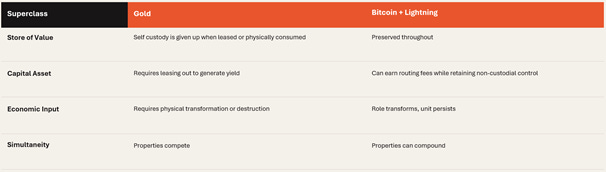
This turns bitcoin into a super asset that embodies all three super classes.
These have been defined by Robert Greer, a financial executive who famously categorized all investable assets into three fundamental “super classes” based on their objective economic behavior.
Store of value assets.
Consumable or transformable assets.
Capital assets that produce cash flow.
Gold can touch more than one category.
It can store value.
It can be used in industrial production.
It can also be leased.
But there is a trade off.
Once gold leaves the vault, the owner gives up some of its store of value function.
The same physical gold cannot sit securely in a vault and be used somewhere else at the same time.
Bitcoin is different.
Because it is digital, the same bitcoin can preserve its monetary properties while being deployed into Lightning payment channels.
It does not need to be consumed.
It does not need to be wrapped into another token.
It does not need to leave the Bitcoin system.
It can remain bitcoin while becoming productive capital.
Lightning nodes provide liquidity to the network.
That liquidity allows payments to move between users.
When payments are routed through a node, the operator can charge a fee.
This is how a return is generated and it’s commonly referred to as the Lightning Routing Income or LRI.
The basic calculation is straightforward.
Start with routing fees.
Then subtract:
Rebalancing costs.
Onchain transaction fees.
Operational expenses.
What remains is the net return on the bitcoin deployed.
Signal #1: The Yield Comes From Economic Activity
Investors should always ask:
“Where does the yield come from?”
With Lightning, the answer is clear.
Users pay for liquidity and payment routing.
The node provides the infrastructure.
The node earns the fee.
That does not make the return guaranteed.
But it makes the source of the return understandable.
This is different from yield products that depend on token issuance, leverage, rehypothecation or the price of an asset continuing to rise.
Signal #2: Velocity Can Replace Leverage
aditional finance often creates more volume through leverage.
The same collateral is pledged repeatedly.
Balance sheets expand.
Risk becomes harder to trace.
Lightning works differently.
The same capital can route payments repeatedly without being rehypothecated.
The return comes from velocity.
According to Chris, Zeus has seen deployed capital turn over almost 70 times on an annualized basis.
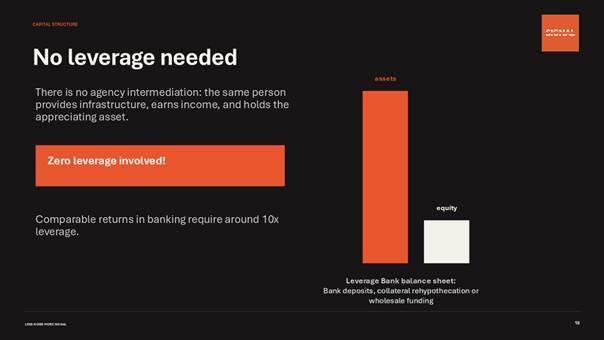
That level of velocity is unusual in traditional financial markets.
It also changes the economics.
A node does not necessarily need to charge high fees if the same liquidity can be used repeatedly.
Zeus reported that its fees declined by more than 50 percent while payment velocity increased.
Returns still improved.
Signal #3: Custody And Management Can Be Separated
Bitcoin has traditionally presented owners with a choice.
Keep custody and manage everything yourself.
Or hand over custody and let somebody else manage it.
Lightning may introduce a third model:
Self custody with managed operations.
Through tools such as Validating Lightning Signer, or VLS, the owner can retain control of the keys while allowing a professional operator to manage the node.
The operator can optimize channels.
Manage liquidity.
Adjust fees.
Rebalance capital.
But it cannot take the bitcoin.
This matters because operating a profitable Lightning node is not simple.
Professional management may improve execution.
VLS can make that possible without recreating the traditional custody model.
Important to note: Lightning yield is not risk free!
Apart from remaining technical risks, execution risk is among the biggest challenges.
Returns can vary.
A poorly managed node can lose money.
Capital may be deployed in the wrong channels.
Fees may be set incorrectly.
Rebalancing costs can consume the routing income.
There is also liquidity risk.
Bitcoin committed to a channel cannot always be withdrawn immediately.
In an uncooperative channel closure, the capital could remain locked for up to roughly two weeks.
Execution matters
Topology matters
Liquidity management matters.
The yield may be native.
But it is not passive.
That is why Chris expects Lightning to professionalize in a similar way to Bitcoin mining.
Early mining could be done at home.
Over time, specialized companies emerged.
Lightning may follow the same path.
It is our firm belief at LNMS that Lightning is finally about to scale. Things have matured enough for serious players to look at it and even integrate with it.
Just recently, the renowned custodian BitGo announced Lightning Earn, a product that allows corporate bitcoin treasury holders and others to deploy their capital as liquidity on the Lightning Network and capture routing fees.
At the Swiss bank that I am working for, we are also looking to potentially integrate with Lightning and become a liquidity provider.
Now, providing the liquidity is one side of the metal. The other side is users, using Lightning as payment infrastructure.
While this development has lagged behind, easy-to-use payments APIs like the Amboss Payments API are said to make Lightning a straightforward integration for business and merchants.
Already today, businesses can accept payments in USDT, USDC, or bitcoin over one Lightning connection and settles to its own infrastructure. A customer can pay in stablecoins while the merchant thinks in bitcoin.
For the institutions to seriously deploy large amounts of Bitcoin to the Lightning Network and earn a native yield on it, this side of the equation with merchants certainly has to grow.
One of Lightning’s biggest challenges is the lack of visible data.
The network is private by design. That makes it difficult to estimate:
Network wide payment volume
Average routing income
Real capital efficiency
Institutions want data.
They want risk frameworks.
They want operating histories.
They want to know how much capital the network can absorb.
Right now, those answers remain incomplete.
Chris openly admits that nobody knows exactly how Lightning yield scales.
Deploying ten bitcoin is different from deploying one thousand.
That is the constraint.
It is also the opportunity.
Because of these visibility limits, some might argue that institutions will face regulatory hurdles when interacting with Lightning. Without visibility, there is no clear answer as to whether a possible interaction with the Lightning Network meets all the compliance requirements.
What is important to recognize though:
Lightning routing is not money transmission. This is because the capital deployed is never controlled by an intermediary (similar to staking and for these institutions like banks do have approvals in place, at least the ones in Switzerland). HTLCs cryptographically ensure that money is being forwarded. No node ever receives client instructions to send money to a recipient. The routing node does not have any discretionary control and cannot alter any payments.
And from the perspective of a regulated, well-trusted bank, yield generation through capital deployment on the Lightning Network does indeed represent a step change.
Most of these institutions have built very institutional-grade, resource-intensive custody solutions. These solutions are the very reason why many people end up using banks to store their bitcoin.
If all of a sudden, a bank has to give up custody to generate a BTC yield for clients, which is actually the case with most other yield solutions, the bank undermines its own custody solution that they so carefully built and represents their moat.
Integrating with the Lightning Network the bank can keep custody of the clients’ BTC, while also earning a native yield. This is a sea change for sure!
There are three ways we want to present.
Comments
Nothing yet. Say the first thing.
Sign in to join the conversation.