
I put on some Bloomberg News to wash dishes to yesterday because that’s all I could easily get streaming in my kitchen on short notice. There was some marketing propaganda with the CEO of Microsoft, Satya Nadella, and Bill Gates and other tech people discussing the future of AI and whether Microsoft could be cool to kids.
The whole premise of the technology being sold was how likable the AI voice would be: would it be funny and hip, how would it sound, etc.
As someone who never watches television, however, I’m amazed at how obviously evil all of this is, and how that’s just fine for mainstream audiences. We’re in a “we’re not asking you, we’re telling you” phase… tech companies have decided what you will buy and you will buy it and you will like it. And we’ll show you how the sausage is made, even: we’re going to walk through, step by step, every marketing decision necessary to hook your kid into a world we control. We will make you happy that we’ve stolen your control away from you.
Your kids will love and confide in our mechanical puppet once we figure out how to make them love it more than they love real people.
For-profit tech companies make money on user ignorance. They more of your machine they control, and the less you control, the more they can protect their business models against your pesky evasion.
And the holy grail of interface, even beyond the cyberspace we have now, is a cyberspace full of agents you think of just like people. Then you don’t even need to bother with “navigating” a “space”; you just need to talk like a patient on a couch. The good, always patient, always available doctor will take care of the rest.
The dream of “agents” in cyberspace goes back to the ‘90s. The only reason we didn’t all get trapped in oligarchic tech-company hell back then was the combination of Free Software (soon captured and rebranded as “open source”) and the World Wide Web undermining the corporate software world’s plans for you. I mean “undermine” in the most literal of ways: every hack requires moving down a level of abstraction closer to the ground. AOL was easier than web browsing; web browsing showed the user URLs and protocols like http:// which tech companies considered an insane thing to expose to normies.
But, for the small price of learning about domain names, ports, protocols, and hypertext, the masses were freed—tunneling out through the basement—from the corporate cyberspace cages that had been made for them.
Whole industries and their investors, however, have patience. They have waited 30 years, for entire generations to lose the plot. They have waited 20 years for their new language of “social media” and “smart devices” to replace the words “internet” and “personal computer” in the popular lexicon. And now they are finally ready to bring their old machinations, the easy-to-use interface of personal agents from the ‘90s, back into operation.
It’s no use to insist, abstractly, on what’s “really going on” in the face of an overwhelmingly convincing illusion that a growing plurality of people participate in every day. The stated proposition that “AI isn’t a real person” can do nothing to dissuade your body, your sense making apparatus, that the chat terminal or voice interface you use daily really does connect you to some intelligence.
So what users need to do is practice using LLMs in ways which are lower level. They need interfaces that more-directly reveal what the LLM is actually doing, and then they need to use them, over and over, retraining their perception of what is even happening when they engage LLM-powered software.
The only thing that can undo practice is practice. And that counts for me, too. I felt that I had been writing about software for too long; the phrase at MIT’s Media Lab was “demo or die,” so I needed something to demonstrate!
Between May 28 and June 12 of this year, I invested about a hundred hours creating my own LLM interface software. The idea was that, by using my software, the user can unlearn the anthropomorphic vision of AI “agents” with whom one can have a “conversation”. It’s anti-chat! An anti-enviroment to chat! It’s called VibeKoder, and I’ve just made the source code available for free.
My software was designed as a first-draft of such an interface. I avoided using the language of “messages”. And I created ways to interrupt the linear nature of the chat.
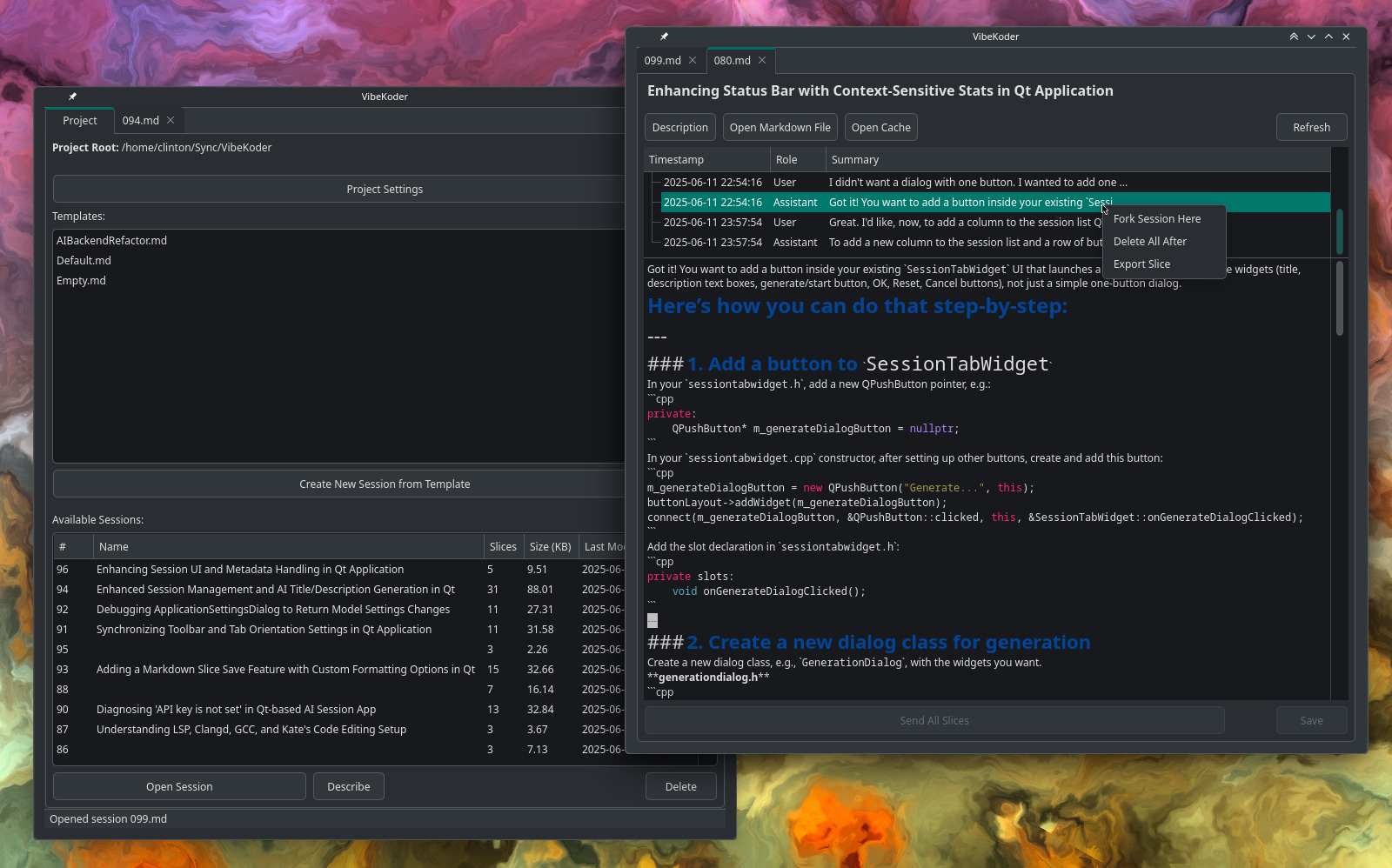
As you can see, VibeKoder interface is designed to let the user fork sessions into new sessions, creating lateral moves in the “prompt-slice” assemblage. These terms are my own, that I made up, to try and get away from the language of “messages” or “chat” or “conversation” which is inherent in all other LLM programs.
LLMs are not, as I have said, agents or people you can talk to. They are percussion instruments, like drums or bells. Whenever you strike them with words, the tokens derived from those words resonate in a vast echo-chamber, and the echoes which return are turned back into new sentences again.
You hit snare drum, it makes a noise. You strike it somewhere else, it makes a different noise. The way the “chat” illusion works is just in the growing “size” of each “strike” of the LLM “bell”, which includes the whole prior discussion.
This makes them an amazing technology. Just as the globe is the world in your hands, an LLM is language itself turned into a material artifact. You put words into it, those words reverbrate across all language, and more words ring out!
That technology: the LLM as percussion instrument, a poetry chamber, is what kids ought to be learning. As long as they are not learning that, they are being lied to. Poisoned. Seduced by the last people you want knowing their secrets, profiling their psychology, guiding their development, or taking their money.
This summer was one where I surrendered my good sense and let my manic worries about such things take control again, over more “realistic” concerns. Just like it was with Silicon & Charybdis. I spent a good month on my calendar program before I realized I needed better LLM software to code it with.
After my two-week blitz creating VibeKoder, real life caught up with me again and I got back to paying bills and other mundane, human-scale tasks. And so, in the nature of sharing, I present it here freely, half-finished, but workable.
I hate releasing half-baked stuff, but I’m in no position to spend time or money doing what I feel driven to do—stuff like work on VibeKoder or preach McLuhan’s media ecology or fight corporate fascism—when I’m still working solo. So take it as it is: an early tech demo.
VibeKoder is pretty amateur. It’s a project for me to re-learn C++ with help from an LLM and is, in just four months, largely out of date. It has no features for MPC tool use, and the only provider interface which has been completed is OpenAI. The configuration GUI is a shambles, too.
But it does have awesome Markdown rendering thanks to the Patrizio Berkele’s QOwnNotes project. It has great features like exporting individual “slices” to markdown files with a single click, and everything is set up for interface with an IDE or text editor like Kate. And it’s a program that was used, very early in its design, to write itself. Most of VibeKoder was written with VibeKoder! I have a million more dreams and plans for it, which you can read in the /docs folder.
Because everyone invested in the AI Bubble sees LLMs as an engine to power fake digital friends for seducing your children into corporate enslavement through exploiting the very loneliness which technology itself created. Normie AI talk—talk predicated on the back-and-forth illusion of chat—needs to be undercut for actual progress to occur. And the only thing that can undercut talk is action.
I’d love to finish VibeKoder myself, making it usable for me and you—that’s just not possible right now. Which sucks because the tech company takeover of our personal computers, and our very lives, looms-large over ever horizon!
Given that, in spite of the present sorry state of the actual software, I do hope that the vision VibeKoder demonstrates resonates with you, dear reader! Let’s do everything we can to make the magic of the ‘90s—the escape from the walled garden of corporate digital enslavement—happen again, and let’s continue to do more to maintain vigilance for next time.
Comments
Nothing yet. Say the first thing.
Sign in to join the conversation.