
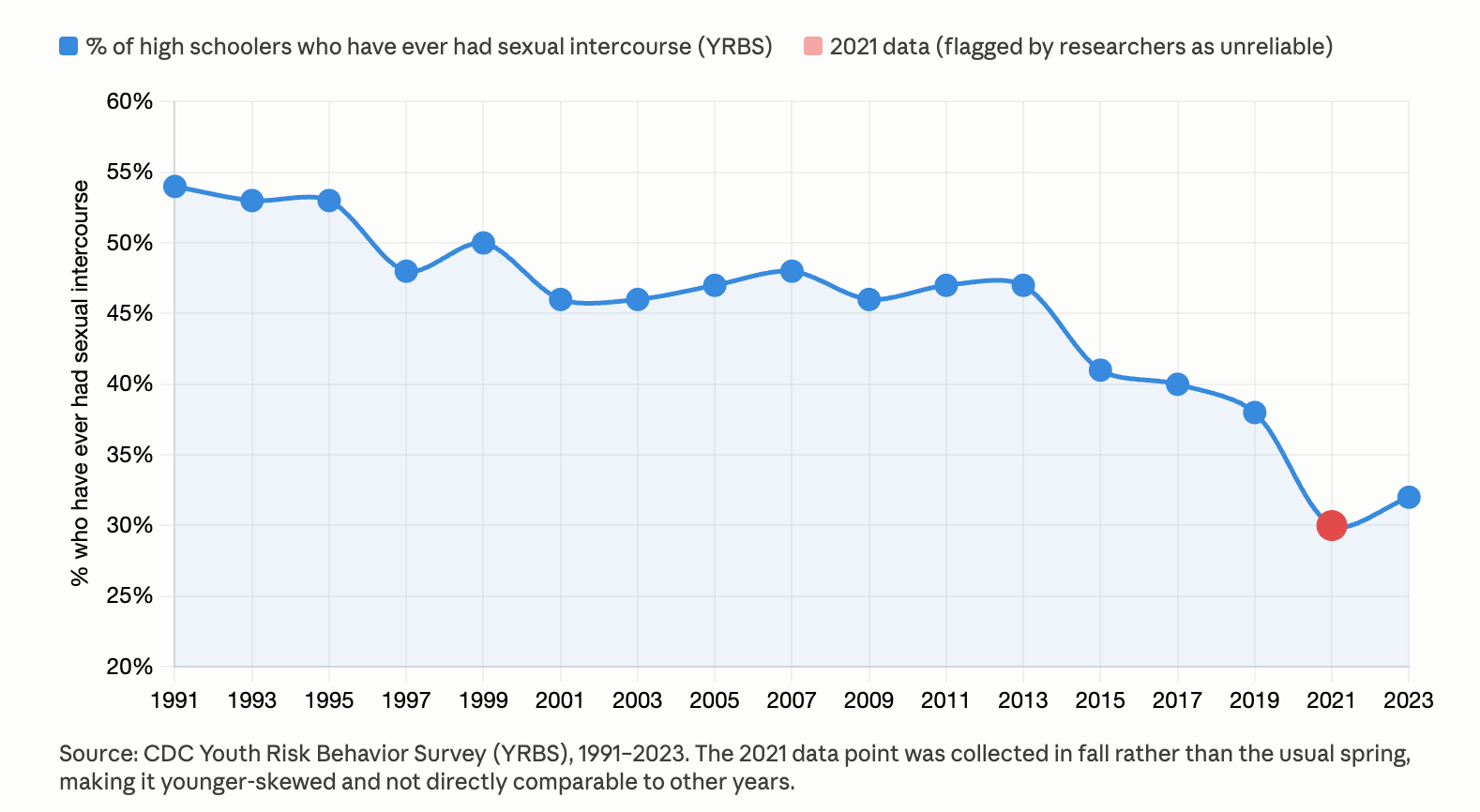
Are teens having less sex?? Because the headlines have screamed so for a few years now. But dive into the data and you’ll find that the situation isn’t quite crystal clear. YES teens have reported having much less sex over the past 30 years — from 54% in the early 1990s to 32% today. These topline numbers make it seem like we have absolute answers about teens’ sexual behavior, when in fact their sexual activity and the data itself is far from absolute. Do we know if teens are, in fact, abstaining from any and all sexual activity? How reliable are the studies on which we depend?
Turns out, super short, attention-grabbing headlines miss nuance. So today, we’re going to help you unpack the messiness of the teen sex data. It’s is worth understanding, especially for anyone trying to have an honest conversation with a teenager about sex.
WHERE DO THESE NUMBERS COME FROM?
Almost every headline about declining teen sex traces back to the same source: the CDC’s Youth Risk Behavior Survey, known as the YRBS. It’s a large survey of high school students that’s been running since 1991. Data is collected every-other year, with the most recent round in 2023. Results are published the year after collection, so the newest data we have is from September 2024. This is the source of the now infamous stat that 32% of high schoolers say they’d ever had sexual intercourse — down from 54% in 1991 and 47% in 2013.
If you’re a close reader, you might have noticed that we’re living in 2026. So shouldn’t there be data from 2025 due to published any minute now? The term “should” implies that there’s still funding and infrastructure for the YRBS, but we’re living in a moment when there’s not. And this is especially relevant because there are no added chapters to this particular narrative coming in the near future — maybe kids are having even less sex, or maybe they’re having a whole lot more, who knows! How much of a bounceback has there been post-COVID (that big red dot in the graphic above? That’s not clear either. We need researchers out in the field asking the questions to know how this story is progressing.
So what about the data we do have? This is where things get particularly muddy.
The YRBS asks kids about whether or not they’ve had “sexual intercourse” but never defines the term. Literally, the survey asks students: “Have you ever had sexual intercourse?” — no clarification which we assume teens interpret as vaginal/penile sex but we can’t know for sure. Plus, there’s no mention of oral sex, anal sex, or any other kind of sex in the survey. Each teenager answers based on their own personal definition of what the term means, which, as any adult who was once a teenager knows, varies enormously.
AND THEN THERE’S THE METHODOLOGY PROBLEM
A paper published in 2025 raised serious concerns about the YRBS data — specifically the dramatic 8-point drop everyone keeps citing, from 38% of teens having had sex in 2019 to 30% in 2021. The drop happened during COVID, which makes it seem like social distancing was what drove less sex. But that doesn’t turn out to be the full story. Here’s what actually happened:
The YRBS is typically administered in the spring. But in 2021, because COVID keep many schools closed or minimally operational through the spring, the YRBS was delayed to the fall instead. Sounds minor, but it’s not. That’s because high schoolers surveyed in fall are systematically younger than those surveyed in spring — they are starting their school year (not ending it) so they are younger than the grade above them who really should have been filling out the questionnaires. This is especially relevant because teenagers become significantly more sexually experienced with each passing month during adolescence. So even a small age shift backwards produces a measurable drop in reported sexual experience.
How significant was the age impact? Researchers calculated that somewhere between 30-50% of the 2021 decline was likely explained by this age shift alone — not by any real change in teen behavior.
Another humongous methodological issue came with willingness to answer. Back in 2011, almost all kids answered the “ever had sex” question (7% left it blank). In 2021, though, there was a dramatic increase in N/A, with nearly 30% not answering. Important point here: this wasn’t necessarily on the kids. More states than ever refused to include the question at all, due to political pressure. In fact, fewer schools participated in the survey in the first place: from 81% in 2011 down to 40% in 2023.

THERE IS ANOTHER SURVEY
The YRBS isn’t the only game in town. The federal government also runs something called the National Survey of Family Growth (NSFG), and it’s worth knowing about because it asks much more specific questions. Where the YRBS asks one undefined question about “sexual intercourse,” the NSFG gets granular, asking about vaginal sex, oral sex, anal sex, same-sex partners — these are all asked about separately, with clear definitions. It also surveys a broader age range (15-49 rather than just high schoolers), which makes it useful for tracking what happens to sexual behavior as teens move into their 20s.
The most recent NSFG data was released in December 2024, covering 2022–2023. A few things it showed:
among never-married teenage girls, about 40% had ever had opposite-sex intercourse
for never-married teen boys, about 39% had ever had opposite-sex intercourse
those numbers are actually higher than what the YRBS reports for the same age group — which tells you something about how much the question wording matters.
Unfortunately, the NSFG is also in the middle of a data quality crisis. Response rates have collapsed from 63% in 2017–2019 to just 23% in 2022–2023. The survey also switched to a new format — adding an online option alongside the traditional in-person interview — and people who took it online reported dramatically higher rates of sexlessness. This may be a result of people rushing through to collect the $40 participation incentive… saying “never had sex” lets you skip most of the questions. As a result, even the CDC itself warned researchers not to make direct comparisons between 2022–2023 data and earlier years.
SO WHAT DOES THIS ULTIMATELY MEAN?
YES, the long-term decline in teen sexual intercourse is real but we don’t exactly know to what extent nor do we have reliable data for how it’s continuing (or not).
Which begs the bigger question: Is this decline a bad thing? A good thing? We get that question a lot especially as we deliver news that boils down to: growing-up-has-changed. This highly circulated 2025 quote is from Child Trends, a nonpartisan research organization, frames this issue in a thoughtful way: “A lack of sexual experience isn’t inherently positive or negative. But when lower rates of reported sexual activity occur alongside high rates of sexual violence, limited access to inclusive sex education, and widespread mental health challenges, they reflect a more complex reality.”
What’s more, future research must explore other powerful forces in teens lives that are undoubtedly affecting their sexual behaviors and choices, namely easily accessible online pornography and AI chatbot companions. Not to mention that we need to pull the lens back and consider that this trend toward less teen sex may simply be a symptom of the larger impact tech has on young people’s lives. This juggernaut influence is assumed to be the cause of a decline of in-person socializing and the highly publicized loneliness epidemic amongst young people, which in turn may be the source of lower rates of teen sex.
In other words: even if we believe the numbers, fewer teens reporting sex is neither good news nor bad. The value proposition depends enormously on why they’re having less sex — and the data doesn’t tell us that. As for the takeaway, it’s neither panic nor relief. It’s the same thing it always is: keep thinking critically about the bigger picture and continue talking to the young people in your life.

In this hilarious and heartfelt episode, we’re joined by the dynamic duo Kim and Penn Holderness who share how they handled their daughter’s college departure. We cover it all: from overpacking to the medical preparation needed before sending a kid off to the chaos on move-in day, and ultimately, to the pride of watching a kid grow into their own person.
No posts
Comments
Nothing yet. Say the first thing.
Sign in to join the conversation.