
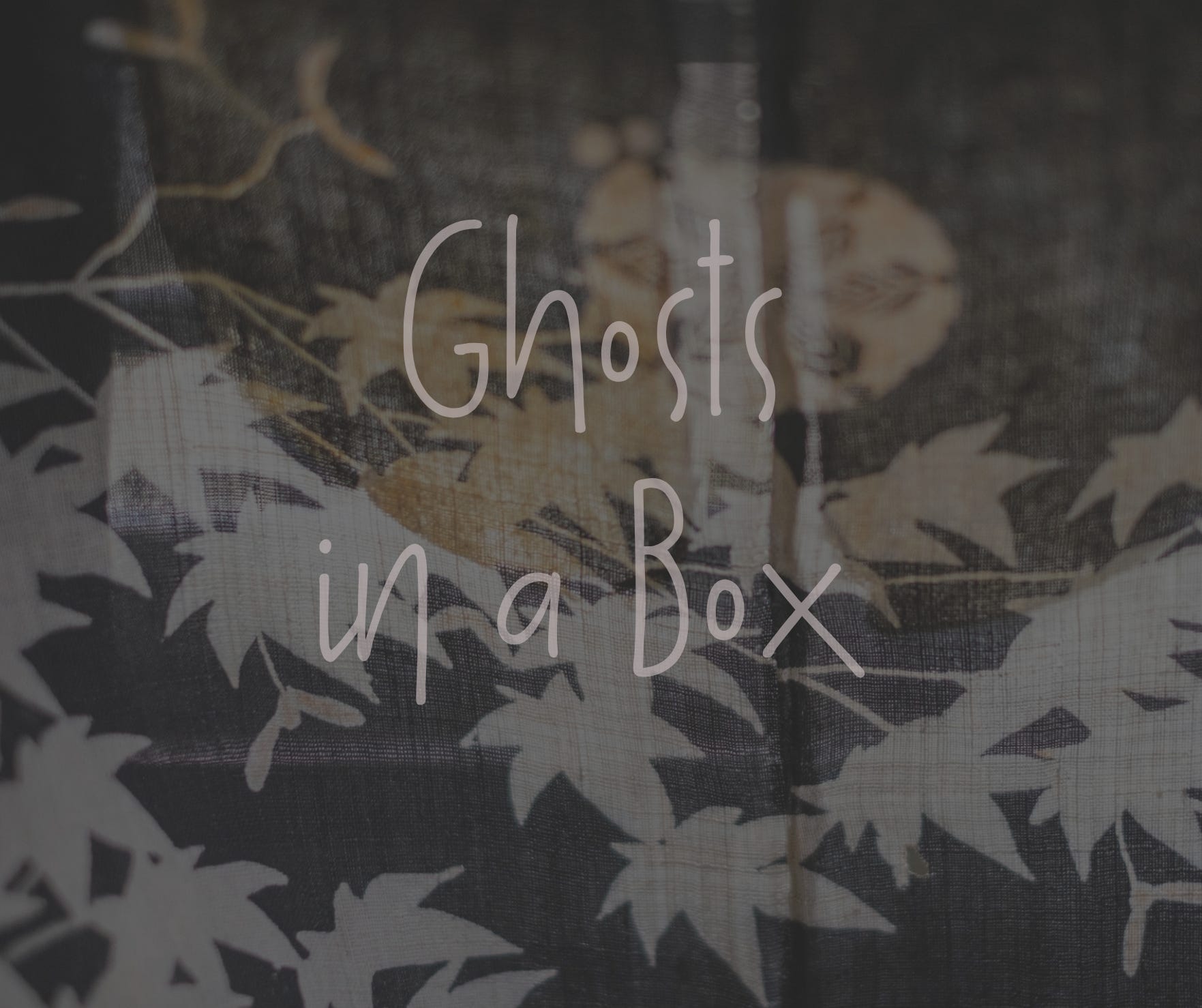
When I pick up a vintage kimono to use in one of my art pieces and start taking it apart, I find a deep connection to it as I remove each stitch.
Someone before me took this time and tender care within each stitch, moving the needle and thread through the fabric.
I follow that thread line.
This has given me a great fondness for vintage kimonos because of the life that was brought with it.
Isn’t it a beautiful thought that a culture would have a word for this process of disassembling and cleaning kimonos? Arai-hari.
Just the tender act and thoughtfulness of these garments that
were made to be deconstructed and to be sewn back together again.
I think it is about continuation.
The kimono has not died.
It has changed relationships
with its place in the world.
The kimono is literally dismantled.
And yet...
its essence remains.
I can sense it.
What if the “ghost” isn’t haunting?
What if it is...
presence?
The fabric carries traces.
Hands.
Ceremonies.
Sunlight.
A woman folding it carefully.
A season.
A family.
I no longer ask,
What can I make from this fabric?
I ask, What does this fabric remember?
I am learning to listen to what it has to offer,
and I am learning to work with it as a companion.
Sometimes I wonder if we are not so different.
We are not broken,
we may be disassembled, taken apart.
But we are not over.
We are being made ready
to be continued.
This can be
our ideas?
Our identities?
Our roles?
Our expectations?
I am deeply honored that I have this collection of pieces.
I wonder if it is really about inheritance.
Not inheritance as possession.
Inheritance as companionship.
I no longer believe beautiful things disappear.
I am not the owner of the cloth.
I am one of its caretakers.
One of its chapters.
One of the hands through which it continues.
Perhaps these are not ghosts after all.
Perhaps they are simply stories waiting for another pair of hands.
Like this post? Read a related post here:
No posts
Comments
Nothing yet. Say the first thing.
Sign in to join the conversation.