
For most leaders, the honest answer is no. Whenever I talk to a leader who describes their company’s AI strategy, it rarely mentions an organizational strategy that supports it.
Leaders pour energy into model selection, prompt libraries, and pilot programs. Meanwhile, the job descriptions, reporting lines, and performance metrics beneath it all remain frozen in place, built for a world where headcount was a sign of importance and tasks moved between departments in a human-driven workflow. That mismatch, not the technology, is the biggest risk to AI-driven transformation.
When AI removes hours of work from a role, two things can happen. Either the organization redesigns the role and redeploys the freed capacity toward judgment, strategy, and higher-value work, or it simply absorbs the savings as a quiet headcount reduction and calls it efficiency. Most companies are doing the second thing while struggling to figure out how to address the first.
The result is a workforce that is technically more “efficient” and organizationally insecure. Nobody’s job description changed. Nobody’s incentives changed. The org chart still shows functional silos, but with fewer people at the bottom.
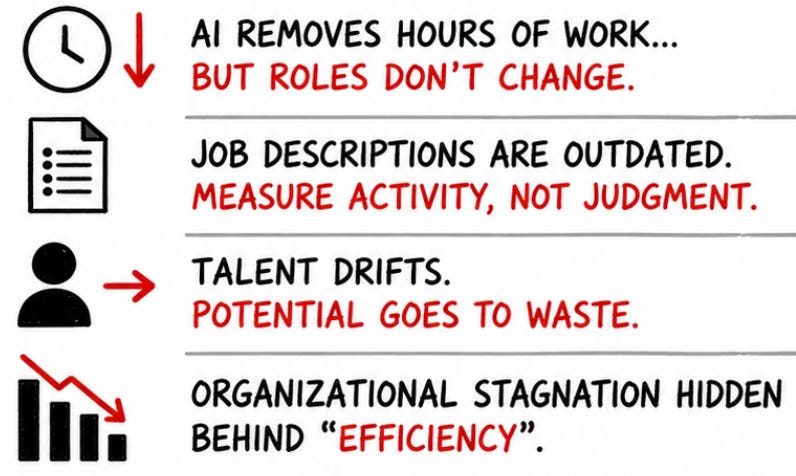
Job descriptions were written for a world of predictable workflow and tasks. AI doesn’t just speed up tasks; it changes which tasks are worth a human doing at all. If the job description doesn’t evolve, you get:
People quietly do less differentiated work while AI does more
Talented people drifting toward irrelevance inside roles that haven’t caught up to what they’re capable of now
Performance reviews that measure metrics that don’t make sense anymore
This is the imagination deficit showing up in HR infrastructure. The tools moved. The org design didn’t.
Look at what’s already shifted in hiring. Resumes are screened by AI. Candidates are using AI to write cover letters, prep for interviews, and in some cases answer take-home assessments. Recruiters are using AI to source and rank candidates faster than ever. The mechanics of getting hired have been quietly rebuilt from top to bottom.
But open the actual job description at the end of that process, and it reads as if it were written five years ago. Same bullet points about “managing stakeholders” and “owning the roadmap.” Same years of experience and title. Even if the job has changed since AI entered the chat.
While “AI proficiency” is already showing up as a checkbox in job postings, the same way “Excel” or “Salesforce” did, that’s exactly the miss. Treating AI as a tool skill to check off misses the real distinction, which is how deeply a person actually engages with it.
That’s the difference between someone who is merely AI-proficient and someone who is AI-native, moving up what I call the AI Engagement Pyramid rather than stalling at the bottom rung of basic tool use. Job descriptions that list “AI skills” as a line item are measuring the wrong thing. They lack emphasis on the skills that matter now more than ever, such as judgment, customer empathy, taste, critical thinking, and understanding what tradeoffs are worth making. They’re capturing whether someone can operate the tool, not whether they’re using it to think differently.
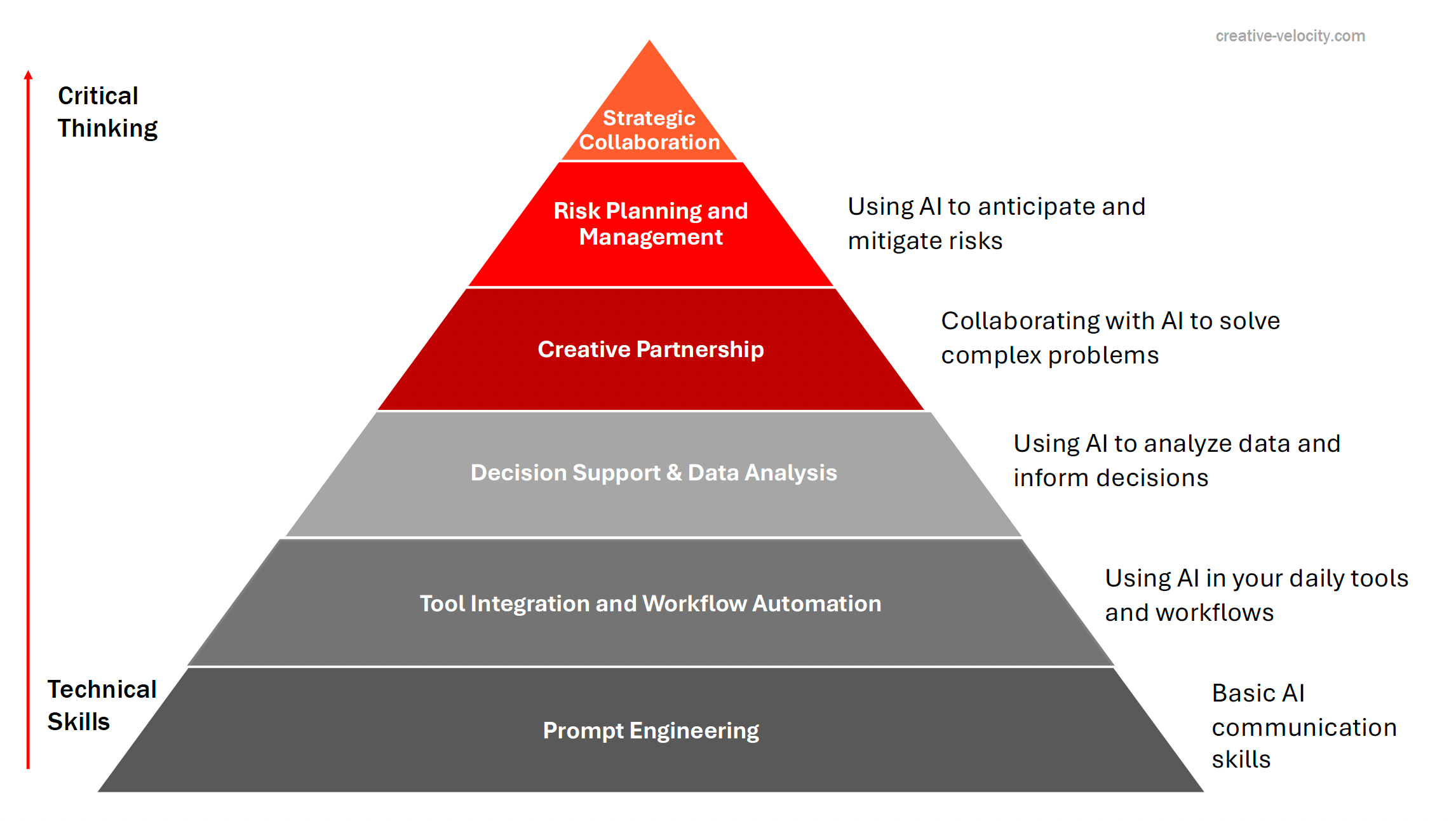
Real AI transformation asks a harder question than “what can we automate.” It asks “what should this person be doing now that they have the hours back.” That’s an org design question, not a tooling question. It requires:
Rewriting roles around judgment, oversight, and decision quality rather than task throughput
Rebuilding career ladders so that AI fluency is a multiplier on human capability, not a replacement for it
Giving managers new criteria for what “high performer” means when the task list itself has changed because a machine is now producing first drafts, designing a UI, or coding a prototype.
Interview candidates for critical thinking skills and customer experience skills.
None of this happens by accident. It happens when leadership treats the org chart as a living document that has to keep pace with the contributions of new technology, rather than a static artifact from the last reorg.
The real test of AI transformation isn’t how many people are using AI tools. It’s about whether anyone’s job description has actually changed and how that employee contributes as a result. If the answer is no, the efficiency gains are real, but the transformation isn’t. You’ve just made the old org chart faster at doing the old job.
In this clip from Episode 12 of “What If With Leslie Grandy”, my guest, Scott Ehrlich, Chief Innovation Officer & Head of Strategy at Sinclair, shares his perspective on their AI transformation.
No posts
Comments
Nothing yet. Say the first thing.
Sign in to join the conversation.