
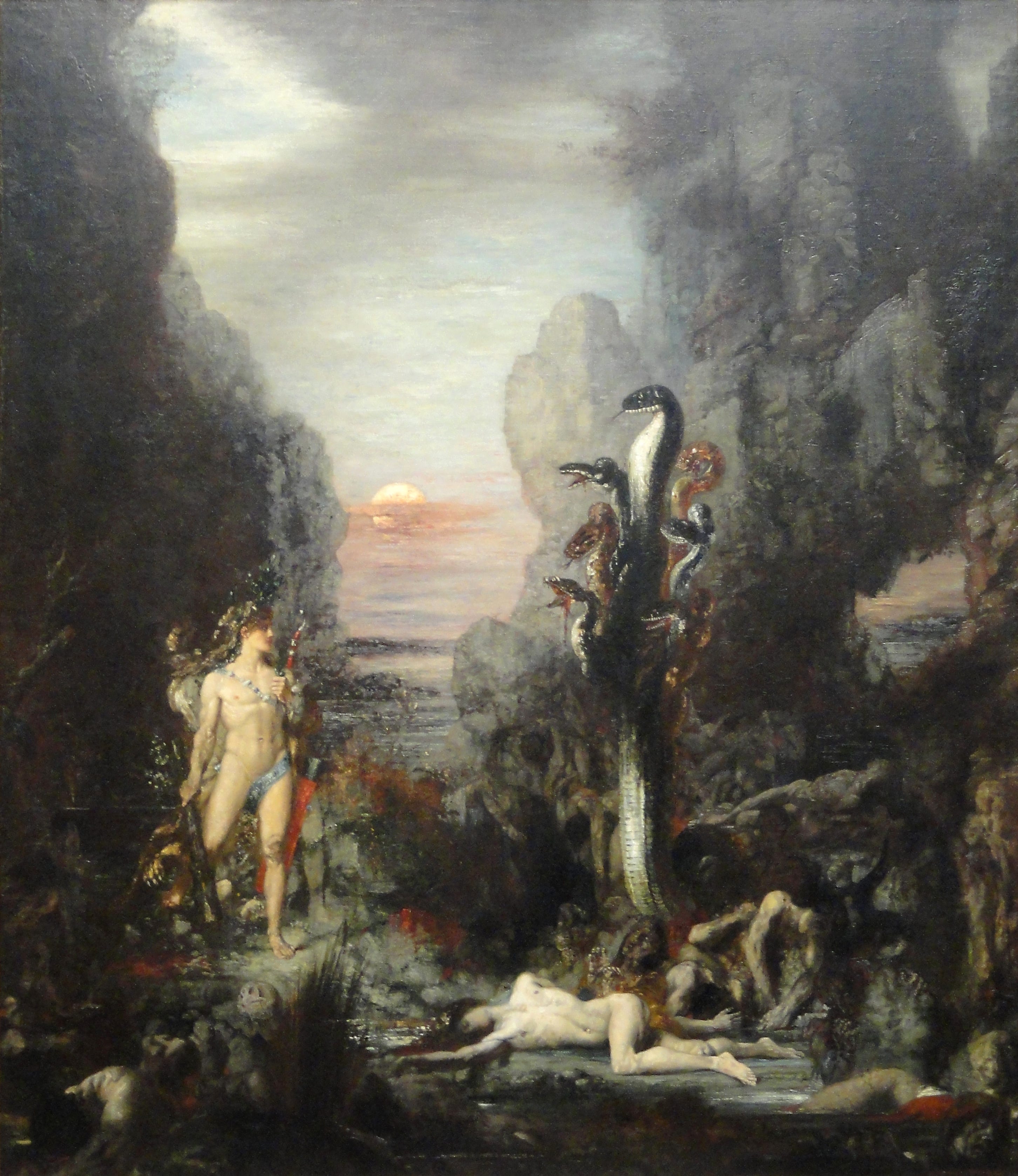
Hercules and the Lernaean Hydra, Gustave Moreau (1826 – 1898)
Poetics (from the Ancient Greek ποίησις/poíēsis, “work, creation, making”) allows for the exhaustive study of possible worlds in order to determine their characteristics. Thus, the world proposed, even imposed, by the current “detached” elite evokes only a centralizing and authoritarian future aimed at radically reducing the human livestock. One could argue that contemporary ideologies are the consequences of more than two centuries of psychological manipulation of the masses. Creating new worlds for the flourishing of mankind therefore does not seem to be part of the dysfunctional psyche of the “elites.” One might argue that contemporary ideologies are the result of over two centuries of psychological manipulation of the masses. Creating new worlds for the flourishing of mankind, therefore, seems to be outside the dysfunctional psyche of the “elites.” But isn’t the term “elites” a gross misuse of language when one examines more closely the private lives of these demigods who claim to orchestrate the destiny of humanity? Recently, the common people have been ecstatic about the greatest material wealth ever acknowledged and acquired by a single individual. And one could certainly criticize this kind of megalomania, which masks a systemic poverty on a philosophical, historical, human, and theological level. The world’s richest man, materially speaking—as if that title were unambiguous—doesn’t seem to be a balanced, even rational, being. His offspring suffer from numerous dystopian visions that suggest the DNA of the hyper-class is corrupted or has undergone numerous mutations that have destroyed the fragile balance between Being and Appearance. Some will flaunt this, becoming the champions of public opinion; they will argue—because the glory and renown that accompany immense wealth will inevitably trickle down to those who are enamored with the image while ignoring its creator—that genius must necessarily be accompanied by instant fame and divine ease. But the new trillionaire is nothing more than a symptom of a decaying era. All great empires have witnessed the rise of excess, avarice, arrogance, ostentation, and so many other characteristics of a dying world that idolizes its criminals and executes its courageous men. We have passed the age of Homo faber and entered the era of “artificial intelligence,” which relentlessly reduces what remains of human intellect to mush for funeral directors. We already compost bodies, so why not also grind up the essential marrow and transform it into an algorithm that will eventually replace human stupidity! But isn’t that another notable “progress” in the age of larvae and slugs! We already compost bodies, so why not also grind up the very essence and transform it into an algorithm that will eventually replace human stupidity? But isn’t this yet another notable “advance” in the age of larvae and slugs?
Thus, when the basin is contaminated by numerous parasites, we must wade through dark waters infested with sharks and pimps, praying to God that he will turn on the tap and flood all of humanity once again! After us, the Flood, chanted Marie-Antoinette! Materialism has reached such a level of power that even the most monstrous and dangerous black holes cannot compete with the heresy of the “elites”! It would be better to hope for the collision of the blue planet with another asteroid in order to “drain the swamp”! Certainly, the orange hot air balloon had promised to cleanse the Augean Stables; but not everyone can be Hercules! And the degree of collapse of Western civilization demonstrates that the moral ferment it possessed to contain and unite millennia of polytheism of all kinds has completely evaporated, and that the Leviathan will envelop all of humanity until its ultimate psychological and philosophical exhaustion. We could always convince ourselves that progress—a rather vicious and viscous artifact when one considers the concept of “creative destruction,” which drowns millions of individuals in a jovial mire with each “innovation,” without anyone batting an eye—favors those most capable of perpetuating a human life that is supposedly precious, even though it is most often eliminated without a second thought. Therefore, I will not revisit the numerous “psychological operations” used during the last century to indoctrinate people and I will focus on human intelligence, which remains a vague and mostly poorly defined concept.
This leads us to believe that the misleading term “Artificial Intelligence” is yet another way to limit life for the benefit of an “out-of-touch” caste, similar to the demigods of ancient Greece. For intelligence is never artificial. Algorithms are programmed in such a way that they trap their “users” in a circular logic. Certainly, these systems can develop “languages” unknown and indecipherable to humans, but this in no way means that these “artificial forms of communication” are “intelligent.” The most sophisticated contemporary language models are always biased and ideologically driven, and never take into account the entirety of reality because it is unknown to us or because it is part of the human soul:
“But logic is like a slide-rule. It can only provide the total of all the factors fed into it. If some vital factors are left out, then the answer will be faulty. Planners of all types, including the Communists, ignore the spiritual nature of man, and are superbly confident that because they can produce in their heads a most carefully devised plan, then it should work. We have the example of planners advocating the ‘reconstruction’ of rural communities in the West arguing that the basic cause of the failure of collectivized farming in the Soviet Union was not this concept of ‘scientific’ farming, but the ‘stupidity of the backward, superstitious peasants.’ The planners ignored the reality of people with such a deep ‘feel’ for their own soil, for a particular way of life, that they prefer death to relinquishing it voluntarily.”[1]
Social Dynamics, Eric D. Butler
Progress, as defined since the “Age of Enlightenment,”[2] thus appears as a “Seven-Headed Hydra” that is leading humanity towards a programmed extinction. It is said that progress cannot be stopped without ever explaining this concept, which carries within it a recurring death drive. Let us explain for a moment this desire for collective suicide as described by Sigmund Freud. We might think that the collapse of Western civilization is circumstantial, whereas, in fact, it is orchestrated and premeditated. The crime is known; but since the criminal (the political regimes in place in Western countries) is accompanied by a plethora of collaborators—bureaucrats, law enforcement, authorities of every kind, favored entrepreneurs because they are subservient, ordinary citizens who deliberately choose to turn a blind eye to the lies, etc.—all more unaware than the next of their complicity in the crime, it becomes impossible to distinguish sociopathic behaviors from endogenous reactions (fear and terror can move mountains!), resulting in the submersion of the entire critical apparatus. From that moment on, the man immediately ceases to think and takes refuge in an obstinate silence, characteristic of people convinced of their own good faith. Observe closely the reaction of contemporary people when one speaks of economics and the perpetual bankruptcy of the monetary system and the entire societal apparatus enslaved to it. The famous concepts manufactured since the Age of Enlightenment, such as creative destruction, belief in a free market, natural selection of the fittest to govern, religious secularism—this last oxymoronic ideology certainly suffering from schizophrenic symptoms—allow us to make an initial diagnosis: Western countries have become madhouses from which it is impossible to escape!
In his equally comical and unsettling short story, The System of Doctor Tarr and Professor Fether, Edgar Allan Poe admirably depicted modern societies where the madness of their members is a daily occurrence. The author illustrates how the visitor, not without apprehension, discovers, during a conversation with the Director of the Asylum, the characteristics of a madman and the dangers of allowing him to roam freely:
«“‘And, sir,’ said I, screaming in his ear, ‘you mentioned something before dinner about the danger incurred in the old system of soothing[3]. How is that?’ ‘Yes,’ he replied,’ there was, occasionally, very great danger indeed. There is no accounting for the caprices of madmen; and, in my opinion as well as in that of Dr. Tarr and Professor Feather, it is never safe to permit them to run at large unattended. A lunatic may be ‘soothed,’ as it is called, for a time, but, in the end, he is very apt to become obstreperous. His cunning, too, is proverbial and great. If he has a project in view, he conceals his design with a marvellous wisdom; and the dexterity with which he counterfeits sanity, presents, to the metaphysician, one of the most singular problems in the study of mind. When a madman appears thoroughly sane, indeed it is high time to put him in a straitjacket.”[4]
The System of Doctor Tarr and Professor Fether, Edgar-Allan Poe
Madness is therefore omnipresent in our society. It stifles all rational discourse, all political questioning, and all serious criticism of the mechanisms of power. Current leaders are responsible for this repression, with the complicity of the most fanatical citizens, whether they occupy the left or the right of the political spectrum. Reason is unknown to them, and repression constitutes their mode of thought and action. Violent acts, whether committed in the name of “freedom” or under the guise of representing individual rights that most often transform into injunctions—I am the center of the world, and you must revolve around me—serve today as instruments promulgating terror and repression. One of the most dangerous tactics—and a decidedly feminist one at that!—consists of deflecting questions or criticism, ignoring them, or suppressing them. Consider, for example, the infamous—and dubious—press conferences during which compliant and servile “journalists” conspire to dilute the message or, better yet, to erase it from the news. The entire political apparatus advances without any safeguards—to say the least!—or accountability, with sadists having seized control of the whole of Western society. Public entertainers—or perhaps abusers?—distract a mass of spineless individuals paralyzed by centuries of psychological manipulation.
The most compelling example of totalitarian control that has concealed its hegemony since the 16th century appears to be the monstrous banking monopoly coupled with the willful blindness of individuals. All along the ladder of power stand individuals of institutional mediocrity. Dr. Oliver Heydorn, in his book entitled LIVES of Our OWN, describes how institutions are themselves organized to drive individuals toward crime. According to Dr. Heydorn, moral sense is not merely an individual value but must also be part of the community, and therefore of associations and institutions:
“Every ostensibly democratic society engages in public policy debates and must make public policy decisions. Since nature abhors a vacuum, choices of this kind simply cannot be avoided. Either the policies that are eventually imposed will promote or facilitate the achievement of a socially just economic system, or they will embody social injustices of various sorts. This ineluctable fact serves to demonstrate beyond peradventure that there is a communal dimension to morality and hence there is a public dimension to the question of social justice; it is not simply a matter of individual actions and choices.”[5]
LIVES of Our OWN, Dr. Oliver Heydorn
Thus, the failure to embed moral values within institutions reduces economic actors to the status of “accomplices in crime.” They are no longer simply incompetent; they are also well aware of the crimes perpetrated daily because these immoral offenses are intrinsic to the system in which they operate. Yet they seem to completely ignore—or naively feign ignorance of—the civilizational crisis we are experiencing. The reflex of any bureaucracy is therefore to turn a deaf ear to any criticism or recrimination and to turn a blind eye—I was just doing my “job”—to endemic, systematic, and organized corruption. It is safe to assume that all civil servants in the state apparatus are subjected to abject blackmail or are simply too corrupt to even acknowledge their own complicity in the crime. The collapse of moral sense has accelerated since the Time of Cholera (the fake pandemic). And even if irrefutable evidence were presented to them, they would only agree laconically in order to get rid of the agitator.
For over two centuries, the concept of risk associated with the Enlightenment has allowed “revolutionaries” to transfer the suffering caused by state violence onto the masses. Enormous sums have been amassed by the plutocracy after inciting the underprivileged classes to a fever pitch, with the obvious aim of sending them to the slaughter of insurrection. “Long live the Revolution!” is chanted behind a shapeless mass, herded with an iron fist to the “Altar of Domination.” The examples of Lenin, Trotsky, Mao, and others illustrate the powerful forces that manipulate ideas for the purposes of psychological warfare. So, we must ask ourselves, who bears the risk of death, violence, and suffering that the communist bourgeoisie[6] constantly invokes in order to escape the Monster they have created? Let us remember that it was the Jewish bankers Siegmund George Warburg and Jacob Schiff who financed Leon Trotsky and the “Russian Revolution.” We can certainly discuss the Banking Cartel without naming its owners. But failing to formally identify the enemy is a significant strategic error that prevents us from broadening our intellectual reflection. That Jews control the international financial system—cosmopolitanism being a defining characteristic of a stateless tribe, proud of it—is not new in itself; but that the eschatological character and its spiritual scope are omitted from the equation in order to reduce the discussion to its purely economic aspect strikes me as a major intellectual error. Certainly, the accusation of antisemitism will be immediately invoked to silence any possible allusion. But this will change absolutely nothing historically; the Jews are a people withdrawn into themselves, a caste that has been dead for centuries and that venerates the cult of death to mask the terror of their spiritual guilt. These singular individuals do not know and will never know any redeeming emotion—being imprisoned as they are in a tribal and primitive castration complex—that would restore their humanity. They are immutable, as Léon Bloy evoked in his book entitled Salvation through the Jews:
“The history of the Jews blocks the history of mankind like a dam blocks a river, raising its level. They are forever immobile, and all one can do is jump over them with more or less of a crash, without any hope of demolishing them.”[7]
Salvation through the Jews, Léon Bloy
The “Jew” is therefore a singular being who rejects all mixing while orchestrating the total destruction of humanity to replace it with a murderous and satanic supremacy through a total monopoly on life—the banking cartel. We could thus establish military, spiritual, political, and economic strategies to counter this global coup. For socialist and capitalist ideologies—two sides of the same coin—have lamentably failed to pacify humanity and reduce contemporary slavery. We currently live under a feudal regime of an entirely new kind in which no chains are necessary to enslave individuals. The specter of social death is the most powerful of prisons; and if the terror associated with this death is not enough, the repressive powers will resort to conventional murder—euthanasia. Is it therefore possible to implement an economic system that is not fundamentally nihilistic? Modern economic doctrines have all demonstrated their systemic failure. I would therefore propose a complement to Clifford Hugh Douglas’s Social Credit doctrine. The Risk Management Banking System (RMBS) is a completely different concept from the current financial system and is ideologically closer to Clifford Hugh Douglas’s Social Credit doctrine. Indeed, loans granted by this banking system take into account the risks incurred by both the lender and the borrower: the risk of bankruptcy, the risk of a lack of profit or innovation, the risk of a bad “investment” that turns into an expense or a loss, and the risk associated with the borrower’s bad faith or the lender’s greed. It must be acknowledged that implementing a doctrine such as Douglas’s entails its share of risks, threats, and opportunities. Many individuals who currently hold power and a monopoly on credit will certainly be reluctant to share it with others. Try creating a bank today that offers zero-interest loans! You will be immediately sanctioned by government authorities, who themselves will have been pressured by the banking cartel! You simply won’t be able to start your business and you will find yourself in court or even in prison without a trial! To eliminate you, your initiative will be compared to that of Charles Ponzi!
But no matter! The concept aligns with that of C.H. Douglas; but this system is supplemented by a transitional process that would allow us to move from a situation of financial monopoly over all aspects of human life to a system that integrates the risk inherent in a new venture as well as the risks associated with the uncertainties of existence. It is therefore not simply a matter of quantifying risk. It is also necessary to transfer it to those who take it. For most adventurers like to present themselves as innovators as soon as they know that the risk will inevitably be transferred to government bodies if their venture fails[8]. Whereas they will hail themselves as heroes of innovation and progress if the attempt is successful. Taking a risk with other people’s money—what a windfall!
It is therefore important to remember that authoritarian systems (fascism, dictatorship, totalitarianism) always foster the emergence of an “out-of-touch” elite that governs by decree and without any political accountability. To “advance,” the banking monopoly must therefore rely on mechanisms of systemic surveillance and internal repression:
“The widespread opinion that the most successful modes of political action are intrigue, falsehood, and machination, if they are not outright violence, goes back to these experiences, and it is therefore no accident that we find this sort of Realpolitik today chiefly among those who rose to statesmanship out of the revolutionary tradition. Wherever society was permitted to invade, to overgrow, and eventually to absorb the political realm, it imposed its own mores and ‘moral’ standards, the intrigues and perfidies of high society, to which the lower strata responded by violence and brutality.”[9]
On Revolution, Hannah Arendt
Thus, some use power to shine, while others shine without needing power, as Hannah Arendt reminds us, quoting John Adams:
“Wherever men, women, or children, are to be found, whether they be old or young, rich or poor, high or low, wise or foolish, ignorant or learned, every individual is seen to be strongly actuated by a desire to be seen, heard, talked of, approved and respected by the people about him, and within his knowledge.”[10]
On Revolution, Hannah Arendt
The lie is thus “programmed” and institutionalized to take on a thousand and one forms, enabling the emergence of a totalitarian state—functional, according to Hannah Arendt—that terrorizes individuals from within. Everything is always presented from a positive, progressive, and unquestionable angle. Unlike classical fascism, in which a certain “elite” seizes power to impose a dictatorial agenda while maintaining a degree of “sympathy” for the citizens of the fascist state, the totalitarian “system” generally relies on an “efficient” bureaucracy that always rationalizes the crimes committed by its officials in the name of the common good, progress, and immediate suffering (socialism as a necessary step toward a utopian and fantasized world—communism) in order to create a radiant future on the carcasses of those who do not adhere to the ideology of the “Party”:
“The true objective of fascism was solely to seize power and establish the fascist ‘elite’ as the undisputed rulers of the country. Totalitarianism is never content to govern by external means, that is, through the state and an apparatus of violence; thanks to its particular ideology and the role assigned to it within this apparatus of coercion, totalitarianism has found a way to dominate and terrorize human beings from within. In this sense, it abolishes the distance between rulers and the ruled and establishes a situation where power and the will to power, as we understand them, are no longer important, or at most of secondary importance. In essence, the totalitarian ruler is nothing more and nothing less than the functionary of the masses he governs; he is not a power-hungry individual imposing a tyrannical and arbitrary will on his subjects. Being merely a civil servant, he can be replaced at any time, and he depends just as much on the ‘will’ of the masses he represents as the masses depend on him”[11]
The Origins of Totalitarianism, Hannah Arendt
The financial mechanisms that have reduced humanity to a form of “wage slavery” for over a century are thus “recycled” and reused for surveillance and control. “Artificial Intelligence” is not a remarkable innovation but the culmination of an eschatological and bureaucratic project rooted in ancient, millennia-old, and tribal beliefs. For the very idea of intelligence must be grounded in feeling (the soul), something algorithms, however powerful, lack. One could argue that these algorithms are programmed to eviscerate the thoughts of their users and that, ultimately, these users will be desiccated and useless. “AI” feeds on the substantial marrow of its users—their victims. Thus, one can only refer to Mary Shelley and her novel Frankenstein; or The Modern Prometheus, to illustrate the vampirization of thought by malevolent entities. Certainly, contemporary vampires do not aim to drink the blood of their victims; or at least, that’s what we are led to believe!
We are already beginning to uncover the diabolical plan of this transhumanist project. “AI” conditions its users to complacency through flattery, the latter ultimately locking themselves in with the beast—their own ignorance and dependence on the tool. The ease of use of these algorithms demonstrates their addictive nature. The computer program’s very purpose is to shape thought and imprison it in circular reasoning, flattering the ego in order to trap it in its own snare. One can also invoke Oscar Wilde’s The Picture of Dorian Gray to get an idea of the illusion that this control mechanism represents. Thus, the entire contemporary apparatus is riddled with anthropomorphism. Robots with human faces, these sexual objects that imprison the mind and fantasy in a sterile onanism, the murderous drones that disconnect their operators from their criminal acts—all contribute to sterilizing life and replacing it with a deadly illusion.
Several methods are thus employed to confine individuals to their intellectual ghetto. This is the case with bureaucracy, which takes on many forms. We can first consider the revolutionary bureaucracy of the nomenklatura, a hermetically sealed system whose members are recruited through co-optation. In a world where cronyism trumps competence, the mediocrity of this group should come as no surprise. Mikhail Bulgakov, in many of his satirical short stories, depicted the incompetence, violence, and drunkenness of many proletarians in the комсомол, the communist youth organizations in the Soviet Union; or the absurdity of the infamous колхоз, the agricultural systems in the Soviet Union where land and means of production were held in common. In the short story entitled About Battered Women, Mikhail Bulgakov describes the “promotion process” of Party members. After repeatedly beating his wife and crippling her, the family man continues his ascent to honorable positions in the communist bureaucracy:
“Someone in charge of a family shows up at the mestkom[12] – What’s that for? – I have just crippled my wife. – Perfect, with what exactly? – With a plate from Popov. […] – Yeah… What are we going to do with you? What level are you at? – On the 9th… – Okay, perfect. You will be on the 10th. – Thank you very much! From the 10th, after breaking his harpy’s arm, he moved to the 12th. So, he tore his ear off with his teeth: there he was at the 14th level of the index grid. Only, in the grid, there is no longer a rung above. What to do with him, one wonders, if he ever exposed his guts? – What if we took it out of class? – No, it would be a little strong coffee, all the same! A man was station manager: he fractured his wife’s three ribs; he was made traffic inspector! So, he beat her to death. But now, all the senior positions are taken. We wonder how to reward him. We’re going to have to give him some money. No, responsible for your family, your plan is not good! If women are beaten, it is not for lack of money. It’s out of ignorance, out of savagery, out of alcoholism, and no amount of promotion will do anything about it. Even if a brawler is appointed head of the traction department, he will still continue to play with fists. Other ways are needed to deal with household quarrels!”[13]
About Battered Women, Mikhaïl Boulgakov
There is also an aristocratic bureaucracy that recruits its “members” from the ranks of the nobility. During the Tsarist era in Russia, the duty of every aristocratic family lay in its allegiance to the Tsar; and each family was required to reserve one of its members, usually the eldest son, for military service or the civil service. Of course, since the aristocracy has now been almost eradicated or is entirely degenerate, this category of bureaucrats is more fiction than reality. The bourgeois class thus provides the majority of the contemporary bureaucracy, which is based essentially on loyalty and subservience to power. As for the working class, it can only access any form of bureaucracy by bribing the authorities; this is particularly true of journalists who constantly sell themselves out in order to obtain these comfortable, subsidized, and lavishly paid positions. All these forms of bureaucracy thus serve to feed the programming mechanisms of “Artificial Intelligence,” which ultimately resembles a structured and “intelligent” organization. But it’s all an illusion!
Because different social classes always have divergent interests, this provides fertile ground for the study of human behavior, which serves as input for increasingly sophisticated algorithms. Every interaction thus becomes a function of the system, which operates without a driver. We could therefore conclude that the poetics of “Artificial Intelligence” reduces all possible worlds to an immense black hole—the impersonal function of the machine—which will absorb all the intangible intelligence of all human history. Erasing the traces of Western civilization and the grandeur of its rise from the message of Christ is therefore a “messianic” project characteristic of nihilism as described by Friedrich Nietzsche. Already, in his essay entitled On the Future of Our Educational Institutions, the author of Thus Spoke Zarathustra warned us against the bastardized popularization of “modern” education focused on the hypertrophy of the ego:
“But even in this highest form of the ego, in the enhanced needs of such a distended and, as it were, collective individual, true culture is never touched upon; and if, for example, art is sought after, only its disseminating and stimulating actions come into prominence, i.e. those which least give rise to pure and noble art, and most of all to low and degraded forms of it. For in all his efforts, however great and exceptional they seem to the onlooker, he never succeeds in freeing himself from his own hankering and restless personality: that illuminated, ethereal sphere where one may contemplate without the obstruction of one’s own personality continually recedes from him—and thus, let him learn, travel, and collect as he may, he must always live an exiled life at a remote distance from a higher life and from true culture. For true culture would scorn to contaminate itself with the needy and covetous individual; it well knows how to give the slip to the man who would fain employ it as a means of attaining to egoistic ends; and if any one cherishes the belief that he has firmly secured it as a means of livelihood, and that he can procure the necessities of life by its sedulous cultivation, then it suddenly steals away with noiseless steps and an air of derisive mockery.”[14]
On The Future of Our Educational Institutions, Friedrich Nietzsche
[1] Eric D. Butler, Social Dynamics, Melbourne, W. & J Barr (Printers). Ltd., THE AUSTRALIAN LEAGUE OF RIGHT, 1969, pages 4-5.
[2] This infamous “Century,” which witnessed some of the most “democratic” massacres imaginable (1789, 1917, 1942, 1968, 2020, 2022, 2023, and so on), is often considered a liberation after the “Great Darkness” of the medieval period. After the foundation of modern science, which supposedly forbade the burning of witches but, in the same “movement,” allowed the guillotining of those who wished to preserve an ancient order several millennia old, we are now witnessing the culmination of more than two centuries of bloody revolutions in the name of “democracy” and human rights! Eliminating the darkness of the past by flipping the switch of repression and shining the lamp of interrogation on critical thinking doesn’t strike me as significant progress, unless the aim is to eradicate life itself by replacing it with an “artificial thought” devoid of intellectual or spiritual grandeur. The proponents of transhumanist heresy therefore believe fanatically – this is the nature of all ignorance, whether it is rich or afflicted with dementia – that life is superfluous and that it must be reduced to its simplest expression: total control over the being in order to eliminate once and for all the very idea of spirituality linked to the soul.
[3] One could certainly compare this “gentleness” the visitor speaks of with the current political correctness that emasculates the rational elements of society while claiming to be feminist non-violent! It is not surprising, moreover, to observe and analyze the arguments of the instigators of this “castrating gentleness,” castration being the logical consequence of the ritual circumcision perpetrated by a tribal association of criminals! On the one hand, a soothing—sleep-inducing—discourse is promulgated in order to feminize the debate, and on the other, a blow is struck with a club over the head of the rational mind! The systemic irreverence towards the homogeneous elements of the system, those whom one labels with every imaginable epithet (far-right, racism, anti-Semitism, etc.), illustrates the visceral hatred of life, of reason—the Logos—and of contradiction on the part of individuals manipulated by their appetites and impulses. The lunatics are out of control and have even gone so far as to pass a law advocating euthanasia for all – a truly socialist and “egalitarian” value! – under the pretext that this killing will relieve the patient! Let’s remember that it’s the “extremists” – those who “get to the bottom of things” – who build airplanes: “Those who insist that there are unchanging absolutes which can only be ignored at great danger, are often charged with being ‘extremists.’ The original dictionary meaning of extremism is the taking of painstaking care. All those who travel in aeroplanes feel much more at ease when they realise that ‘extremists’ have built their planes.” Eric D. Butler, Social Dynamics, Melbourne, W. & J Barr (Printers). Ltd., THE AUSTRALIAN LEAGUE OF RIGHT, 1969, page 12.
[4] Edgar Allan Poe, The System of Doctor Tarr and Professor Fether, 1844, pages 11-12.
[5] Dr. Oliver Heydorn, LIVES of Our OWN, Social Credit, Catholicism and a Distributist Social Order, 2nd Edition, Ancastor, Ontario, CreateSpace Independent Publishing Platform, 2018, page 48.
[6] The expression is certainly not an oxymoron, as it evokes the power of left-wing bourgeois intellectuals – the infamous Antifa – who constantly call for the overthrow of the established power without taking the slightest risk! Leon Trotsky, who had thousands of activists shot while he calmly immersed himself in French literature, is a famous example cited by Alexander Solzhenitsyn in his remarkable essay entitled 200 Years Together: “Trotsky once boasted that during the Civil War, ‘even’ traveling in his special Revvoyensovet’s [Revolutionary Military Council] railroad coach, he was able to find time to acquaint himself with the latest works of French literature. Not that he realized exactly what he said. He acknowledged that he was able to find not just time, but room in his heart between appeals to the ‘revolutionary sailors,’ forcibly mobilized units of Red Army, and a thrown order to execute every tenth soldier in a unit that wavered in battle. Well, he usually did not stay around to supervise carrying out such orders. Orchestrating a bloody war on the vast plains of Russia, he was absolutely untouched by the unprecedented sufferings of her inhabitants, by her pain. He soared aloft, above it all, on the wings of the international intoxication of the Revolution. The February Revolution was a Russian revolution: no matter how headlong, erroneous and pernicious it was, it did not aspire to burn down the entire pre-existing life, to annihilate the whole pre-revolutionary Russia. Yet immediately after the October [Bolshevik revolution], the Revolution spilled abroad and became an international and devastating plague, feeding itself by devouring and destroying social order wherever it spread — everything built was to be annihilated; everything cultivated — to be confiscated; whoever resisted — to be shot. The Reds were exclusively preoccupied with their grand social experiment, predestined to be repeated, expanded and implemented all over the world.” Aleksandr Solzhenitsyn, 200 Years Together, 1917 – 1972, The Jews in the Soviet Union, Volume II, 2002, page 136.
[7] Léon Bloy, Le Salut par les Juifs, Paris, Éditions Henri Aniéré, Joseph Victorion & Cie, 1906, page 20.
[8] The recent bailout of the British Columbia housing sector by the Canadian federal government is the latest prime example. After profiting from preferential interest rates for years, and having built thousands of overpriced apartments following speculation on the level of Canadian immigration, the “investors” turned to the government—the “regime”—to complain of their impending bankruptcy! And what a bargain this was for the Liberal Communist Party, to seize thousands of housing units while lavishing public money on the “sympathizers” of the regime! Emptying the state coffers and imprisoning dissidents—isn’t that the quintessential tactic of apologists for communism or champions of capitalism? What if this move had been premeditated? What if these so-called investors knew from the start that the federal government was going to buy up these thousands of apartments at exorbitant prices in order to rent them out, thus depriving thousands of Canadians of legitimate private property, a guarantee of freedom and dignity? All current strategies serve a single purpose: to dry up the sales market in favor of the rental prison! When the government has eliminated all small landlords and pushed them into the “15-minute gulags,” then we can realize that the project was always genocidal.
[9] Hannah Arendt, On Revolution, London, Penguin Group, 1990 [1963], page 105.
[10] Ibid., page 119.
[11] Hannah Arendt, Les Origines du Totalitarisme ; suivi de Eichmann à Jérusalem, Paris, Éditions Gallimard, 2002 [1951], page 325.
[12] Местком: Local union.
[13] Mikhaïl Boulgakov, À propos des femmes battues in Œuvres Complètes – Tome I, Paris, Éditions Gallimard, Coll. « Bibliothèque de la Pléiade », 1997, pages 1300-1302.
[14] Friedrich Nietzsche, On The Future of Our Educational Institutions, First Lecture, 1872, page 22.
Aucun post
Comments
Nothing yet. Say the first thing.
Sign in to join the conversation.