
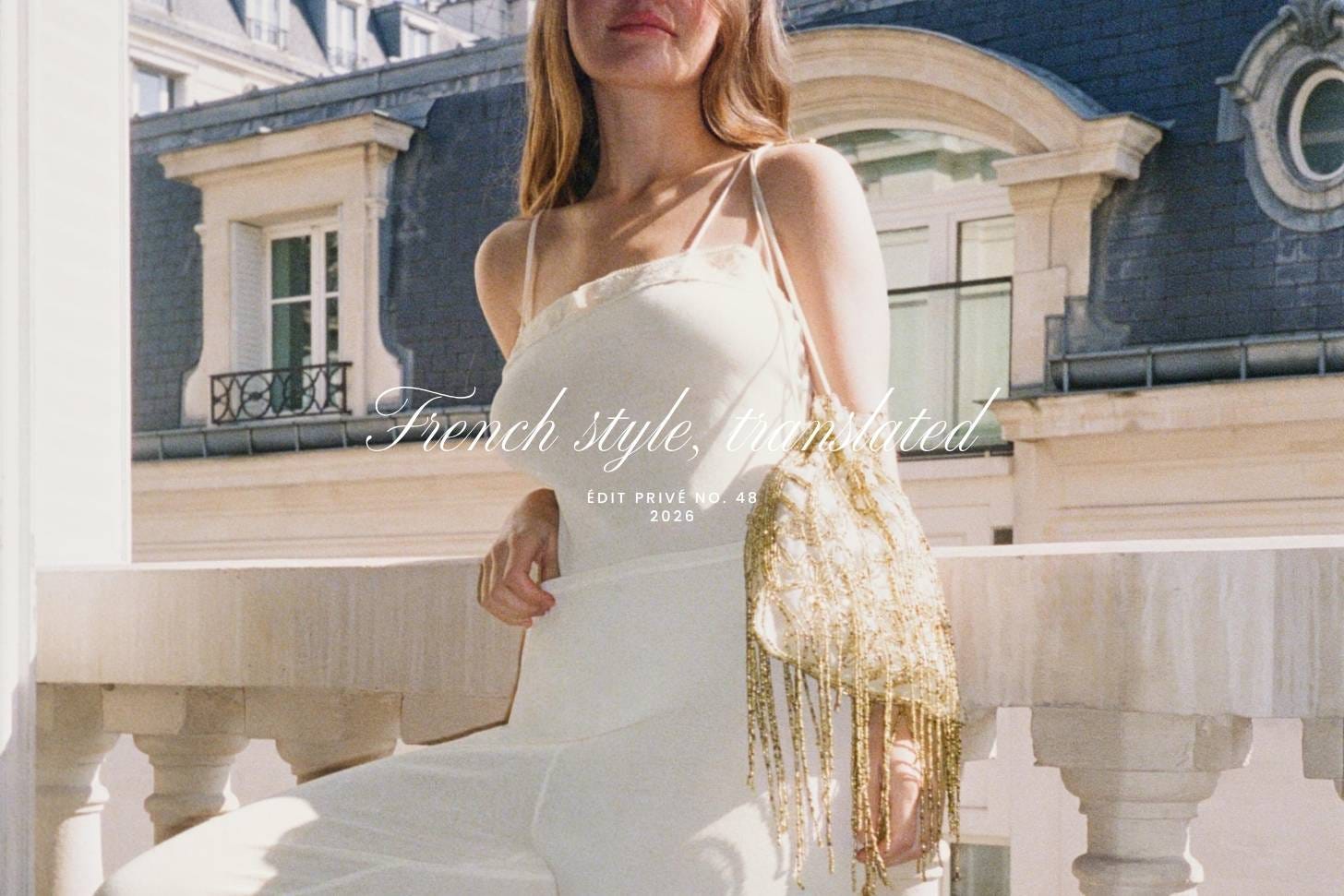
Lately, I’ve been thinking about how much my own relationship with French style has changed over the years, and how much, if I am honest, it is still changing.
When I first began writing about French style on Léonce Chenal eight years ago, while still living in London and working as a data analyst, my wardrobe was much more classic. The lines were sharper, the colors quieter, and my idea of French style was perhaps more restrained, more predictable, more attached to the familiar Parisian uniform: navy blazers, crisp white shirts, camel coats, straight-leg jeans, black ballet flats. The kind of pieces that seem to carry elegance quietly, almost without needing anything else.
I still love many of them. But over time, something in the way I dressed began to soften.
My style became lighter, more intuitive, more feminine. Cream started to feel more natural than strict black. A soft apricot blouse suddenly seemed more desirable than another perfect white shirt. Even my summers changed; a flat sandal adorned with tiny shells said more to me about the season than the most impeccable city shoe. I found myself drawn to more texture, warmth, movement, and light. And yet, I still recognize something deeply French in this evolution. Not a fixed look, but an instinct for balance. A desire for ease. A refusal to let elegance feel too forced.
Perhaps your own style is changing too.
Perhaps the outfits that once made you feel perfectly put-together now feel a little too rigid. Perhaps the version of French style you once admired (the trench, the ballet flat, the white shirt, the undone hair) still appeals to you, but no longer feels quite generous enough for the woman you are now. You may still love the simplicity, the discreet sensuality, the effortlessness. But you may no longer want to disappear inside someone else’s idea of what a French woman should look like.
This is precisely where style becomes interesting.
Because French style is so often reduced to one mythical silhouette. A beautiful one, certainly. But not the only one. There is the vintage, feminine sensuality of Rouje. The bourgeois, sometimes maximalist sophistication of Chanel. The urban, bohemian ease of Isabel Marant. The polished refinement of Celine or Sandro. The romantic, 70s-inspired softness of Chloé. The casual, colorful Parisian charm of Sézane.
And that is only a glimpse. French style is not a mold, a single woman, or a uniform. It is a language. And like any language, it becomes most beautiful when you speak it with your own accent.
So in this week’s Edit Privé, I wanted to explore how to translate this language into something more personal: how to understand what you are truly drawn to, how to separate inspiration from imitation, and how to build a wardrobe around recognition rather than performance.
In this Edit, I’ll show you how to read the principles behind the looks, ask the questions that reveal what already feels like you, and use a 9-piece summer capsule as an example of my own translation of French style now.
Not to dress like someone else. But to feel more clearly and beautifully like yourself.
Comments
Nothing yet. Say the first thing.
Sign in to join the conversation.