
I’ve been thinking for quite some time now why AI slop gets on my nerves. I mean, I created sloppedIn just to express how frustrated I am by the whole thing. Yeah, I’m that guy. And while LinkedIn is by far the worst offender, it is by no means the only one: you can see the slop taking over X, Instagram, and even substack. Instead of leading me to an answer, the question guided me down the path of revisiting why I write in the first place. And to answer that, I need to take you on a short journey.
Over 20 years ago, when I still lived in Brazil, I started writing about programming. Like many at the time, I created a website on the now long defunct Geocities (then blogger.com before finally getting my own domain). Back when the web still looked like this. I don’t really remember why I started writing. I didn’t think much of it then but as time went on I appreciated the clarity and contentment it brought me.
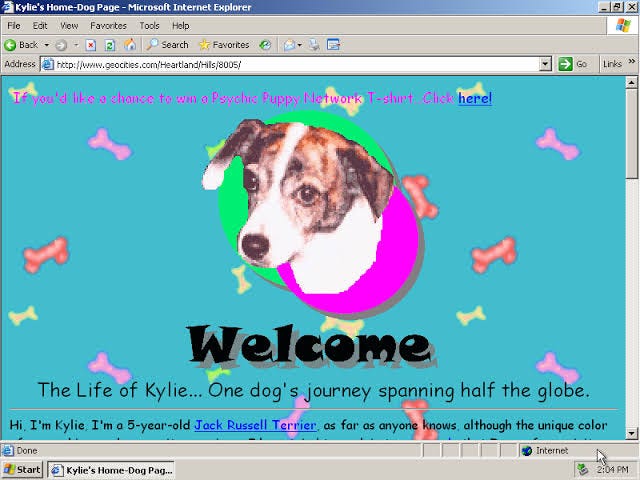
I can no longer find my Geocities site — probably a good thing — so this story starts from my very first public blog post on my own domain, published on October 13, 2007 (in Portuguese). It was a technical blog post around the time I was considering moving abroad. As my move to Spain, where I lived for two and a half years, became more likely, I thought it made sense to switch languages and published my first post in English on November 20, 2007.
A big shout out to Antonio Cangiano who I met online in programming communities and who encouraged me to write that first blog post in English. He helpfully shared it on Hackernews and called it encouragement. Thank you, my friend.
That’s roughly 130 posts between 2007 and 2020, or about 10 articles per year on average. This timespan saw my writing go through many transitions: languages, topics, styles, grammatical errors and much more. The whole trajectory was as much about maturing as a human and professional as it was about internalising what I was working on.
Albert Einstein is thought to have said that “If you can’t explain [something] simply, you don’t understand it well enough” — writing, then, was a way of explaining to myself what I had just learned, thought of or built. And it worked wonders. Through my writing, I slowly built a community of like-minded individuals while improving my communication skills in a foreign language, working in a foreign country — first in Spain and then, for the past 16 years, Australia. So I kept at it.
It’s not exactly easy. Each article required a ton of effort: I’d write down some notes in a markdown file, literally a brain dump, with no structure. I’d let it simmer for days before coming back to it with additional thoughts and ideas. More than once the actual point of a post didn’t become clear until I was deep into it. It’s hard to tell now but back then a single article would take anywhere from 10 to 50 hours over days or weeks before I pushed that publish button. But at the same time, I loved every minute of it.
So much so that in 2015 I published a technical book called Clojure Reactive Programming that brought together my passion for technology, writing and community building. Writing a book is a completely different beast from writing a blog post so while it was rewarding, you’ll have noticed I haven’t published a second book, yet (apart from its 2nd edition in 2019).
I was not writing for an audience. I was writing for myself.
In writing this article I had AI analyse my full archive, after which I created the visualisation above. It’s fascinating to me to see how things have changed over time but also to realise the bulk of my writing structure was already present in 2007. See it for yourself.
Fast forward to 2024—2026 and it’s perhaps easier to understand why the current onslaught of AI slop is so grating to me. From a distance, it feels like most people are dumping AI generated walls of text for no reason other than to be “visible”, liked, to please the algorithm gods. The writing is sterile and the substance just isn’t there. My hypothesis is that they never go through the grind of pouring serious time behind a piece, the time that gives you the reps to internalise a topic, form your own opinions and figure out where you want to go next.
If you didn’t put any effort behind this post, why should anybody read it?
Now, I am not going to sit here and tell you the reason I write has nothing to do with the rest of the community. That would be a lie. Of course I care. But it was never my primary goal, it’s something that happened over time because people found my writing useful. That’s different from doing it for the ‘gram.
I experimented with a sub-section of this newsletter which was almost entirely AI generated, called “This Week’s Special”. It didn’t survive because it was crap, didn’t have my voice and, honestly, didn’t bring me any joy. Lesson learned.
Likewise I won’t lie to you and say I don’t use AI in my articles. But the way I use it matters. I can write faster now, and that is because I can burn through more ideas quickly using AI as a thinking partner. I also kill ideas faster than ever before — the comets in the orrery above are all dead drafts — since I can use AI to research what is out there in minutes, something that would take me hours over a few days in the past. As a result, the substance of what I publish has improved dramatically. I can confidently validate and include real citations that allow my readers to dive deeper into the topics that interest them.
Want to expose an AI slop creator? Ask them “what do you mean?”
So no. I won’t stop calling out AI slop when I see it. It’s taking space away from the people with something to say.
AI hasn’t changed why I write. It has changed the process.
Thanks for reading The Steel Thread! This post is public so feel free to share it.
No posts
Comments
Nothing yet. Say the first thing.
Sign in to join the conversation.