
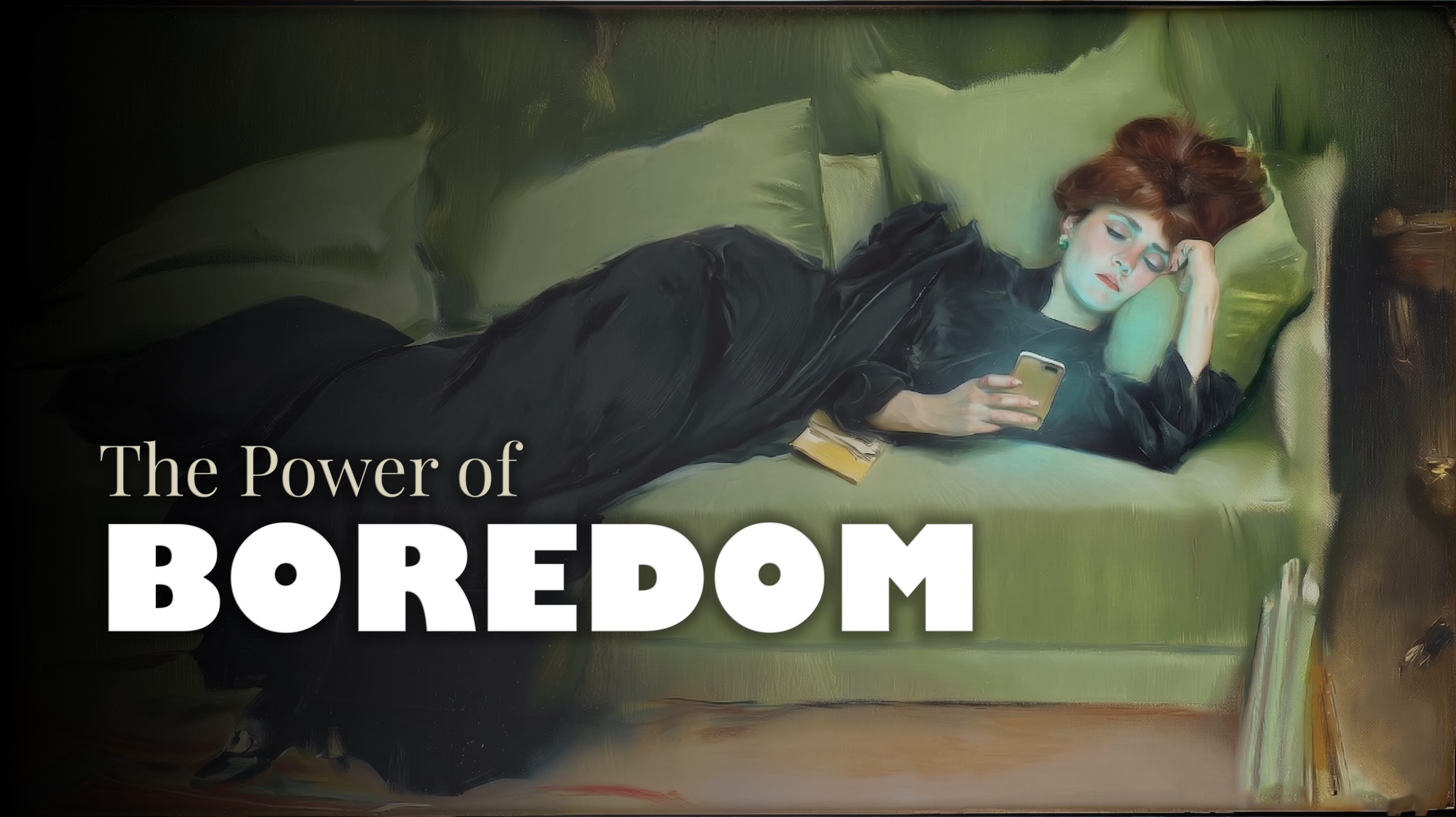
This week on “The David Boos Show,” we explore the hidden power of boredom. What did the great thinkers of the past make of it? And what does modern science say about the mechanics of our brain’s Default Mode Network (DMN)?
Increasingly, we hear boredom praised as the gateway to creativity—and rightly so—but it also has its dark sides. As always, it is about finding a healthy balance, ensuring that this desperately needed idle time leads to profound, associative ideas, rather than succumbing to technological numbing and a dangerous doom loop of meaning crisis and exhaustion.
A plea for the courage to endure “nothingness” once again, and the realization that our best ideas often emerge exactly when we finally stop distracting ourselves.
FYI: In this video, I use AI-generated footage for certain narratives, specifically for the 4th-century monks, Goethe, and the Virginia study. Despite my best efforts, I was unfortunately unable to book Evagrius Ponticus, Johann Wolfgang von Goethe, or some random dude with masochistic tendencies for a film shoot in Egypt and Venice. I hope the gentle viewer will forgive this use of technology. As I said last week: I am not fundamentally opposed to technology; it is all about moderation, meaning, and purpose.
Also, if you want to support the growth of our Youtube channel, drop by at our video there, leave a like and subscribe. And if I may kindly ask: If you visit the video on Youtube, don’t just click on it and leave again. The algorithm is a fickle mistress and punishes these kinds of dead views quite harshly.
Wishing you a great weekend,
David Boos
Editor-in-Chief LEO
Thanks for reading! This post is public so feel free to share it.
The Circle of Life
How AI is Destroying Social Media...
·
Jul 31

This week David Boos devotes his video essay to a development that should worry Substack users in particular. Since the arrival of generative AI models, it isn’t only deepfakes in image and video that have taken over. Articles, and even short social media posts, are increasingly written by machines. On platforms like LinkedIn and Facebook, up to 40 percent and more of certain kinds of posts are AI-generated, and not by corporations, but by ordinary people like you and me.
Comments
Nothing yet. Say the first thing.
Sign in to join the conversation.