
I have followed Jamaica’s long and often contentious debate over republican status for many years: whether we should become a republic, how the transition should occur, and what a genuinely Jamaican Constitution should include. Although I have written about the issue sparingly, I decided that the time had come to examine more carefully what Jamaica has now, and what we should establish in its place.
The debate reached boiling point before the general election of September 2025, with each major political party blaming the other for the lack of progress. But the stalemate was never simply about whether Jamaica should remove the British monarch as head of state. Both parties supported that objective. The disagreement concerned what becoming a republic should actually mean.
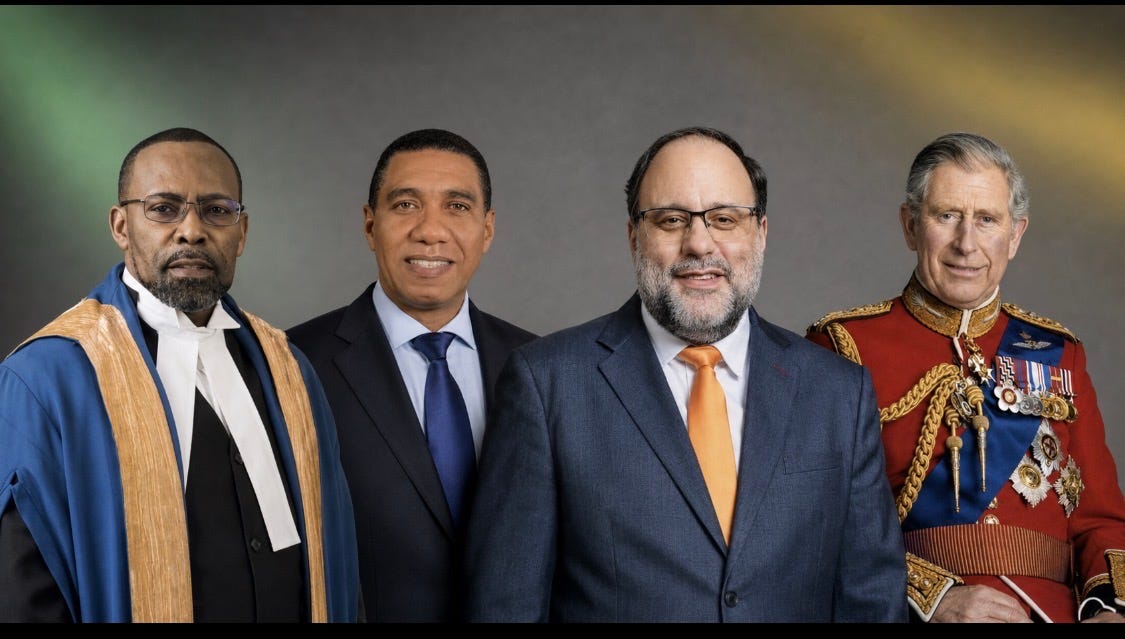
Before the election, the Government had enough votes in the House of Representatives to advance the Republic Bill without Opposition support. In the Senate, however, it needed the support of at least one Opposition senator. The Opposition held that vote steadfastly, insisting that the republican transition must be completed, not merely begin, the process of decolonization. In its view, Jamaica should not remove the British monarch as head of state while leaving the British Privy Council as the country’s final court of appeal.
The Government argued that the two matters could be separated: Jamaica could become a republic first and address the final court in a later phase of constitutional reform. The Opposition refused to accept that phased approach. Since the 2025 election, the Government’s parliamentary position has become even more dependent on cooperation, making political consensus, not simply governmental intent, essential to constitutional change.
Public temperature around the issue has since cooled. That may make this the right moment to examine it more carefully, away from campaign rallies, partisan accusations and political urgency.
What constitutional arrangements does Jamaica have now? What would the Government’s proposed republic actually change? What elements of the colonial constitutional order would remain? And if Jamaica is to remove the Privy Council, should it establish its own final court or adopt the Caribbean Court of Justice?
Those questions led me to this analysis.
Prime Minister Andrew Holness has been consistent about Jamaica’s highest court. As Opposition Leader in 2015, and again as Prime Minister in 2024 and 2025, he argued that Jamaica should have its own final court rather than replace London with Port of Spain.
“Our final court should be a Jamaican final court,” he said in May 2024. “It shouldn’t go to Port-of-Spain, it should come to Kingston.”
The Prime Minister is right about one thing: independent Jamaica should no longer depend upon the Judicial Committee of the Privy Council in London as its final court.
But I believe he is wrong about the alternative.
Our choice should not be between a colonial court in London and a domestic court in Kingston. The stronger constitutional settlement is a Caribbean court, one that removes the remaining colonial connection while preserving the institutional distance that has made final appellate review so valuable.
Jamaica should therefore adopt the Caribbean Court of Justice as its final court of appeal.
What the Privy Council Gets Right
I have considerable respect for the Privy Council. Its judgments have contributed significantly to the development of Jamaican and Commonwealth Caribbean law. It has also provided an additional layer of scrutiny in serious criminal, constitutional and civil cases. That respect, however, does not require Jamaica to retain the Privy Council indefinitely.
The Privy Council possesses one especially valuable characteristic: distance. It stands outside Jamaica’s immediate political, professional and institutional environment.
That distance does not make its judges wiser or more principled than Jamaican judges. Nor does it suggest that our judges are incapable of independence. Jamaica has produced outstanding jurists whose competence is beyond question.
The issue is institutional design.
Jamaica is a relatively small society. Judges, politicians, senior lawyers, prosecutors, police commanders and business leaders operate within a closely connected national environment. Even when everyone acts honorably, proximity can affect public perception. A final court outside that immediate environment reassures the public that the last review of a case is conducted beyond the pressures, relationships and assumptions of the domestic system.
A well-designed final court is not merely another rung on the judicial ladder. It is an institutional safeguard against the possibility that an error, blind spot or injustice could survive every stage of the national process.
What the Kartel and Edwards Cases Teach Us
The case of entertainer Vybz Kartel (Adidja Palmer) and his co-accused demonstrated why a genuinely independent final appellate court matters.
After their 2014 murder convictions, the Jamaican Court of Appeal dismissed their appeals in 2020. The case then went to the Privy Council, which quashed the convictions in March 2024.
The Privy Council did not declare the accused innocent. The decisive question was whether the trial had remained fair after a juror accused of attempting to bribe other jurors was allowed to continue participating in the deliberations. The Court concluded that allowing the juror to remain was fatal to the safety of the convictions. It returned the matter to the Jamaican Court of Appeal to decide whether a retrial was warranted.
The importance of that decision goes far beyond the defendants' fame. It affirmed a fundamental principle: society’s desire to punish wrongdoing cannot override the obligation to conduct a fair trial.
The case of Lescene Edwards offers another example.
Edwards was convicted in 2013 of murdering his partner, though he maintained that she had taken her own life. His appeal in Jamaica was dismissed. When the case reached the Privy Council, however, it considered fresh forensic evidence. The Court concluded that the conviction could not safely stand and quashed it.
It would be unfair to say that Jamaican judges simply ignored the evidence before them. The critical forensic evidence was fresh. But that is precisely the point: a final appellate process must be able to confront new evidence and correct an unsafe outcome, even after the domestic system has completed its work.
These cases do not establish that Jamaican courts are generally unreliable. They establish something more important: no judicial system is infallible.
A final court must therefore examine not only judges' decisions but the entire administration of justice, including the conduct of police investigations, prosecutorial decisions, jury management, the admission of evidence, and the fairness of the trial itself.
When an unsafe conviction is allowed to stand, the damage extends beyond the convicted person. The victim’s family may be given a false sense of closure. The true offender may remain free. Public resources may be wasted, and confidence in the justice system deteriorates.
Rigorous appellate review strengthens justice; it does not weaken it.
Why Kingston Is Not the Best Answer
The argument for a Jamaican final court is often presented as an argument for sovereignty. If Jamaica is politically independent, the reasoning goes, its final court should also be located within Jamaica.
Sovereignty matters, but geography is not the only measure of sovereignty.
A court situated in Kingston would be geographically ours, but it would also place the entire judicial hierarchy within the same national environment. The final court would operate in the same relatively small professional and political ecosystem as the trial courts, Court of Appeal, prosecution, police and political executive.
Again, the concern is not that Jamaican judges lack integrity. The concern is that constitutional systems should never depend solely upon confidence in the people who currently hold office.
We must design institutions not only for governments and judges we trust, but also for governments and officeholders we may have reason to distrust in the future.
Constitutions are built for difficult times. They must remain resilient when political power becomes concentrated, when institutions come under pressure and when public confidence is fragile.
An external regional court creates valuable separation between the national government and the final judicial authority. It makes it more difficult for any one administration to dominate every stage of the justice system. It also gives the public greater assurance that the final decision was reached outside Jamaica’s immediate political environment.
The question, therefore, is not whether Jamaicans can administer justice. Of course we are.
The question is whether concentrating the entire appellate structure within one small jurisdiction is the strongest constitutional arrangement available to us.
I do not believe it is.
The Colonial Contradiction
If Jamaica becomes a republic while retaining the Privy Council, we would remove the British monarch as head of state while still asking a British institution to make our final judicial decisions.
That would be constitutional reform left unfinished.
The Privy Council’s continuing jurisdiction is a legacy of empire. Its judges may be excellent, and its decisions may be respected, but the arrangement still rests upon the proposition that Jamaica’s final legal authority should sit in London.
More than six decades after Independence, that is increasingly difficult to justify.
Yet ending appeals to the Privy Council does not require us to abandon the protection that institutional distance provides. The Caribbean Court of Justice offers a way to preserve that protection while completing our judicial independence.
The CCJ Is the Caribbean Alternative
The CCJ is not simply a Trinidadian court because its headquarters is located in Port of Spain. It is a treaty-based regional institution belonging to the participating Caribbean states.
Its judges are not appointed by the Government of Trinidad and Tobago. The Court’s institutional arrangements include a Regional Judicial and Legal Services Commission and an independent Trust Fund, designed to separate judicial appointments and financing from any single national government's control.
These protections do not mean that the CCJ is beyond criticism. No institution should be. But its structure addresses the central concern that a national government might exercise undue influence over its own final court.
The CCJ therefore offers Jamaica the balance we need:
judicial independence without colonial dependence;
regional distance without foreign control;
Caribbean jurisprudence without domination by any single Caribbean government; and
a final court connected to our societies but institutionally separated from domestic political power.
Jamaica would not be joining an institution created by others. We helped build it.

https://zwww.zeffy.com/en-US/ticketing/jamaica-diaspora-taskforce-action-networks-memberships
Jamaica participated in the preparatory work, signed the Agreement Establishing the CCJ in February 2001 and ratified it in June 2003. Montego Bay hosted the 2003 signing of important instruments relating to the Court, including the agreement establishing its Trust Fund. CARICOM’s official treaty record confirms Jamaica’s role from the beginning.
Under Prime Minister P.J. Patterson, Jamaica was among the strongest advocates of a Caribbean final court. The CCJ was part of a wider vision: a Caribbean capable of building and sustaining serious institutions of its own.
To turn away from that institution now would not be an assertion of Jamaican self-confidence. It would amount to retreating from a regional project that Jamaica helped conceive.
Access to Justice Must Be Part of the Decision
However, another serious weakness in the present arrangement is access.
The Privy Council’s distance can protect judicial independence, but physical and financial distance can also make justice harder to obtain.
An appeal to London can require substantial legal resources, record preparation, specialist attorneys and, in some cases, expert evidence. The principal obstacle is not simply the price of an airline ticket. It is the total cost and complexity of taking a case through another country’s legal system.
As a result, access to the final court may depend heavily on wealth, exceptional legal assistance, or lawyers' willingness to act at reduced cost.
A constitutional right that can be exercised only by the wealthy or unusually fortunate is not an equal right in practice.
The CCJ will not eliminate the cost of litigation. No honest argument should pretend that it will. But a regional court can make final appeals more accessible through electronic filing, remote hearings, greater familiarity among Caribbean lawyers and courts, and procedures designed around the region's realities.
Adopting the CCJ should therefore be accompanied by stronger appellate legal aid, better systems for preparing court records, support for meritorious appeals and clear procedures for introducing credible fresh evidence.
The objective should not merely be to replace one court with another. It should be to create a final appellate system that ordinary Jamaicans can realistically reach.
A Court—and a Region—Worth Building
The case for the CCJ is consequently larger than the location of a courtroom.
Caribbean countries repeatedly declare their commitment to regional integration while hesitating to entrust regional institutions with meaningful authority. But regionalism becomes real only when we are prepared to build, use and improve common institutions.
No single Caribbean country can easily achieve the scale, range of expertise and institutional distance that a properly supported regional court can provide. Collectively, we can create a stronger final court than many of us could maintain independently.
That does not diminish Jamaican sovereignty. It exercises sovereignty through cooperation.
The CCJ can also develop a body of jurisprudence grounded in Caribbean constitutions, histories, economies and social conditions. It can understand the region without being confined by the politics of any single island.
A stronger regional court would also expand opportunity. Greater use of the CCJ would increase the need for Caribbean appellate lawyers, judicial researchers, law clerks, registry officers, legal academics, technology specialists and administrative professionals. It could stimulate more legal scholarship, professional training, judicial education and research across the region.
For young Caribbean people considering careers in law and justice, this matters. They would not have to look exclusively to London, Canada or the United States to imagine themselves working at the highest levels of their profession. They could see serious regional institutions offering pathways to serve, lead and help shape Caribbean law.
The benefits would extend beyond employment. A growing body of Caribbean jurisprudence would create new areas for teaching, publishing, policy development and legal specialization. It would give our universities more reason to study Caribbean cases, our lawyers more opportunities to argue matters of regional importance, and our scholars a larger role in defining how justice responds to Caribbean realities.
The CCJ can therefore become more than our final court. It can be an anchor for professional development, institutional growth and hope—particularly for a generation too often told that meaningful opportunity exists only outside the region.
We should not confuse independence with isolation. Jamaica can be sovereign and Caribbean at the same time. By strengthening the CCJ, we would not only bring final justice home to the Caribbean; we would help build a field in which Caribbean talent can remain, develop and excel.
The Real Choice
The Real Choice
The debate is often framed as a choice among London, Port of Spain and Kingston. But the deeper choice is between three constitutional models.
London offers institutional distance and judicial experience, but preserves a colonial relationship and remains difficult for many Jamaicans to access.
Kingston offers national ownership, but concentrates the entire judicial hierarchy within one small domestic environment.
The CCJ offers the most promising combination: independence from Britain, distance from domestic political power, regional ownership and the possibility of wider access.
It also gives us something neither London nor a Jamaican court alone can provide: an opportunity to build a stronger Caribbean legal community. A fully supported regional court can expand pathways for Caribbean lawyers, researchers, legal scholars, technology specialists and young people who want to pursue careers in law and justice. It can generate not only Caribbean jurisprudence, but Caribbean expertise, employment and hope.
Jamaica should not retain the Privy Council simply because it has served us well. Nor should we establish a domestic apex court merely because it would be located on Jamaican soil.
We should choose the arrangement that offers more citizens the strongest and most durable protection while helping to build the regional institutions and opportunities future generations will need.
Preserve the distance.
Remove the colonialism.
Improve access.
Create opportunity.
Strengthen the Caribbean.
Jamaica’s final court should be neither London nor Kingston.
It should be the Caribbean Court of Justice.
No posts
Comments
Nothing yet. Say the first thing.
Sign in to join the conversation.