
As someone born and raised within a city, it took me a long while to grasp the importance of finding green places in which to spend regular time. When you have no other environments to compare it to, you don’t always realize what’s missing. The densest areas of cities, though structurally ugly, are very engaging to the senses of a child, and offer plenty of experiences to occupy the body and mind throughout youth and adolescence. It was only in my early twenties that I actually realized the extent of the deficiency in my system, the lack of engagement with natural Place.
Tristan helped me to understand, having spent more of his life outside of the city. He brought me out into the woods. Getting some immersion time gave me a more Natural frame of reference—suddenly, I could see that the city is a remnant of the forests and savannas that predate it. I could see the loss of the breadth of that living ecology, and grieve for it; and then, still living within the city’s bounds, I could come to terms with the changing world.
Until last year, we lived a few blocks from a small private college whose campus is built around a natural wetland and lake, the oldest natural lake in the city, at the bottom of a small canyon. The canyon is so concealed within the college that we only discovered the whole area by accident, several years into living in the neighborhood. We stepped over the log that marks the trail’s entry and entered a lovingly tended forest, rich with Douglas-fir, Western redcedar, bigleaf maple, red alder, black locust and elder. Naturally, we returned almost every day for three years. What was a visiting-place steadily became a primary locus of ritual work of many kinds. This is where our story takes Place.
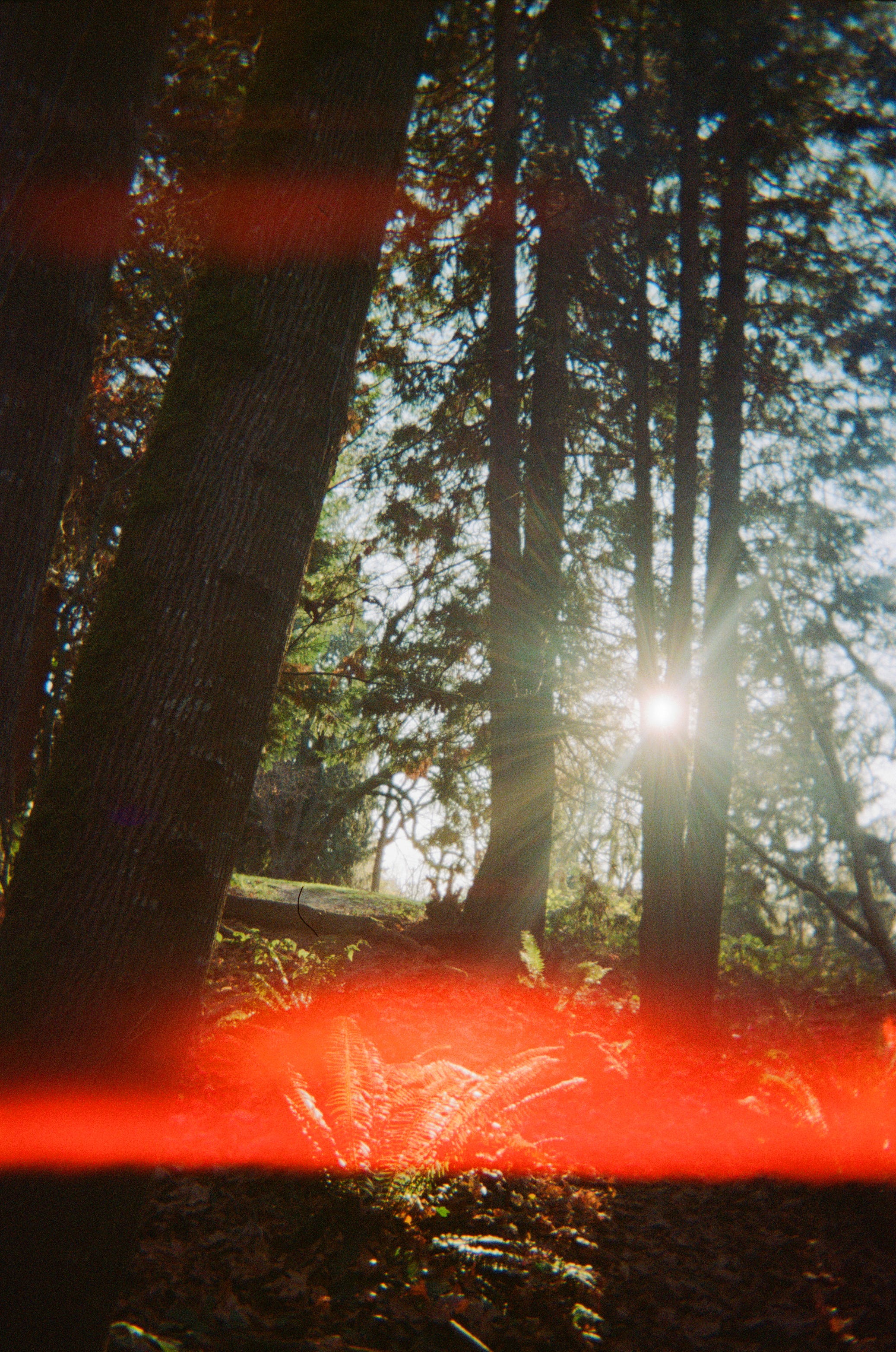
Tristan and I walk down to the canyon for the thousandth time. It is late fall, early winter. The leaf carpet on the ground is thick like pages of a soaked book, and softens each descending step. The trek is steep enough that one must be careful not to slip all year—on mud during the wet season, and on rolling beads of dry dirt in summertime.
We walk our usual route, curving along the trail, heading toward a small clearing beneath a grove of Western redcedar.
This clearing is occasionally a refuge for homeless folks to get sleep and use drugs. As ritualists living in the city, we’ve noticed these tend to be spots worth paying attention to. If others are able to sleep and use drugs there unbothered, you can assume that it’s private enough to perform certain rituals. Accepting the need to pick up litter—which I’ll point out is not a behavior unique to drug users—these places are often primed for human presence, and particularly for more taboo, ritual, or sacred expressions of that presence. Though I can’t speak for all of them, the atmospheres of certain natural using-places are uniquely merciful, patient, and wise. Places like these offer their magic to the most vulnerable.
We crouch down and crawl into the globe-like arboreal enclosure. We sit down on the dry brown needle-bed. The trees have grown so close together that their lower branches, starved of light, are now bare, boney tendrils pointing at us from all sides. Like with all groupings of Western redcedar, the ground beneath them is totally dead; the species forms such dense branches and roots that light from above, and nutrients from below, are rendered inaccessible to other plant life.
The forest’s sprawling body is blurred by the foreground of this cedar-space. We orient ourselves toward meditation. Then, something prompts me to, out loud, offer help to any spirit in the woods who needs it.
We pause and listen with all our senses, inner and outer. A long moment passes and then an old woman’s face flashes in my mind, and an impression of a feathered, winged body. I speak the image aloud for Tristan to hear, and not seconds later, a clamor catches our attention beyond the cedars—a huge bird of prey stumbles from above and falls, landing in some sword ferns maybe 50 feet away. I’ve never in my life seen a bird of prey act so clumsily, and wonder if it’s injured. Quickly, we lose sight of it.
As we sit with the encounter, the concept of a grounded bird, a flightless bird, seems to be what we are meant to glean. We speak aloud and vow to assist the spirit, if it will help us understand how to do so. Having little else to act on in the moment, we take our leave. As we walk out of the canyon, we do not find the grounded bird of prey, though we never heard it fly off.
Rather quickly, the agreement we made begins weighing heavily on me, especially lacking the knowledge of when the help will be needed, or how we will be expected to assist. All I know is some spirit has a problem, and since I’d offered the help, I also know that some unpredictable ritual process will occur in the coming months. I have to trust in both our ability to listen and understand, as well as the spirit’s ability to play their part and communicate.
Comments
Nothing yet. Say the first thing.
Sign in to join the conversation.