
ENTER THE SPIDER’S HOLE / / / \ \ \ PREDATORY ROUND PERFECTION
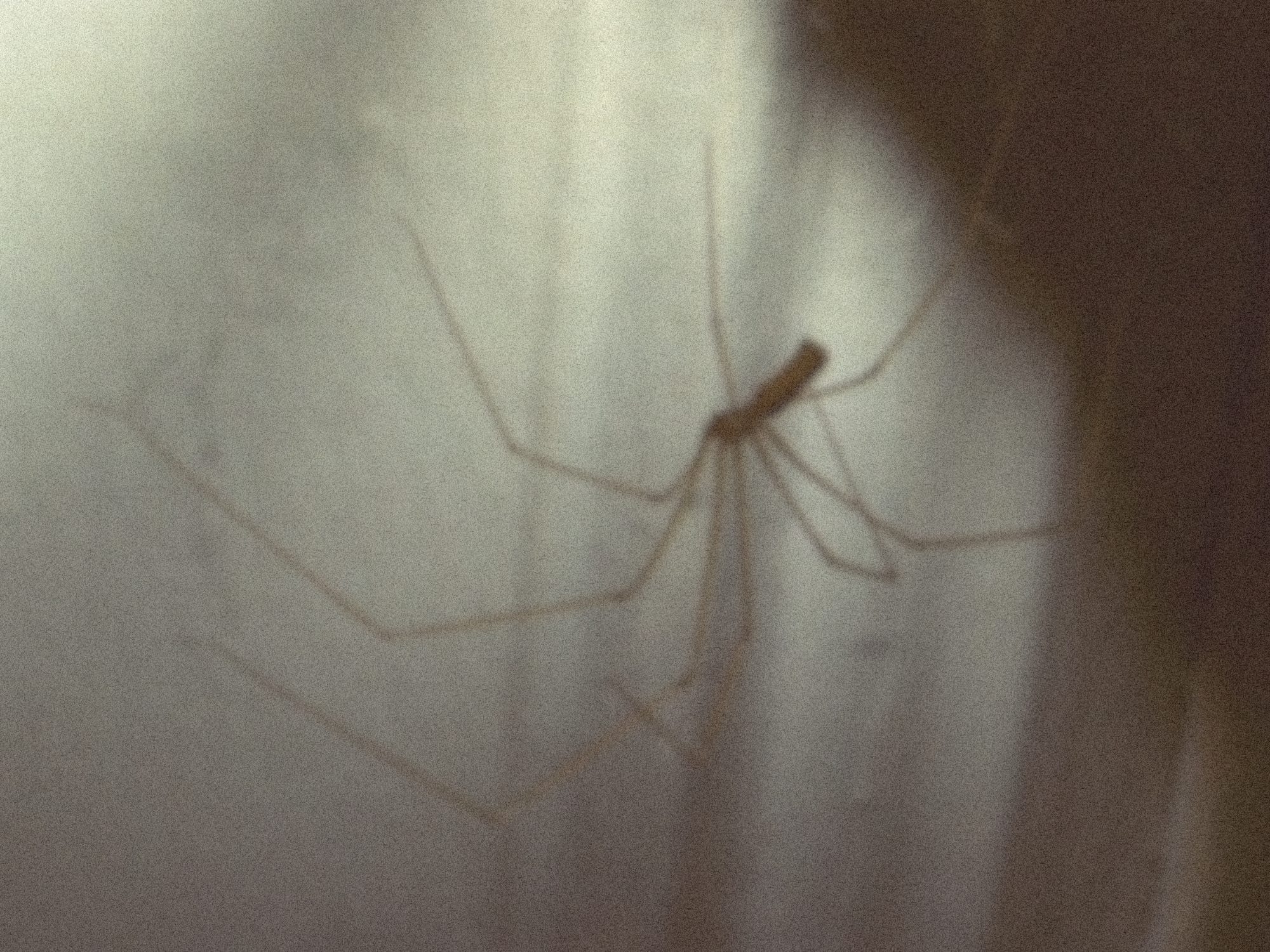
Living in a basement, they are certainly no stranger. Their webs have gathered on most of our window-sills. Generally, we let them live alongside us, relocating the odd trouble-maker out back. Some have had litters, evidenced by the miniature spiders which float down into my field of vision from above, arms ambulating like curious children. I have come to appreciate their company. And while it’s easy to find the little ones cute, I also love the chill I catch when I spot a real mammoth, some of which could stretch out to cover my palm. I am always amazed at the pure power that these tiny beings wield over animals many thousands of times their size.
It was assumed for some time that human fear & repulsion impulses toward spiders evolved as a survival instinct, but only .5 percent of spiders are actually dangerous to us, and those lethal few aren’t widespread enough to support a species-wide evolution of such a fear. What is perhaps more likely is that we have an instinctual aversion to scorpions, who pose a much greater threat to us; their venom is tailored to mammals, and with it, they kill upwards of 3,000 humans a year. Scorpions also existed in Africa alongside our deep ancestors, making an evolved aversion a distinct possibility. Spiders look enough like scorpions that it may trigger a similar reaction. Ultimately, though, a large portion of our aversion is culturally impressed upon us.
Despite my relative placidity around spiders, I found that, as I scanned images of spiders at length during my research for this piece, a distinctly heart-sinking sense of danger would accumulate in my chest. As a ritual practitioner engaged with cultivating altered states of awareness, I have found that to sit within a phobic discomfort is to engage in a potential transformation of that experience into something more constructive. Emboldened by this insight, I have taken to observing, meditating upon, and learning about spiders to articulate my findings.
The most elegant of the house spiders I have thus far observed are cellar spiders: a broad term for the long, thin-legged indoor spiders common to everywhere on Earth except Antarctica. Their scientific family name is Pholcidae, derived from the Greek pholkos (φολκός) meaning ‘bow-legged’. In our region, they are called ‘daddy long-legs’, though the same term is used for harvestmen—which are not spiders, but an arachnid more closely related to scorpions—as well as for crane flies, which are of a different genus altogether. Another recorded name for the Pholcid is ‘angel spider’, and though the origins of this name are elusive, its delicate and graceful physicality certainly call forth ethereal or angelic imagery.
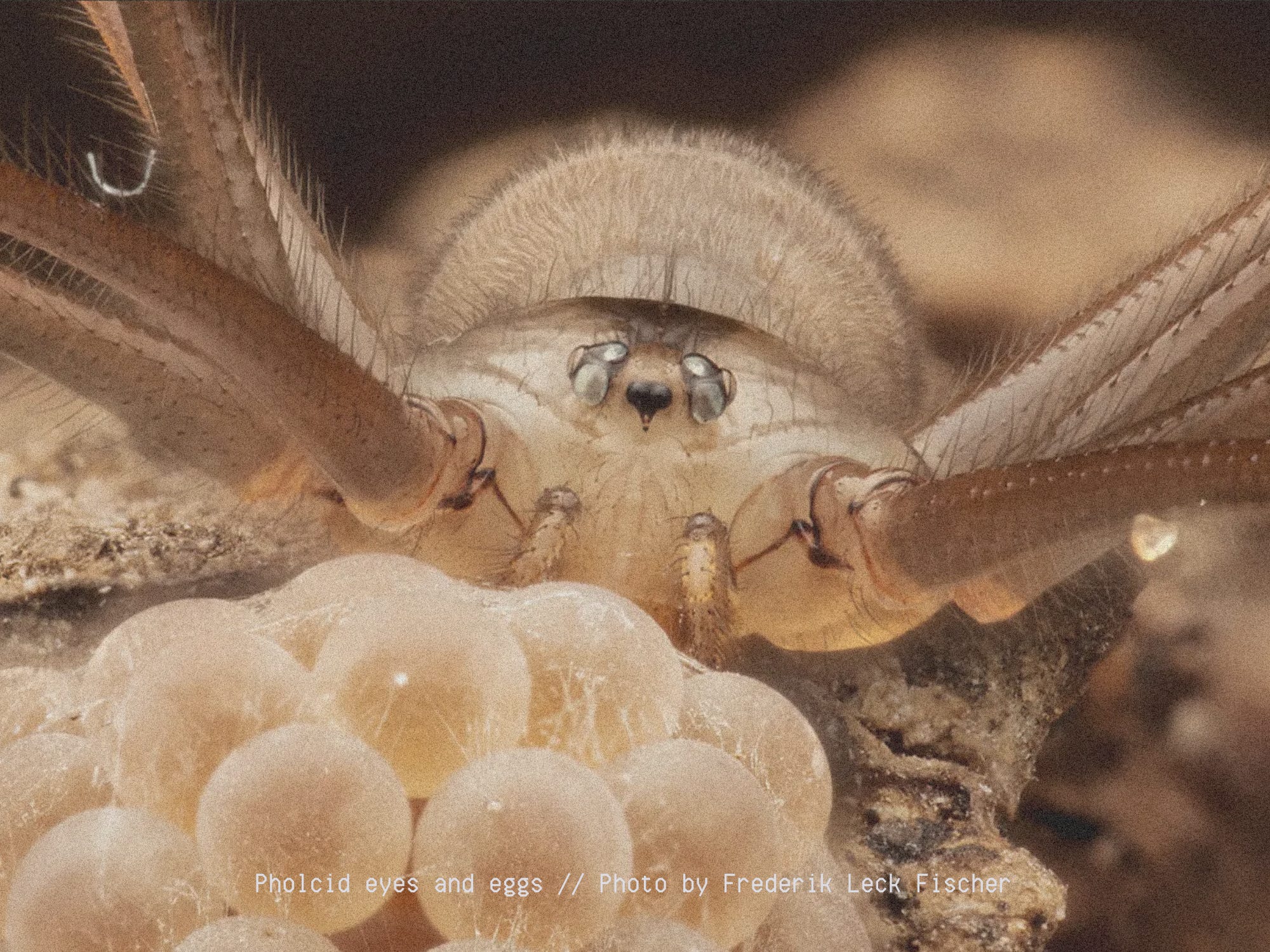
What distinguishes the angel spider from other long-legged arachnids are the arrangement of their eyes: two clusters of three peer out from oblong bodies. In some species, an additional pair are situated between the two main ocular clusters. Being accustomed to the dark, they only need basic photosensitivity for their pursuits, and mainly perceive their prey through the vibrations they emit as they move. Their eyes are relatively primitive compared to those of, for example, the jumping spider, who sees acutely and with rich color—and who, in fact, prey upon cellar spiders. (Probably using their sharp vision as an advantage, jumping spiders have been observed mimicking the vibrations of trapped prey with their legs to get the Pholcid to come right to them; they also approach and attack Pholcidae directly.)
There is an oft-repeated folk belief that the venom of cellar spiders is fatal to human beings, but their chelicerae, their piercing fangs, aren’t long enough to puncture our skin, rendering their extreme toxicity ultimately harmless to us. This is not true. Being non-aggressive, Pholcidae essentially never bite humans, and their venom and their fangs are only powerful enough to overcome their tiny prey—mosquitoes, gnats, flies, ants, and the like. It feels necessary to dispel wrong information about such vilified forms of life.
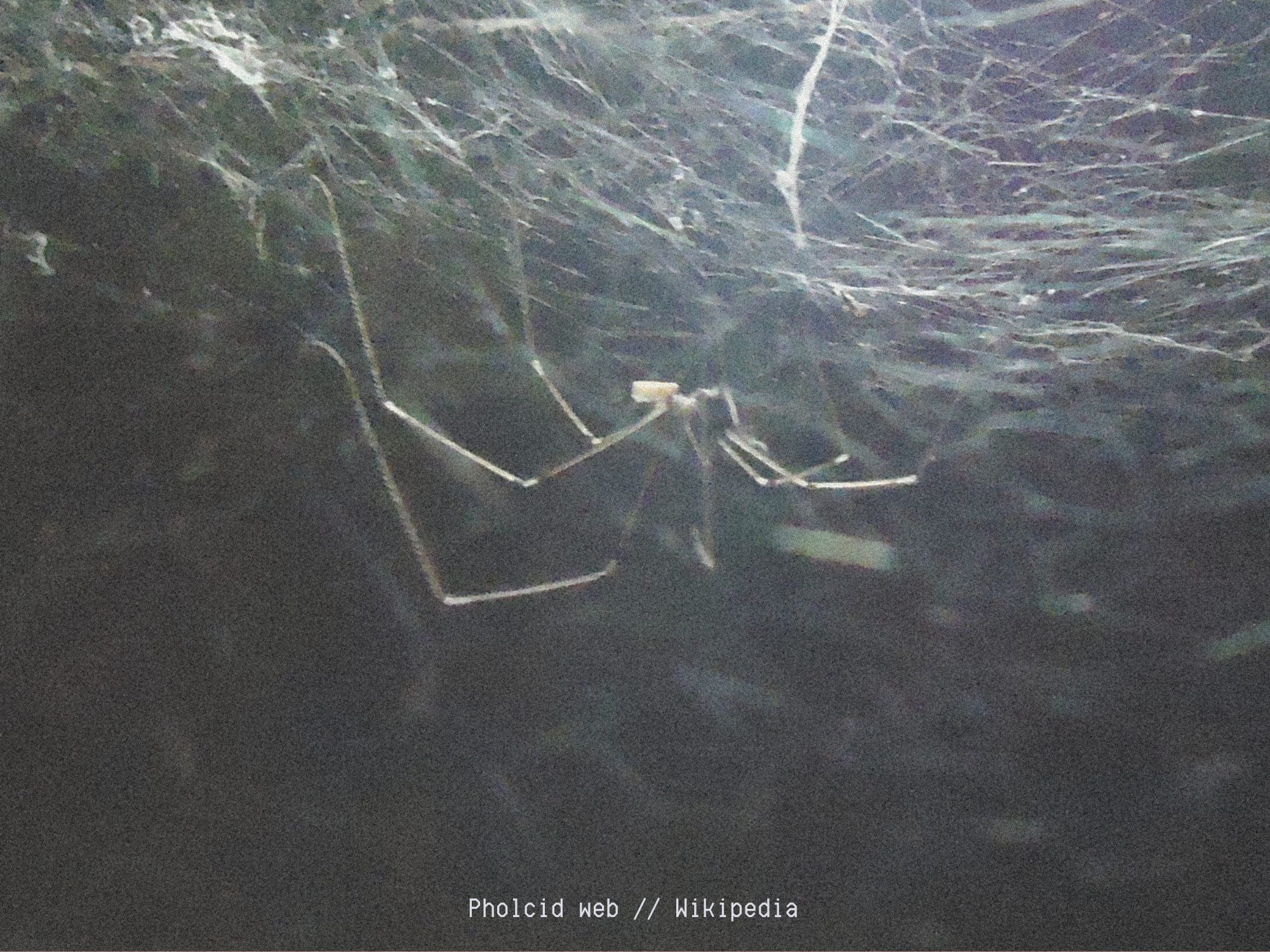
Pholcidae hang upside-down in thickets which are woven without pattern. Unlike some other arachnids, their webs do not have particularly adhesive properties; the tangles themselves are the web’s primary trapping technology. While many spiders with stickier silk will rebuild their webs daily (after eating the old webs to repurpose their silk proteins), the Pholcid maintains the same web over time, adding tangles and strands as they see fit. It uses its web intelligently as a tool: sometimes shaking the web to extend its range and capture a nearby insect, or vibrating in the web to trick a nearby spider into approaching what it thinks is an insect.
Pholcidae immobilize their prey with a coffin of spun silk, only delivering their venom when that encasement is complete.
I find myself sympathizing with a certain specimen who has spun her home in our bathroom.
Comments
Nothing yet. Say the first thing.
Sign in to join the conversation.