
👋 Hey, Leo here. Antifragile Intelligence is where I explore how leaders think, decide, and build in uncertain environments shaped by technology and change.
Each edition is a reflection, a principle, or a field note from the work itself.
Hey Friends,
Welcome to the 163rd edition of Antifragile Intelligence.
After a quick pause from series last week, with Nadal’s documentary, I am back with the 3rd edition of the 5-edition series on “AI and the end of the Org chart” in which I explain why this might be a good time to rethink your organizational structure.
You can read the first two editions below
In this edition, I will do something unusual.
For the last two editions, I have made the case for the dominant narrative.
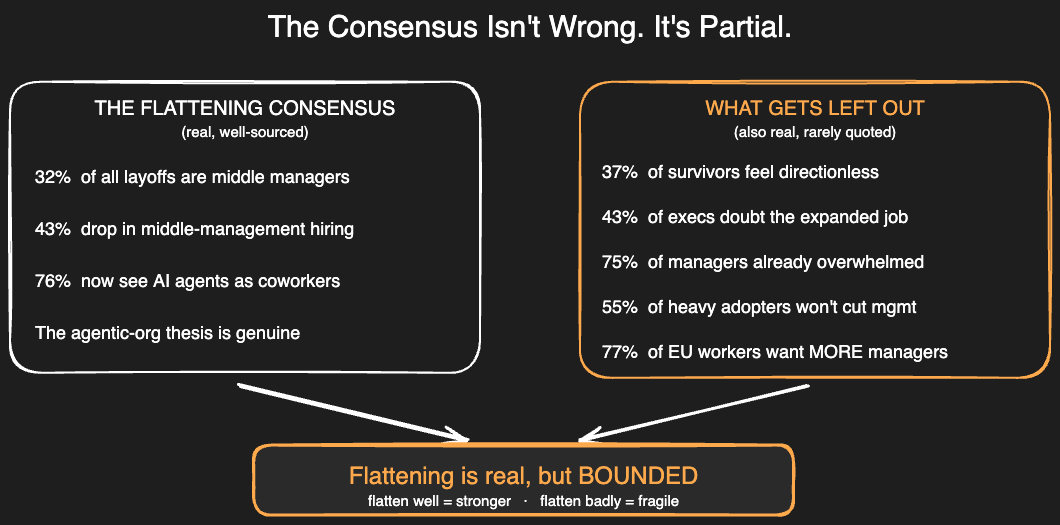
Middle management as 32% of layoffs. Hiring down 43%.
Block’s world model. Haier’s microenterprises. Nvidia’s flat philosophy.
I gave you a clean, well-sourced, increasingly inevitable picture of a future in which the org chart we all grew up with is being dismantled.
Today I am going to break that picture.
Because the data I built that picture from is real. But it is also only one side of the story. And the part that gets left out of every executive talk and every consultancy report is the part that turns out to matter most.
This is the antifragile read. The consensus is overshooting reality. Here is what’s hiding in plain sight.
Korn Ferry, one of the largest HR consultancies in the world, surveyed across all major markets last year.
The headline number matches the consensus. Forty-one percent of employees report that layers were cut from their organization. Flattening is real. Live Data’s number is real. Revelio’s number is real.
But then, another interesting number appeared:
Thirty-seven percent of those same employees feel “directionless” after the cuts.
Exactly the symptom you would expect when you remove the people whose job was alignment.
And then look at the number that should make every CEO reading this pause.
Forty-three percent of senior executives, and forty percent of CEOs, say they doubt they can fulfill the expanded responsibilities that the flattening has handed them.
So, almost half of the people who survived the flattening, the ones whose jobs got bigger when the layers came out, are admitting in confidential surveys that they cannot carry the load.
Fortune wrote it up and called it the “megamanager era.” I call it the “megamanager hangover”: the era of fewer managers, each carrying more direct reports, hitting the limits of what a human can absorb.
This is not a fringe finding. Korn Ferry is the firm Fortune 500 boards hire to design their executive succession plans. When they tell you the survivors are buckling, the survivors are buckling.
In March of last year, Gartner published a piece of guidance that you probably didn’t see because it was buried inside a press release. The headline was: “CFOs should reset expectations about AI’s impact on workforce productivity and headcount.”
The company whose business model is selling CFOs and CIOs the gospel of digital transformation is quietly telling them: the enthusiasm has overshot reality.
Their data: AI lifts span of control by about 20%. Consistent with the flattening thesis. But also:
75% of HR leaders say their managers are already overwhelmed.
69% of HR leaders say their managers lack the change-leadership skills needed for the AI transition.
The picture Gartner is painting for CFOs is not “you will cut managers and reap the savings.” It is “your managers are already drowning, and they don’t have the skills to lead this transition.”
Of all the data I will give you in this series, this is the single number that should change your mind.
In November 2025, BCG and MIT Sloan Management Review published a study called The Emerging Agentic Enterprise. They surveyed executives who are deepest into agentic AI, the companies that are furthest along the curve.
Among those executives, 76% now view AI agents as coworkers, not tools. A real structural shift in framing. Consistent with the consensus.
But: only 45% of heavy adopters expect middle-management cuts.
Which means that among the companies furthest into the agentic AI transition, a majority do not expect to cut middle management.
If middle-management cuts were the natural endpoint of agentic AI adoption, the heavy adopters would be the first to say so. They aren’t. The BCG/MIT phrase for it is precise:
“enthusiasm is running ahead of readiness.”
The executives who are actually living inside the agentic transition are seeing something the press isn’t.
I live and work in Europe. So this source should be in every executive talk on this topic.
Eurofound, the European Foundation for the Improvement of Living and Working Conditions, published their European Working Conditions Survey 2024 last year. Thirty-six thousand six hundred interviews across thirty-five countries. The largest European workforce dataset of the decade.
Their finding: task evolution, not displacement.
30% of EU workers say technology removed tasks from their job.
Over 40% say technology added tasks to their job.
Jobs are changing in composition. They are not disappearing.
Then, in October 2025, the European Commission’s Joint Research Centre reported that 30% of EU workers now use AI at work. Adoption is mainstream, not vanguard.
But the statistic I find the most extraordinary in this entire conversation is the following:
Seventy-seven percent of EU workers want managers actively involved in AI design and execution.
The EU workforce is not asking for fewer managers. They are asking for the opposite. They want their managers more involved in the AI rollout, not removed from it.
This is the data point that almost nobody quotes in the executive briefings. It directly contradicts the US tech-press consensus. And it is from the largest European workforce survey of the decade plus the official EU statistical body.
Here is what I think the honest read is.
Flattening is real. The 32% share of layoffs among middle managers is real. The 43% drop in middle-management hiring is real. The agentic-org thesis is real.
And.
The 41% of employees feeling directionless is real.
The 43% of executives doubting they can do the expanded job is real.
The 75% of HR leaders saying managers are already overwhelmed is real.
The 55% of heavy AI adopters who don’t expect to cut middle management is real.
The 77% of EU workers asking for more management engagement is real.
The consensus is not wrong. The consensus is partial.
Here is what I now believe, and what I am going to spend the rest of this series defending:
Flattening is real, but bounded. The companies that flatten well are getting stronger. The companies that flatten badly are getting fragile.
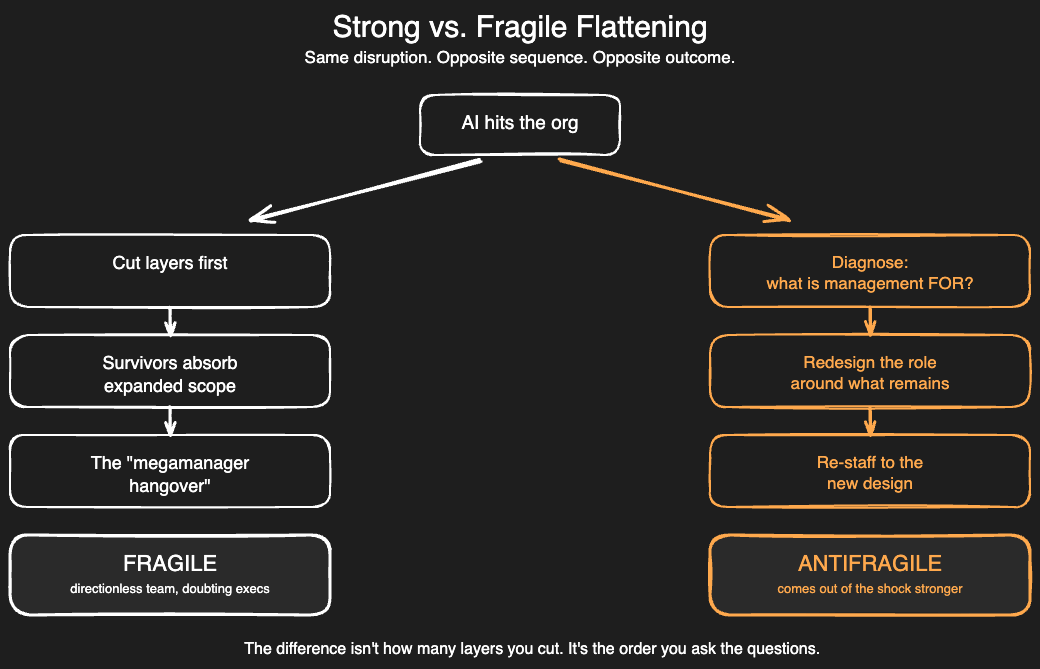
The Korn Ferry “megamanagers hangover” is what fragile flattening looks like. A team of survivors carrying expanded scope they privately doubt they can deliver. A workforce that feels directionless. An HR function watching the whole thing happen and unable to intervene because the cuts were already made.
The companies that get this right are doing something different.
They are not cutting layers first and asking questions later, but are asking questions first:
Which parts of management work are genuinely replaceable, which parts genuinely are not, and what the role looks like after the redesign.
And then they let the headcount changes follow from the answers.
That sequence (diagnose, redesign, then re-staff) is the difference between strong flattening and fragile flattening.
It is also the antifragile read. Disruption is happening. The honest response is not to look away from it, and it is not to imitate the most visible response to it.
The honest response is to ask: what does this make possible that wasn’t possible before, and how do we end up stronger?
In the next edition, I will give you my diagnostic.
The specific list of management work that AI is genuinely good at replacing, and the specific list of management work that it is genuinely bad at.
With those two lists in hand, you can do something most companies cannot: have an honest conversation about what your management layer is actually for.
Claude Fable 5 is back but can used on the paid plan only until July 7th. So make the most out of this weekend :)
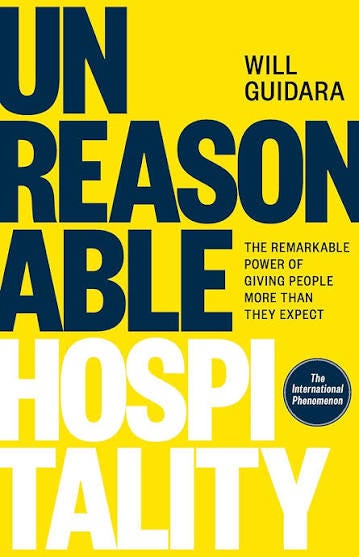
Finished reading a great book that I thought was on Hospitality, but it turns out it has a lot of great advice for all people and companies offering services.

This short tutorial on building beautiful designs using AI
Thank you for reading.
If this resonated, forward it to someone who might benefit from it.
Stay antifragile.
Leo
If you enjoyed this piece and want to support my writing, please consider sharing it and becoming a paid subscriber.
Thanks for reading Antifragile Intelligence! This post is public, so feel free to share it.
This is Edition C of a five-part series on how AI is reshaping organizations. Next week: a precise diagnostic, exactly what AI replaces inside the management role, and exactly what it does not.
Korn Ferry. Workforce 2025 survey. Reported in Fortune as the “megamanager era.”
Gartner. “CFOs should reset expectations about AI’s impact on workforce productivity and headcount” (March 2025).
BCG × MIT Sloan Management Review. The Emerging Agentic Enterprise (November 2025).
Eurofound. European Working Conditions Survey 2024 (36,600 interviews, 35 countries).
European Commission, Joint Research Centre (October 2025). EU AI-at-work adoption data (the 30% figure).
CEC European Managers / Eurobarometer. Managers and AI (the 77% figure).
Comments
Nothing yet. Say the first thing.
Sign in to join the conversation.