
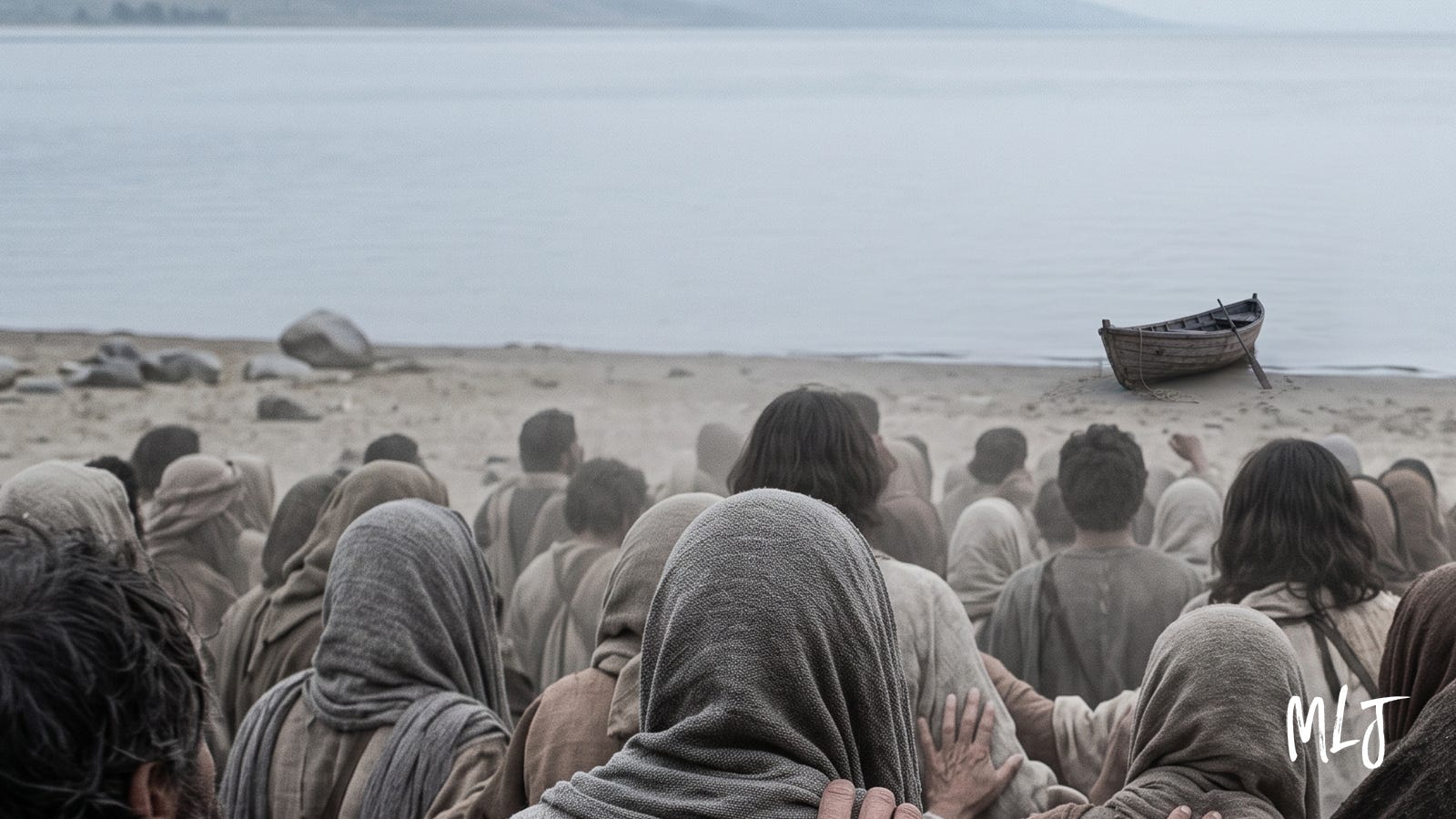
Jesus instructed his disciples to have a boat ready so the crowd would not crush him. He had healed many people that day, so all the sick people eagerly pushed forward to touch him.
Mark 3:9–10 NLT
Some English translations make it sound like the size and push of the crowds were a mild inconvenience, like a group shuffling out of a stadium after the game.
But in the original Greek, the word for crowding is much stronger. It’s the same word used for affliction, oppression, and suffering. The root of the word refers to pressing grapes to make wine.
What happens to the grape? It gets destroyed.
Jesus had to be careful, because the needs of the crowds were so pressing, so desperate, that it created real risk for him. The crowd becomes a physical force that could injure or overwhelm. As we near the end of Season 2, it’s becoming clear that what started as teaching in synagogues is turning into a mass movement that can’t be contained or controlled. The Pharisees are plotting to kill him while thousands are trying to get close enough to touch him.
In ways that get pasteurized out of contemporary retellings, the Jesus story is about desperation.
The crowds were pressing toward Jesus with such urgency that, if he hadn’t taken precautions, they could have crushed him. It’s like a drowning person trying to climb on top of their rescuer in panic. If not handled with care, desperation can drown the one trying to help.
Have you ever felt desperation? I had a conversation once with a friend about desperation. The recovery community has a name for it: rock bottom. We debated, is rock bottom a necessary step of a person’s story?
I argued that while rock bottom can vary from person to person, real change only comes when someone hits their hit rock bottom.
Mafioso Michael Franzese’s rock bottom came when he was sent back to prison for violating parole. Alone in solitary confinement, he thought he’d never see his wife and children again.
“Honestly, I just wanted to close my eyes and not wake up,” he recalls.
A guard noticed and slid a Bible through the slot in his door. At first, Michael was angry. He picked it up and threw it against the wall. But later, he picked it up again.
“It was just me and God in that cell,” he said.
“I started to read the Book of Proverbs. For some reason, the Bible just opened to that book. My spirits were lifted a little by Solomon’s words.”
That night, Michael challenged God: “You know what, God? I took a blood oath. I love my father. Look where it got me.”
Then he added, “If you really are God and Jesus is my Savior, then you’ve got to prove it to me.”
God didn’t answer him right away. But over time, Michael found what he was looking for.
“I spent almost three years in solitary. During that time, I read my Bible inside and out. I searched every faith. And, you know, the Bible became my Bible. It became true to me.”[i]
That’s an extreme version of rock bottom—a mobster in solitary confinement, literally imprisoned and isolated.
My rock bottom looked different. As you may have learned in this Substack, it happened on February 27, 2011, in a stranger’s upper room in Nashville. Business failing, marriage strained, fourth child, exhausted from performing. The night I realized my entire adult life had been built on spiritual quid pro quo.
I wasn’t in solitary confinement, but a different kind of prison—the prison of trying to earn God’s favor through performance. Franzese’s rock bottom was dramatic. Mine was quiet and didn’t involve police. But both led to the same realization: I couldn’t save myself. I couldn’t manage my way out. I needed Jesus, not as a teacher giving me a better system, but as Savior.
Rock bottom isn’t always solitary confinement or a pastor’s crisis. It’s simply the moment when you’re desperate enough to stop pretending and start trusting.
For you, rock bottom may not be as cinematic as Franzese. It might simply be the moment you realize you can’t manage your life on your own anymore.
In Mark’s story, people came from all over. But these weren’t casual visitors stopping by for a chat. They were desperate for help. They were at rock bottom.
If you’ve ever felt such desperation, you’re not alone. Many people need change. You may think you’re suffering in silence, but you’re not. Your suffering affects other people as well.
There are people who love you and care for you, who want what’s best for you.
But knowing you need to change isn’t enough. Even if your actions are hurting others, you still need to take that first step toward Jesus.
The truth is most people don’t get serious about Jesus until they have to. Why? Because real change is not easy. It may feel like you’re crushing your old self. Like you’re a grape getting smashed.
For many, change is so scary that they’ll stay right where they are, like children trapped in a burning house, too scared to jump into their father’s arms below. Even when the flames are touching their heels, the fear of falling is stronger than the touch of the fire.
People tend to only make a move when the pain of staying the same becomes worse than the perceived pain of trying something new.
The question is, what do you want?
Change won’t come until you’re ready to see the end of the road you’re on and take a step toward something new.
If you’re like most people, you’ll do everything you can to avoid change. Why? The work feels overwhelming.
Rock bottom isn’t necessarily waking up in a gutter. It’s the moment when you’re desperate enough to finally think differently. It’s the moment when you’re ready to leap out of the window of the flaming house that you’ve made of things.
Are you finally ready to trust God and take the leap?
Lord, ready my spirit to take the leap and trust you. Keep me from continuing to take the path of what is known and comfortable, especially when how I’ve been is less than the full and abundant life you promise. Amen.
[i] Ibid.
The More Like Jesus series is a story-driven journey through the Gospel of Mark and our own spiritual formation. Staying close to Jesus changes who we become.
Learn more about book 1, The Way to Begin Again, and pre-order today.
Comments
Nothing yet. Say the first thing.
Sign in to join the conversation.