
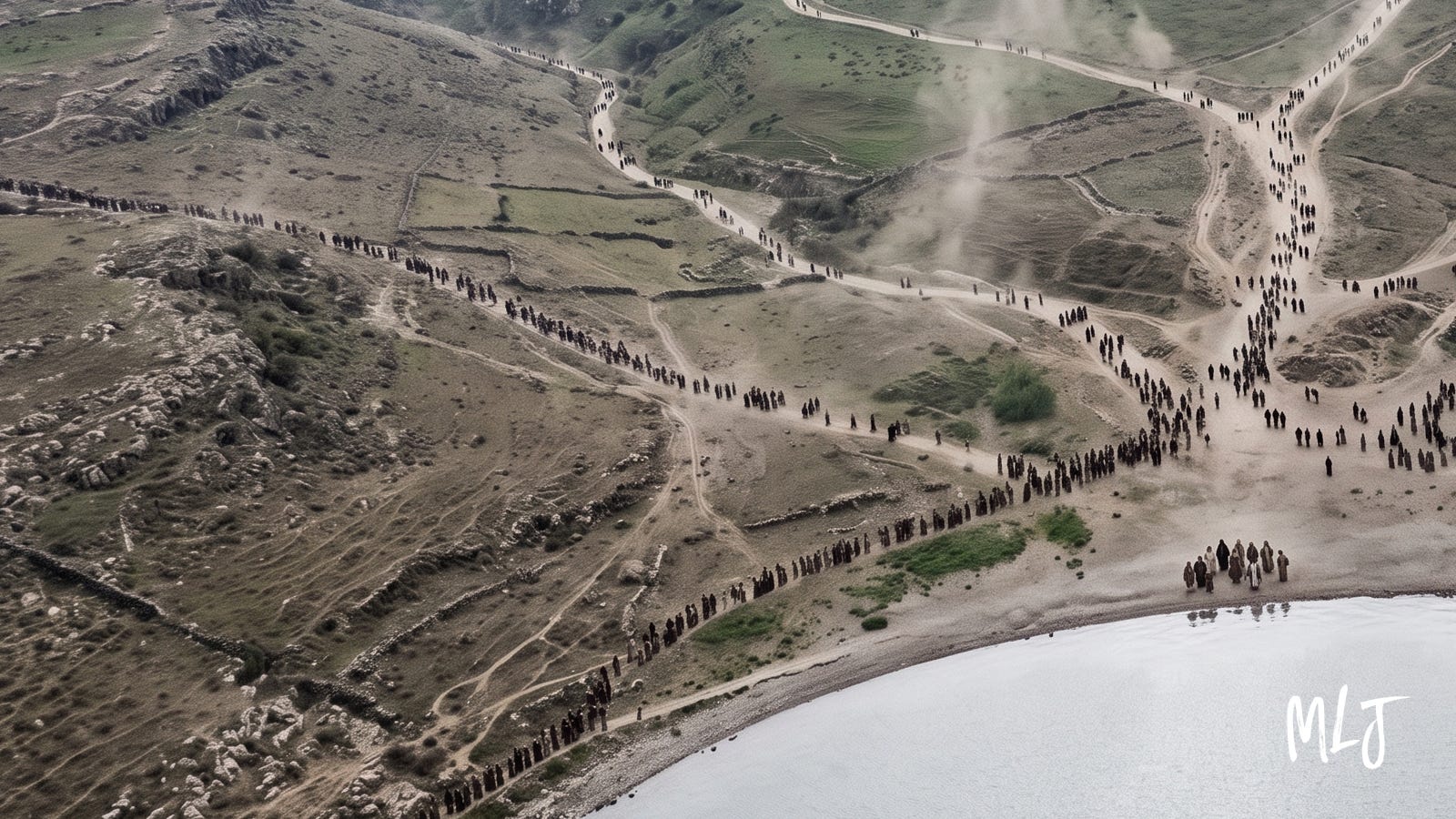
Jesus withdrew with his disciples to the lake, and a large crowd from Galilee followed.
When they heard about all he was doing, many people came to him from Judea, Jerusalem, Idumea, and the regions across the Jordan and around Tyre and Sidon. Because of the crowd he told his disciples to have a small boat ready for him, to keep the people from crowding him. For he had healed many, so that those with diseases were pushing forward to touch him.
Whenever the impure spirits saw him, they fell before him and cried out, “You are the Son of God.”
But he gave them strict orders not to tell others about him.
Mark 3:7-12
Jesus knew that last healing was going to take the combative Pharisees over the edge.
Now, it is only a matter of time before they make their move.
So Jesus pulls back to the lake with his disciples—for time to process, teach, we don’t know. Maybe just to catch his breath after a sequence of very difficult conversations.
But no break comes. Instead, the crowds follow. Picture a bird’s eye view shot of Jesus and his core group, walking toward the water, but as the camera gets higher and higher, a big reveal… the crowds aren’t just coming from Capernaum and the Galilee region now. Word has spread. People are coming from all directions, as far as the eye can see.
They’ve heard what he’s doing. The healings and the exorcisms. The teaching with authority. And they want a part.
Can we grasp the size of the groundswell that has begun?
The camera cuts back to Jesus, who is unable to retreat from the crowds. The mass of people presses so close that Jesus tells his disciples to get a boat ready, an escape route if the crush becomes too much. People with diseases push forward, desperate to touch him.
Among the action, a demon-possessed man recognizes him and cries out, “You are the Son of God!”
Jesus comes close and silences him.
Don’t tell anyone.
The closing scene of season 2 is all about gnawing, desperate need. Each of us knows it and has felt it. The question is, where do we direct our need? Who do we trust enough to share it?
The problem is, once you’ve been burned enough times, you learn to keep your distance. You learn to keep a part of you protected, because people disappoint. Leaders fail and friends betray. And eventually, you decide it’s just safer to keep everyone at arm’s length.
I speak from experience, if you can’t tell. Not just with church people, either.
Keeping your distance is a lonely way to live. But for a time in my life, it felt necessary, because the alternative—being vulnerable, trusting again, risking more hurt—felt impossible. So I withdrew. I kept people at a distance where they couldn’t wound too deeply. And I told myself it was wisdom.
But alone, needs do not abate.
In our story, the needs of the people seem endless. People are coming from everywhere. Galilee, Jesus’ home region. Judea and Jerusalem, the religious center where the temple stands. Idumea to the south. Gentile regions across the Jordan. Even Tyre and Sidon to the north, pagan coastal cities. Jews and Gentiles. Religious and irreligious. The close and the distant.
Jesus’ reputation has spread across ethnic, religious, and geographic boundaries. While the religious leaders plot murder, the broken and desperate are pressing in to touch him.
In a world where the religious leaders plot murder, where crowds press in for healing, and where even demons tell the truth about Jesus—who can you trust?
Jesus is forming the answer: a new kind of community. One built not on religious performance or spectacular displays, but on proximity and faithfulness. Twelve ordinary men. Fishermen. Tax collectors. Zealots. Not because they were perfect, but because they were willing. Over the next three years, they’ll fail him repeatedly. Misunderstand him. Deny him. Abandon him. But Jesus will keep investing in them.
The lie says no one is worth trusting, and it is true that everyone disappoints, eventually. Even the disciples Jesus handpicked will fail spectacularly. The only thing that makes this moment different is that Jesus himself is trustworthy.
Not the religious system. Not the crowd. Not even the people he calls to follow him.
Jesus.
The entire journey so far has been a road from suspicion to trust.
Suspicion says: “I have to perform to prove I matter.”
Trust says: “I can abide because I am already loved.”
The whole story has led to this point. Now it’s the moment to do something.
The question is no longer: Is God real? Or even: Is Jesus good? The question now is: Will I trust Jesus? Not “trust in” Jesus, which still sounds like buying into a philosophy. Simply, trust Jesus.
As I said earlier, the right image for what Jesus offers is a hospital, not a courthouse. You don’t reason your way into the ER. You go because you can’t fix yourself.
Look again at what the crowd did. No one in that scene weighed the evidence, reached a verdict, and then decided to come. They shoved through the crush of bodies and stretched out a hand—sick, unhealed, certain of nothing except that he was within reach. Their reaching was itself the trust; the approach came first, and the conviction, if it came at all, came after. This is the whole of what he asks—not a settled mind, not a healed body brought to him as proof, but a hand extended before any of that is in place.
You don’t need to know all the answers, and you don’t need to be fully healed. You just need to be willing. Jesus isn’t looking for perfect people. He’s calling for honest ones.
And when you learn to trust him—when you discover he’s the one person who will never betray you—it changes how you relate to everyone else. You don’t have to keep everyone at arm’s length anymore, because your trust isn’t ultimately in them. That’s why Jesus is forming a community: trust in Jesus makes trust in people possible again. Not because people won’t fail—they will—but because failure isn’t fatal when your foundation is anchored in the One who has never broken faith with anyone who came to him.
Are you ready to see Jesus as more than a teacher—and follow him as Lord?
Lord, I’m afraid to trust. The wounds are real and the walls feel necessary. But you’re calling me to trust you first, so that I can then risk trusting others. Give me the courage to step out of the crowd and into the life you’re offering. Amen.
The More Like Jesus series is a story-driven journey through the Gospel of Mark and our own spiritual formation. Staying close to Jesus changes who we become.
Learn more about book 1, The Way to Begin Again, and pre-order today.
Comments
Nothing yet. Say the first thing.
Sign in to join the conversation.