
So, this post is coming in pretty late. I’ve had a ton of priority deadlines to hit, plus work on my current novel, and also preparing to travel to Paris next week(!!). I’ll make sure my next update includes lots of pictures of my flaneurie while I’m there. In the meantime, here’s some reading I’ve been doing that’s been a major eye-opener for my writing. I hope there’s something helpful in here for you, too!
In a recent Twitter thread (which I can no longer embed here because boo), bestselling author Delilah Dawson recommended that every aspiring author read Lisa Cron’s Story Genius. In her words, she used to write one book every year that would absolutely miss the mark — until she read Cron’s book. Now, she’s hitting her stories out of the park every time, nailing the execution even if the market doesn’t always recognize her brilliance.
It was a hell of a recommendation. Cron’s book has been on my shelf for a while, and I guess this was the push I needed to see what all the fuss was about.
Support my work! Caffeinate me!
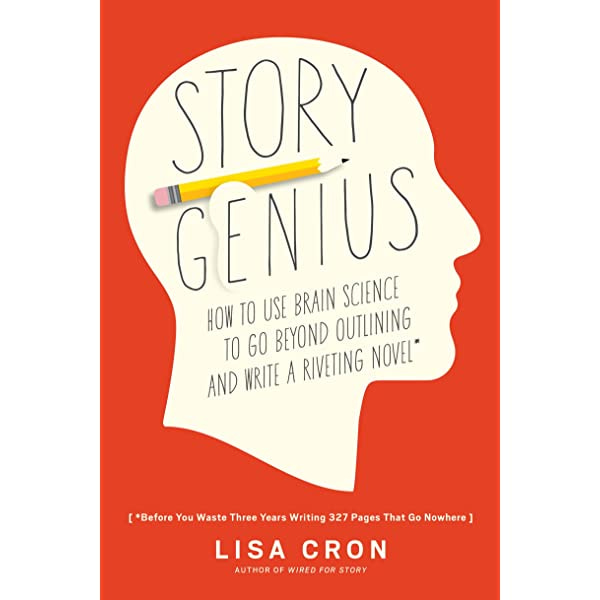
Cron argues that while most of us know a good story when we read it, very few of us have the innate ability to understand why said story is so good, let alone replicate what makes it good.
Many best-selling authors are too talented and intuitive to be much help; they explain their success in terms of prose and plot, and this highly variable and idiosyncratic advice ends up forming generally unhelpful creative writing syllabi the world over.
But neither prose nor plot make a story, according to Cron. Neither accounts for the actual experience of closing a book and saying, “Damn that was good.” What does make sense of this is the “third rail”: the inner life of the story’s focal character, and the intense emotional development they go through as they’re forced to change in order to get what they want—or not. More than any heroic journey or plot twist, this personal, emotional “rail” is what’s going to drive us as readers through the pages of a book.
To have a strong “third rail,” it isn’t enough that a character want what they want and face a tough road to get it. There’s another ingredient: what some screenwriters call the “Wound” or the “Big Lie”. This is a bias or a misperception that the character has about reality—a “misbelief.” It’s deeply engrained, affecting their desires. It’s the reason why what a character wants can be a far cry from what they actually need:
A misbelief feels identical to a belief that’s spot on. That is, it feels right, not to mention true. And here’s the key thing: it doesn’t feel right because the protagonist is a big fat idiot or so flawed he or she can’t tell the different between what’s right and what isn’t. It feels right because at a crucial moment in your protagonist’s life, it was right. Right, that is, with an asterisk. (Cron, 80)1
A good story will rally all its symbolic and setting elements around this discrepancy and its consequences, creating an organic and cohesive-feeling world in which the story’s central question can play out. That central question is, of course, “Will the protagonist escape their core misbelief, or will they dive deeper into it?”2
To write a truly riveting story, Cron recommends a three phase process:
Determine the point you want to make. What feeling or message do you want your story to convey to your audience? What’s the theme?
Create a protagonist whose wants, needs, and wounds can deliver your message with maximum impact.
Flesh out the pivotal moments in your protagonist’s past, then outline a plot that references that past and forces your protagonist to confront it.
I like Cron’s approach. It resonates with another lesson I’ve been learning lately: that good stories get us to ask and answer questions in fundamentally new ways. These questions don’t arise at the level of plot (Cron calls the “What If” writing prompt one of the biggest perpetuators of bad story instincts). Rather, they arise at the level of feeling. The emotional arc of the protagonist puts me in touch with a whole suite of sensations that tell me, “Hey, there’s something here worth thinking about here.” And, as Cron writes in her introduction, emotion—rather than logic—is the midwife of meaning: “without emotion, we can’t make a single rational decision.”
Cron also points out that while there are a finite number of really compelling emotional arcs you can trace, there are an infinite number of ways to tell those stories. But that infinity also feels like a bigger problem than Cron lets on. She’s very aware of this problem, and of the bigness you take on when you start creating from such an intuitive, emotional space. This is why Cron keeps doubling down on specificity in her exercises. And yet, several times, I found myself reading an example and saying, “Wait, that’s not specific enough yet?!”
It made me realize that I was going to need to do a lot more front-end work if I was going to follow Cron’s process. I think that goes for a lot of writers I know, actually. We’re so used to starting from the “What If”, from the vibes of an imagined world. What happens if you’re just not as used to starting with the questions Cron starts with? I think there’s a small danger of feeling you’re doing things out of order, and that can cost valuable time and energy.
Thank God, then, for John Truby’s new book, The Anatomy of Genres, which has worked perfectly for me alongside Cron’s book as I refine my brainstorming and outlining process.
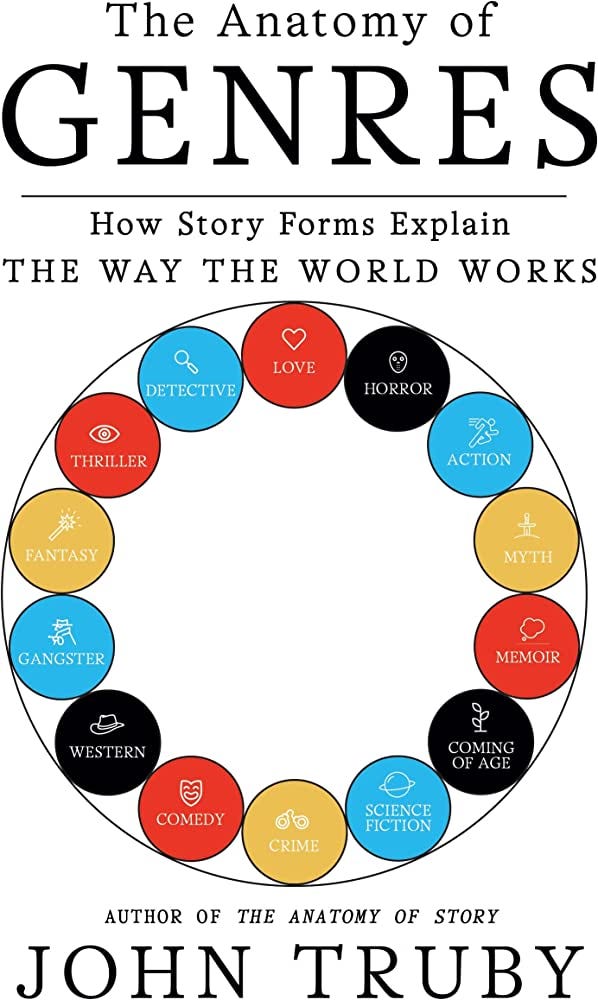
While Cron is implicit about stories being great big questions, Truby puts that thesis right out in front. What’s more, he shows that certain genres have solidified around certain core thematic questions. For example:
Horror: How do I confront the reality of death and/or the ghosts from my past?
Science Fiction: What are the right choices I need to make right now to ensure a better future for everyone? What are the social structures on which a society stands or falls?
Western: What is the meaning of “home?” Of “help?” Of “freedom?”
Truby provides a more reliable jump-start, I think, to the kind of process Cron recommends. It works for those of us who still start with “What If,” or with vibes. Who start out with grand vistas or gothic castles, houses of cosmic horror and weird gods with veiled faces and hands where there shouldn’t be hands.
Truby meets writers like me where we are. He provides the right tools to start with the “What If”, but still move into a process much like what Cron recommends. Anatomy of Genres does this by helping you understand that your vibes are already asking crucial questions for you.
For example, I’ve been sitting a long time on a novel idea about a wintery wasteland, maybe something post-apocalyptic, where priests have 40 days to calm the spirits of the dead before they transform into terrible wraiths. The vibes of this story already cross three or four genres with built-in questions:
Horror: These characters are regularly confronting death and undeath. They’re haunted by past mistakes, and some even get the chance to very briefly come back from the dead in order to close their accounts. But they’re also asking about the meaning of life and death, and so this is a very religious story.
Western: This world I’m imagining is very spread out and sparsely settled. Of course it would be, what with constant threats from ghouls. How do people help one another in a world like this? How are they afraid to help? What does “thriving” look like, here? Who achieves it and how?
Fantasy: How does this weird blend of traditional clericism and necromancy I’m playing with lend itself to expressing deeply held values such as faith, mercy, hope, etc?
Gangster: Tying back to the ways horror lends itself to religious themes, I’m imagining a corrupt Church at the heart of this story, frustrating the good that its necromancer-priests try to do in the world. How does that corruption affect people’s ability to find hope in the face of a supernatural threat?
These are, according to Truby, the sorts of thematic expectations that accompany the genres I’m vibing with. Stories with these thematic concerns will feel right for the “What If” already in my head. So now that I know which genres I’m vibing with, I can more confidently seek out that “third rail” and figure out what the hell happens:
One character in the “40 Days” story is a revenant, raised from death by a priest who hopes to lead them to absolution. Except that this revenant was betrayed and executed by the Church, her family wiped out by their negligence. She plans to use the priest as a tool in her own pursuit of revenge. Her wound leads her to believe this priest is also her enemy, and her Third Rail involves the question of whether vengeance is really more important than justice and salvation.
The priest, meanwhile, is haunted by his failures as a parent. One child was killed by ghouls, and the other responded by joining an especially zealous and militant sect of the Church. Because of his response to the tragedy, the priest’s own ideas about love and faith have fallen into disrepute, and since he’s been deposed from leadership the Church has become a much more draconian institution. His Third Rail involves reckoning with his past, recognizing that he’s using his ministry to the dead as a substitute source of redemption for his failures as a father. Will he seek forgiveness, or despair of everything he teaches his ghostly wards?
Neither of these are as specific as Cron would recommend, yet, but Truby helps me get three quarters of the way there just by thinking about the conventions I'm already attracted to.
The biggest upshot of this process? It helps you pitch your story with much more success. I write some weird and fantastic stuff, and I’m no stranger to others’ eyes glazing over when I talk about my work unless those others are writers themselves, or at least into the genres I’m into. But since I’ve been practicing this approach — What are my genre questions? What’s my third rail? — I’ve had much more success getting people interested in my stories. Even people who aren’t into horror or fantasy at all perk up when I talk about the emotional journeys of my characters — and what’s more they recognize the genres I’m working in as fitting places for exploring those emotions and asking those questions.
We all share certain assumptions about genre, and we all share big feelings and big questions attached to those assumptions. Use those to your advantage when sharing your ideas, and I bet you get a lot more people interested in your plot.
In fact, how about you start in the comments here? What genres are you most attracted to? What questions does that genre tend to ask? What are some memorable “third rails” you’ve experienced that you think can only be told within a particular genre? Let me know; I’d love to hear what you’re writing/reading, and why you love it.
If this sounds like the textbook definition of a coping strategy, you’d be right.
If I may make a philosophical aside here, this also means that our sense of drama lives down in our ideas about whether it’s really possible for us to overcome bias: the wounds and misbeliefs “that prevent the instinctive dynamism of our minds from attending to experience, seeking to understand, and making a disinterested judgment on the evidence that life offers.” Stories are about characters—and us through them—navigating those things that keep us from seeing life as true, good, or beautiful.
No posts
Comments
Nothing yet. Say the first thing.
Sign in to join the conversation.