
Come ride with me at the Copper Triangle on August 1 and/or on a shakedown ride at 3pm the prior afternoon to the Frisco marina. After the ride on Saturday, visit me at our booth and come to my maintenance/mountain riding clinic at the expo at Copper Mountain!
Alternatively, come ride the Enchanted Circle Century with me on August 8. I’ll also be doing a shakedown ride as well as a clinic the prior afternoon at our booth at the expo in Red River, where I’ll also be after the ride on Saturday.
Dear Lennard,
As an anesthesiologist, thank you for bringing the arrhythmia issue to light and getting me to stop racing after a scare with a bout of pretty irritating PVC’s at the age of 56!
Stan
Dear Stan,
You’re welcome! No sense encouraging bouts like that!
― Lennard
Dear Lennard,
Dehydration is a big risk factor [for AFib—atrial fibrillation].
Hugh
Dear Hugh,
Thanks. Indeed, that’s true for AF (AFib) as well as for other types of arrhythmias, including the PVCs (Premature Ventricular Contractions) mentioned by Stan above.
― Lennard
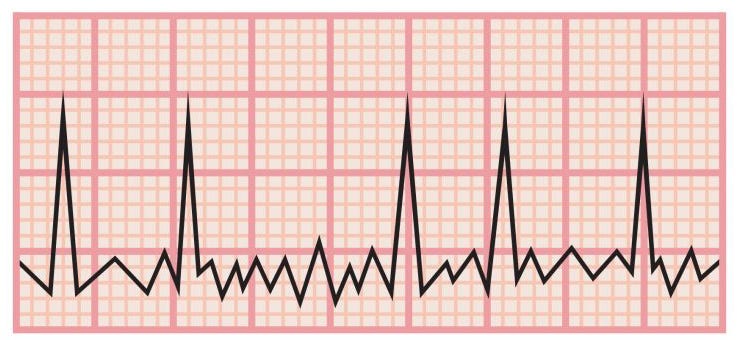
The erratic tracing on an ECG of atrial fibrillation
Dear Lennard,
Why do so many cyclists get Afib in the first place? I keep hearing about it amongst my friends as well as among pro riders.
Forrest
Dear Forrest,
That’s the million-dollar question! Dr. John Mandrola, Chris Case, and I tried to answer that in The Haywire Heart. I will begin by saying that it is not just by chance that it happens.
As Hugh mentioned, dehydration can play a role in the heart exhibiting erratic electrical behavior. Maintaining hydration and electrolyte balance is a good idea for anyone, not just for athletes.
In the interest of being brief here, I’ll just mention two studies from the The Haywire Heart that Dr. Mandrola leads into by saying, “In the not-too-distant past, patients with AF without an obvious cause—thyroid disease, heart valve disease, or heart failure—were said to have ‘lone’ AF. This label implied that AF occurred for no reason, perhaps due to bad luck. This old thinking also held that once AF began to occur, it perpetuated itself. The phrase ‘AF begets AF’ became common. In other words, patients with bad luck who got AF for no reason kept having it because AF simply caused more AF.”
This theory was shot down by research studies like one in the Netherlands where researchers rapidly paced the atria (the upper chambers of the heart) of goats with implanted pacemakers to stimulate AF. Initially, AF in the goats would stop as soon as the pacemaking stopped. After a couple of weeks of continual atrial stimulation, however, the goats developed persistent AF; pacemakers were no longer needed to initiate or maintain AF in the goats.
If simply high electrical pacing of the atria could put goats into AF, why did it take weeks of that for the goats to stay in AF? Turns out, it was due to structural changes (i.e., disease) in the atria, like fibrosis (i.e., scar tissue), dilation, stretch, and inflammation, that had occurred due to the long-term rapid pacing. The parallels of long-term rapid atrial pacing with long-term endurance racing and training are obvious.
The atria of humans who have high blood pressure, obesity, and sleep apnea often exhibit these same types of structural changes as occurred in the goats. However, the idea of healthy people—athletes—who don’t have these diseases also showing these same structural changes in the atria is hard to believe for many people, including cardiac researchers until 10-20 years ago.
Mandrola describes in our book that a big breakthrough in the understanding of this came from an Australian group of clinicians who performed catheter-based studies on 50 patients divided into two groups. The first group contained 25 patients with AF whom cardiologists had referred to receive ablations and who had no other diseases—no hypertension (high blood pressure), no diabetes, no diseased valves—they only had AF. The control group consisted of 25 other patients with a congenital arrhythmia called Wolfe-Parkinson-White syndrome (WPW). This control group was chosen because WPW is caused by one abnormal left-side electrical pathway in the heart that is present at birth in people with otherwise healthy hearts.
The imaging from the catheters inserted through veins and into the hearts of these patients revealed large differences between the groups. The 25 AF patients had larger left atria as well as electrical and structural properties of diseased atria. This went against the prevailing thinking that patients without diseases known to cause AF had healthy atria.
These and other studies point to the conclusion that the high prevalence of AF in long-term endurance athletes is due to their atria becoming diseased, presumably from pushing their hearts so hard for so long.
In addition to the PVCs mentioned above by Stan, which are premature beats in the ventricles, PACs are Premature Atrial Contractions. I mention them because they are often associated with AF.
You may have felt PACs or PVCs from time to time in your own heart. Though the heart contracts (prematurely), the sensation is one of a skipped beat; you don’t feel a beat because the premature contraction happens before the ventricles have filled with blood. The heart then waits to initiate the next beat until the normal signal for it comes from the sinoatrial (or sinus) node in the upper atrium, so there will be an abnormally long time between beats.
Premature beats can trigger AF, and smartwatches often call a very brief run of it as AF. However, the definition of AF requires that it lasts at least 30 seconds.
The muscle of the atria is referred to as the “substrate” by cardiologists. A normal substrate only allows for normal electrical conduction, so a premature beat in a healthy atrium cannot result in sustained AF. A diseased substrate, i.e., one that is abnormally stretched, enlarged, inflamed, or scarred, is required for prolonged AF (as well as for some other atrial arrhythmias). Research has shown that these sorts of structural atrial changes can be associated with long-term endurance training and racing. It can no longer just be chalked up to bad luck that so many athletes have AF.
― Lennard
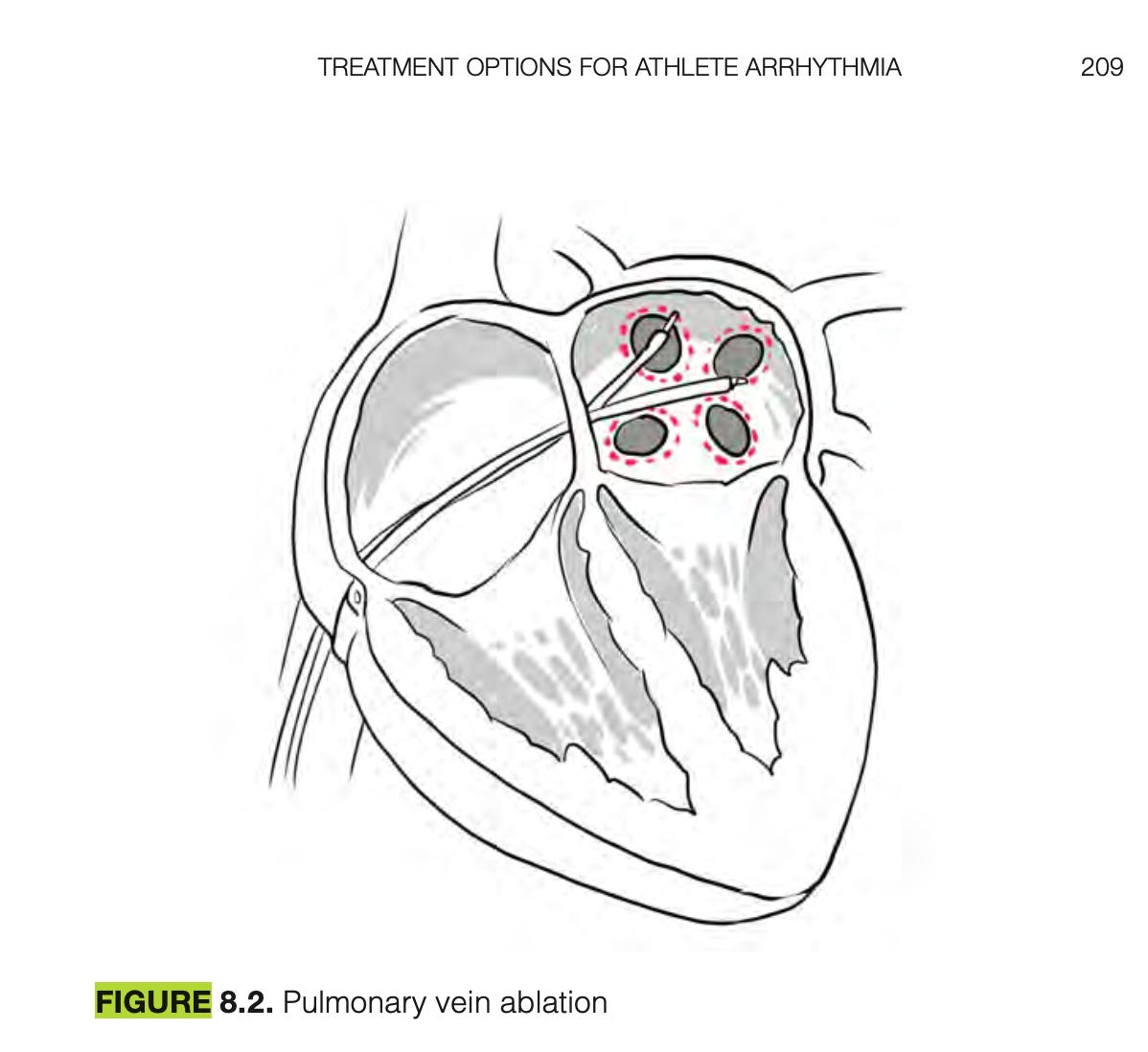
Illustration from The Haywire Heart of ablation for AF creating point-to-point burns with catheters in the left atrium at the orifices of all the pulmonary veins.
Dear Lennard,
I have read with interest the recent letters and responses about cycling with a diagnosis of atrial fibrillation. As has been made clear, atrial fibrillation requires an individualized approach and an experienced electrophysiologist to treat, preferably one that is knowledgeable about endurance sports. There is really no one-size-fits-all solution. For some, medical therapy is effective while for others ablation will be the best option.
Many people with AF may start off with medical therapy and eventually be ablated. Then there is the question of anticoagulation - is it still needed after an ablation? Are there alternatives?
Is there is a substantial body of large, double-blind, randomized, international clinical trials specifically looking at thousands of elite amateur cyclists who race while on “blood thinners”? Certainly the answer to this last question is no. So, really, nobody knows with certainty the best approach for anticoagulation in cyclists with atrial fibrillation.
But there are alternatives that patients - and perhaps cyclists in particular - should be speaking to their EP docs about. These alternatives include devices that can be placed internally into the left atrial appendage to prevent strokes, and devices that can be applied externally (from a surgical approach rather than by catheters directed through the veins).
The most common catheter-based device is called Watchman. Such devices have not been on the open market for decades like other medical technology, and the opinion of EPs about these devices does vary. While they may not be appropriate for all cases, at least there should be a discussion with cyclists with AF in whom long-term anticoagulation is indicated and who are at risk of bleeding because of their activities.
Alternatively, in some cases anticoagulation can be stopped after ablation if it is deemed successful. But again, this is not appropriate for all patients and should be discussed in detail with the patient’s EP to determine the relative risks and benefits of each approach. Even though there is not a large body of clinical data addressing each of the issues in competitive cyclists specifically, most EP’s should be able to individualize the management of AF in cyclists based on their training, education, and experience together with some expert consensus (and the cyclist’s training as well!).
Scott Bernstein MD
Dear Scott,
Thanks for that advice based on your hard-earned experience and expertise.
― Lennard
Subscribers can send brief technical questions to Lennard at: veloqna@comcast.net.
Lennard Zinn has been designing and building custom bicycles for over 45 years; he founded Zinn Cycles in 1982 and co-founded Clydesdale Bicycles in 2017 and Tui Bikes in 2022. His Tech Q&A column on Substack follows his 35-year stint as a technical writer for VeloNews (from 1987 through 2022). He is a former U.S. National Cycling Team member and author of many bicycle books including Zinn and the Art of Mountain Bike Maintenance, Zinn and the Art of Road Bike Maintenance, and The Haywire Heart. He holds a bachelor’s degree in physics from Colorado College.
Follow Lennard Zinn on Substack, Strava, X, Instagram, LinkedIn, or Facebook.
No posts
Comments
Nothing yet. Say the first thing.
Sign in to join the conversation.