
It’s comforting to think that you’d know evil if you saw it, that the kind of person who would unleash a holocaust would stop you in your tracks. But if you had happened to see the young, unknown Adolf Hitler walking down the street, would you have noticed him? In later years, upper-class observers often said he looked like a taxi driver, by which they meant ‘common’. His friend, the American millionaire Ernst ‘Putzi’ Hanfstaengl, thought he looked like “a suburban hairdresser on his day off”1
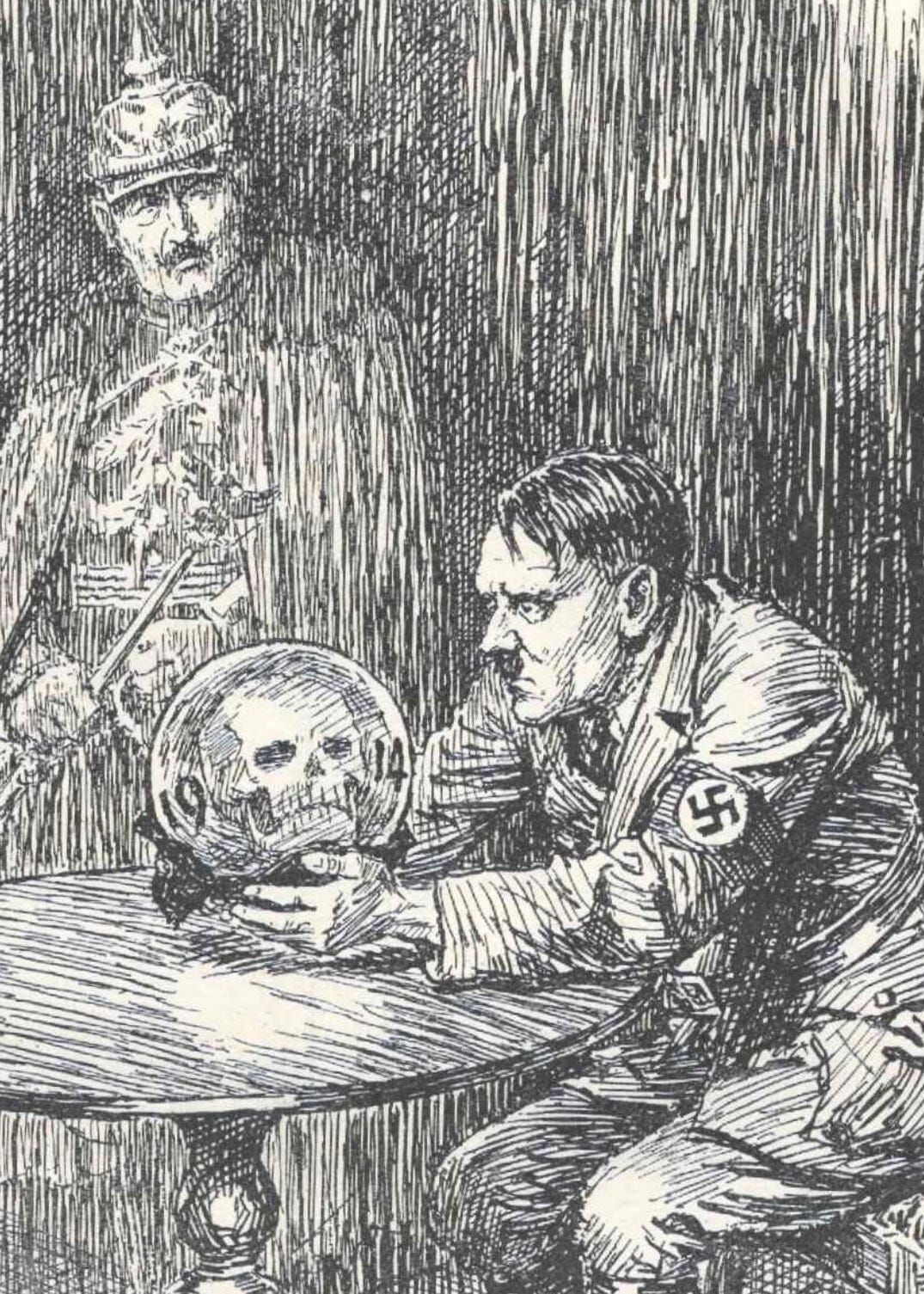
But, in 1921, someone did notice the anonymous thirty-two-year-old Hitler as he strolled along the Thierschstrasse in Munich. William Walter Crotch was an English academic who happened to live in the same neighbourhood. As a Dickens scholar, he was a connoisseur of eccentricity, and he frequently noticed a man who reminded him of “a militant edition of Charles Chaplin, owing to his characteristic moustache and his bouncy way of walking2”.
Crotch wrote about his early sighting in the New Statesman magazine in July 1933, six months after Hitler had become Chancellor of Germany. He described this springy young fellow as wearing a gangster hat and a trench coat, and carrying a whip, “which he used incessantly to chop off imaginary heads as he walked3”. Intrigued, Crotch asked the neighbours about him.
Most took him to be a Russian immigrant who was probably “a trifle mentally deranged”. The grocer identified him as Herr Adolf Hitler from Austria, the leader of a tiny political group who boarded in the apartment of a small artisan, wrote articles for an obscure newspaper, and spoke regularly to audiences of a dozen or two. The shopkeeper added that despite his eccentric appearance, Hitler was “quite a pleasant fellow, though inclined to talk sixteen to the dozen about anything and everything”.
Crotch began spending his evenings in a wine saloon popular with artists and students, and Adolf Hitler, who would sit with his plate of vegetables and his water, either regaling the place with “chaotic speeches” or staring into space. Hitler may have been earning himself a reputation as an electrifying speaker in Munich’s beer halls, but in smaller groups, his harangues were not as well-received. One listener couldn’t stand a lecture on art and artists any longer and asked him, “ Tell me, have they shit in your brain and forgotten to flush it?”
Not surprisingly, Hitler’s ‘Roman Empire’ was, well, the Roman Empire, and he frequently lectured his fellow diners on the greatness of the Caesars. His obsession with the occult was perhaps more unexpected. Crotch recalled that one day, a man came in who, “for the price of a plate of soup,” told fortunes. Hitler spent an hour with him in a corner, and afterwards, when a sceptical student rolled his eyes, he angrily defended divination and astrology. Just what this wandering psychic glimpsed in Hitler’s future no one knows, but if he saw mass murder on an unprecedented scale and a looming apocalyptic war, he kept it to himself.
In the early 1920’s, the former Kingdom of Bavaria was as untamed as the wild west. The revolution of 1918 had overthrown the monarchy and established a Soviet-style socialist republic, which was seized by communists, who were quickly overthrown by the German army. Munich had been fought over in beer hall rallies and street battles ever since. There were seventy-three nationalist groups in Germany, and between the years 1919 and 1922, right-wing groups carried out 354 political murders.4
Hitler thrived in the chaos. By the time of his thirty-fourth birthday, he had enough admirers to fill his grubby flat with their gifts of sweets and cakes, yet he hadn’t taken one bite, fearing poison. “This house belongs to a Jew,” he told his friend Putzi, “and these days you can drip slow poison down the walls and kill your enemies. I never eat here ordinarily.”5
Given the competition among the rowdy agitators, Hitler wanted attention for his National Socialist group at all costs, saying, “It makes no difference whatever whether they laugh at us or revile us, whether they represent us as clowns or criminals; the main thing is that they mention us, that they concern themselves with us again and again.”6
The first news of this incendiary little Austrian to reach Great Britain came on December 4, 1922. Attentive newspaper readers might have noticed a little article in their local paper taken from the Westminster Gazette:
“Extraordinary information is at hand of the activity of the Bavarian Fascisti under the leadership of an Austrian named Hitler. Their emblem is a hooked cross, something like a swastika. They appear to be well supplied with funds and have been touring the various towns in motor-lorries. They are generally armed to the teeth.
“In the hope of appealing to the working classes, they call themselves National Socialists, a term strongly resented by the Republicans. Their stosstrupp (storming party) gangs have spread a reign of terror against which the police are powerless…
Jews are everywhere singled out for attack, and a pogrom on a large scale is threatened before Christmas.”7
At the very end of this first Hitler news story, printed 17 years before World War II, at the bottom of page 5, next to an advertisement for Xmas presents, is a sentence that, with the benefit of hindsight, should be sprawled across the front page in big, red capitals.
“In the Munich beer-halls, collecting boxes labelled “Jewish Massacre Fund” are frequently seen.”
Among the millions of people who thought this kind of talk was a cynical grab for votes was a famous hypnotist and psychic named Erik Jan Hanussen. Raised in a family of impoverished travelling performers, he had become incredibly rich and famous by the early 1930s thanks to his popular mind-reading and hypnosis act. Hanussen drove fancy cars, held thrilling seances, and threw decadent parties, keeping an ear out for inside information he could use in his act.
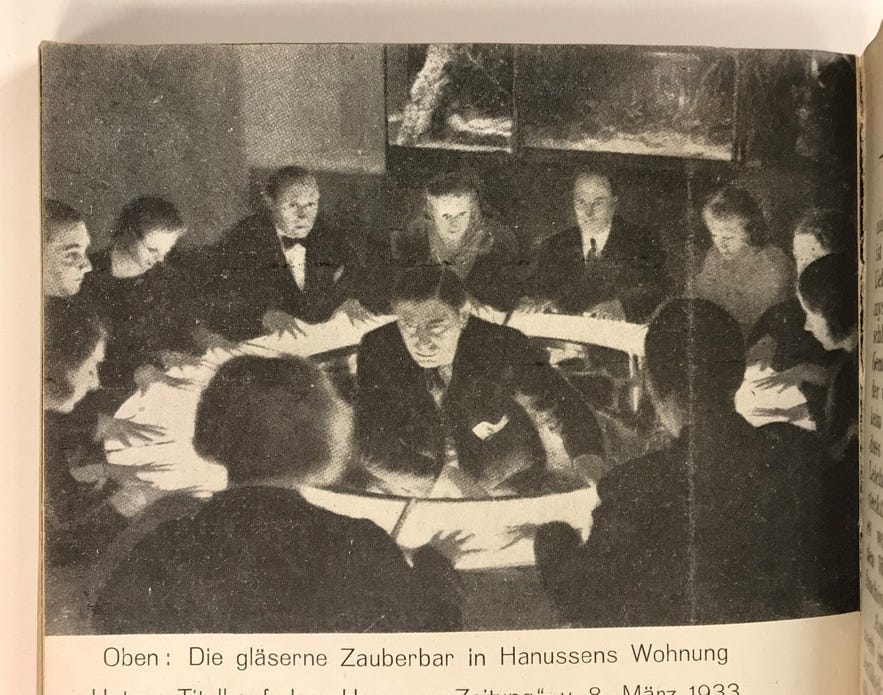
In 1932, he was riding high. He knew everyone, and he paid attention, using his insider status to make bold predictions in his own tabloid newspaper, predictions that often came true. He was the kind of man who sniffed the wind with the expertise of a bloodhound, and although the Nazi party had only secured 30.1 percent of the vote, he clearly sensed a future in which the incumbents needed Nazi support. In this March 1932 headline, he put all his chips on a big Hitler win:
“HANUSSEN IN TRANCE PREDICTS HITLER’S FUTURE”.8
The following story predicted that Hitler would become the Chancellor of Germany in exactly one year.9
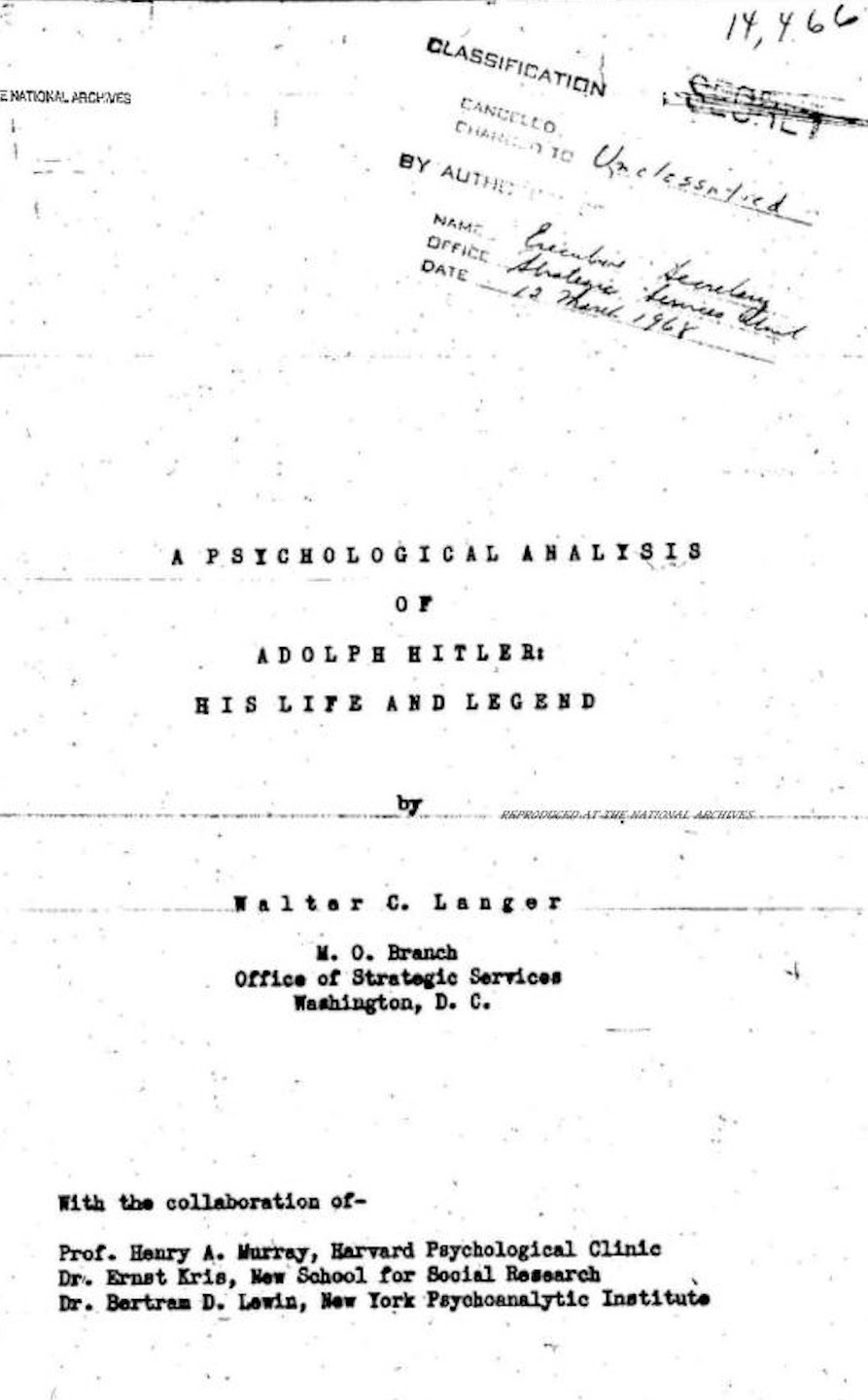
Needless to say, this prediction played very well with the Nazis in Berlin. A report into Hitler conducted by the US secret service in 1943, called A Psychological Analysis of Adolf Hitler: His Life and Legend quotes witnesses who say Hitler consulted Hanussen, not just about his future but about how to work a crowd, how to mesmerise, distract and inspire. After his first meeting with the aspiring dictator, Hanussen phoned his wife Fritzi and excitedly referred to Hitler as “my pal Adolf”.10
His apparent closeness with Hitler went two ways; jealous acolytes such as Joseph Goebbels started building a massive file on Hanussen, while other top Nazis flocked to his side. They were the worst of the worst, and chief among them all was Count Wolf Heinrich von Helldorf. An aristocrat, a gambler, and a savage anti-semite, von Helldorf was a leader of the SA in Berlin. The two cemented their friendship when Helldorf attended an orgiastic ritual celebration aboard Hanussen’s yacht.
The psychic’s occult-themed parties had more than a whiff of P Diddy to them, and on this occasion, SA-Oberführer Helldorf had a 14-year-old boy stripped and tied to a table top, before drawing a riding crop from his boot and whipping him so violently the boy passed out. Seeing the shock of his fellow guests, Helldorf reportedly yelled, “All right, I’m a sadist! I admit it. We’re all sadists! In the SA, my friends, one must learn to be desensitised to petty human compassion.”11
Far from being deterred by this display, Hanussen paid off von Helldorf’s large gambling debts and gave piles of cash to other top Nazis, including SA leader Ernst Roehm and Hermann Göring. He even bought 400 pairs of military boots for the SA. But why was he so concerned with the finances of the Nazi party and its stormtroopers’ footwear? It wasn’t because he was generous. He certainly wasn’t a committed Nazi. He liked power and influence, but he also had a secret. He was Jewish. His name was Herschmann-Chaim Steinschneider. 12
Word of his antecedents began to get around Berlin. Hanussen had made enemies along the way who made sure to let Josef Goebbels know that Hitler’s favourite psychic was Jewish. But Hanussen was a survivor, and when he was confronted by his sadist buddy von Helldorf, he was ready. He spun an improbable story about how he was the orphan of Danish nobles who perished in a mountaineering accident, and he’d been adopted by kindly Jews. He even had the paperwork.
This worked for a while. Until February 26, 1933, to be exact, when the talk of Berlin society was of a fabulous party the night before. Hanussen had entertained the soiree by putting himself into a trance at midnight and intoning, “I see a blood-curdling crime committed by the Communists. I see blazing flames. I see a terrible firebrand that lights up the world”.13 Just imagine the chatter a mere twenty hours later, when the Reichstag went up in flames, giving the new Hitler government emergency powers to rule by decree.
Had Hanussen found out too much from his very good Nazi friends? Had he learned of a plot to torch the seat of government? Had he even hypnotised the communist patsy into starting the blaze? However it happened, this careless talk of an inside job, the debts owed to him by some of the world’s most violent men, his (to the Nazis) dubious ethnicity, and the recordings he had filmed of them at his dissolute parties, sealed his fate.
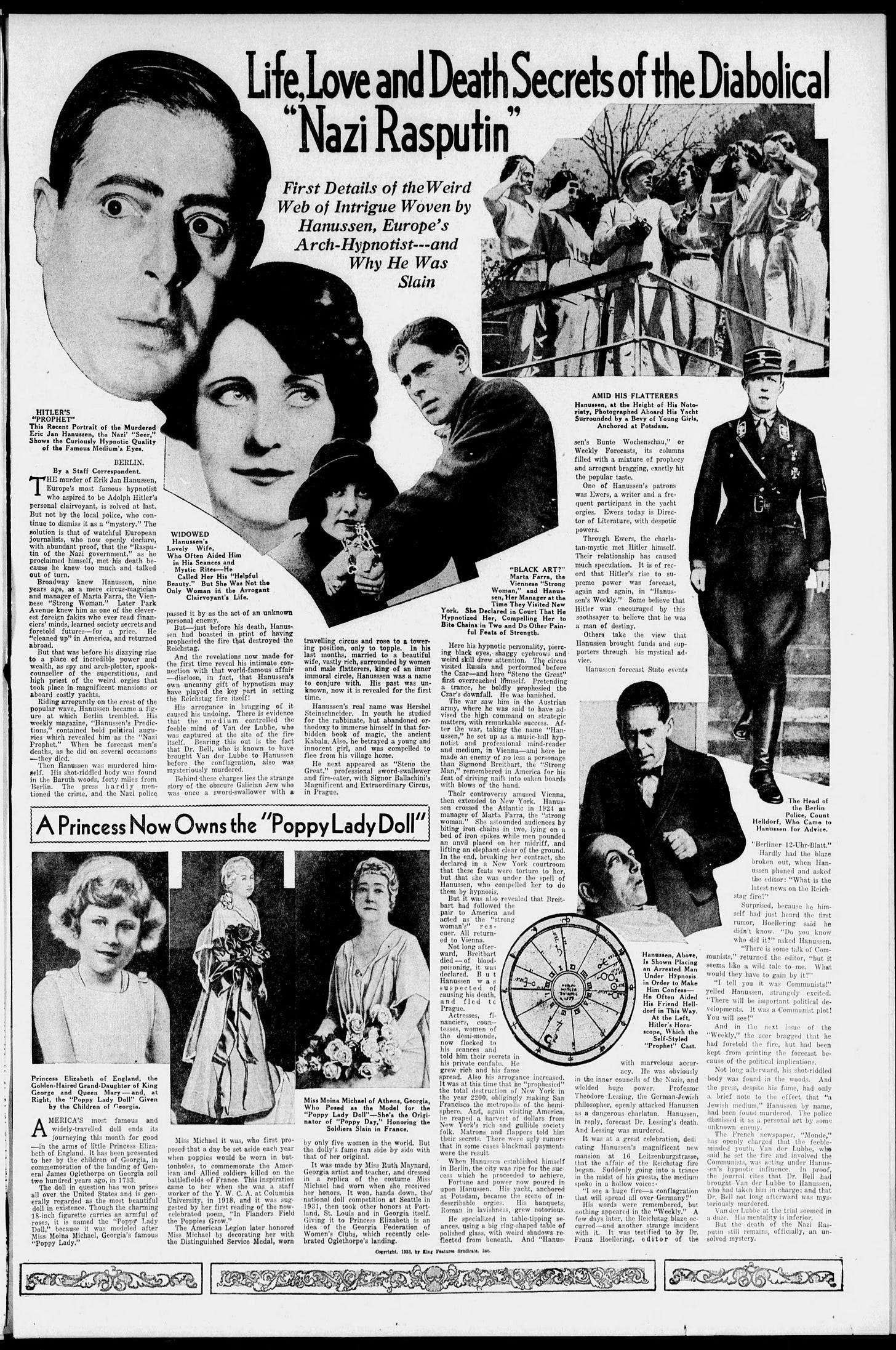
Just over three weeks after the fire, Hanussen was arrested and driven to Nazi headquarters in his own red Bugatti. There, he was subjected to all the brutality of the men he’d been desperately trying to buy and outwit. He was charged and released as “the Jew Steinschneider”. At home, in his ransacked apartment, he made his last prediction, writing it in invisible ink and giving it to a friend to smuggle out of Germany.
“Yesterday, they beat me until I was half dead. But half isn’t enough for them. I know that without going into a trance….I always thought that business about the Jews was just an election trick of theirs. It wasn’t.”14
Early the next morning, three SA men broke into his apartment and dragged him back to the Gestapo barracks. What happened next is what’s happened before and since to men who think they have befriended, bought, blackmailed, and outwitted the world’s most powerful men. Three of his former party pals lined him up with their pistols, and each fired. His body was dumped in a field north of Berlin. And that was the end of Hitler’s favourite psychic.
Ernst Hanfstaengl, Unheard Witness, (Philadelphia, Lippincott, 1957): 22
William Walter Crotch, “Early recollections of Adolf Hitler: Eccentric but quite a pleasant fellow,” New Statesman, 29 July 1933
Ian Kershaw, Hitler 1889-1936: Hubris, (London, Penguin, 2001 Kindle) 171
Hitler, Mein Kampf, 544 cited in Kershaw, Hitler 1889-1936, 147
“Collecting Box for Massacre.” Belfast Telegraph, December 4, 1922, 5
Mel Gordon, Erik Jan Hanussen: Hitler’s Jewish Clairvoyant (Los Angeles, Feral House, 2001) 207
Hitler became Chancellor 44 weeks later, 2 months ahead of Hanussen’s prediction
Tracey Felder, “Erik Hanussen’s Berliner Wochenschau”, Leo Baeck Institute – New York | Berlin, https://www.lbi.org/collections/periodicals/erik-jan-hanussens-berliner-wochenschau/
Bella Fromm, Blood & Banquets: A Berlin Social Diary, (1943 repr., New York, Carol Publishing Group, 1990) 78
Comments
Nothing yet. Say the first thing.
Sign in to join the conversation.