

In the summer of 2023, Patrick Radden Keefe had the opportunity to go to London to observe the production of the FX adaptation of his 2018 book Say Nothing: A True Story of Murder and Memory in Northern Island. One morning in July, he was on set, at an office building on Chancery Lane that was made to look like Scotland Yard.
A sixty-something friend of the director, named Andrew Fingret, who was also visiting set that day, chatted with Keefe during a break. They spoke about the differences between New York and London, and Fingret, who is Jewish, told Keefe about how small and close-knit London’s Jewish community is. So small that you could play a game that Fingret called “Jewish Geography,” like Six Degrees of Kevin Bacon, but for Jewish people to discover who they know in common.
Keefe isn’t Jewish, but he named a rabbi, an old friend of his parents, who lived in London: Julia Neuberger.
Neuberger, it turns out, had officiated the bar mitzvah of Zac Brettler, the son of one of Fingret’s friends from university.
“I may have a story for you,” Fingret said.
At 2:23 a.m. on November 29, 2019, nineteen-year-old Zac Brettler stood on the fifth-floor balcony of a luxury apartment complex on the Thames. On the other side of the river, security cameras at M16 headquarters captured “his slender silhouette against the brightly lit windows,” Keefe would later write. Zac “made his way to one corner of the balcony and seemed to peer over the ledge, before crossing to the other corner and briefly pausing there. Then, returning to the center of the balcony, he jumped.”
What made Zac jump?
This is the central question that haunts both the longform essay that Keefe published in the New Yorker, seven months after meeting Andrew Fingret, and his new narrative nonfiction book London Falling: A Mysterious Death in a Gilded City and a Family’s Search for Truth, which came out in April.
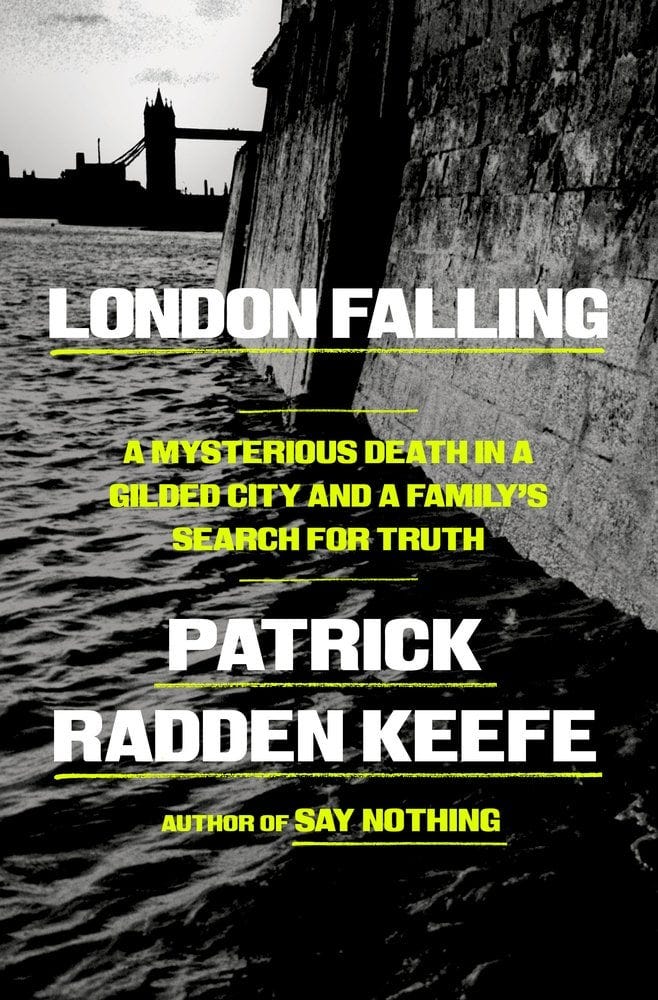
Patrick Radden Keefe is one of the best storytellers working today. Reading his work is like going on a long hike with an experienced guide—I see things I never would have noticed on my own, and I never have to worry about getting lost.
When I think about good writing, I think of diction, style, voice, tone, atmosphere. If you gave me an unattributed paragraph or stanza from each of my favorite authors, I could identify them by voice. Good writing can be practiced at the level of a sentence, a paragraph, a page, a poem, a short story or an essay. In creative writing programs, writers are trained to write well by practicing on pieces that are short enough to be workshopped by their peers and instructors.
But good writing isn’t enough for a book with the scope of London Falling. We’ve all read “good writing” that is pretentious and boring. There are books with “good writing” on our shelves that we DNF’d.
This is because good longform storytelling—the controlled unfolding that’s necessary to hold a reader’s attention over the course of 300 pages—is much harder to teach within the constraints of the workshop model, and it’s one reason that books like London Falling are so rare.
I’ve pulled some storytelling lessons from the book, and from interviews with Keefe about his process, to help any writer working on a book-length work of nonfiction.
A novelist has the challenge of inventing a plot. Beginning memoirists often believe they have it easier than novelists—they already know everything that happened!
But anyone who’s ever tried to write 80,000 words of a sustained nonfiction narrative, whether that narrative is personal or reported, knows how difficult it is to construct a story out of a chronology of true events.
You might think, I’ll just tell the story chronologically… But even that approach requires answering the question, “Starting where?”
Keefe told Harvard Law School students that his first outline for any book begins with “big hinge moments” for each character, written on an envelope. The limitation of the envelope forces him to be concise, before he drafts a more detailed outline.
These big hinge moments, or turning points, are moments when everything changed for your narrator, or character: they often include firsts and lasts (first time you ever met him; last time you ever saw him), moments when a character received life-altering news, life-changing events like births and deaths, relocations, accidents, crimes, miracles, and discoveries.
Your turning points are your map.
Once you have a list of your turning points, you can start to organize them into an outline for your book by asking yourself: What does the reader need to know when?
A good storyteller controls the pacing, and creates suspense, by making decisions about when to reveal what they know. What are you hiding from the reader initially? What would they be surprised to learn? In London Falling, Keefe is also using genre tropes, like red herrings, to create suspense.
As an opening, what turning point would hook your reader’s attention?
Keefe told ProPublica, “I’m always thinking about structure, and I’ve gotten better at that over the years having the confidence as I’m reporting to be thinking, ‘How am I going to tell this story?’ To me, an opening is like the top of the water slide. I just need to get you over there and get you going, and hopefully, once I have you there, the rest of it will fall into place.”
London Falling is a true crime book, so it starts in true crime fashion, with a description of Zac’s jump from the balcony. When I started writing this Substack post, I chose a different turning point, from page 271: when Keefe met Andrew Fingret. I transitioned from that turning point into the turning point of the jump, four years earlier.
London Falling began as a conversation with Andrew Fingret, who introduced Keefe to Matthew and Rachelle Brettler, Zac’s parents. As Matthew and Rachelle share all the documentation they’ve collected, trying to solve the mystery of their son’s death with little help or engagement from law enforcement, Keefe zooms out from individual players in the story and gives the reader a sense of how large the canvas of this story truly is: from the history of the Thames and the urban development of London, to the influence of Russian money and power in the UK after the fall of the Soviet Union, to Idi Amin’s expulsion of Asians from Uganda in 1972.
The zoom lens in Keefe’s mind creates a transportive1 reading experience.
Many writers know they’d like to include history in their books, but they struggle to figure out when to zoom out to the bigger picture, because they fear losing their reader with a history lesson. After you’ve picked up a copy of London Falling, look at how Keefe leaves the reader on a cliffhanger in the crime story (the A story) on page 90, before taking us to Uganda in 1972 on the following page. Six paragraphs later, the reader finds out how this history lesson connects to the character we’ve just left on page 90.
Like The Talented Mr. Ripley, London Falling is a book about deception. Before he jumped from the balcony, Zac Brettler was living a double life: in reality, he was the angsty teenage son of loving parents. The comfortable lifestyle they’d provided him was nothing compared to the ostentatious wealth he coveted, so he invented an alter ego, pretending to be the son of a Russian oligarch, about to inherit a great fortune. His bold lies helped him gain access to luxury apartments and nightclubs, and a network of influential, dangerous men.
As the book proceeds, the reader will not be surprised to learn that Zac is not the only character hiding behind a cloak of deception.
But Keefe finds narrative rhymes in unexpected places.
Rachelle Brettler, Zac’s mother, is the daughter of Hugo Gryn, a Holocaust survivor and prominent Reform rabbi in London.
One of the “big hinge moments” in Zac Brettler’s life happened almost sixty years before he was born:
On the day Hugo arrived in Auschwitz, in 1944, and stepped off the train with his family, a gaunt man in a striped prison uniform approached him on the platform. He was muttering under his breath, like a madman, and as he passed Hugo he hissed in Yiddish, “You’re eighteen and you have a trade.” The family joined a long column of new arrivals waiting to be processed, and when Hugo reached the front of the line, he told the Nazi administrators that he was nineteen and a carpenter. In fact, he was only thirteen. But that lie saved his life.
The reader never wonders, why is Patrick Radden Keefe including Zac’s grandfather in this true crime book? Keefe is showing us another powerful illustration of the life and death stakes of maneuvering the truth.
If you feel like you have too much research, too much history, too many characters, too much story for your book, look for places where the material rhymes.
London Falling is a tragedy, like all crime stories, and conveys the inexorable grief that Zac’s family will always carry. There is nothing pleasurable about what’s happened to these people.
Many writers (including yours truly) turn to memoir because they have experienced trauma and grief.
To alchemize the darkest thing that has ever happened to you into a book that will keep a reader up late into the night requires distance, self-awareness, skill, and practice—it also requires you to think about the story from the reader’s point of view.
One way to do that is to understand what delivers pleasure to our reader brains.
Dr. Jennifer Lynn Barnes, a novelist and former psychology professor, gave a lecture at the Romance Writers of America conference that I was able to listen to, about the six universal pleasure buttons that good stories hit. We love novels that hit all six buttons:
Beauty
Money & Wealth
Status & Power
Sex & Touch
Competition
Danger
Think Heart the Lover. Think Vladimir. Think The Compound. Think The Wedding People. Think… Love Island.
London Falling pushes at least three: Money & Wealth, Status & Power, and Danger.
How many of the six does your work-in-progress hit?
If you’re interested in this framework, read my former student Petya K. Grady on “reading kinks.”
Non-fiction sales have been declining for years, due to the proliferation of competing media (like podcasts), which creates a paradox. Publishers are not investing in time-intensive, investigative narrative nonfiction like London Falling because the sales numbers aren’t there to support them, but are readers not buying narrative nonfiction because publishers aren’t placing bets on books that could be every bit as compelling as London Falling?
In 2023, the books vertical at Esquire published an article asking if a book like Moneyball could be published today. (A year after publishing this, Esquire closed this vertical and laid off its editor.)
Most writers do not have the institutional support that Patrick Radden Keefe has, so they write nonfiction books that they can afford to write: memoirs, essay collections, and memoir+ with a research element that’s accessible from their laptops or local libraries.
Publishers would love to see “transportive” works of nonfiction with great storytelling, but will they fund them? Who can afford to do the level of investigative reporting that Keefe did for his extraordinary book?
What incredible stories are we missing?
On July 15 at 1pm ET, I’m speaking to award-winning documentary filmmaker Penny Lane about creating content as a filmmaker, and her forthcoming film Wild Inside, about Flaco the owl. The official trailer for the film has almost a million views on Instagram (!!) and Penny wrote about her experience in my winter Hype House here.
On July 21 at 1pm ET, I’m speaking to literary self-help author Catherine Baab about how Substack helped her sell her second book, and how she’s used Reddit to promote her work.
Hype House, my four-week content strategy workshop for authors who want more attention for their writing, and more leverage in their careers, starts on September 13. One-third of the spots have sold out since I publicly announced, so register soon if you’re interested!
If you’re not sure if Hype House is for you, watch my Live with my former student, debut novelist Sonia Feldman, about how she created content on Instagram that helped her hit the USA Today bestseller list, or my Live with my former student Lu Chekowsky, who gained 15,000 followers on TikTok in the months leading up to her memoir launch.
No posts
Comments
Nothing yet. Say the first thing.
Sign in to join the conversation.