
Joanna MacKenzie is one of the literary agents who reads my Substack and when she saw that I had moved to Chicago, she reached out and asked if I wanted to meet in person. On January 20th, we met for coffee. That same day, I received this email from Joanna’s client Gina Banks through my website:
Hey Leigh,
I am an avid reader of your Substack and as luck would have it, I just sent my agent Joanna MacKenzie my revised manuscript and a submission slide deck that was inspired by your vibes deck. She told me you met earlier today so the timing is very auspicious. I loved the idea and how it will hopefully help an acquiring editor sell the book in house.
Gina was inspired by the pitch deck—similar to a non-fiction book proposal—I created to help me sell my Gothic mystery If You’re Seeing This, It’s Meant for You to Ballantine in 2024. I shared pages from my actual pitch deck here. Jane Friedman interviewed me about my pitch deck, in reporting on the trend.
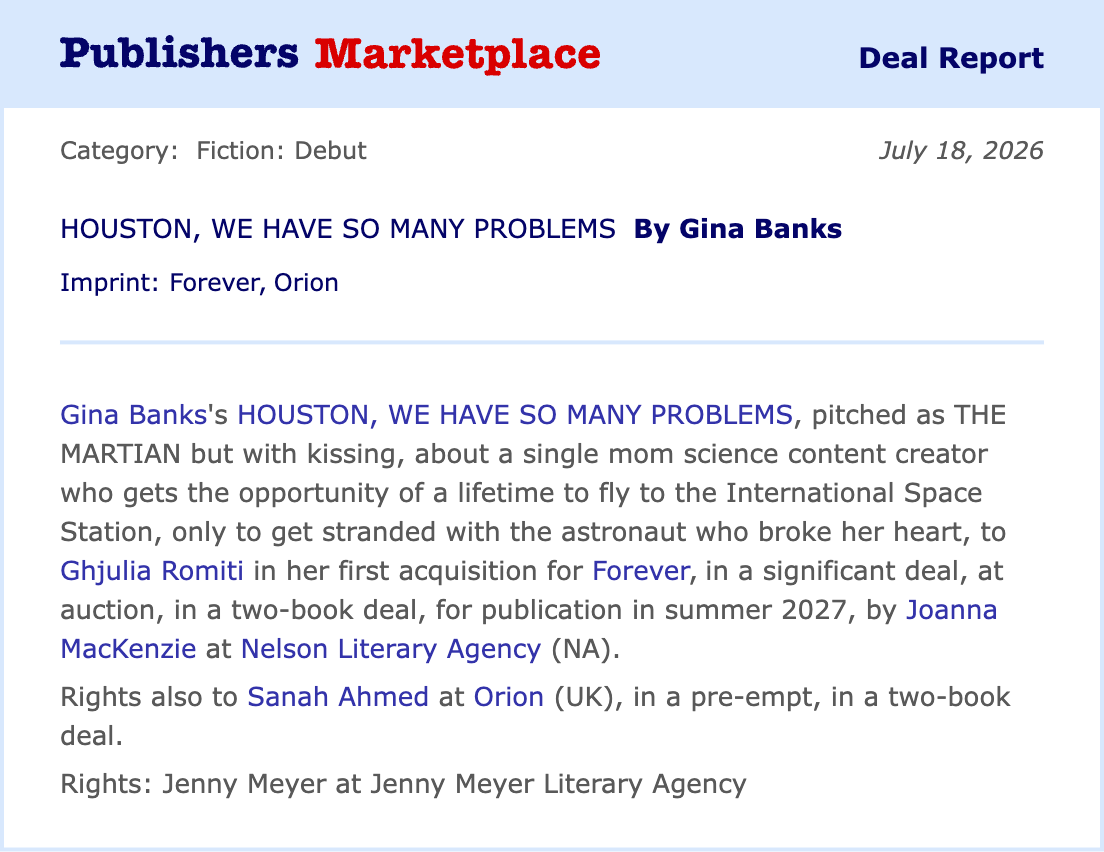
Six months after my coffee with Joanna, and that email from Gina, I’m delighted and excited to share that not only did Gina sell her novel in a two-book deal at auction—she also generously offered to share slides from her deck with Attention Economy subscribers, so that more authors and literary agents can learn this strategy for getting attention in a crowded market!
As Gina shares below in our interview, this was her third novel on submission—and the first one that sold.
GINA: This was my third time on submission, and I knew from experience how crowded the marketplace is for fiction right now. Some of my earlier rejections were variations on “I don’t know how to break this out” or “it’s not expectation-defining enough in a crowded marketplace.” Creating a pitch deck with a clear vision for the book’s audience and comps felt like something tangible I could do to help editors have a vision for how to position my book. My hope was that once an acquiring editor was interested in Houston that the deck would help them sell it internally. This definitely seemed to be the case.
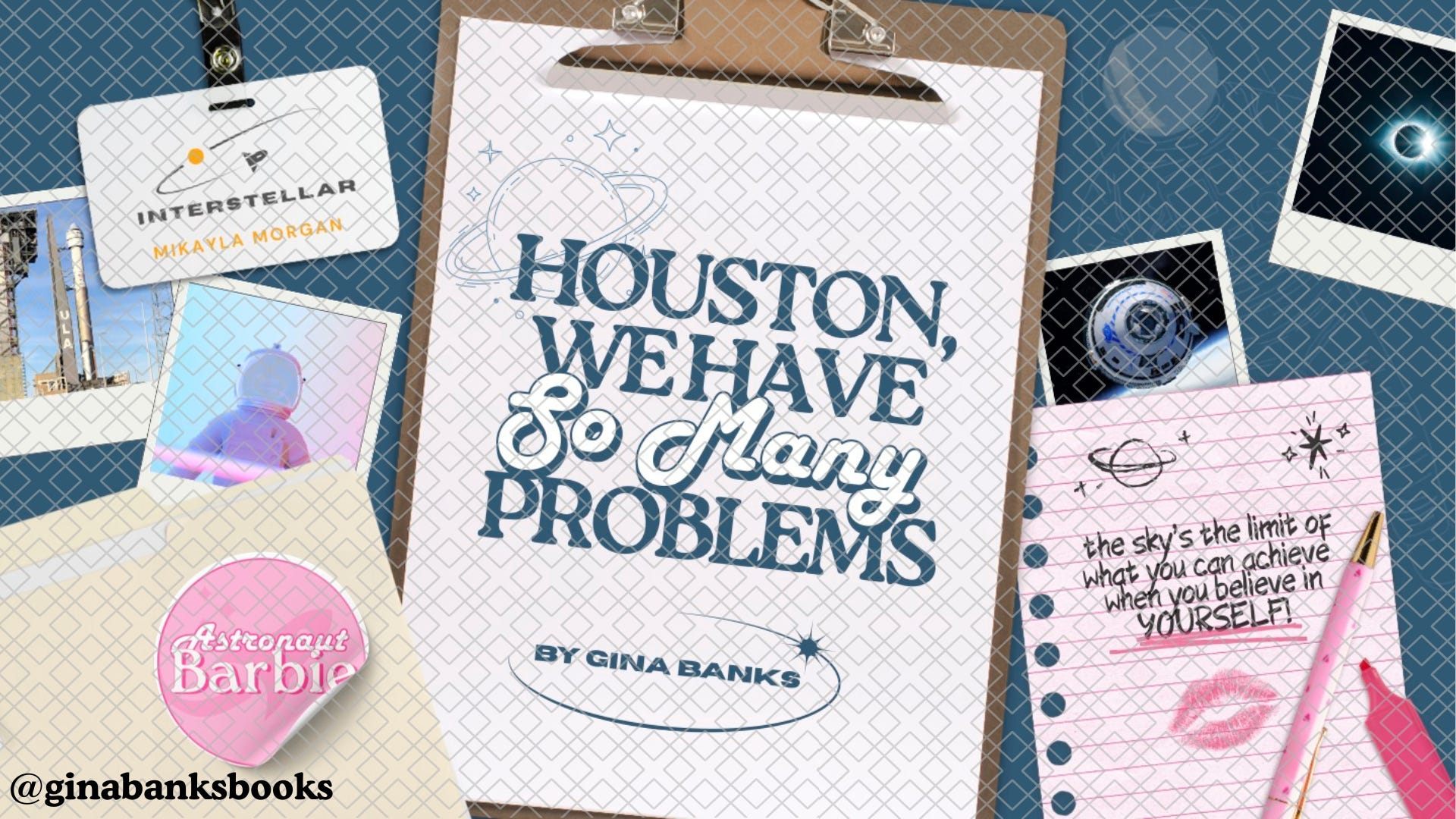
GINA: I created a Pinterest board with images and ideas for the pitch deck and used a Google Doc for the text of each slide. I followed roughly the same outline as your deck for If You’re Seeing This It’s Meant for You focusing on story, comps, audience, publicity, and partnerships. I cannot recommend my friend (and fellow romance author) Cara Calloway enough. She absolutely nailed the vibes of my book and added so many details that delighted me like the name badge for Mikayla Morgan (my protagonist) at Interstellar, the SpaceX-like private space company where she works in Houston.
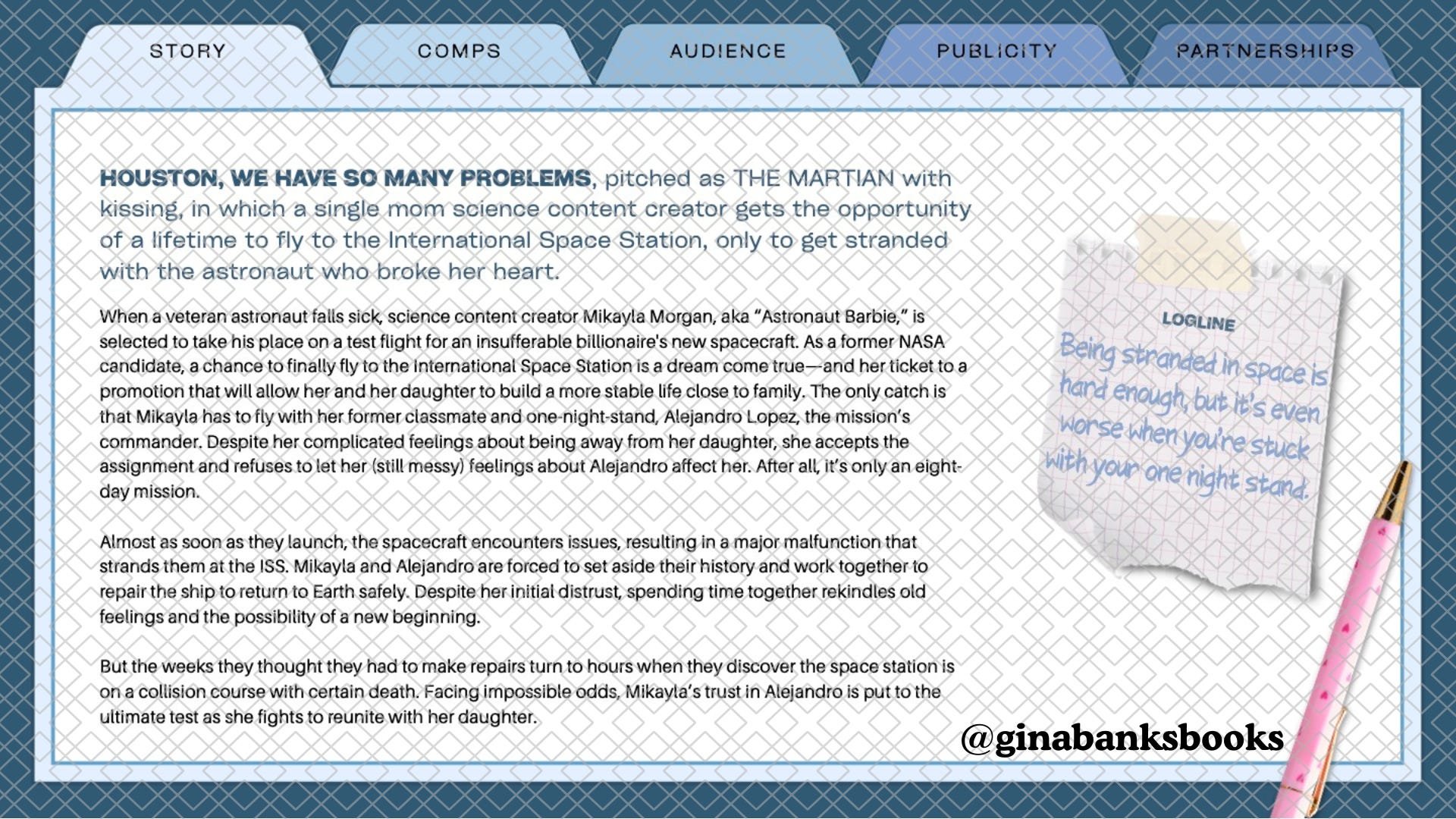
GINA: I wrote the (dreaded) synopsis and determined the comp titles. Atmosphere was released while I was revising my book and while they are both about female astronauts, Houston is a contemporary romance with open door sex scenes. To indicate the difference in tone, I added “Atmosphere if written by Ali Hazelwood.” For the elevator pitch, I usually draft the text and then Joanna edits it before sending it out to editors. Similar to querying, you want to hook the reader (whether it’s an agent or an editor) but not give away too much information. When I feel stuck on how to frame a story, I look at the back covers of the comp titles to see how other authors described their stories in a curiosity-inducing way.
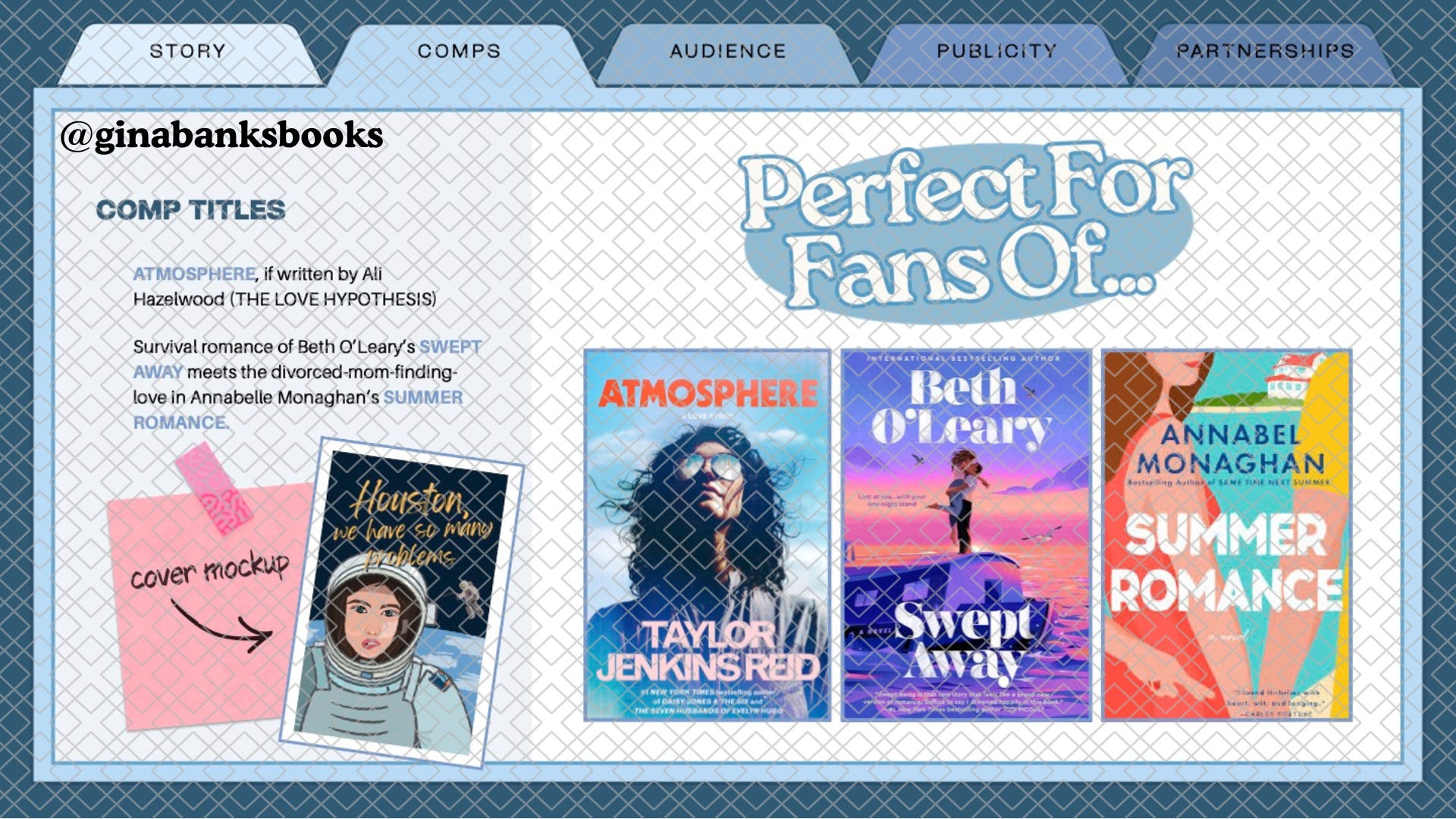
JOANNA: Gina came up with the brilliant “The Martian, but with kissing” tag line. I added “which leads to more than kissing” to really drive home the spiciness for editors. 😉 The last thing we wanted was for anyone to be surprised by the sex. Gina is such a pro that all the pitch documents were stellar! One thing we did talk a lot about and ended up switching was the background or thematic color of the deck. Initially it was (my favorite) bubblegum pink, but I thought it was important that we underscored that there was more to this story and these characters than bubblegum.
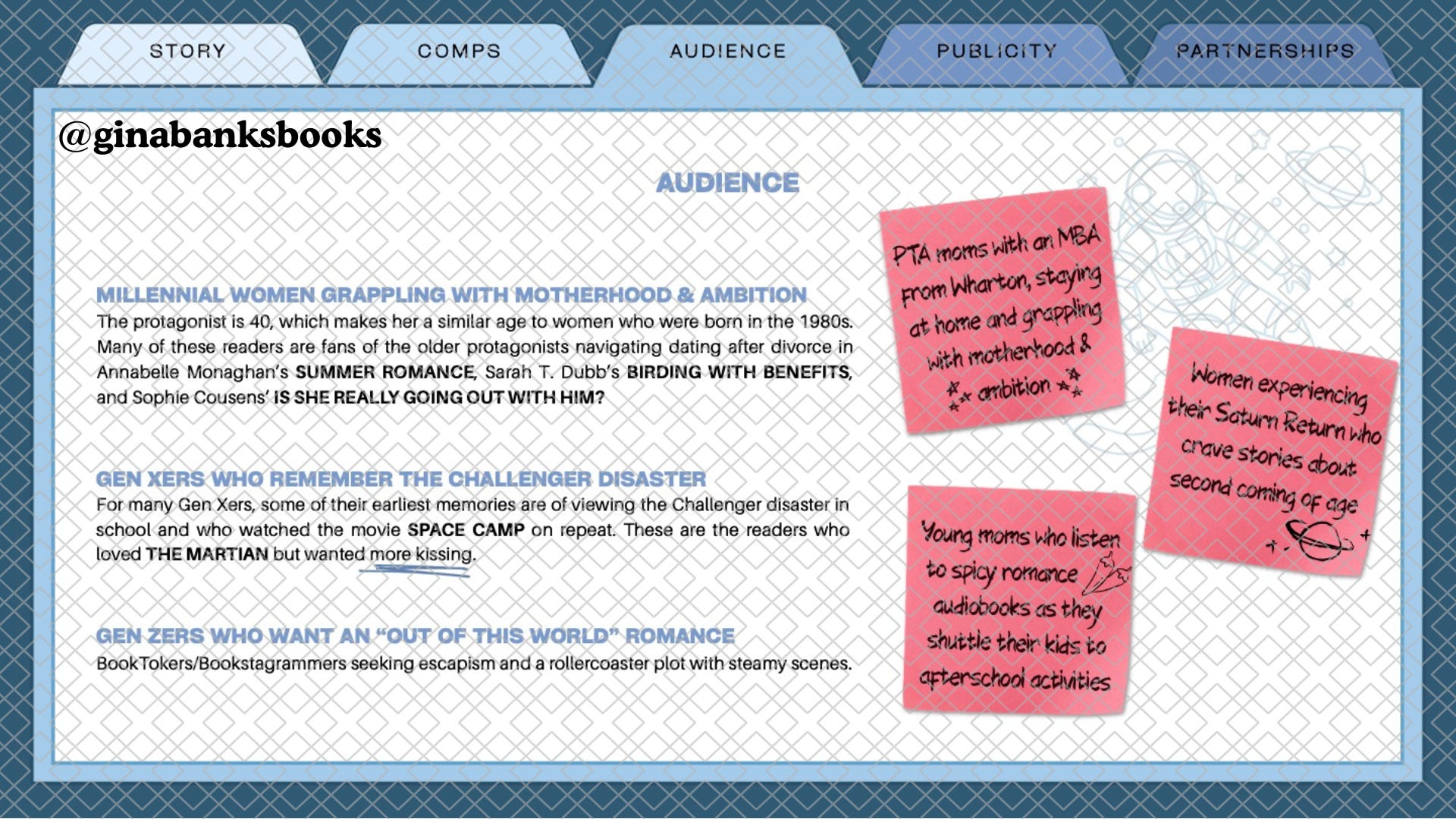
JOANNA: I’ve always believed that it’s the job of the agent to make the path as clear as possible for editors to take a project to acquisitions. Sometimes that’s identifying the right comps, sometimes that’s showcasing an author’s platform and sometimes that is identifying all possible audiences. I also think that authors need to know where their book will live when published, so having a sense of audience is really important. It’s a little of the wild, wild west in publishing right now as everyone tries to figure out what readers want and how to break books out, so the more information we can gather and provide to editors the better. In my many years doing this job I have been surprised by publisher’s narrow-mindedness in terms of potential audience as well as surprised by authors who got their comps completely wrong, so do want to underscore that this isn’t a perfect science—and it’s one that depends on collaboration.
GINA: I don’t usually think of my audience as I draft, especially not while I write the first, very shitty draft because my only goal is to get to the end and figure out what story I’m actually trying to tell. That said, more than any of my other books, the audience for Houston was clear to me as the story took shape. The protagonist is a millennial single mother to a five-year-old, and I knew that issues about motherhood and ambition would resonate with readers. There has also been a lot of discourse in the romance community about too many books feeling the same. I thought that my “out-of-this-world” romance would be perfect for readers who want escapism, but something they haven’t read a hundred times before. In terms of reader habits, friends have told me that audiobooks are one of their favorite ways to read because they can fit it in during errands, picking up the kids, etc. I’m a huge fan of Jane Friedman’s newsletter—she has such great data—and there has also been a marked upswing in audiobook sales in recent years.
JOANNA: I only sent the deck once editors requested to read the manuscript. No sneak peaks 😉 Across the board, everyone loved the deck—even those who didn’t think the project was right for them.
GINA: During calls with interested editors, several of them referenced the pitch deck and how much they loved it. When we went to auction, one of the imprints even created their own pitch deck in response and included several of my ideas in how they would position the book. It seemed like the pitch deck helped to get the sales/marketing folks on board and also the publisher and others higher up the food chain who wouldn’t have time to read the entire book.
JOANNA: The impact of this pitch deck for this book was incredible. As Gina mentioned, we received pitch decks in response, which was a first for me and so fun to see.
When we went to auction, one of the imprints even created their own pitch deck in response.
JOANNA: A pitch deck makes the editor’s job easier by anticipating and answering all the points about audience, market, vibe, etc., that an editor will have to address during the acquisitions process and in so doing can speed up that process as well. We’re trying to say this is how the book will work in the market and this is why it will be successful and make it an obvious yes. We’re giving them the tools to get as many people on board as fast as possible, which hopefully means a faster and more enthusiastic sale.
This wasn’t my first pitch deck. And I’ve had various levels of success with them overall. Gina is spot-on when she says that it helped Houston stand out in a crowded marketplace and that’s really how I think about it when I consider adding one to the submission package. In the past, I’ve created a deck that I’ve sent out as part of a follow-up to a submission; a review highlights package; or a deck featuring a collection of articles that showcases why a particular project is of the moment. The thing I can’t control is if an editor will open any of these. We can’t know if every editor who considered Houston opened the deck for example. Editors have a lot on their plates so when we’re asking them to open one more thing, to read one more thing, it has to be worth their time—it has to be entertaining, exciting and make their job easier.
I do think pitch decks work for certain genres better than others. I don’t know that I’d see one for a literary project as those are so craft dependent, for example.
JOANNA: I think it is overkill for queries. At that stage in the game, I’m looking to connect with an author’s writing and truthfully, with the volume of queries I receive, I don’t have time to peruse extra materials. I’m sure somewhere out there there is an author who has a success story of sending some kind of supporting deck, or mood board, or playlist, and that made all the difference, but I’d say that would be an outlier situation.
Did this post inspire you to make a pitch deck? Share it with your agent!
I interviewed Catherine Baab this week about how a viral Substack Note helped her sell her second non-fiction book
On Tuesday, August 25 at 1pm ET, I’ll be hosting a Chat Room event with editor Nneoma Amadi-obi, who acquires literary fiction and nonfiction for Norton. My Chat Room conversations with book publishing professionals are available to diamond medallion members of Attention Economy.
On Wednesday, September 2 at 1pm ET, I’ll be hosting another Chat Room with editor Batya Rosenblum, who acquires personal development, parenting books, and non-fiction about religion and spirituality, for Tarcher, an imprint of PRH. Save the date!
Paid subscribers to Attention Economy will receive the Zoom link by email on the morning of the event.
No posts
Comments
Nothing yet. Say the first thing.
Sign in to join the conversation.