
Happy Birthday to John Clayton. The jazz bassist, bandleader, composer and arranger turns 74 years young today. A few years ago, in a piece for the Chops column of JazzTimes, I interviewed John, along with pianists Billy Childs and Uri Caine, about his experiences in writing for classical orchestras. I hope you enjoy it.
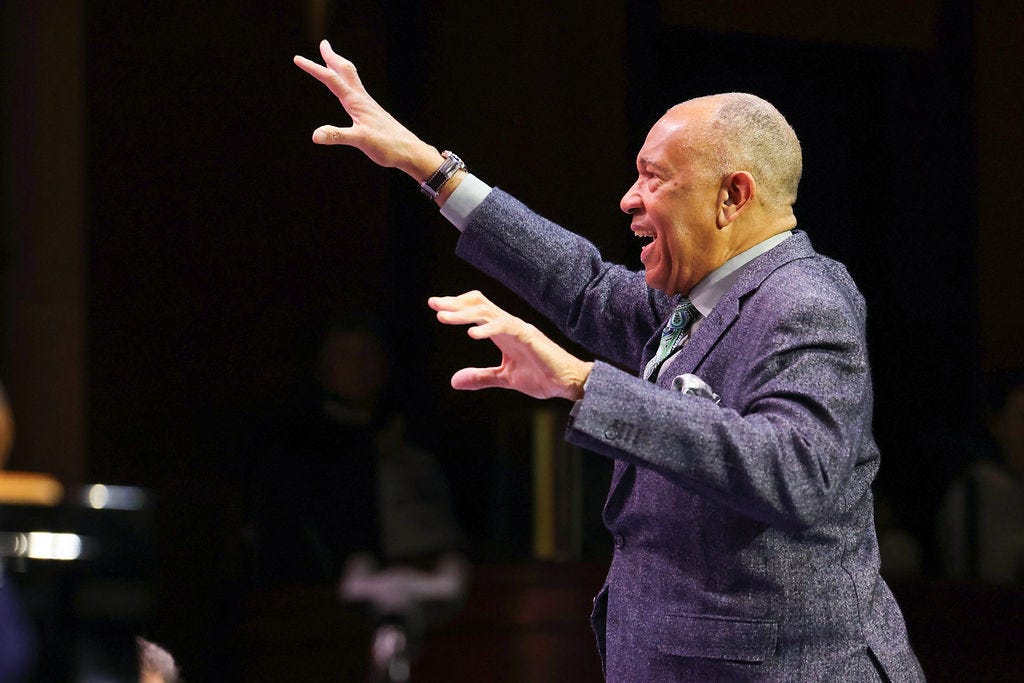
Photo of John Clayton by John Abbott #abbottphoto
Many jazz artists have written music for large ensembles, from nonets all the way up to a traditional (or even non-traditional) big band. But precious few have written for orchestras – chamber or full scale. I spoke with three noted jazz players and composers who have composed for classical orchestras in order to learn a few of their tricks of the trade.
John Clayton was trained as a classical bassist and has written numerous works for orchestras including most recently “Home” a piece inspired by Dvorak’s New World Symphony and composed for the Cleveland Orchestra. He explains that anyone looking to write an orchestra piece should start with the basics. “I’ve learned the importance of not starting with the roof,” says Clayton. “Build a foundation first. If you’re going to write an orchestra piece, don’t start with an orchestra piece because you will totally be overwhelmed. You can start with smaller ensembles that might reflect the same instrumentation of a larger orchestra, such as chamber pieces or string quartets or whatever. Find the model that really thrills you and excites you, and then analyze that. After you’ve analyzed it, you put your feet in those shoes and you actually create something following the guidelines that you have discerned and analyzed from that example.”
Clayton recommends studying scores so that you can truly understand the technique behind creating the sound. “Fall in love with the sound, learn the piece by how it sounds,” explains Clayton. “For the composer, if you’re not going to transcribe the whole thing, choose sections of it that you would like to transcribe, that you’re really curious about, and then write out what you’re hearing. Then go to the score and compare what you’ve done to what was actually done. That is a huge learning experience because, what composers are trying to do is take the sounds in their ears and their bodies and put them down on score paper, and then you take those black dots on paper and you share them with your friends who then breathe life into the music so that you can experience how close the performance is to what’s in your head. You learn all that technical stuff but it needs to come from clarity that’s within, in your ears, in your body.”
Pianist Billy Childs, who has been composing for orchestras and chamber ensembles since he studied composition at USC in the ‘70s, concurs that doing a deep dive with scores, particularly classical scores, can reap dividends for a developing composer. “If there’s a piece that you really loved, it’s not enough to just love that piece and appreciate it, you have to get a score and analyze and find out why, what it is that you love about it, why it works,” says Childs. “I think a good thing to study is traditional theory. Not so much jazz theory, but common practice theory, the theory of Bach, of baroque music, of the romantic era. It’s more of a template of what works and what doesn’t harmonically and it gives you more flexibility. You just have to work on the craft to get the clarity, to get it communicated the way you want.”
Like Clayton and Childs, pianist Uri Caine had some academic training for the orchestral work, but found the on-the-job demands to be more educational. “I studied it at Penn, but it’s one thing to read an orchestration book, but it’s another to write something that when you hear it back, you realize why it doesn’t sound right. It’s like anything,” he explains. “You start to build up a certain idea how to make things happen. Honestly, it’s still a learning process. Orchestrating is an art and it’s a science.”
Caine learned much about properly writing a score on one of his earlier commissions. “I played Sibelius with the Cleveland Orchestra. I got a call from the percussionist who I didn’t know,” he says. “He said to me, ‘The parts you sent, they’re not going to respect it if they see it the way you’ve written it out. Come out here and we’ll show you how to do it.’ I don’t know if they expected me to show up but I did. I sat with them for three days and I got the whole science of making it not just sight readable, but correct in that way.”
All three have mixed feelings about the software that’s available to composers. “These days, there are shortcuts—software and that kind of thing—and the shortcuts, I think, are inhibiting the growth of musicians, of composers, of players,” Clayton says. “People are entering their music into Sibelius or Finale or some music notation software, they do all of their editing through the computer. Something like that is not going to hurt a Billy Childs or Maria Schneider or Rufus Reid or a composer who is pretty established, but it is definitely going to hurt the younger composers that are using that as their entry way to doing this. The software is making it easier, but the software should not take away the learning process or diminish the learning process. It’s all about balance. The balance of pushing back from the score so that the music in your ear has clarity in your mind.”
Caine uses Sibelius but is aware of its limitations when creating a score. “It definitely makes you aware that when you’re writing it, you get addicted to hearing it back, played perfectly in time and in tune, even if it sounds plastic. That’s not going to be the way it’s going to sound in real life.”
Coming from the more casual and collaborative jazz world, Caine said he had to get over certain differences when working with an orchestra. “Orchestras are different,” he says. “Especially established orchestras are really aware of their own identity and their own culture. You are entering into their territory. For example, when they’d take a break, some guy would clap and that meant ‘That’s it,’ even in the middle of your sentence. Let’s just say it’s a different environment.”
To best write for an orchestra, Clayton recommends using the mindset of a jazz bandleader. “I think the whole Duke Ellington thing that all of us do is to write for the person, don’t write for the instrument,” explains Clayton. “Find that violinist, violist, cellist, bass player that you feel good about as a person, find them and write for them and they’ll open up your world to writing for a large ensemble.”
I talked with John about his Two-O Duo project. You can read that here.
The “Mergner He Wrote” logo is by Nan Parati, the Queen of Music Festival Signs. For a custom sign of your own, contact her at Nan@nanparati.com
No posts
Comments
Nothing yet. Say the first thing.
Sign in to join the conversation.