
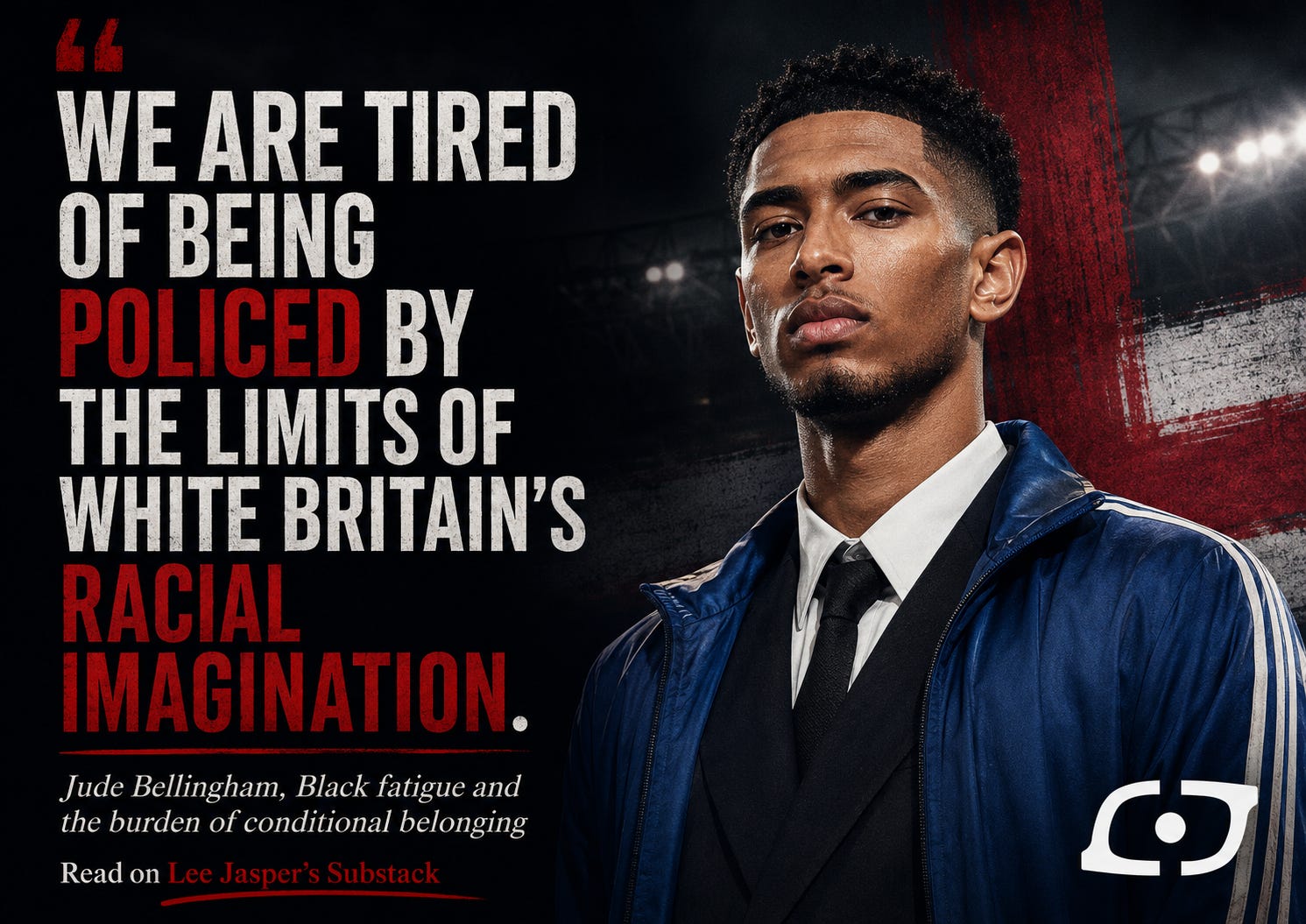
The final whistle on Englands game with Norway had barely sounded before the conversation shifted from Jude Bellingham’s performance to his personality.
England had again depended upon his brilliance, but attention quickly moved elsewhere: his tone, his temperament, his confidence, his manner. When Black excellence becomes impossible to deny, character is often placed on trial.
Bellingham is not merely playing for England. He occupies the national stage with the assurance of someone who does not regard Englishness as a favour conferred upon him. He directs, demands, challenges and carries himself as though belonging were settled at birth.
That confidence unsettles those who remain more comfortable with Black performance than Black authority.
England knows how to celebrate Black athletic labour. It knows how to cheer the goal, sell the shirt and wrap itself in the glory. What it has never entirely learned is how to accept the Black player who speaks with authority, refuses humiliation and declines to perform gratitude for an acceptance that should never have been conditional.
Bellingham belongs to a generation that includes Raheem Sterling and Marcus Rashford: Black, articulate, globally recognised and exhausted by the old demand to explain themselves to people determined not to understand.
They are not careless. They are tired.
Tired of proving their intelligence. Tired of softening their anger. Tired of being told that confidence is arrogance, disagreement is disloyalty and self-possession is menace.
Their exhaustion appears in the pause before an answer, the clipped response, the refusal to perform emotional labour for interviewers who have already decided what the story will be.
They are, in effect, the fuck-your-permission generation.
Not because they reject responsibility, but because they reject the racial contract that says Black people may belong only if we remain servile. useful, grateful and carefully managed.
Ian Wright and others spoke with insight and energy on this very issue in a recent podcast
Let me just head the racists off at the pass; no serious argument should pretend that white footballers have never been vilified. David Beckham endured appalling abuse after his dismissal against Argentina in 1998. Wayne Rooney was repeatedly condemned for his behaviour. Paul Gascoigne was alternately canonised and treated as a national embarrassment.
But their Englishness was never an issue and generally survived intact despite the condemnation.
While a white player may be accused of failing England. A Black player can be treated as though failure reveals that he never truly belonged to England at all.
That distinction was exposed after the Euro 2020 final. Marcus Rashford, Jadon Sancho and Bukayo Saka missed penalties and were met with monkey imagery, racial slurs and demands that they “go home”. Sporting failure became racial evidence. Their nationality was symbolically revoked at the precise moment the nation needed somewhere to deposit its disappointment.
Beckham was burned in effigy. Saka was portrayed as an ape.
These are not equivalent forms of public hatred.
One attacks conduct, however viciously. The other attacks humanity and belonging.
The racial bargain offered to Black footballers remains conditional. England will claim you when you score, sing your name when you win and present your face as proof of national greatness. But your confidence must not become too visible. Your anger must remain regulated. Your authority must not disturb the established order.
And God help you if you miss.
Black players are English in triumph and precariously Black in defeat.
This is why Bellingham’s personality attracts almost as much scrutiny as his football. The very qualities celebrated in white sporting icons, intensity, swagger, hunger, self-belief, become suspect when carried by a young Black man who appears fully conscious of his own worth.
The point is not that Bellingham should be protected from criticism. He is young, an exceptional talent, hugely ambitious and capable of being wrong.
Equality does not mean immunity from judgement. It means the right to be judged as an individual.
Will he be allowed to be brilliant and difficult, inspiring and occasionally irritating, proud and mistaken? Or will each gesture be interpreted through the accumulated mythology of race?
C L. R. James was one of the great Black intellectuals of the twentieth century: Trinidadian historian, Marxist thinker, anti-colonial revolutionary, cricket writer and cultural critic gives us the clearest route into this question.
In his seminal book Beyond a Boundary, James asked: “What do they know of cricket who only cricket know?” His point was that sport cannot be understood apart from the society that produces it. Cricket in the colonial Caribbean carried race, class, empire, authority and national aspiration onto the field.
The same is true of football.
The England team is one of the principal stages upon which the nation performs itself. Who wears the shirt, who is trusted to lead, who is forgiven for failure and who is symbolically expelled from belonging reveal structures far older and deeper than the final score.
James also understood the difference between Black performance and Black authority. His campaign for Frank Worrell to become the first regular Black captain of the West Indies was not merely about selecting the best cricketer. Black players had long supplied the excellence. The unresolved question was whether a Black man could command, represent and personify the whole West Indian nation.
That distinction illuminates Bellingham’s position.
England has learned to consume Black excellence. It remains less comfortable with Black authority.
Bellingham does not present himself merely as a talented employee of the national team. He directs, demands, challenges and behaves as a leader.
He is not troubling because he lacks Englishness. He is troubling because he embodies it so confidently that the old racial gatekeepers can no longer pretend to be its exclusive custodians.
What do they know of football who only football know?
Not enough to understand that every debate about Bellingham’s attitude is also an argument about who may lead England, define England and stand at its centre without apology.
Football is also one of the places where Black excellence becomes hardest to conceal.
The rules are public. The boundaries are marked. The contest is visible. Performance can be witnessed, recorded and replayed. Decisions are made before a public audience and are increasingly expected to be explained.
The pitch is not neutral. Selection, coaching, refereeing, ownership and media narratives all contain bias and discretion. But football reduces some of the spaces in which prejudice can remain invisible.
The pass reaches its target or it does not. The tackle is made. The goal is scored. The result enters the record.
That matters because racism often operates most effectively through hidden judgement.
In employment, education, policing and institutional life, opportunity can be withheld behind closed doors. Talent can be overlooked through opaque processes. Confidence can be recoded as aggression. Leadership can be described as arrogance. Informal networks can reproduce themselves while insisting that every decision was based upon merit.
The goalposts move, but nobody admits moving them.
Football shows what becomes possible when the goalposts are visible.
Where rules are clear, judgement is exposed to scrutiny and power must explain itself, Black excellence becomes harder to suppress. It does not require charitable recognition. It steps forward and shines.
Black people have never lacked talent, imagination, discipline or leadership. What has been lacking are institutions honest enough to recognise them and transparent enough to prevent prejudice masquerading as judgement.
Equality does not weaken excellence.
It releases it.
The racial crisis surrounding Black footballers is not simply about abuse. It is about the power to define another human being.
African American cvil rights icon James Baldwin understood that racism begins not in the Black body, but in the dominant society’s need to capture and control Black bodies body as means of exerting white supremacist control over every aspect of our being . The racist does not encounter the person standing before them. They encounter a figure they’ve historically constructed from their profound insecurity, racial anxiety, guilt, history and mythology.
The Black person becomes a screen.
Onto that screen are projected fears about crime, masculinity, sexuality, demographic change and national decline.
Bellingham enters that imagination carrying qualities that can be celebrated and feared almost simultaneously: youth, beauty, strength, wealth, confidence and Black masculine authority.
When England needs rescuing, those qualities are romanticised. When he speaks sharply or displays anger, the same qualities can be recoded as aggression or menace.
Frantz Fanon described the Black person as overdetermined from without: surrounded by racial meanings before he has spoken, trapped beneath legends he did not create. His body arrives in the public imagination before his biography.
That is the burden.
Bellingham is required not only to play football, but to compete against the meanings projected onto him.

The Black athlete is invited to be superhuman when the nation needs saving and treated as less than human when he fails. These are not opposites. They are neighbouring cells within the same racial prison.
Both deny him the right to be ordinarily, vulnerably and contradictorily human.
Bellingham may not seek to carry this political meaning, but a country arguing over its own identity has placed it upon him.
That argument extends beyond the stadium.
Where direct human contact is weak, media and political narratives acquire greater power to define the absent other. A person who rarely meets a Muslim can become consumed by fear of Islam. A town with few migrants can be persuaded that it is being overwhelmed. A community with little direct experience of Black life can imagine itself to be on the front line of racial displacement.
Racism flourishes where fantasy is permitted to replace relationship.
The fears manufactured within one community then become the lived nightmares of another. Black citizens are forced to inhabit the outer limits of somebody else’s racial anxiety.
We are judged before we speak, watched before we act and interpreted through stories we did not write.
This is where football connects to citizenship.
In football, conditional belonging says: you are English while you perform for us.
In ethno-nationalist politics, conditional belonging says: your passport, birthplace or lawful residence may still not make you one of us.
That is the significance of the growing language of remigration and ethnic nationalism. The argument increasingly reaches beyond future immigration towards people already settled, naturalised or born here, whose citizenship is treated as weaker than ancestry.
This is not ordinary border policy.
It is an attempt to replace civic citizenship with racial citizenship.
Civic citizenship says that belonging rests upon equal legal status, participation, residence and reciprocal obligation.
Racial citizenship says that some people possess the title deeds to the nation by blood, while others inhabit it under licence.
In a multicultural democracy, the shared foundation cannot be ethnic resemblance. Britain contains many traditions, faiths, histories and ways of living.
Culture may be plural. Citizenship must be equal.
A democracy cannot require citizens to resemble one another. It must require them to recognise one another as equals.
Britain still speaks about multiculturalism as though it were a future experiment. In truth, it is already the ordinary life of the country.
Most people experience it not as ideology, but through schools, workplaces, hospitals, friendships, marriages, football teams and families. They live across difference in ways that are imperfect, unequal and often unremarkable.
The country is already more plural than its politics knows how to describe.
Paul Gilroy’s idea of conviviality captures this ordinary ability to live across difference, while Stuart Hall reminds us that national identity is not a museum piece. It is continually made and remade through history, migration, culture and conflict.
Englishness is not weakened because Black people participate in defining it.
It becomes more truthful.
Britain cannot spend centuries entering the world and then complain that the world entered Britain. It cannot celebrate empire while disowning its human consequences. It cannot worship Black excellence in the stadium while treating Black citizenship as an intrusion beyond it.
The England of Jude Bellingham already exists.
The political struggle is over whether the nation will accept what its own life has become.
The far right offers an escape from that reality. Unable to provide security, prosperity or functioning public services, it offers racial reassurance. It converts economic abandonment into cultural grievance and tells frightened people that somebody else has stolen their country.
Racial hierarchy becomes a substitute for material hope.
You may be poorer, less secure and politically powerless, the demagogue whispers, but at least the nation belongs more to you than to your Black neighbour.
Bellingham disturbs that fantasy because he makes the new England visible in its most emotionally compelling form. He does not resemble an outsider seeking admission. He stands at the centre of the nation’s attention, wearing its colours and shaping its image before the world.
The struggle is no longer merely for inclusion.
Inclusion still assumes that somebody else owns the house and may decide who enters.
The struggle is for authorship.
Black Britain is no longer asking to be accommodated within an old definition of the nation. We are claiming an equal right to shape the common life, define its institutions and write its future.
Bellingham, Sterling and Rashford embody that shift in different ways. They are not identical personalities, but they share a generational refusal: a refusal to spend their lives making Black humanity intelligible to those committed to misreading it.
At some point, explanation gives way to exhaustion.
At some point, exhaustion gives way to refusal.
The question is not whether England can cheer Bellingham when he scores. It plainly can.
The harder test is whether England can protect his dignity when he fails, accept his authority when he speaks and recognise his humanity when he is no longer performing miracles.
Love that depends upon exceptional performance is not belonging.
It is a transaction.
Black citizenship cannot be renewed every ninety minutes. Our right to belong cannot depend upon goals scored, medals won, patients treated, taxes paid or gratitude displayed.
Citizenship worthy of democracy must include the freedom to be brilliant, mediocre, difficult, mistaken and ordinary.
White citizens have always possessed that freedom.
Equality means extending it to everyone.
Jude Bellingham does not prove that England has overcome racism. The scrutiny surrounding him proves that it has not.
England already knows how to celebrate his goals.
It has yet to prove that it can accept the country his presence reveals.
No posts
Comments
Nothing yet. Say the first thing.
Sign in to join the conversation.