
First I want to offer my deepest and sincere condolences to Professor Jason Arday’s family, his loved ones, his friends, colleagues and students. They have lost someone they loved, and no argument about what happened in the weeks and months before his death should ever obscure the enormity of that loss. I hope they are afforded the privacy, dignity and space to grieve that every family deserves at a moment such as this.
I have been trying for hours tonight trying to find the right words since hearing that Professor Jason Arday is died, and I am still not entirely sure that I have found them. There is an overwhelming sadness, obviously, but there is anger too, a deep anger, and I am trying to resist the temptation simply to let that anger run because there is enough heat around this story already.
Professor Arday was 41 years old.
He was found unresponsive at his home in south London on Friday afternoon. Police have said that his death was unexpected but is not being treated as suspicious, and the matter will now pass to the coroner. At the time of writing, we do not have an official cause of death.
His family have lost somebody they loved. That comes before Cambridge, before journalism, before Nathan Cofnas, before arguments about DEI, before anything I might want to say about racism or Black academic life. There is a family trying to comprehend an absence that was not there yesterday morning, and I am conscious of that as I write every sentence.
I have also wondered whether I should write at all, this soon.
There is a respectable case for silence, particularly when so much remains unknown. I understand that. In truth, there is something decidedly uncomfortable about contributing another piece of commentary when the relentless production of commentary is itself part of the process I want to examine.
But what troubles me here did not begin with Professor Arday’s death.
Nor did I arrive at these concerns retrospectively because a man has died.
Before his death, Professor Arday had already spoken publicly about the profound toll that the accusations, speculation and commentary were taking upon him and those he loved. He said the personal cost had become too great. He wanted privacy, peace and time to heal.
Those words do not tell us why Professor Arday died. Cause belongs to evidence, not anger, and the coroner must now be allowed to establish whatever can properly be established.
What those words do tell us is that the human cost of this affair was already visible while Jason was alive.
There is also the fact that media will no doubt be absolving itself of any responsibility for Jasons death. That is why I am writing.
That concern predates Jasons tragic demise. I had become increasingly convinced that what was happening to Professor Jason Arday had moved beyond the legitimate investigation of serious questions and into something more totalising, more racialised and, ultimately, more dehumanising. His death does not prove that judgement, and I refuse to use it as though it does. There is no miserable satisfaction to be extracted from saying that one was worried before everybody else became worried. That would be obscene.
But neither should grief compel us to forget what we were all watching.
I believe Professor Jason Arday was racially attacked and publicly traduced.
That is a serious judgement, and I mean it.
Let me deal first with the obvious point, because it matters. There were serious questions concerning Professor Arday. Questions arose about aspects of his academic work, his professional record and parts of the extraordinary biography that had become inseparable from his public identity. Some warranted investigation. Liverpool John Moores University examined the plagiarism allegation concerning the doctorate it awarded and did not uphold it. Other matters concerning his biography, qualifications and academic affiliations were disputed or remained under examination.
Those distinctions still matter. Allegation is not finding. Correction is not confession. An unanswered question is not automatically proof. One of the problems with a scandal of this intensity is that eventually sheer accumulation begins to do the work that evidence is supposed to do: there are so many stories, so many allegations, so many headlines, that people stop distinguishing between what has actually been established and what has merely been repeated.
Black people do not acquire exemption from academic standards because we are Black. I have no interest in an anti-racism that requires me to stop thinking the moment evidence becomes inconvenient. But there is an equally important truth which has been lost throughout much of this affair: racism does not require innocence from its victims.
Professor Arday could have made mistakes and still have been subjected to racism. He could have had serious questions to answer and still have been treated disproportionately. Something in his biography could be false without Black academic achievement becoming fraudulent. One citation could be deficient without DEI finding itself in the dock.
This matters because scrutiny does not take place in some colour-blind all white newsroom or some academic laboratory outside history.
Britain remains a deeply racialised society, and Black people know something about what I have sometimes called the permanent cloud of suspicion. Did you really earn the qualification? Did you really deserve the promotion? Did diversity get you there? Was the standard lowered? Is the achievement quite as solid as it looks? How did you afford the house? Who opened the door for you?
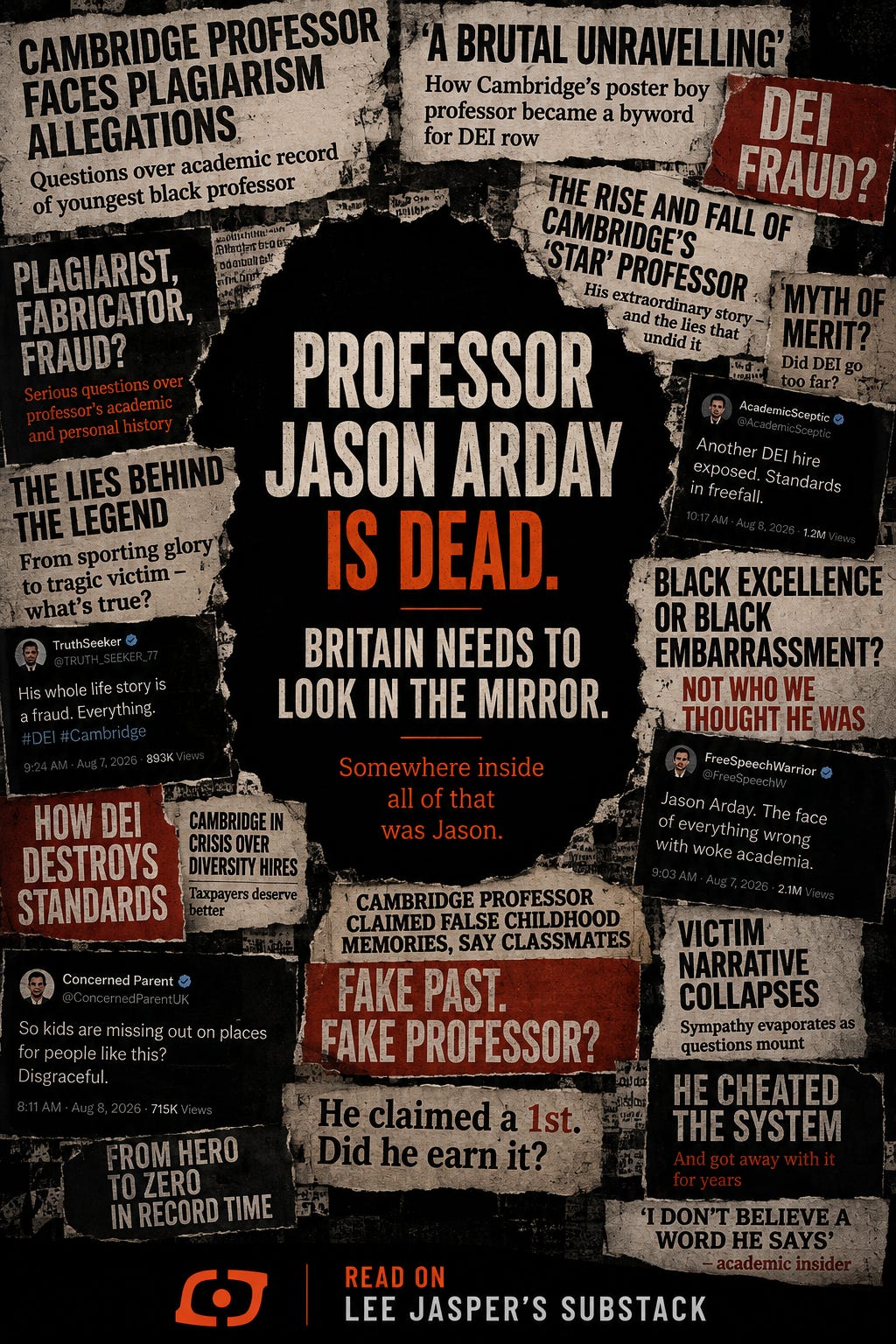
There is nothing imaginary about that cultural inheritance. The point is not that every question asked of a Black person is therefore racist. That would be foolish. The point is that ostensibly universal standards can become racialised through differences in how they are applied, how intensely they are pursued, how widely the scrutiny travels and, crucially, what conclusions are subsequently permitted to attach themselves to the individual.
That comparative question is important. The issue is not whether white academics are ever investigated; plainly they are. It is whether similar shortcomings produce the same breadth of excavation, the same presumption of illegitimacy and the same tendency to turn individual wrongdoing into a political argument about whether people like the person under investigation should have been there in the first place.
Professor Arday’s scholarship was examined, then his appointments and biography, his athletic claims and charitable work, his childhood and disability, his memories and his own account of his life. By the closing stages of the controversy, people who had known him at school decades earlier were being asked whether they remembered him speaking as a child.
Now, come on. There is plainly a public-interest argument here. If somebody’s extraordinary life story has contributed materially to their public reputation, serious inconsistencies in that story can become legitimate matters for journalists. I accept that without reservation.
But public interest is not some magic incantation which abolishes proportionality.
And Professor Jason Arday was not an elected politician. He had not asked the country to entrust him with executive power. He was not a Cabinet minister spending public money or a Prime Minister asking millions of people for their votes. He was a professor. A highly visible professor, certainly, someone who had written books and told his story publicly, but still fundamentally a man doing his job.
That distinction does not remove the right to investigate his scholarship or public claims. It should, however, make us think about the scale and boundaries of legitimate intrusion.
We have become remarkably casual about the phrase “public figure”, as though visibility is some kind of waiver by which a human being consents to unlimited excavation. There is a circularity here that should trouble us: institutions and media help make somebody famous, and then the fame they helped create becomes part of the justification for subjecting that person to ever more intrusive scrutiny.
At some point, the question has to become not simply whether another investigation can be justified, but whether the cumulative intrusion remains proportionate to the public interest supposedly being served.
Because racism does not always need to invent a fact. Sometimes it simply decides what an actual fact is allowed to mean.
A genuine error can become evidence about Black scholarship. A disputed biography can become evidence about Black advancement. One professor can become evidence about DEI.
The fact can be true while the racial meaning attached to it is false.
That distinction sits at the centre of everything that followed.
There is an old Jamaican saying that has been circling my head throughout this whole affair: the higher the monkey climbs, the more he is exposed.
I grew up understanding exactly what that meant. The higher you rise, the more visible you become. And where Black people enter spaces in which our presence remains exceptional, visibility has never been simply about recognition. It can also mean exposure.
That takes us into an uncomfortable conversation about Black exceptionalism.
Professor Arday’s appointment carried enormous symbolic weight from the beginning. Cambridge celebrated an autistic, working-class Black academic becoming the youngest Black professor in the University’s history, a story apparently so extraordinary that it seemed almost designed to embody the triumph of human possibility over disadvantage.
Black Britain celebrated too. Why wouldn’t we?
When you have spent generations watching institutions like Cambridge explaining their overwhelmingly white senior ranks through the allegedly neutral language of excellence and merit, somebody breaking through one of those ancient doors means something. Their success can feel collective precisely because the exclusion was collective.
There is joy in that and there is defiance in that. I will never sneer at it.
But celebration can become exceptionalisation, and that is where things get dangerous.
Universities are attracted to these stories because the exceptional Black figure can become evidence of institutional progress. Liberal media are attracted to them because a journey from disadvantage to extraordinary achievement makes irresistible copy. Publishers see inspiration. Politicians see social mobility. Black communities see possibility. The individual at the centre may understandably enjoy some of that recognition too.
Different interests, different motivations and very different responsibilities. There is no moral equivalence in saying that.
But everybody takes something from the exceptional Black figure while the story is rising.
And I want to be careful here because this argument can easily be hijacked by people who will say, “Ah, so you admit DEI is promoting under-qualified Black people.”
No. I am saying almost the opposite.
One of the stubborn realities of institutional racism is the extraordinary number of highly qualified Black people whose talent remains under-recognised, whose promotion arrives late if it arrives at all, whose competence is repeatedly tested and whose mistakes are remembered with considerably greater longevity than their achievements.
Black people can be under-promoted collectively and over-symbolised individually.
Indeed, those things are connected.
Under-representation creates the conditions for over-symbolisation. If Black professors at Cambridge were utterly commonplace, the appointment of one Black professor would not need to carry the whole weight of Cambridge’s racial progress. The scarcity produced by exclusion helps manufacture the superstar.
That is the contradiction.
The problem was not that Cambridge celebrated Professor Arday. The breakthrough mattered. The danger comes when an institution mistakes celebrating progress for turning a human being into proof of progress.
And we have to look at ourselves here too.
Black Britain leans into exceptionalism because we know what it means when one of us is the first, the youngest, the breakthrough. There is nothing remotely shameful in that. But there is danger when we load so much collective meaning onto one person that we no longer allow them simply to be human.
Human beings make terrible monuments. They contradict themselves. They disappoint. They are brave in one part of their lives and foolish in another. They can inspire thousands of people and still make a mess of something. They can be brilliant and flawed at exactly the same time.
That is why the ultimate destination of racial equality cannot be Black exceptionalism. It has to be something considerably more radical: the freedom of Black ordinariness.
The freedom to be brilliant without becoming proof of the race. To succeed without becoming a monument. To make a mistake without bringing Black people into disrepute. To fail without your failure being recruited as evidence that equality itself was fraudulent.
Perhaps one of the deepest tests of racial equality is not whether a Black person can be permitted to succeed exceptionally.
It is whether they are permitted to fail individually.
That freedom still does not belong to us in quite the same way.
Nathan Cofnas’s framing matters here because Professor Arday did not remain simply an academic against whom allegations had been made. Cofnas explicitly placed him inside an argument about DEI at Cambridge. Professor Arday became useful as evidence in a wider ideological prosecution of diversity, racial equality and Black academic advancement.
Whatever Professor Arday got wrong belonged to Professor Arday.
It did not belong to every Black professor. It did not belong to every Black student sitting in Cambridge wondering whether other people believed they deserved to be there. It did not belong to racial equality. And it certainly did not belong to generations of Black scholars whose achievements had nothing whatsoever to do with Professor Jason Arday.
Yet the controversy travelled almost immediately in precisely that direction.
This is one of racism’s most persistent habits. White people generally retain the privilege of individual failure. A disgraced white professor does not normally create a national debate about white intellectual competence. A fraudulent white businessman does not become proof of the failure of white entrepreneurship. A corrupt white politician does not trigger an inquiry into whether too many white people have been promoted beyond their natural abilities.
Their wrongdoing stays attached to their names.
Black people can become representative on the way up and representative again on the way down.
Once Professor Arday became useful in that wider racial argument, other actors gathered around the story. Some were serious academics and journalists asking legitimate questions and they should not be casually conflated with people engaged in racialised culture-war politics simply because we may dislike their conclusions.
But alongside them came a different ecosystem altogether: professional provocateurs, YouTube commentators whose business model is attention, anonymous accounts and ideological entrepreneurs who can turn the public humiliation of another human being into content.
I struggle sometimes with calling all of them culture warriors. Some looked much more like culture vultures.
The machinery is now familiar. One allegation generates the story, the story generates the video, the video generates the reaction, the reaction produces another round of podcasts, posts and commentary about the commentary. Nobody needs to orchestrate the whole thing. The commercial and technological incentives do much of the work themselves because platforms have learnt something rather depressing about us: outrage holds attention, humiliation travels and certainty invariably performs better than complexity.
There was a time when yesterday’s newspaper eventually wrapped tomorrow’s chips. Today the controversy lives in the phone in your pocket and follows you home.
Eventually the person ceases to be a person and becomes content.
That is where my disgust lies.
Not in criticism. Not in journalism which establishes matters of genuine public interest.
In the gradual dehumanisation of the person underneath it.
Anybody who has worked for years with people caught in high-profile cases learns something about publicity which is rarely discussed outside campaigning circles.
Going public is itself a risk.
Someone comes to you after experiencing some dreadful injustice and, understandably, wants the story exposed. Sometimes publicity is exactly what is required. Institutions that have ignored people for years can suddenly discover the ability to answer the telephone when a national newspaper starts asking questions.
But responsible campaigning involves another calculation too. What happens when the counterattack comes? How psychologically resilient is the person at the centre? What support surrounds them? What happens to the partner and children when reporters begin calling, photographs start circulating and thousands of strangers acquire opinions about somebody’s history, personality and motives? And, crucially, have we actually got the resources to protect the person if the whole thing gets away from us?
I have worked on appalling cases which never went anywhere near a newspaper precisely because, having made that assessment, I believed publicity might inflict more damage on the individual than it could ever deliver benefit to the campaign.
Sometimes keeping somebody away from the media is not cowardice. It is safeguarding.
I am not trying retrospectively to diagnose Professor Arday. I do not know what was taking place inside his mind, and autism should certainly not now become some convenient posthumous explanation for every disputed aspect of his behaviour.
But we do not have to speculate about whether he was struggling with the pressure.
He told us.
And that is where Cambridge eventually has questions to answer, though they need to be asked with the same evidential discipline we are demanding from everybody else.
Cambridge celebrated the symbolism of Professor Arday’s appointment. That did not make his appointment illegitimate and it does not mean the University cynically invented his story. But when an institution publicly turns an employee into evidence of its own progress, that institution surely acquires responsibilities which extend beyond normal reputation management when the symbolism collapses.
What support was provided as the controversy escalated? Who was responsible for Professor Arday’s welfare? What assessment was made once he said publicly that the accusations and commentary had taken a profound toll and the personal cost had become too great?
I do not know.
There may have been extensive professional, pastoral and medical support behind closed doors. If so, that matters and should be acknowledged. Anger does not give us permission to manufacture institutional neglect simply because we cannot see what happened privately.
But neither can Cambridge simply disappear behind procedure.
The institution was willing to tell the world what Professor Jason Arday represented while his appointment reflected magnificently upon Cambridge. At the appropriate time, Cambridge must be equally prepared to explain how it discharged its responsibilities towards Jason Arday when carrying that symbolism became extraordinarily difficult.
I know something about sustained hostile publicity myself, although I hesitate to say much because this is emphatically not my story. During the later period of the Livingstone administration, I went through months of waking up to headlines, walking out of my house and seeing my name on newspaper billboards, turning on the television and finding myself leading the news, then waking the following morning knowing that the whole machine was about to start again.
Eventually I became numb. The pressure gets into your family, your relationships, your children, your friendships and ultimately into your own mind. My experience was different from Professor Arday’s, largely confined to British politics and lived through before social media acquired anything approaching its present reach, so I leave the comparison there.
What I learnt is that we keep extraordinary records of scandals while keeping almost no record at all of their human debris.
We count resignations and investigations. We count exclusives, corrections, viewing figures and clicks. We know which journalist broke the story and which commentator won the day’s argument.
Nobody maintains the ledger of damaged families, frightened children, exhausted partners, destroyed friendships and crushed psyches.
We call that collateral damage.
Sometimes I think civic vandalism gets closer to the truth.
I have long believed that racism is an emotional commitment to ignorance.
That does not mean racists are simply stupid. Some highly educated people are perfectly capable of being racist. What I mean is that racism depends, at least in part, upon an investment in not knowing another human being too deeply, because human knowledge complicates prejudice.
It is easier to despise migrants as an abstract mass than to know the migrant nurse finishing a twelve-hour shift. It is easier to dismiss Black academics as diversity hires than to encounter them as individual scholars with research, students, partners, children, strengths, contradictions and the messy ordinariness of everybody else.
Human beings complicate prejudice. Categories make it manageable.
Professor Jason Arday became politically useful when the complicated human being could be compressed into the DEI professor, the fraud, the exhibit proving standards had been lowered. The allegations did not need to create that racial narrative from scratch. The cultural architecture was already there waiting for them.
That is why I also think there is a relationship, and not a mechanical one, not a crude causal conveyor belt, between the violence increasingly normalised in sections of our political and media and the racial violence that is erupting on our streets.
The person who throws the brick remains responsible for throwing the brick. But violence does not emerge from culturally sterile soil. Somebody has normally told a story beforehand about who deserves suspicion, whose presence threatens the country, whose advancement is fraudulent and which categories of people can legitimately be held collectively responsible for the actions of individuals.
Professor Arday’s treatment and racist attacks upon migrants are not the same phenomenon and I do not wish to manufacture an equivalence between them. But the racist formula by which the individual disappears and the category takes over is recognisable.
And this is where Professor Jason Arday’s story holds a mirror up to Britain.
I am not sure we are going to like the face reflected back.
Britain has changed. That needs saying. Overt racism has been driven out of spaces where it was once utterly routine. Black people now occupy professions and institutions from which previous generations were systematically excluded. I have spent most of my adult life fighting for those changes and I am not going to deny decades of progress merely to sharpen an argument.
But progress and racism can live in the same house.
Perhaps the deepest test of racial progress is not how enthusiastically Britain celebrates an exceptional Black person when they succeed. Perhaps it is what Britain does when a Black person fails.
That is when you discover whether belonging was ever really unconditional.
What has troubled me throughout the Professor Arday affair is the speed with which questions about one man became questions about Black advancement. DEI was put in the dock next to him. Black academics who had never met Jason and had absolutely nothing to do with the allegations suddenly found their own legitimacy implicated in the argument.
There is an ugly racial visage staring back from that mirror.
It suggests that Black belonging inside some of Britain’s most prestigious institutions remains conditional in ways that white belonging generally is not. You may enter the institution and excel there, you may even be celebrated by it, but somewhere overhead sits that old cloud of suspicion: Did you really earn this? Was the bar lowered? Was diversity responsible?
And when one of us falls, the suspicion does not always fall with the individual.
It spreads.
A genuinely equal society would permit Professor Jason Arday to fail entirely on his own.
That thought is worth sitting with.
He could make mistakes without Black academics becoming suspect. Parts of his biography could be challenged without racial equality becoming fraudulent. Cambridge could have made mistakes without the presence of Black people at Cambridge becoming the mistake.
That is a freedom whiteness still largely enjoys: the freedom to fail individually.
And Black Britain belongs somewhere in this mirror too, because we cannot condemn institutions for turning people into racial symbols while pretending we never participate in that symbolism ourselves. We do. We understand why. The breakthrough matters when the wall was built against you.
But we need a mature solidarity capable of celebrating Black achievement without manufacturing Black saints; capable of defending somebody from racism without pretending they are beyond criticism; capable of saying somebody has got something badly wrong without handing them over to people who want their failure to become evidence against an entire race.
There has to be some human territory between sainthood and annihilation.
And perhaps that brings me to what I find most disturbing about the whole affair.
No single person needs to own the entirety of what happened around Professor Jason Arday. That is how modern public destruction works. A journalist writes one piece, an academic raises one allegation, somebody uploads a video, another person posts an insult, another outlet commissions the follow-up, an algorithm distributes all of it to hundreds of thousands more people. Each contribution exists separately and many may be individually defensible. The herd mentality takes effect amplified by biased algorithms.
The person at the centre does not experience each of these things separately.
They experience the cumulative weight.
Our technologies have developed the ability to concentrate the attention and judgement of millions upon a single human being much faster than our ethics have developed any serious account of the responsibility that accompanies that power.
Much of what people did individually may have been defensible.
That does not make the totality humane.
Professor Jason Arday was not beyond scrutiny. He was not beyond criticism, and his death should not now be allowed to turn complicated questions into forbidden ones. That would be another failure to see him as he actually was.
But neither did those questions ever remove him from the human family.
And perhaps what I cannot get out of my head is just how useful he became to everybody.
Cambridge had its extraordinary breakthrough story. Liberal Britain had its reassuring story of progress. Black Britain understandably had a source of collective pride. His critics had serious questions. The anti-DEI Right acquired an extraordinarily useful exhibit in its prosecution of racial equality. The press had an unfolding drama. The culture vultures had content. The platforms had engagement.
Everyone found something Professor Jason Arday could represent. They all took what they wanted.
Somewhere inside all of that was Jason.
A 41-year-old man doing his job.
Complicated, fallible, sometimes inspiring, evidently vulnerable, and human.
Only days before he died he told us that the relentless accusations, speculation and commentary were taking a profound toll. He wanted some peace. Some privacy. Time to heal.
We do not yet know why Professor Jason Arday died.
But we know considerably more about the society in which he was made to live through his final public months.
We did not have to stop asking difficult questions in order to remember the human being.
We simply had to remember him while he was still here.
RIP Jason
No posts
Comments
Nothing yet. Say the first thing.
Sign in to join the conversation.