
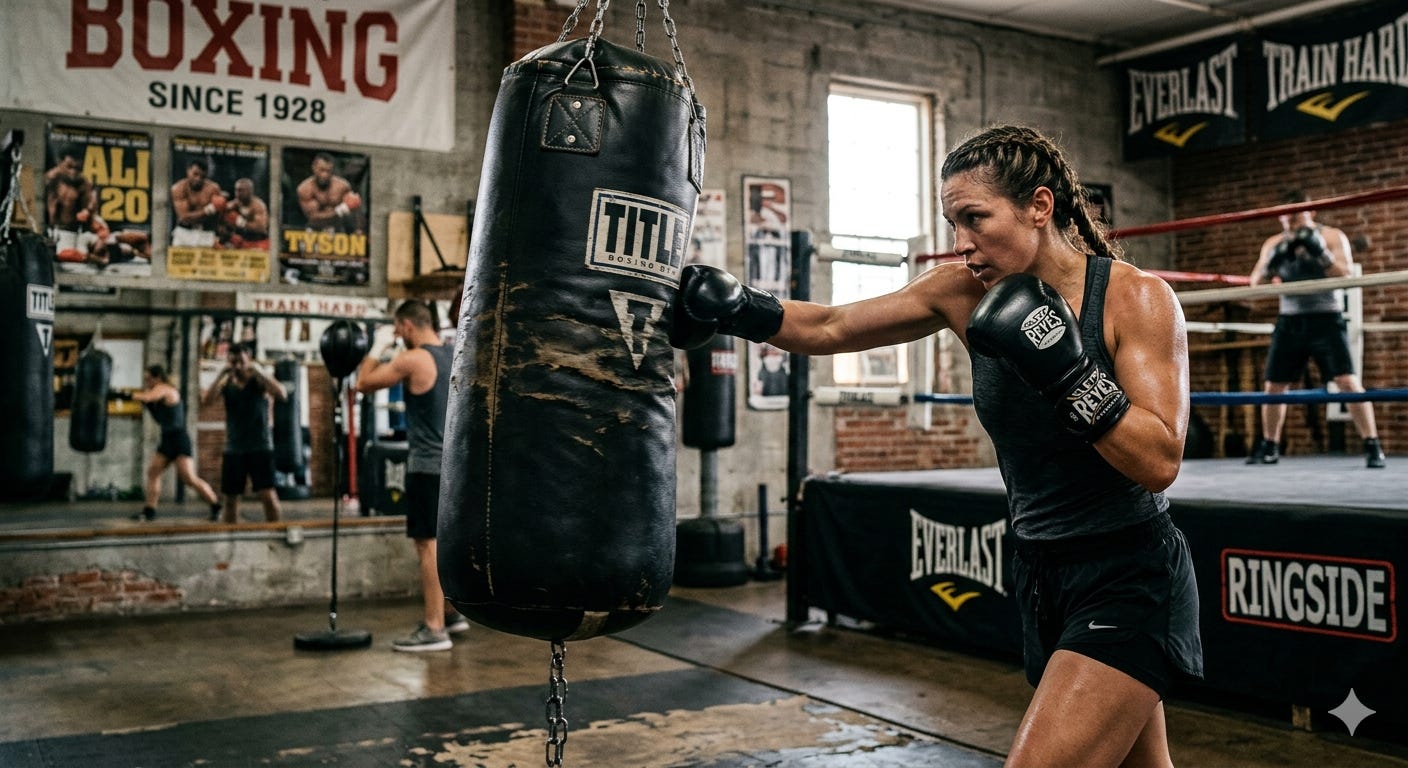
Welcome back to training. Coach Lee here—today we’re breaking down why boxing hasn’t just survived the evolution of fitness… it’s quietly stayed at the top.
Fitness trends come and go.
From aerobics in the 80s…
To bodybuilding splits in the 90s…
To CrossFit, bootcamps, and boutique studios in the 2000s and beyond…
But through all of that?
Boxing training never left.
It didn’t need a rebrand.
It didn’t need a gimmick.
Because it was already built on something deeper:
Real performance. Real conditioning. Real results.
At its core, boxing is one of the most complete training systems ever developed.
Not because it tries to be everything—but because it naturally demands everything.
When you train boxing, you’re developing:
Cardiovascular endurance (round-based conditioning)
Strength & power (punching, resistance, bodyweight control)
Speed & explosiveness (combinations, reactions)
Coordination (hands, feet, eyes working together)
Mobility & agility (constant movement, angles, pivots)
There’s no wasted movement.
No isolation without purpose.
Every drill carries over to performance.
A lot of workouts can make you tired.
But boxing conditions you in a way that translates beyond the gym.
Think about it:
3-minute rounds simulate high-intensity intervals
Short rest periods build recovery under fatigue
Movement + output forces your body to stay efficient
This is why boxing-style conditioning shows up everywhere now—HIIT classes, athletic training programs, even strength and conditioning systems.
Boxing didn’t follow the trend.
The industry followed boxing.
One of the biggest reasons people fall off in fitness?
They get bored.
Boxing solves that.
You’re not just “working out”—you’re learning a skill.
You’re thinking about combinations
You’re adjusting your footwork
You’re reacting and staying sharp
That mental engagement does two things:
Keeps training interesting
Improves consistency over time
And consistency is what actually drives results.
Here’s what separates boxing from a lot of modern fitness trends:
It scales.
You can adjust intensity, volume, and complexity based on:
Age
Experience level
Goals
A beginner can hit the bag and learn basic movement.
An advanced athlete can push elite-level conditioning.
And both are getting a high-level workout.
That’s why boxing gyms have always had a mix of:
Fighters
Everyday professionals
Youth athletes
Older adults staying active
Same system. Different levels.
You don’t need a full gym setup to train boxing.
At its simplest, you need:
Your body
Space to move
Optional: gloves, bag, jump rope
That accessibility is a big reason boxing has stood the test of time.
It removes barriers.
And when there are fewer barriers, people actually train.
Boxing isn’t just “good cardio.”
That’s how it’s often marketed—but that undersells it.
Boxing is a system.
A system that builds:
Work capacity
Discipline
Movement efficiency
Mental toughness
And those qualities don’t go out of style.
In today’s fitness world, there’s more information than ever.
More programs.
More apps.
More options.
But the question is still the same:
What actually works—and keeps working?
Boxing answers that.
Because it’s not built on trends.
It’s built on principles.
And principles don’t expire.
You don’t need to become a fighter to benefit from boxing.
Start simple:
Add 2–3 boxing sessions per week
Focus on basic combinations + footwork
Structure your training in rounds (2–3 minutes work, 30–60 seconds rest)
Build from there.
Stay consistent.
Let the system do the work.
Boxing has been around for generations—and it’s not going anywhere.
Because while fitness continues to evolve…
The fundamentals still win.
And boxing is built on fundamentals.
That’s the work for today.
Stay sharp—and keep your hands up. 🥊
No posts
Comments
Nothing yet. Say the first thing.
Sign in to join the conversation.